

What does supervised visitation mean in Florida?
When a court orders supervised visitation, it means a parent’s time with their child must be monitored by a neutral third party. The primary goal is to ensure the child's safety and well-being during that visit.
It’s critical to understand that this is not a punishment. Instead, think of it as a protective measure—a safety net that a Florida court puts in place when there are legitimate concerns about a child's welfare during standard timesharing. This arrangement allows the parent-child relationship to continue, just in a controlled and secure environment. Our firm handles all family and divorce issues, including for LGBTQ+ parents, and we understand the sensitivity surrounding these court orders. We proudly serve clients in Pasco, Pinellas, and Hillsborough Counties.
The Core Purpose Of Supervised Visitation
When family dynamics get messy, Florida courts have one overriding duty: to prioritize the child’s best interests above all else. Supervised visitation is a tool judges use to strike a difficult balance. It upholds a parent's right to have a relationship with their child while simultaneously protecting that child from potential harm.
This type of court-ordered timesharing is typically put in place only when serious allegations or evidence suggests a child’s physical or emotional safety could be at risk. The ultimate objective is to provide a safe, structured setting for visits to happen, allowing a parent to maintain or rebuild their bond with their child while they work on resolving the underlying issues.
Common Reasons For A Court Order
A judge in Pasco, Pinellas, or Hillsborough County won't restrict a parent's time with their child on a whim. The decision is always grounded in evidence that suggests unsupervised contact might not be safe.
Some of the most common situations that lead to a supervised visitation order include:
- History of Abuse: Evidence of past domestic violence, child abuse, or neglect raises serious safety flags.
- Substance Abuse: Active and untreated drug or alcohol addiction can impair a parent's judgment and ability to care for a child.
- Mental Health Issues: An unstable or untreated mental health condition may prevent a parent from providing a safe and stable environment.
- Long-Term Absence: If a parent has been absent for a long time, supervision can help re-establish the bond in a healthy way.
- Abduction Risk: If there are credible fears that one parent might try to abduct the child or flee the jurisdiction.
These are just a few examples, but they illustrate the protective function of supervised visitation. It's an important tool for addressing legitimate safety concerns for both children and protective parents, especially in complex family law cases.
It's crucial to understand that supervised visitation is usually intended to be a temporary solution. It is a step the court takes to manage difficult circumstances while giving the supervised parent an opportunity to resolve the issues that led to the order.
The process is designed to be fair and focused on safety. In many family law matters, other relatives may also have questions about their own ability to see a child, and it's worth noting that Florida has specific laws about whether grandparents can sue for visitation rights. Our firm handles all family and divorce matters, including gay divorce and custody issues, and we do not discriminate.
Exploring The Types Of Supervised Visitation
Supervised visitation isn’t a one-size-fits-all mandate from the court. In reality, Florida law gives judges the flexibility to create different arrangements based on a family’s unique situation and the specific safety concerns at play.
Getting a handle on these options is crucial. The type of supervision a judge orders in Pasco, Pinellas, or Hillsborough County depends entirely on the level of risk involved and what the court is trying to achieve.
Professional Vs. Non-Professional Supervision
The biggest difference you’ll see is between professional and non-professional supervision. Each serves a very different purpose, and the choice comes down to how much protection a child really needs.
Professional supervision is exactly what it sounds like: a trained, neutral third party is paid to monitor the visit. These supervisors typically work for an agency and are skilled at observing family dynamics, stepping in to de-escalate tension, and writing objective reports for the court. A judge will almost always order this in high-stakes cases involving serious allegations like domestic violence, substance abuse, or child neglect, where rock-solid security and impartial documentation are non-negotiable.
On the other hand, non-professional supervision is when a court allows a trusted family member or a mutual friend to watch over the visits. This is more common in lower-risk scenarios. For instance, maybe a parent is being reintroduced after a long absence, and the main goal is just to have a comforting presence nearby. The catch? Both parents have to agree on the person, and the judge must be convinced that the supervisor can stay neutral and keep the child safe.
The court's primary concern is whether the supervisor can actually intervene if something goes wrong and provide unbiased feedback. If there's any doubt about a family member's ability to remain neutral or enforce safety rules, a professional will be brought in.
This concept map breaks it down. No matter who is supervising, the core goals are always the same: keep the child safe, ensure the monitor is neutral, and create a space for a healthy parent-child relationship to grow.
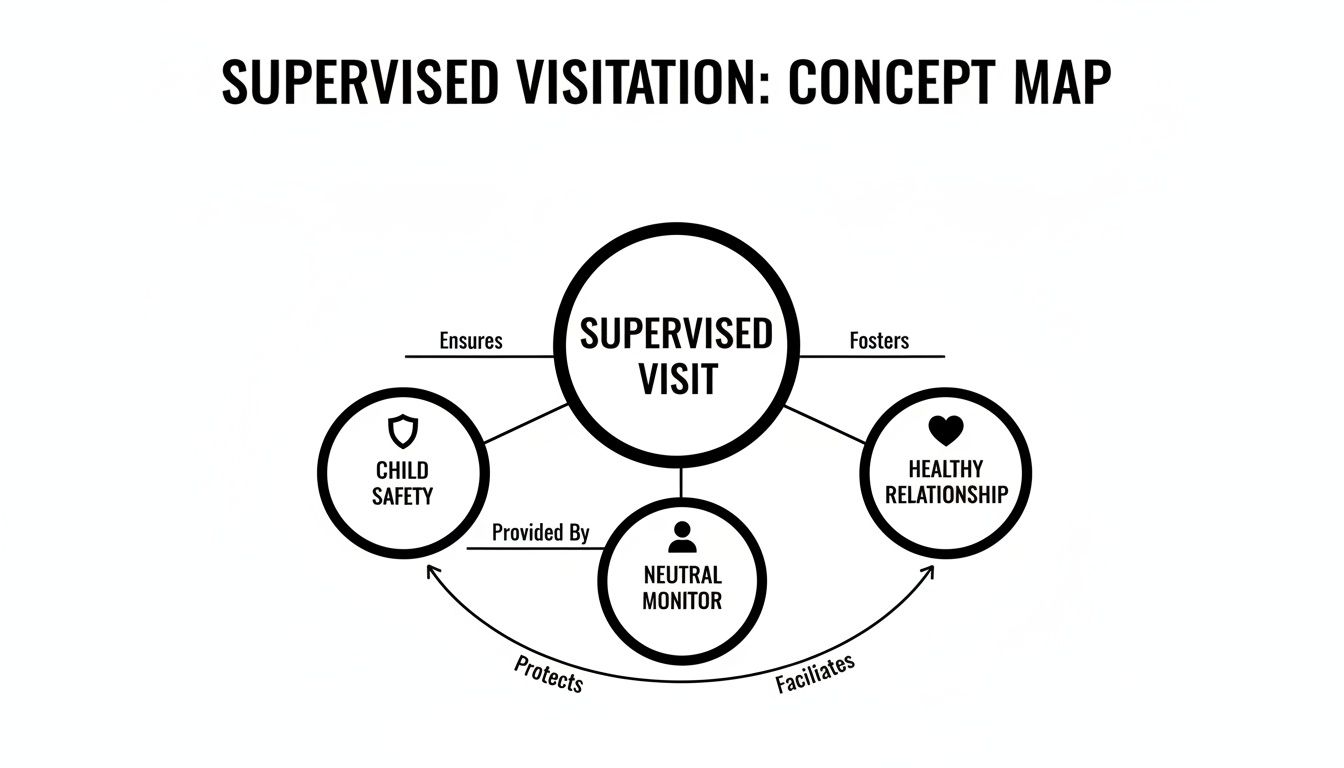
As you can see, safety and connection are the pillars of any supervised visit, regardless of the specific setup.
Therapeutic Supervision: A Specialized Approach
There's a third, highly specialized option called therapeutic supervision. This goes way beyond just monitoring—it's an active intervention designed to heal.
With this model, a licensed mental health professional, like a family therapist or counselor, supervises the visit. Their job is two-fold: ensure the child is safe while also actively working to improve the parent-child bond. The therapist might offer real-time coaching to the parent, guide difficult conversations, and help rebuild a connection that's been damaged by trauma or conflict.
This approach is often ordered in complex cases involving issues like parental alienation, where the goal isn't just to see each other, but to fundamentally repair the relationship. The structure and quality of this kind of supervision can make a world of difference.
Ultimately, whatever form of visitation is ordered, the details must be spelled out clearly in a comprehensive parenting plan in a divorce or custody order to be legally binding and enforceable.
What To Expect During A Supervised Visit

Facing your first supervised visit can feel nerve-wracking. We get it. But knowing what actually happens from start to finish can take a lot of the stress out of the equation for both you and your child.
Think of the supervisor as a neutral referee. Their only job is to make sure everyone sticks to the court-ordered rules and—most importantly—that the child stays physically and emotionally safe.
While the process is structured, it’s designed to feel as normal as possible for the child. The real goal is to create a positive, memorable experience together. We’re proud to help all parents, including those in the LGBTQ+ community, navigate these visits in Pasco, Pinellas, and Hillsborough Counties.
The Stages Of A Supervised Visit
A typical visit follows a clear, predictable pattern. When you know the steps ahead of time, you can prepare and feel more in control.
- Pre-Visit Check-In: It all starts before your child even arrives. The supervised parent usually gets there first to check in with the supervisor, go over the rules one more time, and sometimes complete a quick security or sobriety screening.
- The Visit Itself: Once your child is there, the supervisor shifts into observation mode. They will stay within sight and sound of you and your child at all times, taking notes on the interactions. Their job is to monitor, not to participate, unless an intervention is absolutely necessary.
- Conclusion and Departure: The supervisor will give you a heads-up when the end of the visit is approaching. When time is up, you and your child say your goodbyes, and the custodial parent picks them up. The supervised parent typically waits a few minutes after the child has left to depart, which prevents any unmonitored contact.
Common Ground Rules And Tips
Following the ground rules is non-negotiable if you want the visit to be a success. These rules exist to head off conflict and keep the focus where it belongs: on the child.
The single most important rule is to avoid discussing the legal case, bad-mouthing the other parent, or quizzing your child about the other parent's life. These topics place a huge emotional weight on a child and will almost certainly lead the supervisor to end the visit on the spot.
Here are a few more practical tips:
- Focus on Fun: Plan simple, age-appropriate activities. Think board games, coloring, or building with blocks.
- Let Your Child Lead: Let them guide the play and conversation. It helps them feel more comfortable and in control of the situation.
- Stay Positive: Keep your conversation and attitude light and upbeat. Your child will absolutely pick up on your mood.
Sticking to these guidelines doesn’t just make the visit go smoothly—it also creates a positive record for the court. A well-documented history of successful visits is a powerful tool for showing that supervision might not be needed anymore. For more on the legal side of things, you can explore our detailed guide on creating a child custody agreement template.
How To Legally Request Or Change A Supervision Order

Whether you’re a parent trying to protect your child or one fighting to regain unsupervised time, the path forward is through the court. You can’t simply decide to start or stop supervision on your own. It requires a formal legal process, and a judge’s decision will always come down to one thing: what’s in the child's best interest.
Navigating this process in Hillsborough, Pinellas, or Pasco County courts demands a strategic approach backed by clear evidence. Our firm is proud to represent all families, including LGBTQ+ couples facing gay divorce or custody issues, making sure your rights and your child’s well-being are front and center.
Filing A Motion To Request Supervision
If you have a genuine fear that your child’s physical or emotional well-being is at risk with the other parent, you have to ask the court for help. This is done by filing a Motion for Supervised Visitation.
This legal document is your formal request to the judge, and it must spell out exactly why you believe supervision is necessary. A judge won't take the step of limiting a parent's time lightly, so your motion needs to be built on a foundation of solid proof.
The burden of proof is squarely on the parent asking for supervision. You have to convince the judge with credible evidence that unsupervised time presents a real danger to the child. Personal arguments or vague feelings won't be enough.
Evidence is everything. You have to show, not just tell, the court why your child needs this layer of protection. Strong evidence might include things like:
- Police reports from domestic violence calls or other relevant incidents.
- Results from court-ordered drug or alcohol screenings.
- Testimony from neutral third parties—think teachers, therapists, or daycare providers—who have seen concerning behavior.
- Relevant photos, emails, or text messages that show a pattern of risk or instability.
Modifying Or Ending A Supervision Order
If you’re the parent whose time is supervised, don't lose hope. Florida law provides a clear path to getting back to normal, unsupervised timesharing. The key is demonstrating that you’ve made real, positive changes.
To start this process, you must file a Motion to Modify Timesharing. In it, you'll have to prove to the court that there has been a material and substantial change in circumstances since the supervision was first ordered. Basically, you need to show that the original safety concerns are no longer an issue.
Proving that change means taking concrete steps and documenting your progress. To build a strong case for ending supervision, you should be prepared to:
- Complete all court-ordered programs. This could be anything from anger management and parenting classes to substance abuse treatment. Get the certificates of completion.
- Show a consistent history of clean drug and alcohol tests, if that was the root cause of the order.
- Gather positive reports from the supervisor that detail appropriate, successful, and positive visits with your child.
Every single successful visit helps build your case. A documented track record of safe, positive parenting is powerful proof that you are ready for unsupervised time. Understanding the general court process is also helpful, so learning how to prepare for a custody hearing is a great place to start, as many of the same principles apply.
Navigating The Evidence And Costs Of Supervision
When a judge orders supervised visitation, two practical questions immediately jump to mind: "What proof do I need?" and "Who is going to pay for this?" Getting a handle on both the evidence and the costs is absolutely essential as you prepare for the road ahead in your family law case.
Whether you're the parent asking for supervision or the one being supervised, the evidence you bring to court is the foundation of the judge's decision. A judge in Pasco, Pinellas, or Hillsborough County isn't going to make a ruling based on accusations alone. They need credible, objective proof.
Building Your Case With Strong Evidence
The most convincing evidence is almost always the kind that comes from official and neutral sources. These documents and testimonies are powerful because they paint a clear picture for the court, taking the guesswork out of a very serious decision.
Some of the strongest forms of evidence include:
- Police Reports: Official records of domestic incidents or calls for a welfare check.
- Prior Court Rulings: Documents like injunctions for protection (restraining orders) that show a history of concerning behavior.
- Witness Testimony: Statements from credible, third-party individuals like teachers, therapists, or doctors who can speak to the child’s well-being or a parent’s conduct.
Beyond that, one of the most critical pieces of evidence is actually created during the supervision process: the supervisor's notes. After every single visit, the professional supervisor writes a detailed, objective report about the interactions they observed. These notes create a running record that can heavily influence whether the court decides to continue, change, or end the supervision order down the line.
Sometimes, proving a specific issue like parental alienation can feel like an uphill battle, but these supervisor reports can be invaluable. If you find yourself in that difficult position, it’s worth learning more about how to prove parental alienation in a courtroom setting.
Understanding The Financial Side
Evidence is only half the battle; the financial side is a major factor. Professional supervision isn’t a free service. Agencies and certified supervisors charge an hourly fee for their time and expertise, which naturally leads to the big question: who pays?
Ultimately, the court decides how these costs are split. A judge might order one parent to cover the entire fee, particularly if that parent's actions are what made supervision necessary in the first place. In other cases, the court may split the cost between both parents, often based on their respective incomes and ability to pay.
It's important to budget for this expense, as the duration of supervised visitation can be uncertain. Being prepared for the financial reality helps you stay focused on the main goal: ensuring your child has a safe and positive experience.
Supervised visitation is a critical tool used in family law. While the need for this protective measure is a consistent part of family court systems, the specific details and application are governed by state law.
Frequently Asked Questions About Supervised Visitation
It’s completely normal to have a lot of questions when you’re first introduced to the idea of supervised visitation. To help you get a better handle on what it all means, we’ve answered some of the questions we hear most often from families in Pasco, Pinellas, and Hillsborough Counties. Our firm is committed to giving clear, direct answers to everyone we serve, including members of the LGBTQ+ community and those dealing with gay or transgender name changes.
How Long Does Supervised Visitation Usually Last?
There isn't a magic number or a fixed timeline set by Florida law. Supervised visitation is meant to be a temporary bridge, not a permanent destination.
How long it lasts depends entirely on the reasons a judge ordered it in the first place. The court will periodically review the case, looking for tangible progress from the supervised parent. If that parent has completed court-ordered therapy or classes and has shown a consistent pattern of safe, positive visits, the judge will likely start transitioning the family toward unsupervised timesharing.
Can I Choose The Supervisor For My Child's Visits?
Sometimes, you can. If you and the other parent can agree on a neutral and trusted family member or friend to act as a supervisor, the court might approve it. But this only works if the judge is confident that person can be truly impartial and has the backbone to enforce the rules and keep the child safe.
If you can’t agree, or if the case involves serious safety concerns like substance abuse or domestic violence, the judge won’t take any chances. In those situations, you'll be required to use a professional from a list of court-approved agencies in your area.
The judge's number one priority is the child's well-being. If there's even a shadow of a doubt that a family member can remain neutral and enforce the rules, a professional will be mandated.
What Happens If Someone Breaks The Rules?
The consequences are real and immediate. Supervisors have the authority—and the duty—to shut down a visit on the spot if a parent violates the court order. This could be anything from bringing up the court case to bad-mouthing the other parent.
A single minor slip-up might just earn a warning or an early end to that day's visit. But repeated violations or a major breach of the rules will have much bigger repercussions. The supervisor documents everything in their report to the court, and that report can lead a judge to reduce visitation time or even suspend it completely until the parent gets back on track.
Is Supervised Visitation Only For Divorce Cases?
Not at all. Supervised visitation is a tool family law judges can use in any case involving a timesharing schedule for a child.
While it’s certainly common in contentious divorces, we see it just as often in paternity cases where unmarried parents are creating their first parenting plan. Anytime credible safety concerns are raised about a parent's ability to care for a child alone, supervised visitation is an option to ensure the child is protected.
Your Next Steps For Protecting Your Family
Working through a supervised visitation case is incredibly stressful, but you don't have to do it alone. The big picture should be clearer now: supervised visitation is a specific tool courts use to protect children when there are serious safety concerns. It’s a structured process with clear legal paths to either request it or, eventually, end it.
Our firm is here to guide families—including our LGBTQ+ clients—through these exact challenges with both compassion and proven expertise. We serve clients across Pasco, Pinellas, and Hillsborough Counties, building legal strategies that fit their real-world circumstances. We handle all LGBTQ+ family and divorce issues, from gay custody matters to name changes, and are committed to serving every family without discrimination.
Creating A Clear Plan Of Action
If this is your reality, the most critical first step is to get a firm grasp on your rights and options. An experienced family law attorney can help you pull together the right evidence, file the correct motions with the court, and build a persuasive case for the judge. For more articles on family law and other legal topics, the Justice-Today Blog is another excellent resource.
Protecting your child's well-being starts with a concrete plan. Whether you are the parent asking for supervision or the one working to resolve it, your greatest asset is a knowledgeable legal advocate fighting in your corner.
Don't let uncertainty and fear dictate your family's future. The proactive steps you take today can secure a safer, more stable environment for your child tomorrow. The right guidance truly makes all the difference.
At Foley Family Law, we are dedicated to helping you protect what matters most. Contact us for a consultation to create a clear plan of action and safeguard your child's future. https://wfoleylaw.com


