

A "gray divorce" is what we call a separation that happens later in life, usually when a couple is 50 or older. It’s a term that’s become more common because it’s happening more often, typically after decades of marriage. This isn't just about ending a long-term partnership; it’s a profound life shift, a total reevaluation of what happiness and the future look like. Our firm handles all family and divorce issues, including for our LGBTQ+ clients, and we do not discriminate. We serve clients in Pasco, Pinellas, and Hillsborough Counties.
Understanding The Rise Of Gray Divorce

The idea of splitting up in your golden years has gone from a rare event to a significant cultural phenomenon. While divorce rates for younger folks have actually been on the decline, the rate for those over 50 has skyrocketed. This isn't just a local trend—it's a nationwide shift that's completely reshaping how we think about the second half of life.
The numbers really tell the story. Divorce rates for adults over 50 literally doubled between 1990 and 2010. Today, a staggering one in four Americans going through a divorce is over the age of 50. It’s a statistic that hammers home just how much things have changed. You can discover more insights about these divorce trends and what’s driving them.
So, what's behind this massive shift? It’s not just one thing, but a combination of powerful societal changes.
Key Drivers of Gray Divorce
- Increased Longevity: Let’s face it, people are living longer, healthier lives than ever before. The thought of spending another 20 or 30 years in an unhappy or unfulfilling marriage just isn’t as appealing as it might have been for our grandparents.
- Shifting Social Norms: The stigma that used to be attached to divorce has faded dramatically. Society is far more accepting of individuals choosing to prioritize their own happiness, no matter their age.
- Greater Financial Independence: This is a big one, especially for women. With more women in the workforce over the last few decades, many now have the financial means to leave a marriage that isn't working—a choice that was much less realistic for previous generations.
The decision to pursue a gray divorce often boils down to a simple, powerful realization: the desire for personal fulfillment doesn't have an age limit. Many people get to a point where they want their retirement years to be defined by personal growth and joy, not just by their marital status.
Here’s a quick summary of what we're seeing.
Gray Divorce At A Glance
- Age Group: Typically couples aged 50 and older.
- Marriage Length: Often involves long-term marriages of 20, 30, or even 40+ years.
- Driving Factor: Longevity: With longer life expectancies, individuals are unwilling to spend decades in an unfulfilling relationship.
- Driving Factor: Social Norms: Reduced social stigma makes divorce a more acceptable option for finding personal happiness.
- Driving Factor: Independence: Greater financial independence, particularly for women, provides the means to start over.
These factors combine to create a new reality where ending a long-term marriage is a valid and increasingly common path.
At our firm, we recognize that every couple’s story is unique. We provide dedicated and inclusive legal guidance under Florida law for everyone facing this modern life transition, including LGBTQ+ partners. With deep experience serving clients in Pasco, Pinellas, and Hillsborough Counties, we're here to help you protect your future and navigate this next chapter with confidence.
The Human Story Behind Late-Life Separation
Beyond the statistics and legal jargon, what really leads couples to part ways after a lifetime together? The decision to divorce later in life is rarely a sudden one. Instead, it’s usually the final chapter in a long story of quiet evolution, personal growth, and priorities that have simply drifted apart. It’s a deeply human experience, not just a legal event.
One of the most common catalysts we see is the "empty nest" phenomenon. For decades, the rhythm of a couple's life revolves around raising children—school runs, soccer practice, homework battles, and family dinners. When the last child leaves home, the quiet that fills the house can be deafening. It forces a couple to look at each other, often for the first time in years, without the buffer of parenting.
Many discover that the partnership they put on the back burner to focus on family has changed. Sometimes, it's no longer recognizable. This isn't about blame; it's about the natural, slow drift that can happen when two people are so focused on a shared project that they forget to keep tending to their own connection.
Personal Growth and Changing Priorities
It's also important to remember that people don't stop growing or changing just because they're married. The person you are at 60 is often worlds away from the person you were at 30. Individual passions, goals, and core values can diverge significantly over the decades.
A late-life separation is often less about a marriage failing and more about two individuals succeeding—at evolving. It’s a recognition that to be truly happy for the next 20 or 30 years, you might need a different path than the one you started on together.
This personal evolution is happening at a time of increased longevity. People are living longer, healthier lives than ever before, and the idea of "retirement" has been completely transformed. It's no longer an end; it's a "third act," a brand-new chapter with decades of potential. More and more people are unwilling to spend this precious time in a partnership that feels unfulfilling or unhappy. They want to travel, learn a new skill, or simply live a life that feels authentic to the person they've become. When navigating the emotional complexities of late-life separation, finding professional support through award-winning counselling services in Kelowna can be an invaluable step towards healing and new beginnings.
Acknowledging Universal Experiences
These feelings are universal, touching couples from all walks of life. Whether you live in Pasco, Pinellas, or Hillsborough County, the emotional journey is often remarkably similar. Our firm understands that these decisions are deeply personal and apply to all couples, including our LGBTQ+ clients who face the same life transitions. Understanding the human element is the absolute first step toward a compassionate, respectful, and effective legal process.
Protecting A Lifetime Of Assets In Divorce
When a marriage ends after decades, untangling the finances isn't just complicated—it's a completely different ballgame than it is for a younger couple. You're not just splitting a few assets; you're dividing a lifetime of accumulated wealth. The stakes are incredibly high, with little time to recover from a financial misstep. This is precisely the moment where strategic, experienced legal guidance becomes non-negotiable.
In Florida, the legal standard for dividing marital property is equitable distribution. That doesn't always mean a clean 50/50 split. Instead, the court aims for a division that is fair and just, which can be a complex calculation when dealing with assets that are deeply intertwined after 20, 30, or even 40 years.
The Financial Stakes Of A Late-Life Divorce
Dividing a lifetime of wealth means getting into the weeds with complex accounts. It's rarely simple.
We're often looking at:
- Retirement Accounts: This is a big one. It covers everything from 401(k)s and 403(b)s to various types of IRAs. Any portion of these accounts that grew during the marriage is considered marital property and is on the table for division.
- Pensions: Pensions have their own set of tricky rules, especially for military members, first responders, and other government employees. Dividing them requires specialized knowledge to get it right.
- Investments and Real Estate: This bucket can hold everything from brokerage accounts, stocks, and bonds to the marital home and any rental or vacation properties you bought together.
It's a lot to navigate. This infographic breaks down some of the common personal reasons that bring couples to this challenging financial crossroad later in life.
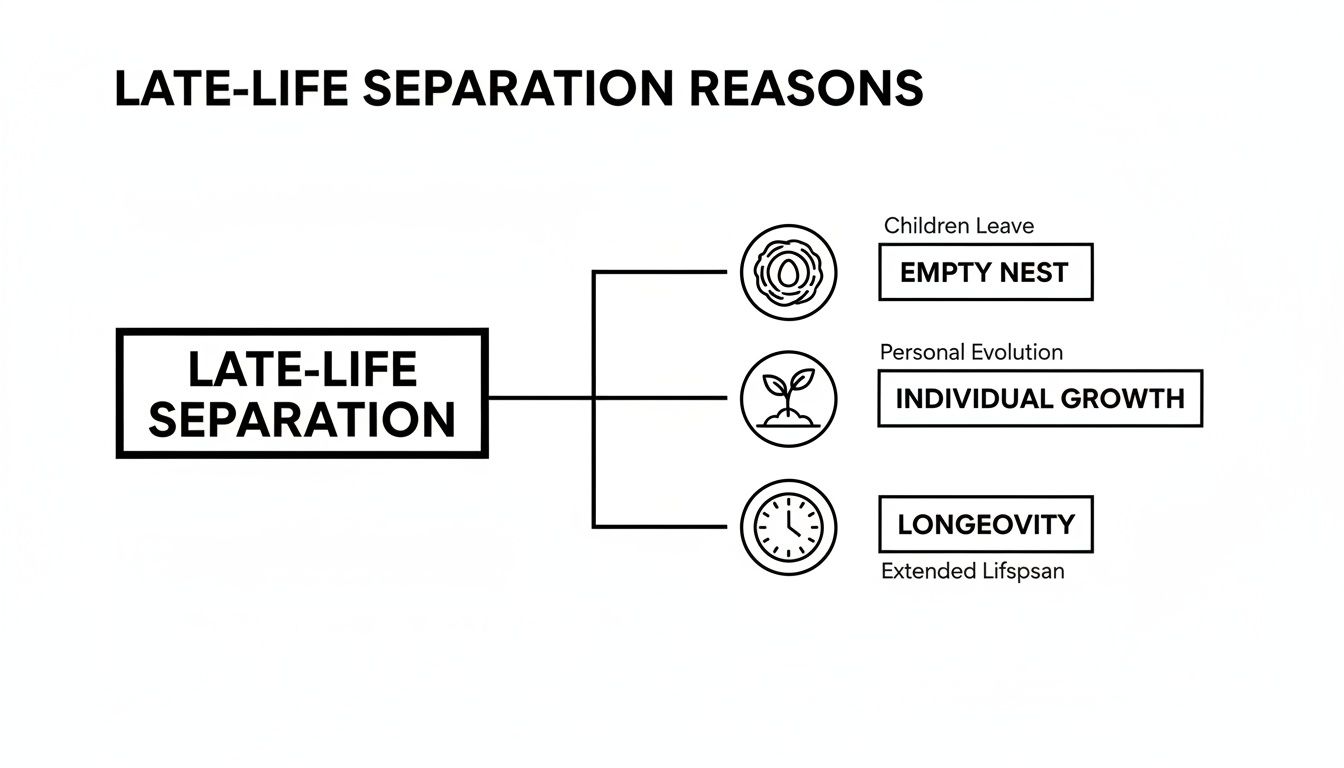
As you can see, major life shifts like children leaving home, evolving personal goals, or simply living longer can lead people to reevaluate their marriage and decide it's time for a change.
Ensuring Financial Stability After Decades Together
Beyond just splitting what you have, the real goal is to ensure both spouses can maintain financial stability on their own. This is where spousal support, or alimony, often plays a crucial role. For long-term marriages, Florida law recognizes that a lower-earning spouse may need ongoing support to maintain their standard of living.
A gray divorce presents unique financial hurdles. When you divide assets after 30 or more years, retirement plans can be completely upended. Studies paint a stark picture: the risk of poverty can jump significantly after a late-life divorce, especially for women over 50.
This isn't just a statistic; it's a harsh reality that underscores how critical a well-structured settlement is. The economic gap between spouses can be severe, which is why spousal support is awarded in 40-50% of long-term gray divorces—it provides a necessary financial bridge. You can read the full research on the financial impact of gray divorce on Purdue.edu to better understand the stakes.
Other critical pieces of the puzzle include securing new health insurance, as you'll no longer be covered under your ex's plan. And don't forget taxes. The tax consequences of selling a home or transferring retirement funds have to be managed carefully to avoid nasty, unexpected penalties. Each of these moving parts demands a strategic approach. To get a better handle on specific assets, you can check out our guide on what happens to a 401(k) in a divorce.
Wading through these financial complexities requires a seasoned legal partner who has been here before. We have extensive experience helping clients in Hillsborough, Pinellas, and Pasco Counties protect the future they've worked a lifetime to build. We handle these sensitive matters with the diligence they deserve, ensuring all assets are valued and divided fairly so our clients are positioned for a secure and stable new beginning.
Managing The Marital Home And Your Estate Plan

For couples navigating a gray divorce, the marital home is rarely just an asset. It’s a time capsule packed with decades of memories, making any decision about its future one of the most emotional and financially significant choices you’ll face.
This home is often the centerpiece of a lifetime of shared investment. Under Florida law, its value must be divided equitably, which gives you a few practical paths forward. Many couples choose to sell the property and split the proceeds, offering a clean financial break. In other cases, one spouse might buy out the other’s share, a move that typically requires refinancing and a precise valuation. The right choice depends entirely on your financial reality and what you want your future to look like.
Beyond Property: The Urgent Need To Update Your Estate Plan
A divorce doesn’t just end a marriage; it instantly makes your existing estate plan obsolete. This is a critical detail that's shockingly easy to overlook, and the consequences can be a legal nightmare. If you don't update these documents, your ex-spouse—not your children or other intended heirs—could inherit your assets.
It is absolutely essential to revise your will, trusts, and other directives as soon as you can. These updates ensure your assets go where you intend, protecting your legacy for the people you choose.
Here are the key documents that demand immediate attention:
- Wills and Trusts: These must be amended or completely redrafted to remove your former spouse as a beneficiary, executor, or trustee.
- Beneficiary Designations: This is a huge one. It covers life insurance policies, retirement accounts like 401(k)s and IRAs, and other financial accounts. Don’t skip this.
- Powers of Attorney and Healthcare Directives: You almost certainly want to name someone new to make financial and medical decisions for you if you become incapacitated.
A gray divorce is a profound restructuring of your entire life, and that includes who receives your assets after you’re gone. Forgetting to update a beneficiary designation on a life insurance policy or retirement account is one of the most common—and costly—mistakes. It can accidentally divert hundreds of thousands of dollars to an ex-spouse.
If you don't address these details, the courts may be unable to honor your true intentions. It takes careful, deliberate action to secure your future and provide for your adult children as you see fit. For those in Pasco, Pinellas, and Hillsborough Counties, creating a legally sound plan is a cornerstone of moving forward with confidence. You can learn more about how these financial details are formalized in our article explaining what a marital settlement agreement is.
Choosing A Divorce Process That Works For You
Not every divorce has to turn into a courtroom battle. When you’re facing a gray divorce, Florida law provides several different paths you can take, and each one comes with its own set of pros and cons. The key is to choose the process that protects your interests without creating unnecessary emotional and financial chaos.
For many couples, especially those who can still communicate, cooperative methods are a far better choice. They offer a more private and controlled way to separate your lives after decades together. These approaches keep you and your spouse in charge of the outcome, rather than handing all the decision-making power over to a judge. They are almost always less expensive and emotionally draining than traditional litigation.
Cooperative Divorce Options
If you and your spouse are willing to work together toward a resolution, two excellent options stand out in Florida.
Mediation: This process brings in a neutral, third-party mediator to help guide the conversation between you and your spouse. Their job isn’t to make decisions for you, but to help you find common ground and negotiate your own settlement agreement on everything from dividing retirement accounts to figuring out spousal support. It’s completely confidential and puts you in control.
Collaborative Divorce: Think of this as a more structured, team-based approach. You and your spouse each hire an attorney who is specially trained in the collaborative process. Everyone signs an agreement committing to resolve all issues outside of court. You can also bring in neutral financial professionals or family specialists to help create solutions tailored to your unique circumstances. You can learn more about how these two effective methods compare by reading our guide on collaborative divorce vs mediation.
These cooperative methods are designed to preserve relationships and find creative, mutually agreeable solutions. They are especially beneficial in a gray divorce where the focus is on protecting a lifetime of assets and starting a new chapter on good terms.
When Litigation Is Necessary
Sometimes, working together just isn't in the cards. Litigation becomes the only viable path when communication has completely broken down, if one spouse is hiding assets, or when one person simply refuses to negotiate in good faith.
In a litigated divorce, you and your spouse present your cases to a judge, usually through your attorneys. The judge then makes the final, legally binding decisions on every disputed issue. While this process guarantees a final resolution, it’s also public, significantly more expensive, and can be far more adversarial and emotionally taxing than the cooperative routes.
To help you visualize the differences, here’s a quick comparison of the three main approaches in Florida.
Comparing Divorce Resolution Methods In Florida
Litigation
- Control: A judge makes the final decisions.
- Privacy: Proceedings are public court records.
- Cost: The highest cost option, involving significant attorney fees and court expenses.
- Timeline: The longest path, dictated by the court's schedule.
- Tone: Adversarial and often contentious.
- Outcome: A win/lose result is common.
Mediation
- Control: The spouses make all final decisions together.
- Privacy: The process is completely confidential.
- Cost: A lower-cost option, with a mediator's fee and limited attorney time.
- Timeline: Faster, as it is scheduled by the parties involved.
- Tone: Cooperative and focused on solutions.
- Outcome: A win/win result based on mutual agreement.
Collaborative Divorce
- Control: The spouses retain final decision-making power.
- Privacy: The process is completely confidential.
- Cost: Moderate cost, which can be less than litigation.
- Timeline: Faster, as meetings are scheduled by the parties and their team.
- Tone: Cooperative and team-based.
- Outcome: A win/win result based on mutual agreement.
Ultimately, the right path depends entirely on your specific circumstances. A cooperative process like mediation or collaborative divorce is often the best fit for a gray divorce, but litigation is a necessary tool when one party won't play fair.
At our firm, we adapt our strategy to fit your unique situation. Whether you need a skilled negotiator to guide you through mediation or a tenacious litigator to fight for you in court, we are prepared to advocate for your best interests throughout Pasco, Pinellas, and Hillsborough Counties.
Finding The Right Partner To Secure Your New Beginning
Getting through a gray divorce isn't just about ending a marriage; it's about protecting the future you've spent a lifetime building. The emotional and financial stakes are simply too high for generic legal advice. The complexities of splitting up later in life demand an attorney who lives and breathes these unique challenges, from valuing decades of intertwined assets to ensuring your long-term stability is rock-solid.
Our firm brings a compassionate but fiercely strategic approach to every case. We get that a gray divorce is more than just paperwork—it’s a profound life transition. This is especially true for our clients here in Pasco, Pinellas, and Hillsborough Counties, where we routinely handle complex cases involving high-value assets, intricate retirement division, and spousal support under Florida law.
Your Path Forward Starts Here
The first step toward getting clarity is sitting down for a structured consultation where we can map out a plan together. This initial meeting is all about understanding your specific situation and creating a clear, actionable path forward.
We provide dedicated guidance and unwavering support to everyone who walks through our doors. We proudly handle all family and divorce issues for every member of our community, including gay divorce and other LGBTQ+ matters. Our commitment is simple: protect what you’ve built and help you move on with confidence.
Choosing a law firm is one of the most critical decisions you'll make in this process. It’s not just about finding someone who knows the law, but finding a team that understands the human story behind your case. Your future security depends on it.
The next step is to choose an advocate who truly aligns with your goals. As you weigh your options, we invite you to read our guide on how to choose a divorce attorney to help you make an informed decision.
Let us help you start your new beginning on solid ground.
Gray Divorce In Florida: Your Questions Answered
When you're facing a divorce later in life, the questions feel different, and the stakes are often higher. Here are some straightforward answers to the most common questions we hear from clients in Florida.
How Is Alimony Determined In A Long-Term Marriage In Florida?
In Florida, alimony isn't just a simple formula. For a long-term marriage, the court's decision hinges on one spouse’s genuine need and the other’s ability to pay.
A judge will look at the whole picture: the standard of living you both enjoyed, how long you were married, each person's age and health, and all your financial resources. The ultimate goal is to ensure the receiving spouse can maintain a lifestyle that’s reasonably comparable to the one they had during the marriage.
Am I Entitled To My Spouse's Social Security Benefits?
This is a big one, and the answer is often yes. Generally, you can claim benefits based on your ex-spouse's work record if:
- You were married for at least 10 years.
- You are currently unmarried.
- You are 62 or older.
The critical thing to know is that your claim does not reduce the benefits your ex-spouse or their current spouse receives. It’s a separate entitlement you’ve earned through the long-term marital partnership.
A common misconception is that divorce automatically cuts you off from a former spouse's benefits. For marriages lasting a decade or more, this is simply not the case. Overlooking this can mean leaving a significant amount of retirement income on the table.
What Happens To Our Family Home In A Gray Divorce?
Under Florida's equitable distribution laws, the marital home is an asset that has to be divided fairly—which doesn't always mean a clean 50/50 split.
There are a few common paths forward. Many couples sell the home and split the proceeds. Another option is for one spouse to buy out the other’s share, allowing them to stay in the house. Before you decide on a path, it's also important to understand Florida residency requirements for divorce, as where you live can impact your case.
We have the experience to answer all your questions and guide you through the unique challenges of a gray divorce. We proudly serve clients throughout Pasco, Pinellas, and Hillsborough Counties. Contact us today to secure your future.


