

A court order in a Florida family law case isn't just a suggestion; it’s a legally binding directive from a judge. When someone willfully ignores that order, it’s called contempt of court. This is the court's core tool for enforcing its own rulings and making sure the process is fair for everyone.
Defining Contempt in Florida Family Law

Think of a final judgment as the official rulebook for your post-divorce life. It lays out everyone's responsibilities for things like child support, alimony, parenting plans, and how property was divided. Contempt of court is what happens when one person knowingly and intentionally breaks those rules.
The whole system depends on people following these orders. Without a way to enforce them, court rulings would be meaningless. A contempt action is the formal legal process you use to hold the non-compliant person accountable.
At Foley Family Law, we help clients navigate these frustrating situations with clear advice and strong advocacy. Our firm serves families throughout Pasco, Pinellas, and Hillsborough Counties, and we are committed to providing equal representation to all, including members of the LGBTQ community facing these tough family law challenges. We handle all LGBTQ issues, family and divorce issues, and do not discriminate.
The Importance of Willful Disobedience
The key word in any contempt case is willful. To prove contempt, you have to show that the violation was intentional—that the person had the ability to follow the court's order but simply chose not to.
For instance, someone who loses their job and can no longer pay their full child support amount might not be in willful contempt. But a person who has the money and decides to buy a boat instead of paying support? That’s likely a willful violation. The distinction is everything.
How Common Are Contempt Actions?
Contempt actions are a constant feature in Florida family law. Enforcing orders is critical for financial stability and making co-parenting work. In Pasco, Pinellas, and Hillsborough Counties, enforcement and contempt issues are among the most common reasons people have to return to court after their case is finalized. Many of these cases are tied to unpaid child support or failure to follow a parenting plan.
Contempt proceedings aren't really about punishment. The court's main goal is to compel compliance—to get the other party to follow the original order, not just to penalize them for failing to do so.
Understanding this process is the first step toward protecting your rights. Whether you need to file a motion or defend against one, having a clear strategy is non-negotiable. You can learn more about how a Tampa contempt lawyer can help enforce your court order.
Understanding Civil Versus Criminal Contempt
When you hear the term “contempt of court,” it’s natural to think of punishment. But in Florida family law, contempt isn’t a one-size-fits-all concept. It’s split into two distinct categories—civil and criminal—and they serve very different purposes. Getting a handle on this difference is critical, as it shapes the entire legal action, from the potential penalties to how you can get things back on track.
Think of it this way: civil contempt is meant to be coercive, while criminal contempt is punitive. They are two different tools in a judge’s toolbox, each used to manage the courtroom and enforce orders depending on the specific situation.
The Goal Of Civil Contempt: Coercion
The main objective of civil contempt is to coerce—or persuade—someone to follow a court order they are currently violating. It’s not about punishing them for what they did yesterday; it’s about getting them to comply right now. This is the type of contempt we see most often in family law, typically for issues like unpaid child support or a parent refusing to follow a timesharing schedule.
There’s a powerful analogy for civil contempt: the person found in contempt "holds the keys to their own jail cell." What this means is that as soon as they comply with the court’s order—whether that’s paying the overdue support or turning over a piece of property—the penalty is lifted. The power to end the sanction is entirely in their hands.
The Goal Of Criminal Contempt: Punishment
Criminal contempt, on the other hand, is all about punishment. It’s designed to penalize someone for a past act of willful disobedience that showed a profound disrespect for the court's authority. Its purpose isn't to get someone to act, but to uphold the dignity and power of the court itself. An act of criminal contempt is treated as an offense against the justice system.
Unlike its civil counterpart, complying with the original order won't necessarily get you out of trouble. For example, if someone screams insults at the judge during a hearing, that's a past act that can't be undone. The judge might find them in direct criminal contempt and impose a specific punishment, like a fine or a fixed jail sentence, to penalize the disruptive behavior. The penalties are definitive and aren't tied to future compliance.
The core difference really boils down to the objective. Civil contempt says, "Do what the order tells you to do." Criminal contempt says, "You will be punished for what you already did."
A side-by-side comparison can make the distinction even clearer.
Civil Contempt vs Criminal Contempt at a Glance
This information breaks down the key differences between civil and criminal contempt in Florida family law cases.
Feature: Primary Purpose
- Civil Contempt: To coerce compliance with a court order.
- Criminal Contempt: To punish a past act of disrespect to the court.
Feature: Nature of Penalty
- Civil Contempt: Indefinite. Lasts until the person complies (e.g., jail until support is paid).
- Criminal Contempt: Punitive. A fixed sentence or fine is imposed for the past act.
Feature: "Key to the Jail Cell"
- Civil Contempt: Yes. The person in contempt can end the penalty by complying.
- Criminal Contempt: No. The penalty is a punishment for a completed act and cannot be "undone."
Feature: Common Scenarios
- Civil Contempt: Failure to pay child support/alimony, violating timesharing schedules.
- Criminal Contempt: Yelling at the judge, lying under oath, disruptive courtroom behavior.
Feature: Initiated By
- Civil Contempt: Typically filed by the other party in the case (the petitioner).
- Criminal Contempt: Can be initiated by the judge or the state prosecutor.
Understanding these distinctions is essential because the process and potential outcomes are vastly different for each.
The enforcement power of civil contempt orders is no small thing. The threat of jail time is a powerful motivator, and Florida courts use it frequently. In courts throughout Pasco, Pinellas, and Hillsborough Counties, judges take compliance very seriously, especially in cases involving the financial support and well-being of children. The process can be complicated, and if you find yourself on the receiving end of a contempt motion, knowing your rights is essential.
The Contempt of Court Process In Florida Family Law
So, how does this all work in practice? If you need to enforce a family court order, the journey begins by filing a Motion for Contempt.
This legal document is your starting point. It needs to clearly lay out which court order was allegedly broken—think unpaid child support or a missed timesharing weekend. You'll need to specify the date of the original order, the exact terms the other party ignored, and a straightforward statement explaining their noncompliance.
Once the motion is drafted, it has to be properly served on the other party. The rules for service can vary, but it's not as simple as just handing it to them. Typically, you'll need to use a sheriff's deputy or a certified process server to make it official.
With the motion filed and served, both sides gear up for a court hearing.
Preparing For The Hearing
This is where the rubber meets the road. At a contempt hearing, evidence is everything. You'll need to present documents like payment histories, text messages, or communication logs from a co-parenting app. Sometimes, you might even bring in witnesses who can testify about the other person’s ability to comply with the order.
The burden of proof rests on the moving party to show willful disobedience.
That term, willful violation, is the key concept here. It means the person had the ability to follow the court's order but actively chose not to. For example, if someone can show they had the money to pay child support but decided to make a big-ticket purchase instead, a judge is likely to see that as a willful violation. It's a serious matter because it shows a direct disregard for the court's authority.
Presenting Evidence And Legal Arguments
Your evidence can be direct or circumstantial. A bank statement showing available funds on the day support was due is direct, powerful proof. On the other hand, inconsistent testimony about why they lost a job could be considered circumstantial evidence that they aren't being truthful about their ability to pay.
At the hearing, your argument will need to cover a few critical points:
- The original court order is still valid and hasn't been changed.
- The violation was deliberate, not an accident or a simple mistake.
- The other person had the means to comply but failed to do so.
Of course, the judge will also listen to any defenses, like a genuine and provable inability to pay due to a sudden job loss.
Typical Timeline
While every case is different, the process generally follows a predictable path. A motion is filed and served, and then a hearing date is set by the court. The timeframe can range from a few weeks to several months, depending on the court's schedule in Pasco, Pinellas, or Hillsborough Counties and the complexity of the case.
Illustration Of Process Flow
Here's a visual that helps break down the different paths a contempt action can take:
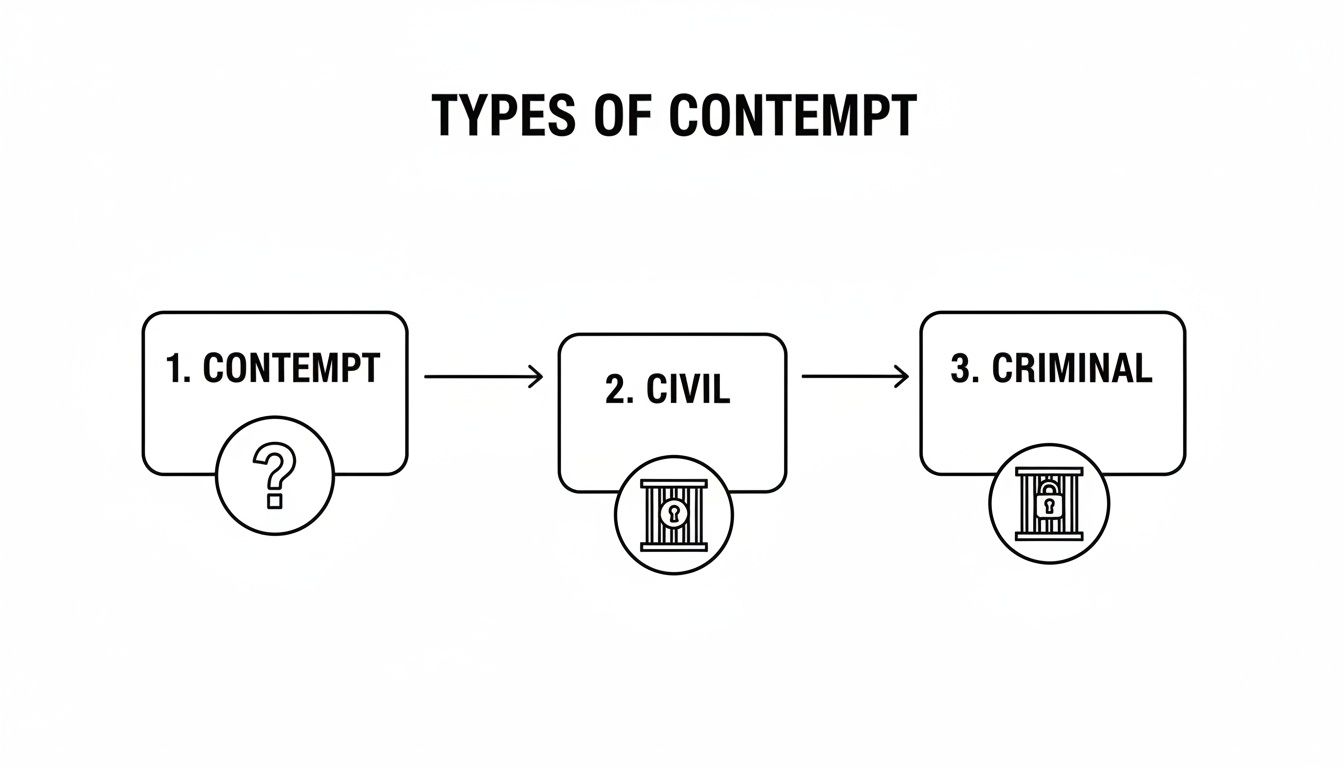
This flowchart shows the crucial split between civil and criminal contempt. As you can see, civil contempt is about compelling someone to act—they hold the keys to their own jail cell. Criminal contempt, however, is about punishing past disobedience with fixed penalties.
Sanctions And Purge Conditions
If a judge finds someone in contempt, sanctions can be handed down right then and there.
In a civil contempt case, the goal is compliance. The person might be sentenced to jail, but it's an open-ended sentence. They are released as soon as they comply with the order.
Criminal contempt is different. It results in a fixed punishment for defying the court, like a specific fine or a set number of days in jail.
"Purge conditions" are the get-out-of-jail card in civil contempt cases. A judge will set a "purge amount"—often the total of past-due support plus the other party's attorney’s fees. Once that amount is paid, the jail sanction is lifted. It’s a direct way for the system to say: comply, and you're free.
For a deeper dive into how these tools are used, check out our guide on enforcement strategies in Florida family law.
The Role Of An Experienced Attorney
Navigating contempt proceedings is tricky. The local rules in Hillsborough County can be different from those in Pasco or Pinellas counties. An experienced attorney makes sure your motion is drafted correctly, service is done by the book, and your evidence is presented in a way that meets Florida's legal standards.
At Foley Family Law, we guide clients through enforcing all types of orders, from child support and alimony to parenting plans. We're here to provide clear counsel and compassionate support at every step.
Key benefits of having legal support include:
- Precise motion drafting that avoids the risk of your case being dismissed on a technicality.
- Evidence gathering and presentation to build a stronger, more compelling case.
- Tailored strategies that account for the unique procedures of your specific county court.
Best Practices For Responding to a Motion
If you're on the receiving end of a contempt motion, don't panic. Be proactive.
- Gather all your proof of payment, like bank statements, cancelled checks, or receipts.
- If your financial situation has genuinely changed, file a formal request to modify the order. Don't just stop paying.
- Keep the other party and the court informed about any issues preventing you from complying.
- Never rely on informal, "handshake" agreements. If you agree to a change, get it in a formal court order.
Next Steps After A Contempt Finding
If the court rules against you, quick action is vital. For civil contempt, your priority is to meet the purge condition. If you can't, you might need to file a motion to modify the original order based on new circumstances. For criminal contempt, you could explore options like requesting community service instead of jail time.
Always document every single attempt you make to comply. Keep receipts, screenshots, and logs. This paper trail demonstrates your good faith and can be incredibly valuable if the judge reconsiders your case.
Consistent documentation can mean the difference between release and continued sanction.
Understanding what a contempt of court order is gives you the power to protect your rights, whether you're the one filing the motion or the one responding to it. For personalized guidance on any family law enforcement matter in Florida, please contact Foley Family Law today.
Common Scenarios Leading to Contempt
A contempt of court order isn't some abstract legal threat; it grows out of real-life family disputes every single day. Knowing the common triggers helps you recognize when a line has been crossed and you might need to take action. These situations almost always revolve around money, parenting, or property—the core issues that affect families across Pasco, Pinellas, and Hillsborough Counties.
Let's walk through some of the most frequent reasons a judge gets asked to step in and force someone to follow an order.
Failure to Pay Child Support or Alimony
This is, hands down, the most common reason for filing a Motion for Contempt in Florida family law. A court order to pay support is a direct command from a judge, not a friendly suggestion. When one person has the money to pay but simply decides not to, it creates an immediate crisis for the other family members.
Picture this: A parent is ordered to pay child support. They have a good job and the income to cover it, but for months they fail to pay the full amount. Their excuse? Other bills came first. This isn't a case of "can't pay"—it's a willful choice to ignore the court's mandate. The parent who is owed that money can file for contempt to force them to pay up. If you're struggling because of unpaid support, you need to act. On the other hand, if your own financial situation has changed, you can learn more in our article about how to modify child support in Florida.
Violating Parenting Plans and Timesharing Schedules
Parenting Plans are the detailed roadmaps that give children stability and routine after a separation. When one parent decides to take a detour from that map, it throws the child's life into chaos and tramples on the other parent's rights. The violations can be obvious or sneaky, but either can land someone in contempt.
Here are a few classic examples:
- Denying Timesharing: One parent consistently "forgets" to drop the kids off for the other's court-ordered weekend, always with a flimsy excuse.
- Interfering with Communication: A parent blocks the other's phone number or just "isn't available" for scheduled calls with the children.
- Unilateral Decision-Making: One parent enrolls a child in a new school or schedules a non-emergency surgery without ever talking to the other parent, blowing past a shared parental responsibility requirement.
These aren't just disagreements; they are actions that directly damage the parent-child relationship, and judges in Pasco, Pinellas, and Hillsborough Counties take them very seriously.
A parenting plan is not a set of suggestions to be followed when convenient. It is a binding order, and Florida judges expect strict compliance to protect the best interests of the children involved.
Refusing to Follow Property Division Orders
When a divorce is finalized, the judgment spells out exactly who gets what—from the house and cars to the debts. This is called equitable distribution. Contempt happens when one person just refuses to follow those instructions.
For example, an ex-spouse is ordered to refinance the house within 90 days to get the other's name off the mortgage. If they drag their feet and do nothing, they leave their ex financially exposed and are in clear violation of the order. Another common scenario is someone refusing to hand over property awarded to the other person, whether it's the family car or a piece of art. These aren't minor slip-ups; they are direct defiance of a court's final judgment. At Foley Family Law, we see this all the time and are ready to take decisive action to protect our clients' financial awards.
Penalties And How To Purge Contempt
When a Florida judge finds someone in contempt of a court order, the consequences aren't just a slap on the wrist. They are powerful, serious tools designed to compel immediate compliance and uphold the authority of the court.
For families in Pasco, Pinellas, and Hillsborough Counties, it's critical to understand just how serious these penalties can be. They are tailored to the specific violation, ranging from stiff financial sanctions all the way to jail time.
Common Penalties Imposed By The Court
A judge has significant leeway in deciding the right penalty. The ultimate goal isn't just punishment; it's about correcting the behavior and making the other party whole for the trouble and expense they went through to enforce their rights.
Here are some of the most common sanctions you could face:
- Fines: The court can levy a monetary penalty to punish the deliberate disobedience.
- Attorney's Fees and Costs: This is a big one in family law. The judge can order the person in contempt to pay every dollar the other party spent on legal fees to bring the matter to court.
- Make-Up Timesharing: If one parent has been wrongfully denied their court-ordered time with the kids, the judge can order make-up visitation to compensate for that lost time.
- Incarceration: For civil contempt, this is the court's ultimate tool. A judge can order the non-compliant person to jail until they follow the order.
At Foley Family Law, we're experienced in handling these complex issues for clients from all walks of life, including every member of the LGBTQ community. Whether you're seeking to enforce an order or defending against a motion, we are here to protect your rights. We don't discriminate and are committed to helping all families navigate these tough situations.
Understanding The Concept Of a Purge
In any civil contempt case, the word "purge" is one of the most important you'll hear. A purge isn't the punishment—it's the way out. It’s the specific action you can take to "cure" the contempt and avoid sanctions, or literally get out of jail.
This whole idea is built on a classic legal principle: a person in civil contempt "holds the keys to their own jail cell."
A purge condition is the judge's way of saying, "Here is exactly what you need to do to fix this problem and regain your freedom." It is a clear, actionable path back to compliance.
Let's say a parent is found in contempt for being behind on child support. The judge might order them to jail but also set a purge. That purge condition might be to pay a portion of the arrears to secure their immediate release.
The Critical Role Of "Ability To Comply"
But there's a crucial check on this power: the person's ability to actually comply. A judge can't hold you in contempt or keep you locked up if you genuinely lack the means to meet the purge condition. There's a world of difference between someone who won't pay and someone who can't pay.
The court must find that the person has the present ability to take the required action. This is why financial evidence is everything.
A person who just got laid off and has drained their savings has a very strong defense against being found in contempt for non-payment. On the other hand, someone with a steady job and money in the bank who simply chooses not to pay is the exact person these contempt powers were designed for. This distinction is the bedrock of a fair process.
Defending Against a Motion for Contempt
Seeing a “Motion for Contempt” with your name on it is a stressful, intimidating experience. Your first instinct might be to ignore it and hope it goes away, but that’s the worst thing you can do.
Let me be clear: never, ever ignore the notice. Failing to respond or show up in court is a fast track to having a judge rule against you. That outcome can lead to serious penalties, so you need to act fast and start building your defense.
The good news is that you have options. Florida law recognizes several valid defenses to a contempt charge, but winning depends entirely on your ability to back up your claims with clear, convincing evidence. Just telling the judge you couldn’t pay or follow the order isn’t enough. You have to prove it.
Common Legal Defenses
Every case is different, and the right defense strategy will be unique to your situation. An experienced family law attorney can pinpoint the strongest argument, but most defenses fall into a few common categories.
Inability to Comply: This is the most frequent defense we see, especially in child support or alimony cases. To succeed, you have to prove you genuinely did not have the financial means to make the payment. This requires hard evidence—think bank statements, termination letters, or medical bills that clearly show your money was going elsewhere out of necessity.
Vague or Unclear Order: Was the original court order written in confusing or ambiguous language? If you genuinely couldn’t understand what you were supposed to do, a judge may find the order unenforceable through contempt.
Mutual Agreement to Deviate: Sometimes, two people will make an informal deal to change the terms of an order. For example, you might have a verbal agreement to lower child support for a few months while you’re out of work. While it’s always risky not to get changes approved by the court, proof of this mutual agreement (like text messages or emails) can sometimes serve as a defense.
The Risk of Representing Yourself
Trying to defend yourself against a contempt motion is a high-stakes gamble. The rules of evidence in a courtroom are strict, and with your freedom potentially on the line, a mistake can be devastating.
The process is far more complex than just telling your side of the story. Sometimes, other issues like parental alienation can make custody and timesharing matters even more tangled. If you're facing those kinds of accusations, it's crucial to also understand how to prove parental alienation in Florida as part of a complete legal strategy.
A valid defense requires more than just a good reason; it requires a legally sound argument supported by admissible evidence. An attorney knows how to build this argument effectively.
The team at Foley Family Law has defended countless clients against contempt motions across Pasco, Pinellas, and Hillsborough Counties. We know the local court procedures inside and out, and more importantly, we know what judges need to see to accept a defense. We’ll dig into your situation, help you gather the right evidence, and build the strongest possible case to protect your rights.
Frequently Asked Questions About Contempt Of Court
When you're navigating a family law dispute, it's easy to get overwhelmed. People often run into the same roadblocks when trying to enforce a court order. Here are some straightforward answers to the questions we hear most often from our clients in Pasco, Pinellas, and Hillsborough Counties.
What Should I Do If My Ex Is Violating a Court Order?
First and foremost, start documenting everything. Keep a meticulous log of every violation with dates, times, and specific details. It is absolutely critical that you avoid taking matters into your own hands or getting into arguments over the issue.
Instead, the right move is to talk to an experienced family law attorney. The proper legal path forward is filing a Motion for Contempt, which is a formal request asking a judge to step in and enforce your rights. This is the only way to hold the other party accountable under Florida law.
Can I Go To Jail If I Genuinely Cannot Afford My Support Payments?
Not necessarily. For a judge to find you in contempt, the violation must be willful. If you truly can't pay your court-ordered support because of circumstances completely outside your control, you might have a valid "inability to pay" defense.
But you can't just stop paying and hope for the best. You have to prove this inability to the court with clear, compelling evidence. The correct legal step is to file a formal petition to modify the support order, showing that you've had a substantial change in circumstances.
How Long Does a Contempt Of Court Case In Florida Take?
The timeline can vary quite a bit. It really depends on the local court's docket in Pasco, Pinellas, or Hillsborough County, the complexity of your specific case, and how cooperative the other party is.
A simple, straightforward case might wrap up in a matter of weeks. On the other hand, a more contentious situation that involves significant fights over evidence or testimony could easily take several months to reach a final hearing.
Do We Need To Follow The Order If We Both Agree To a Change?
Yes, you absolutely must follow the written order until a new one is officially entered by the court. In Florida, informal verbal agreements are not legally binding or enforceable.
Relying on a verbal agreement is a huge risk. If the other person changes their mind or denies the agreement ever happened, you could still be found in contempt for violating the original, legally binding written order.
To protect yourself, any permanent change has to be approved by a judge and formalized in a new court order. There are no shortcuts.
Facing a contempt issue requires immediate, knowledgeable action. To understand your specific rights and map out a clear plan, contact Foley Family Law for a consultation at https://wfoleylaw.com.


