

TL;DR:
- A writ of bodily attachment is a civil court order in Florida that forces law enforcement to arrest a person for contempt and present them before a judge. It is used mainly in family law cases involving nonpayment of child support or alimony, functioning to ensure compliance rather than impose punishment.
A writ of bodily attachment is a civil court order directing law enforcement to take a person into custody for contempt of court and bring them before a judge. It is not a criminal arrest warrant. Florida courts issue these writs primarily in family law matters when someone willfully fails to comply with a court order, most commonly involving child support or alimony.
Key facts about a writ of bodily attachment in Florida:
- Governed by Florida Statute 61.11 and Florida Family Law Rule of Procedure 12.615
- Issued after other enforcement efforts have failed and the court finds willful noncompliance
- Commands physical custody and a mandatory court appearance, not criminal prosecution
- Entered into the Florida Crime Information Center (FCIC) system for statewide enforcement
- Includes a purge condition, a specific dollar amount the person can pay to secure immediate release
The writ’s purpose is compliance, not punishment. Courts use it to compel a person to appear and answer for their failure to follow a court order.
How Florida courts issue and enforce a writ of bodily attachment
The process begins when a party files a motion for civil contempt, typically because the other party has stopped paying court-ordered support or failed to appear at a scheduled hearing. The court reviews the motion, and if it finds sufficient grounds, it schedules a contempt hearing with proper notice to the respondent.
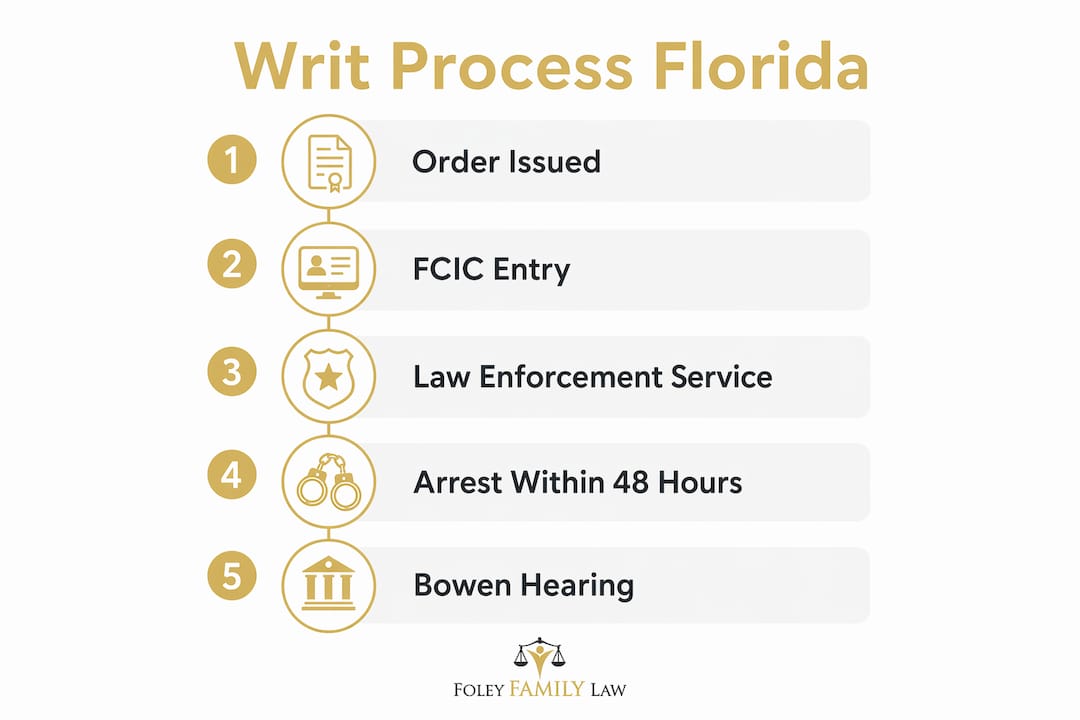
Here is the typical procedural flow:
- Motion filed. The moving party files a motion for civil contempt, documenting the specific violation.
- Notice served. The respondent receives proper notice of the hearing, satisfying due process requirements under Florida Family Law Rules of Procedure.
- Contempt hearing held. The court hears evidence and determines whether noncompliance was willful.
- Writ issued. If the respondent fails to appear or the court finds willful contempt, it issues the writ.
- FCIC entry. Law enforcement enters the writ into the Florida Crime Information Center, making it enforceable statewide, any day, any time.
- Arrest executed. Any Florida law enforcement agency may detain the individual upon encounter.
- Brought before judge. The arrested person must appear before a judge within 48 hours for a hearing.
Sheriffs and authorized law enforcement personnel carry out the writ’s execution. The writ itself authorizes service on any day of the week, including Sundays and holidays, at any hour.

How writs of bodily attachment enforce child support in Florida
Child support enforcement in Florida relies on several tools, and a writ of bodily attachment is among the most direct. When a parent repeatedly misses payments and ignores court orders, the other parent or the Department of Revenue can seek a contempt finding that leads to writ issuance.
Key points in this process:
- Statutory authority. Florida Statute 61.11 and Family Law Rule 12.615 together authorize the writ in support enforcement cases.
- Willfulness requirement. Courts must find that the nonpayment was willful, meaning the person had the present ability to pay but chose not to.
- Purge condition. Every writ includes a purge amount covering unpaid support plus sheriff’s fees and Department of Revenue costs, payable in certified funds.
- Immediate release. Paying the purge amount at any point releases the individual from custody right away.
- Alimony cases. The same mechanism applies when a former spouse willfully fails to pay court-ordered alimony.
A practical example: a parent owes $8,000 in back child support, has been served with multiple notices, and still does not pay. The receiving parent files for contempt. The court finds willful noncompliance and issues a writ. The parent is arrested during a routine traffic stop, brought before a judge within 48 hours, and released only after paying the purge amount or demonstrating a genuine inability to pay.
How long does a writ of bodily attachment last in Florida?
A writ of bodily attachment remains valid indefinitely until the court recalls, purges, or otherwise terminates it. There is no automatic expiration date. This means a writ issued years ago can still result in arrest today.
| Stage | Timeline |
|---|---|
| Writ issued by court | Immediately upon judge’s order |
| FCIC entry and statewide activation | Same day as issuance |
| Arrest may occur | Any time, any day, statewide |
| Brought before judge after arrest | Within 48 hours per Rule 12.615 |
| Bowen hearing (ability to pay) | At or shortly after the 48-hour appearance |
| Release upon purge payment | Immediately upon payment |
| Writ terminated | Only by court order (recall, purge, or case resolution) |
The 48-hour rule comes directly from the Florida Supreme Court Approved Family Law Form 12.962, which directs law enforcement to bring the arrested person before the court within a short, defined period after execution of the writ. Some jurisdictions schedule the Bowen hearing, which assesses the person’s present ability to pay and the willfulness of their noncompliance, even sooner, within 24 hours.
What you should do if served with a writ of bodily attachment
Receiving a writ is serious, but your response in the first hours matters enormously. Ignoring it only makes things worse.
- Contact a Florida family law attorney immediately. An attorney can assess whether the writ was properly issued and identify grounds to challenge or recall it.
- Consider voluntary surrender. Turning yourself in proactively typically results in a faster hearing and a better outcome than being arrested unexpectedly.
- File a motion to recall or purge. Your attorney can file this motion, especially if circumstances have changed since the original order.
- Gather financial documentation. If you genuinely cannot pay, bring evidence: pay stubs, bank statements, proof of job loss, or medical records showing inability to comply.
- Do not ignore the writ. It is entered into the FCIC system and can result in arrest at any time, including during a traffic stop or at your workplace.
Pro Tip: Voluntary appearance before arrest almost always leads to a more favorable hearing outcome. Courts respond better to someone who shows up willingly than to someone who had to be detained.
If you need guidance on your rights and options, understanding what family law attorneys do in these situations is a good starting point.

Foley Family Law’s perspective on writs of bodily attachment
William S. Foley leads Foley Family Law with a practice focused exclusively on family law matters across Hillsborough, Pinellas, and Pasco counties. The firm handles contested and high net worth divorce, child custody, paternity, and contempt proceedings in family law, including cases involving active writs. Their approach centers on clear communication and cost-effective strategy, helping clients understand exactly where they stand and what their options are before a situation escalates.
How a writ of bodily attachment differs from similar writs
The terms “writ of bodily attachment” and “writ of body attachment” refer to the same civil enforcement tool explained in this ghid pas cu pas obținere asistență juridică custodie, which provides detailed legal enforcement mechanisms like writs of bodily attachment in family law. The U.S. Marshals Service uses “writ of body attachment” in federal civil proceedings, while Florida state courts use “writ of bodily attachment.” The function is identical: compel a person’s appearance before a court for civil contempt.
A writ of bodily attachment differs from a criminal arrest warrant in several important ways. A criminal warrant arises from alleged criminal conduct and can result in prosecution and a permanent record. A writ of bodily attachment is a civil process, focused entirely on compelling compliance with a court order. It does not create a criminal record on its own. However, repeated willful noncompliance can escalate to criminal contempt charges, which do carry criminal consequences.
A writ of attachment (sometimes called a property attachment) is a separate instrument entirely. It targets assets, not people, directing law enforcement to seize property to satisfy a judgment. The bodily attachment targets the person.
What consequences follow enforcement of a writ
Being arrested under a writ carries real, immediate consequences beyond the detention itself.
Jail time is possible if you cannot pay the purge amount and the court finds you had the ability to pay. The court may also modify the underlying support order, increase arrears, or impose additional sanctions. Attorney’s fees and court costs are frequently assessed against the non-compliant party. In cases of repeated contempt, the court may refer the matter for criminal contempt prosecution, which carries its own separate penalties.
Beyond the legal consequences, an arrest affects employment, housing applications, and custody proceedings. Even without a criminal record, the contempt finding becomes part of the family court file and can influence future rulings on custody or support modifications.
Other family law cases where writs of bodily attachment are used
Child support is the most common context, but Florida courts issue writs in several other family law situations:
- Alimony enforcement. A former spouse who willfully stops paying court-ordered alimony faces the same contempt process under Florida Statute 61.11.
- Failure to appear at hearings. A party who repeatedly skips scheduled court hearings may face a writ compelling their appearance.
- Violation of parenting plan orders. In some cases, courts have used civil contempt tools when a parent refuses to comply with a custody or time-sharing order.
- Discovery noncompliance. A party who refuses to comply with court-ordered financial disclosure in a divorce can face a writ if other enforcement measures fail.
- Domestic relations injunctions. Willful violation of certain injunctions tied to family law proceedings can also trigger contempt and writ proceedings.
How to challenge or appeal a writ of bodily attachment
You have real legal options when a writ has been issued against you. The most direct route is filing a motion to recall the writ, asking the court to withdraw it based on changed circumstances, procedural errors, or proof of compliance. If the writ was issued without proper notice or without a sufficient finding of willful noncompliance, those are grounds to challenge its validity.
At the Bowen hearing following arrest, you can present evidence that you lacked the present ability to pay. Florida courts cannot incarcerate someone who genuinely cannot comply; the ability-to-pay finding is a constitutional requirement. If the court rules against you at that hearing, you may appeal the contempt order to the appropriate district court of appeal.
Working with a Florida family law attorney before the hearing gives you the best chance of presenting a complete financial picture and avoiding incarceration. Understanding how Florida determines alimony and related support obligations can also help you build a stronger case for modification if your financial situation has genuinely changed.
Key Takeaways
A writ of bodily attachment in Florida is a civil court order, not a criminal warrant, and paying the court-set purge amount secures immediate release from custody.
| Point | Details |
|---|---|
| Civil, not criminal | A writ of bodily attachment does not create a criminal record on its own. |
| Statewide enforcement | Once entered into the FCIC system, any Florida agency can execute the writ at any time. |
| 48-hour hearing rule | Florida Family Law Rule 12.615 requires a judge appearance within 48 hours of arrest. |
| Purge amount releases you | Paying the court-set purge amount, covering arrears plus fees, results in immediate release. |
| Act before arrest | Voluntary appearance and proactive legal counsel consistently produce better outcomes. |
FAQ
What is the purpose of a writ of bodily attachment?
A writ of bodily attachment compels a person found in civil contempt to appear before a judge. Its goal is compliance with a court order, not criminal punishment.
How long does a writ of bodily attachment last in Florida?
The writ remains valid indefinitely until the court recalls, purges, or terminates it. There is no automatic expiration date.
What happens at the hearing after arrest under a writ?
The court holds a Bowen hearing within 48 hours to determine whether the person had the present ability to comply and whether the noncompliance was willful, per Florida Family Law Rule 12.615.
Can you get a writ of bodily attachment removed without paying?
Yes. You can file a motion to recall the writ or present evidence at the Bowen hearing showing a genuine inability to pay. Courts cannot incarcerate someone who truly lacks the ability to comply.
Is a writ of bodily attachment the same as a criminal warrant?
No. A writ of bodily attachment is a civil enforcement tool that does not result in a criminal record on its own, though repeated willful noncompliance can escalate to criminal contempt charges.


