

Think of a Marital Settlement Agreement (or MSA, as it's often called) as a legally binding contract that you and your spouse create together to settle every issue in your divorce. It’s the detailed blueprint for your separation, covering everything from who gets the house to how you’ll share time with your children.
Most importantly, this document puts you in control of your divorce's outcome, rather than leaving those critical decisions up to a judge. In our practice serving Pasco, Pinellas, and Hillsborough Counties, we have found that a well-crafted MSA provides clients, including those in the LGBTQ+ community, with the clarity and security needed to move forward.
Your Roadmap for Life After Divorce

You can think of a Marital Settlement Agreement as the foundational plan for your future, carefully designed during the divorce process. It's a comprehensive contract you and your spouse develop, ideally outside a courtroom, to resolve every last detail of your separation. This approach allows you both to create solutions that are more personalized and often more amicable.
The whole point of an MSA is to turn the chaos and uncertainty of divorce into a clear, predictable path forward. Instead of rolling the dice in prolonged court battles, you and your spouse can collaboratively define the terms of your new beginning.
Defining Your New Financial Landscape
A well-drafted MSA meticulously outlines how you’ll handle your finances after the divorce is final. It creates a clear division of both your assets and your liabilities. Specifically, the MSA will detail:
- Division of Property: How real estate, cars, bank accounts, and investments will be split.
- Allocation of Debt: Who is on the hook for paying off the mortgage, credit card balances, and any outstanding loans.
- Financial Support: The specific terms of any spousal support (alimony) or child support, including the exact amounts and for how long.
This kind of clarity is crucial for preventing financial fights down the road and provides a stable foundation for both of you to build upon. As you start this journey, it's wise to get a handle on the full financial picture. You can learn more about the cost of divorce in our detailed guide.
A Marital Settlement Agreement provides structure and predictability during an otherwise unpredictable time. It empowers you to create a customized resolution that reflects your family’s unique circumstances, rather than accepting a one-size-fits-all court decision.
Creating Stability for Your Family
For parents, the MSA is absolutely vital because it includes a detailed parenting plan. This section addresses your children's care and well-being with precision, mapping out timesharing schedules, holiday arrangements, and who makes what decisions. By defining these terms proactively, you create the stable and consistent environment your children need to thrive after the divorce.
At Foley Family Law, we guide clients throughout Pasco, Pinellas, and Hillsborough Counties, including members of the LGBTQ+ community, in crafting these critical agreements. We work to ensure they are fair, thorough, and protect your interests for years to come. As you navigate this process, mediation is often a key step. Understanding how to prepare for mediation effectively can make a huge difference in the outcome, helping to smooth out the negotiation process.
The Essential Building Blocks of Your Agreement
Think of your Marital Settlement Agreement as the architectural blueprint for your post-divorce life. If the foundation is weak or a critical support beam is missing, the whole structure could come crashing down later, leading to more conflict and legal battles. To be truly effective, an MSA has to be meticulously built, addressing every key area of your separation with absolute clarity.
The goal here isn't just to get a document signed; it's to create a legally binding contract that anticipates future challenges and prevents them before they start. A well-drafted MSA transforms the uncertainty of a separation into a clear, final resolution.
Dividing Assets and Debts Fairly
One of the heaviest lifts in any divorce is untangling your finances. Florida law starts with the principle of equitable distribution, which means everything you acquired as a couple gets divided fairly—though "fairly" doesn't always mean a perfect 50/50 split.
This process kicks off with a complete and honest inventory of every asset and liability you both accumulated from the day you said "I do" until the day one of you filed for divorce. This is a non-negotiable step, and it covers more than just the obvious.
- Real Estate: The family home, any vacation properties, or investment real estate.
- Financial Accounts: All checking and savings accounts, investment portfolios with stocks and bonds, and mutual funds.
- Personal Property: Cars, furniture, jewelry, art collections—anything of value.
- Debts: Mortgages, car loans, student loans taken during the marriage, and those credit card balances that add up.
By methodically listing and valuing every single item, you and your spouse can negotiate a division that you can both live with, avoiding nasty surprises and arguments down the road about who truly owns what.
A Marital Settlement Agreement is more than just a document; it's a binding contract that transforms ambiguity into certainty. By defining the terms of your separation, it helps avoid costly and emotionally draining court battles, a common scenario given that U.S. divorce rates can be as high as 73% for third marriages. Learn more about divorce rate trends from this insightful analysis.
Structuring Financial Support
Financial support—alimony for a spouse and support for your children—is another cornerstone of a solid MSA. Vague language here is a recipe for disaster. Your agreement needs to be incredibly specific to hold up in court.
For alimony, the MSA must spell out the exact type of spousal support, the precise dollar amount of each payment, and the duration. Is it temporary? For a set number of years? Or is it permanent? For child support, the agreement must incorporate Florida's official Child Support Guidelines, which use a formula based on both parents' incomes and the timesharing schedule. Leaving any of this open to interpretation is asking for future conflict.
Crafting a Detailed Parenting Plan
If you have minor children, your MSA must include a comprehensive Parenting Plan. This isn't optional; it's required by Florida law. This plan is essentially the rulebook for how you will co-parent after the divorce is final.
A strong Parenting Plan gets into the weeds and details everything:
- Timesharing Schedule: A specific calendar showing when the children are with each parent. This includes regular weekdays and weekends, but also holidays, summer vacation, and other school breaks.
- Parental Responsibility: This section determines who makes the big decisions about the children’s health, education, and religious upbringing. Will you share this responsibility, or will one parent have the final say?
- Communication Protocols: It even lays out the ground rules for how the two of you will communicate with each other and with the kids.
This level of detail is crucial. It provides the stability and consistency that children desperately need to thrive during and after their parents' divorce.
Addressing Complex Financial Details
Finally, a truly thorough MSA tackles the financial details that are easy to overlook but can cause massive headaches later. Your agreement needs a plan for how these complex assets will be handled. To help organize these crucial elements, here’s a look at the non-negotiable sections that must be clearly defined in your agreement.
- Property & Debt: This covers real estate, bank accounts, vehicles, investments, credit cards, and loans. It is critical because it prevents future disputes over who owns what and who owes what.
- Parenting Plan: This section details timesharing schedules, decision-making authority, and communication rules. It provides stability for children and a clear co-parenting roadmap.
- Financial Support: Here you define alimony (type, amount, duration) and child support calculations. This ensures financial obligations are clear, predictable, and enforceable.
- Retirement & Pension: This addresses the division of 401(k)s, IRAs, pensions, and other retirement assets. It is vital for protecting each spouse's long-term financial security.
- Taxes & Insurance: This clarifies who claims child tax credits and who maintains health or life insurance. It helps avoid costly surprises with the IRS and ensures coverage continuity.
Each of these components is a critical piece of the puzzle. Overlooking just one can create problems that last for years.
For example, retirement accounts are considered marital assets and must be divided. Your MSA must specify exactly how pensions, 401(k)s, and IRAs will be split, which often requires a special court order to avoid steep tax penalties. For a closer look at this topic, you might find our guide on dividing retirement accounts in a Florida divorce helpful.
Other key details include life insurance policies, often required to secure support payments, and tax issues, like who gets to claim the children as dependents each year. By systematically working through each of these building blocks, our firm helps clients in Pasco, Pinellas, and Hillsborough Counties create resilient agreements that stand the test of time. We are proud to serve all families, including LGBTQ+ couples, with the dedication and expertise they deserve.
Making Your Marital Settlement Agreement Official
A Marital Settlement Agreement starts out as a private contract, just between you and your spouse. It’s the roadmap you’ve both carefully built. But its real power comes when it’s transformed into an official, legally binding court order. This is the step that gives the agreement its teeth, ensuring the terms you worked so hard to create are actually followed.
Once you’ve both signed the MSA, it doesn’t just get filed away in a drawer. It’s formally submitted to the court. A judge will review it to make sure it’s fair and lines up with Florida law, and then incorporate it directly into your Final Judgment of Dissolution of Marriage. This is the moment your private agreement becomes a public order with the full force of the law behind it.
From Private Contract To Court Order
When the MSA is incorporated into the final judgment, its terms are no longer just promises. They become legally enforceable obligations. If someone fails to follow through—by stopping alimony payments, for example, or refusing to sign over a car title—the other person has immediate legal recourse.
This legal backing is what provides genuine, long-term security. You aren’t left simply hoping your ex-spouse honors their word; you have a court order that demands they do. This is a critical distinction and why a formal, written agreement is essential, even when a divorce seems amicable. Our firm supports clients throughout Pasco, Pinellas, and Hillsborough Counties in making this transition seamless, ensuring their agreements are properly filed and approved.
The Power of Enforceability
So, what happens if someone just ignores the agreement? Because the MSA is part of a court order, the person following the rules can file a motion for enforcement or contempt of court. This brings the issue back in front of a judge, who has the power to impose serious consequences to force compliance.
These legal actions can include:
- Wage Garnishment: Ordering an employer to deduct support payments directly from the non-compliant spouse's paycheck.
- Fines or Sanctions: Imposing financial penalties for failing to follow the court's order.
- Awarding Attorney's Fees: Making the non-compliant person pay for the legal fees you had to spend to enforce the agreement.
This enforceability is your ultimate safety net. It ensures the decisions made during your divorce are respected long after the ink has dried.
An MSA that is properly incorporated into a final judgment is a powerful tool for your future. It provides a clear, court-backed path to resolving disputes and ensures that the financial and parental arrangements you agreed upon are upheld, protecting your stability and peace of mind.
This infographic breaks down the core components that become legally binding through this exact process.
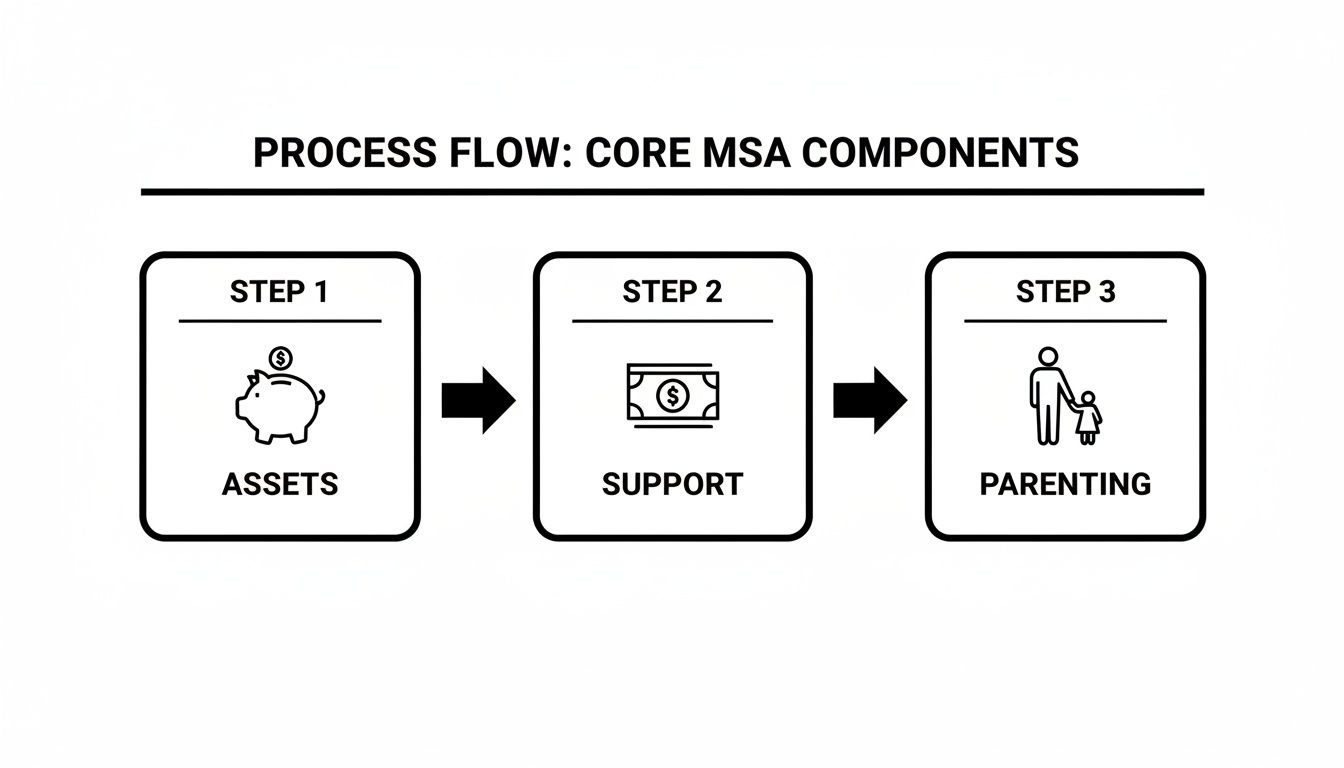
As you can see, the agreement takes your personal decisions about assets, support, and parenting and turns them into legal mandates that a court will enforce.
The Difficulty of Modifying An Agreement
Once an MSA is made official, changing it is intentionally difficult. For property and debt division, the terms are almost always final. You can't come back years later and ask for a different split just because your circumstances have changed. Issues involving children or alimony can sometimes be modified, but only if you can prove a substantial, material, and unforeseen change in circumstances.
That's a very high bar to clear, which is why getting the agreement right the first time is so critical. The need for these ironclad agreements has grown as divorce has become more common; the worldwide crude divorce rate has doubled since 1970. The U.S. alone saw over 630,000 divorces in 2020, highlighting the need for the efficient, final resolutions that MSAs provide for all couples, including same-sex partners.
At Foley Family Law, we guide our clients, including all members of the LGBTQ+ community, through this entire process. We make sure your agreement is built on full financial disclosure, is free from duress, and is drafted with the precision needed to provide lasting security. For a closer look at complex assets, read our guide on what happens to a 401(k) in a divorce.
Avoiding Common Pitfalls In Your MSA
A poorly drafted Marital Settlement Agreement can feel like a ticking time bomb, just waiting to create more conflict and expense down the road. The whole point is to build a document that’s clear, comprehensive, and truly final. Knowing where people usually trip up is the first step toward sidestepping those traps and securing your future.
So many problems start with simple mistakes that have huge consequences. One of the biggest? Agreeing to terms while you're under intense emotional stress, without a legal professional looking out for you. Our role is to be your safeguard, helping you see through the fog of the moment to avoid costly errors and ensure your agreement is a solid foundation for your new life.
The Dangers Of Vague Language
One of the most critical—and common—errors in drafting an MSA is using ambiguous or fuzzy language. Phrases that sound perfectly agreeable on the surface can easily become sources of endless arguments later. Without crystal-clear definitions, you’re basically leaving the door wide open for different interpretations and future court battles.
Think about these common but dangerous phrases:
- "Reasonable access" to a child: What on earth does "reasonable" mean? To one parent, it might mean calling every single night. To the other, it could mean a quick text once a week. This kind of ambiguity is a recipe for constant conflict.
- "Splitting the household goods": This sounds fair, but it says nothing about how you'll actually divide everything. Who picks first? What happens when you both want the same sentimental painting? A detailed list or a clear process is absolutely essential.
- "As mutually agreed upon": This phrase is just kicking the can down the road. If you couldn’t agree on it during the divorce, it’s not going to magically get easier later without a defined process in place.
A strong MSA gets rid of all this uncertainty. It uses specific, measurable terms. It locks in dates, times, dollar amounts, and clear processes for every single point of potential disagreement. This precision is what makes the agreement worth the paper it's written on.
Incomplete Financial Disclosure
A Marital Settlement Agreement is only as solid as the financial information it’s built on. Here in Florida, both spouses are legally required to provide full and honest financial disclosure. Hiding assets or "forgetting" to disclose debts is a massive pitfall that can have severe consequences.
When one person isn't truthful about their finances, the resulting agreement is fundamentally broken. If hidden assets or undisclosed debts pop up after the divorce is final, it can be grounds to challenge and potentially invalidate the entire agreement. This could drag you right back into court years later to fix the mess. Our firm guides clients in Pasco, Pinellas, and Hillsborough Counties through the formal discovery process to make sure all financial cards are on the table. You can learn more about this critical step in our article on the discovery process for divorce.
A Marital Settlement Agreement based on incomplete information is like building a house on a shaky foundation. Sooner or later, the cracks will show, and the entire structure could be at risk.
Overlooking The Fine Print
Beyond vague language and hidden assets, there are plenty of other easily overlooked details that can cause serious headaches. These "fine print" issues often involve things like taxes, insurance, and real estate. Ignoring them can lead to some very unpleasant and expensive surprises.
Here are a few crucial details that have to be addressed:
- Tax Consequences: Who gets to claim the kids as dependents on their tax returns? This can make a huge difference to your annual refund. A proper MSA should spell this out, often alternating years between parents.
- Beneficiary Designations: Your will does not override the beneficiary you named on your life insurance policy or 401(k). You have to remember to update these documents after a divorce, and your MSA should explicitly require it.
- Handling the Family Home: If you agree to sell the house, the MSA must detail every single step. Who pays the mortgage and upkeep until it sells? Which real estate agent will you use? How will you divide the proceeds—or cover a shortfall if it sells for less than you owe?
At Foley Family Law, we meticulously comb through every detail for our clients, including those in the LGBTQ+ community, to ensure nothing is left to chance. A thorough agreement tackles these issues head-on, giving you the clarity and peace of mind you need to move forward.
Partnering With A Lawyer To Protect Your Future

Trying to make sense of a Marital Settlement Agreement on your own can be an overwhelming experience. The good news is, you don’t have to do it alone. This is where a skilled family law attorney steps in to provide the clarity and dedicated guidance you need to protect your interests and your future.
Our primary goal is always to find common ground through negotiation and collaborative solutions. In our experience, these approaches almost always lead to better, more durable outcomes while dramatically reducing the emotional and financial toll of a drawn-out court battle. By fostering a constructive environment, we empower you to reach an agreement that both parties can stand behind for the long term.
Of course, we are always prepared to litigate aggressively on your behalf if the other side refuses to be reasonable. Our team has extensive courtroom experience and will not hesitate to fight for your rights before a judge to get the right result.
Specialized Expertise For Your Unique Situation
Every family is different, and your Marital Settlement Agreement must reflect your specific circumstances. We have deep experience navigating the unique complexities that can arise in Florida divorces, ensuring no stone is left unturned.
Our areas of focused experience include:
- High-Net-Worth Divorces: We manage the intricate division of complex assets, from business valuations and investment portfolios to real estate holdings, to ensure a genuinely equitable distribution.
- Military Divorce: Our team understands the specific federal rules governing the division of military pensions and other benefits, protecting the rights of both service members and their spouses.
- LGBTQ+ Families: We proudly handle all divorce and custody issues for the LGBTQ+ community, including gay divorce and transgender name changes, with the sensitivity and respect every family deserves.
We serve clients throughout Pasco, Pinellas, and Hillsborough Counties, developing a personalized strategy for each case we take on. We don’t believe in one-size-fits-all solutions; we listen to your goals and build a legal plan designed to achieve them.
Our goal is to empower you to secure a fair settlement that allows you to confidently begin your next chapter. We provide the legal framework so you can focus on moving forward.
Your Next Chapter Starts Here
Having the right legal partner makes all the difference. We believe a well-crafted Marital Settlement Agreement is the foundation for a stable and secure future after divorce. It provides the clarity and finality you need to close one chapter and start another on solid ground.
Understanding your options is the first step. Our guide on how to choose a divorce attorney can provide valuable insights as you begin this process.
We invite you to schedule a consultation with our team to discuss your situation in detail. Together, we can create a clear plan of action designed to protect what matters most and secure the fair resolution you deserve.
Your Top Questions About Florida MSAs Answered
When you're working through a divorce, it's natural for questions to pop up about the Marital Settlement Agreement. This document is a big deal, and it can feel overwhelming at first. We get it. Over the years, we’ve heard just about every question imaginable from our clients across Pasco, Pinellas, and Hillsborough Counties, including many from the LGBTQ+ community.
To give you some clarity and peace of mind, we’ve put together answers to the questions we hear most often. Think of this as a practical guide to the real-world issues you might face when drafting, signing, and eventually living with your MSA.
Can We Change the MSA After the Divorce Is Final?
This is a big one, and the short answer is: it depends. When it comes to dividing up property and debt, the decisions you make in your MSA are almost always permanent. Once the judge signs off on who gets the house or who pays off that credit card, that part of the deal is locked in for good.
However, life happens, and Florida law recognizes that some things need to be flexible, especially when kids are involved.
- Child Support & Timesharing: These issues are always open to modification. If a parent has a substantial, material, and unforeseen change in circumstances—like a major promotion, an unexpected job loss, or a child’s needs changing significantly—they can ask the court to update the plan.
- Alimony: Some types of alimony can also be modified under that same "substantial change" standard. For example, if the person paying support loses their job through no fault of their own, or the person receiving it moves in with a new partner who supports them, that could be grounds to revisit the alimony arrangement.
The bar for modifying an agreement is set high for a reason. It really highlights how important it is to get every detail right the first time around.
What Happens If My Ex Doesn't Follow the Agreement?
A Marital Settlement Agreement isn't just a friendly handshake or a list of suggestions. It’s a legally binding contract that becomes an official court order. If your former spouse decides to ignore it, you have real power to do something about it. You don't have to just sit back and accept it.
The first move is to file a motion for enforcement or contempt with the court. This gets the judge’s attention and formally puts them on notice that your ex is violating a court order.
From there, a judge can bring down serious legal consequences to force the other person to comply. This is what gives your MSA its teeth—it ensures the promises made are promises kept.
Depending on what they failed to do, a judge can garnish their wages to collect unpaid support, force them to turn over property, or even find them in contempt of court, which can lead to fines or jail time. The court can also make them pay for your attorney’s fees for having to drag them back to court in the first place.
Do We Really Need an MSA If We Agree on Everything?
Yes, 100% yes. This is a trap that even the most well-intentioned, amicable couples fall into. It’s wonderful that you’re on good terms, but relying on verbal promises or informal understandings is a recipe for disaster down the road.
Life changes. Memories get fuzzy. New partners enter the picture and can shift perspectives. A written MSA is your official playbook, the single source of truth that documents every single decision you made together. It protects both of you from future arguments and “he said, she said” debates.
It gets everything in writing, from who claims the kids on their taxes in odd-numbered years to how you’ll split the profits when you sell the family boat. That kind of clarity makes the whole process smoother and gives you a clear rulebook to fall back on if a disagreement ever pops up.
How Specific Does the Agreement Need to Be?
The more specific, the better. Honestly, you can't be too specific. Vague language is the number one cause of post-divorce conflict and litigation. Phrases like "reasonable parenting time" or "split personal items fairly" sound nice, but they're subjective and leave the door wide open for interpretation—and arguments.
A rock-solid MSA gets rid of all the guesswork. Instead of "reasonable time," it will lay out a detailed timesharing calendar, specifying exact pickup and drop-off times for holidays and summer break. Instead of just saying you'll divide property, it will include an itemized list spelling out who gets which couch, which TV, and which set of tools.
This level of detail is your best insurance policy against future conflict. It makes sure every piece of your separation is clearly defined, leaving nothing to chance and giving you true finality.
Who Claims the Children for Tax Purposes?
This is a huge financial detail that’s easy to overlook but absolutely must be in your MSA. If you don't specify, the IRS has its own rules: the custodial parent (the one the child lives with for more than half the year) gets to claim the child tax credits.
But you don’t have to stick to that. In your MSA, you can agree to whatever arrangement works for you. A very common approach is to alternate the tax exemption, with one parent claiming the children in even-numbered years and the other in odd years.
If you agree that the non-custodial parent will claim the kids, the custodial parent must sign IRS Form 8332, which is the official document releasing their claim for that tax year. Your MSA should explicitly state who is responsible for signing this form to avoid any last-minute headaches when April 15th rolls around. As a firm serving Pasco, Pinellas, and Hillsborough Counties, we make sure these critical financial details are never missed.
Navigating the complexities of a Marital Settlement Agreement requires careful planning and experienced legal guidance. At Foley Family Law, we are dedicated to protecting your rights and securing a fair resolution that allows you to move forward with confidence. To discuss your case and create a clear plan of action, contact us for a consultation at https://wfoleylaw.com.


