

When you’re navigating a difficult custody case in Pasco, Pinellas, or Hillsborough County, the term 'Guardian ad Litem' might come up, and frankly, it can sound pretty intimidating. So, what exactly is a Guardian ad Litem, or GAL?
A Guardian ad Litem is a neutral third party appointed by the court. Their job is to act as an investigator and advocate for a child's best interests. They don’t work for you, and they don’t work for your ex. They work for the court, giving the judge an unbiased perspective on what’s truly best for your child.
Understanding The Guardian Ad Litem In Your Custody Case
Family law cases, especially those with heated disputes over parenting time and decision-making, are emotionally charged. A GAL steps into this situation not to take sides, but to give the judge a clear, fact-based view focused solely on the child’s well-being.
Think of them as the eyes and ears of the court. Their entire purpose is to gather the kind of information that parents, caught in the middle of a conflict, might not see or agree upon. At Foley Family Law, we've helped countless families—including LGBTQ parents navigating their own unique custody challenges—understand this role and what it means for their case. We handle all family and divorce issues without discrimination for clients in Pasco, Pinellas, and Hillsborough Counties. A GAL’s involvement is designed to shield the child from the conflict that these legal battles can create.
The Core Mission of a GAL
The GAL’s primary duty is to conduct a thorough investigation into the child's world. This deep dive allows them to make an informed, objective recommendation to the court.
Their investigation usually involves:
- Interviewing the child in an age-appropriate, comfortable way.
- Speaking with each parent separately to get their perspectives.
- Contacting other important people in the child’s life, like teachers, doctors, therapists, and other family members.
- Visiting both parents' homes to see the living environments firsthand.
A critical part of a Guardian Ad Litem's job is to understand what keeps kids healthy and stable. Learning about how children are kept safe is a key piece of their work. Ultimately, the GAL compiles all this information into a final report, which often carries significant weight when the judge makes decisions about the final details in a parenting plan. You can learn more about what goes into one in our guide on how a parenting plan in a divorce works.
The whole point of a Guardian ad Litem is to give the child a voice in court, making sure their needs aren’t lost in the shuffle of parental disagreements. A GAL’s loyalty is to the child's best interests, not to what either parent wants.
In Florida's family courts right here in Hillsborough, Pinellas, and Pasco Counties, GALs are especially vital in high-conflict custody battles. They serve a crucial role in ensuring the child's welfare remains the top priority throughout the legal process.
To give you a quick snapshot, here’s a summary of what a GAL does.
Guardian Ad Litem at a Glance
- Primary Role: To investigate the child's circumstances and advocate for their best interests in court.
- Who They Work For: The court. They are a neutral party, not an attorney for either parent or the child.
- Key Responsibilities: Interviewing the child, parents, and relevant third parties; reviewing records; conducting home visits; and submitting a report.
- Appointment: Appointed by a judge, often in high-conflict cases or when there are allegations of abuse, neglect, or substance abuse.
- Authority: Makes recommendations to the court but does not have the final say; the judge makes the ultimate decision.
- Goal: To provide an objective, child-centered perspective to help the judge craft a parenting plan that serves the child’s well-being.
This list helps break down the core functions, but working with a GAL involves a lot of direct interaction and understanding the nuances of their investigation.
The Guardian Ad Litem's Investigative Process
Once a judge appoints a Guardian ad Litem (GAL) in a Florida family law case, their real work begins. The GAL steps into the role of a neutral fact-finder, launching a detailed investigation to understand the child's world from every possible angle. Their entire mission is to gather objective information that paints a complete and honest picture for the court.
This isn't just a quick look at the family's life. It's a methodical process designed to uncover the facts needed to recommend a parenting plan that genuinely serves the child’s best interests. For families in Pasco, Pinellas, and Hillsborough Counties, knowing what this investigation involves can take some of the mystery out of the process and help you prepare for what's ahead.
This flowchart shows the simple, three-step flow of a Guardian ad Litem's role in the court system.
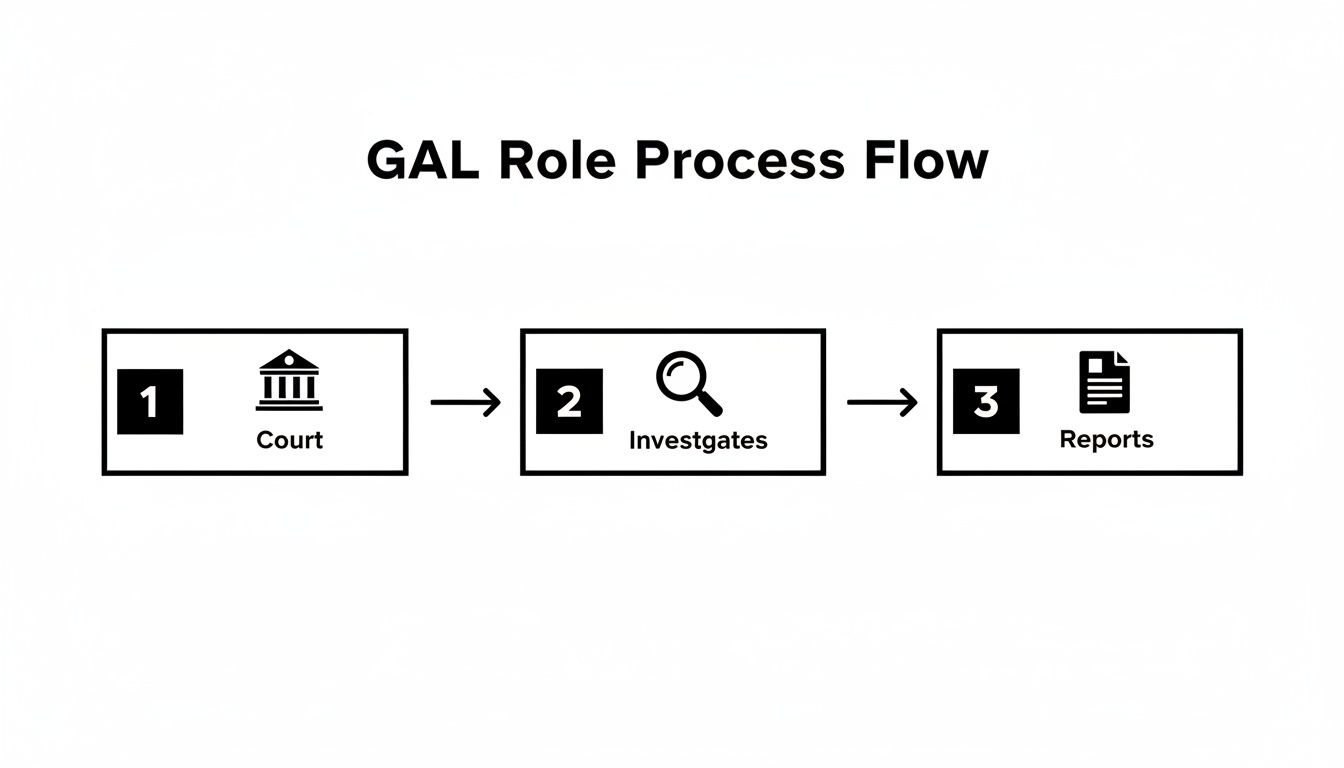
As you can see, the process kicks off with a court appointment, moves into a thorough investigation, and ends with a formal report to the judge.
Gathering Information Through Interviews
A cornerstone of the GAL’s investigation is talking to the key people in the child’s life. This is how they collect firsthand accounts and observe personal dynamics that documents alone could never show.
The GAL will almost always speak with:
- Both Parents: These interviews are crucial for understanding each parent’s perspective, their proposed parenting plan, and their relationship with the child.
- The Child: This is always handled with extreme care, in an age-appropriate way, and often in a comfortable setting where the child feels safe to open up.
- Collateral Contacts: This is a broad category that includes anyone with relevant insight—think teachers, doctors, therapists, coaches, family friends, and other relatives.
A GAL gathers a huge amount of information this way, often relying heavily on these personal interactions. If you're curious about how they process these crucial conversations, this guide on how to analyze interview data offers some great insights. This kind of detailed analysis is what ensures their final recommendations are well-supported by facts.
Reviewing Documents And Conducting Home Visits
Beyond just talking to people, a GAL digs into records and observes environments to double-check information and gain deeper context. This part of the investigation is just as important for building a fact-based recommendation.
A GAL will typically request and review various documents to get a complete picture.
These often include:
- School Records: Report cards, attendance logs, and any disciplinary notes can offer a window into a child’s academic progress and social adjustment.
- Medical and Therapy Records: These documents provide vital information about the child’s physical health and emotional well-being.
- Court Filings: Reviewing motions, pleadings, and affidavits from the case helps the GAL understand the legal arguments and positions of both parents.
Home visits are another standard piece of the puzzle. The GAL will schedule a time to visit each parent’s home to observe the living conditions and see how the child interacts with that parent in their own space. They aren't looking for a perfect home, but for a safe, stable, and nurturing environment for the child.
A Guardian ad Litem’s investigation is not about finding fault or declaring one parent a "winner." It is a neutral, fact-finding mission focused exclusively on determining what environment and parenting arrangement will best support the child’s long-term happiness and well-being.
In some high-conflict cases, a GAL may also investigate specific allegations, like substance abuse or parental alienation. If this is a concern for you, it's a good idea to understand how to prove parental alienation as you prepare to speak with the GAL. At Foley Family Law, we assist clients from all walks of life, including LGBTQ families, in presenting their side clearly and honestly, making sure the GAL gets the accurate information needed for a fair assessment.
How a GAL Is Appointed in Tampa Bay Family Courts
A Guardian ad Litem doesn’t just show up in your family law case. Their involvement is the result of a formal court process, one designed to bring a neutral investigator into a difficult family situation. In the family courts serving Hillsborough, Pasco, and Pinellas Counties, appointing a GAL follows a specific legal path.
The decision to appoint a GAL rests entirely with the judge. A GAL cannot get involved without a formal court order, a power judges have long held to protect those who can't protect themselves, especially children.
Who Kicks Off the Appointment Process?
So, how does a Guardian ad Litem get assigned to your custody case? There are really only two ways it happens, and knowing them can help you see if a GAL might become a factor in your own legal proceedings.
The first and most common way is through a judge’s own initiative. Historically, this has always been the primary method. Judges in Pasco, Pinellas, and Hillsborough Counties frequently appoint a GAL when they determine an independent investigation is necessary.
The other way is when either parent formally asks for one. This is done by filing a legal document called a motion, which is a formal request asking the judge to assign a GAL to investigate the case.
What Makes a Judge Decide to Appoint a GAL?
A judge isn’t going to appoint a Guardian ad Litem in every single custody dispute. This step is usually reserved for cases that have specific red flags or complex circumstances where an independent investigation is truly necessary to figure out the child’s best interests.
Judges in Tampa Bay family courts will often consider appointing a GAL when they see issues like:
- Serious Allegations: When one parent accuses the other of things like substance abuse, domestic violence, or significant mental health problems that could affect their parenting.
- High Levels of Conflict: If the parents are constantly at odds and can't communicate about their child without fighting, a GAL can help the judge see past all the noise.
- Concerns of Parental Alienation: In tough situations where one parent may be trying to turn the child against the other parent, a GAL is critical for getting to the bottom of the family dynamics.
- Emergency Situations: In urgent matters, a judge might appoint a GAL to quickly assess a child's safety. For anyone facing immediate risks, it's also helpful to understand the process for an emergency custody order in Florida.
The decision to appoint a GAL is a sign that the judge needs more information—an unbiased, in-depth look at the child's life—before making critical decisions about their future.
Who Pays for the Guardian ad Litem?
This is one of the first questions parents ask, and for good reason. In most custody disputes in Florida, the court appoints a private GAL—often a family law attorney or a mental health professional who is paid for their time.
The fees for this private GAL are the responsibility of the parents. The judge will issue an order that clearly states how the costs will be divided. It’s often based on each parent’s financial situation, so it might be a 50/50 split, or another ratio if there's a big income difference between the parents. At Foley Family Law, we make sure our clients in Pasco, Pinellas, and Hillsborough Counties, including those from our valued LGBTQ and military communities, understand these potential costs right from the very beginning.
Key Differences Between A GAL And Other Child Advocates
When you’re in the middle of a family law case involving your children, you’ll likely hear a swirl of different professional titles. It’s easy to get confused, but each role is distinct, with a very specific purpose. Getting a clear handle on who does what is critical for navigating your custody case in Pasco, Pinellas, or Hillsborough County.
To really nail down "what is a Guardian ad Litem," it helps to see how they stack up against other professionals who might get involved. A GAL isn’t the only person advocating for a child, but their mission is unique. Let’s break down the key differences between a Guardian ad Litem, an Attorney for the Child, and a Parenting Coordinator.
Guardian Ad Litem vs. Attorney For The Child
The most common point of confusion is the difference between a Guardian ad Litem and an attorney appointed to represent the child directly. They both focus on the child, that's true, but their core missions are fundamentally different—and sometimes, they can even be at odds.
A Guardian ad Litem has one job: to investigate the facts of the case and advocate for the child’s best interests. The GAL’s recommendation to the court is based on an objective, 360-degree view of what’s best for the child’s well-being in the long run. This recommendation might not line up with what the child says they want.
An Attorney for the Child, on the other hand, acts just like any other lawyer. Their client is the child, and their duty is to represent the child's stated wishes to the court. This attorney is the child's legal voice, arguing for the outcome the child has asked for.
The easiest way to remember the difference is this: A GAL tells the court what the child needs, while an Attorney for the Child tells the court what the child wants. These two things aren't always the same, especially with younger children or in situations where a child might be influenced by one parent.
Guardian Ad Litem vs. Parenting Coordinator
Another role that often gets mixed up with a GAL is the Parenting Coordinator. While both professionals work to lower conflict and help families, their authority and day-to-day functions are completely different. They come into the legal process at different times and with different goals.
A Guardian ad Litem is brought in during active litigation to investigate disputed issues. Their job is to dig into the facts and make recommendations to the judge before a final parenting plan is put in place. Their work culminates in a report designed to help the judge make a well-informed decision.
A Parenting Coordinator usually gets involved after a parenting plan is already in place. Their job isn’t to investigate but to help parents follow the existing court order. They help resolve day-to-day conflicts, improve communication, and make sure the co-parenting relationship runs as smoothly as possible. Think of them more like a facilitator or mediator for an existing plan.
- GAL Focus: Investigating the facts to recommend what the parenting plan should be.
- Parenting Coordinator Focus: Helping parents follow the parenting plan that already exists.
Role Comparison of Child Advocates in Florida Law
To make these distinctions even clearer, let's look at them side-by-side. Each of these roles serves a vital, but separate, function in the Florida family law system.
- Guardian ad Litem
- Primary Function: Investigates and makes recommendations on the child's best interests.
- Represents: The child's best interests, as determined by the GAL's investigation.
- Confidentiality: Not confidential; the GAL reports findings to the court and all parties.
- Attorney for the Child
- Primary Function: Advocates for the child's stated wishes and legal position.
- Represents: The child as a client, advancing what the child wants.
- Confidentiality: Bound by attorney-client privilege; communications are confidential.
- Parenting Coordinator
- Primary Function: Facilitates dispute resolution and helps parents implement an existing parenting plan.
- Represents: A neutral third party; does not represent anyone.
- Confidentiality: Varies by court order, but generally not confidential from the court.
Understanding these roles is vital. At Foley Family Law, we guide our clients, including those in the LGBTQ community, through these complexities. We make sure you know exactly who is involved in your case in Pasco, Pinellas, and Hillsborough Counties and what their role means for you and your children as you work toward a resolution.
The GAL Report and Its Impact on Your Custody Case
After all the interviews, home visits, and document reviews, the Guardian ad Litem’s work comes together in a single, critical document: the GAL report. This formal, written report is submitted directly to the court, summarizing everything the GAL has learned. For families navigating the courts in Pasco, Pinellas, and Hillsborough Counties, this report can dramatically shape the outcome of a custody case.

Think of this document as more than just a summary. It's a detailed analysis weaving together all the facts, conversations, and observations the GAL has gathered. Its purpose is to give the judge a clear, unbiased snapshot of your child’s world and recommend an arrangement that best serves their interests.
What Is Inside The GAL Report
A GAL report is structured to be thorough, fact-based, and easy for the court to follow. It methodically lays out the information collected, connecting the dots between the investigation and the final recommendations.
In a typical Florida family court case, you can expect the report to include a few key sections:
- A Summary of the Investigation: This is the "how they did it" part. The GAL lists every person they interviewed (parents, kids, teachers, therapists) and every document they reviewed (school records, medical files, police reports).
- Factual Findings: Here, the GAL presents the objective information they uncovered, steering clear of personal judgments. This could include direct observations from a home visit or summaries of what collateral contacts had to say.
- Specific Recommendations: This is the heart of the report and its most influential section. The GAL will provide clear, actionable recommendations on the biggest issues in your case, like the timesharing schedule, who has parental responsibility (decision-making), and other key parts of the parenting plan.
At Foley Family Law, we guide our clients in Pasco, Pinellas, and Hillsborough Counties, including those in the LGBTQ community, on how to communicate effectively with the GAL. The goal is to ensure their report is built on a foundation of accurate and complete information.
The Weight Of The GAL's Recommendation
It’s absolutely crucial to understand this: the GAL’s report is not a final court order. The judge, and only the judge, has the final say on your child’s custody arrangement. The GAL’s role is purely advisory.
However, that advice carries significant weight. Judges appoint GALs for a reason—they trust them to be a neutral set of eyes and ears focused solely on the child. Because of this, judges often give considerable deference to a GAL’s recommendations, which are based on a deep-dive investigation the court simply doesn't have the time to do itself.
While the report isn't legally binding, an unfavorable one can create a serious uphill battle in your case.
A Guardian ad Litem's report provides the court with a road map based on the child's best interests. While the judge is the one driving the final decision, they often rely heavily on the directions that map provides.
What To Do If You Disagree With The Report
Getting a GAL report with recommendations you feel are unfair, inaccurate, or just plain wrong can be incredibly frustrating and scary. Don’t panic. You have the right to challenge it. If you believe the report is biased, based on incomplete facts, or contains flat-out errors, you have options.
This is where your family law attorney becomes your most important ally. A skilled lawyer can contest the GAL’s findings in court using several legal strategies. The most common approach is cross-examination, where your attorney questions the Guardian ad Litem on the witness stand during a hearing or trial.
This process allows your attorney to expose weaknesses in the investigation, highlight inconsistencies in their testimony, or reveal potential biases to the judge. In severe cases where a parent’s fundamental rights are on the line, knowing every legal avenue is critical. For more on this, you can read our guide on the termination of parental rights. Preparing for this fight with a strong legal team is the best way to protect your relationship with your child.
Navigating The GAL Process With A Trusted Advocate
Knowing what a Guardian ad Litem does is one thing. Actually going through the process is another beast entirely. When the court brings an investigator into your family’s life, it’s natural to feel overwhelmed. But with the right legal partner, you can face this stage with confidence and a clear head.
This is exactly where Foley Family Law steps in, offering crucial, hands-on support for families across Pasco, Pinellas, and Hillsborough Counties.
Our job is to guide you through every single step. We’ll help you prepare for interviews with the GAL, organize the documents needed to back up your case, and make sure your side of the story is told honestly and effectively.
Your Advocate In and Out of Court
An experienced family law attorney does more than just prep you for interviews; we are actively involved in protecting your parental rights during the GAL’s entire investigation. We make sure the GAL gets access to all the relevant information that shows you are a loving and capable parent.
But what if the GAL's final report gets it wrong? If a report contains inaccuracies, shows obvious bias, or is based on a flimsy investigation, we are ready to challenge it head-on in court. The value of a GAL often comes down to their training and resources. A historic evaluation found that well-supported GALs do a much better job for children by digging into every part of a case. This just underscores how vital it is to have a legal team that can hold the investigation to a fair standard. You can learn more about the findings on GAL effectiveness yourself.
Your attorney is your shield and your voice when a Guardian ad Litem is involved. We ensure the process remains fair and that the court receives a complete and accurate picture before making decisions that will shape your child's future.
At Foley Family Law, we are dedicated to serving all families with compassion and strength, including members of the LGBTQ community, military families, and first responders in Pasco, Pinellas, and Hillsborough Counties. The first, and most critical, step in this journey is picking the right attorney. If you need some pointers, check out our insights on how to choose the right divorce lawyer.
We’re here to empower you with knowledge and to stand by your side to protect what matters most.
Common Questions About Guardians Ad Litem in Florida
When a Guardian ad Litem (GAL) is appointed to your family law case, a flood of questions is completely normal. Understanding what's expected of you, and what your rights are, is the best way to get through this with your confidence intact. Here are some straightforward answers to the questions we hear most from parents in Pasco, Pinellas, and Hillsborough Counties.
Can I Refuse to Cooperate with the Guardian Ad Litem?
You can, but it’s a terrible idea. I strongly advise every client to cooperate fully with the Guardian ad Litem.
Think of the GAL as the eyes and ears of the court. When you refuse to speak with them, block a home visit, or won't provide documents, you're not just being uncooperative—you're signaling to the judge that you have something to hide. That lack of cooperation will absolutely be detailed in the GAL’s final report and can do serious damage to your case. The best path forward is always transparency and honesty.
Who Is Responsible for Paying the Guardian Ad Litem?
In a private family law case in Florida, the parents are almost always responsible for paying the GAL's fees. These are highly trained professionals—often experienced attorneys or mental health experts—and they are compensated for the massive amount of investigative work their role requires.
The judge will issue an order explaining exactly how the costs will be split. Sometimes it’s a 50/50 split, but if there's a big difference in your incomes, the court might order the higher-earning parent to cover a larger portion. It’s a critical piece of the financial puzzle you need to be aware of from the very beginning.
At Foley Family Law, we make sure our clients, including our LGBTQ families in Pasco, Pinellas, and Hillsborough Counties, have zero surprises about the financial side of a GAL investigation.
Does the Guardian Ad Litem Make the Final Custody Decision?
No. This is one of the most important things to understand. The Guardian ad Litem does not have the power to decide your parenting plan or timesharing schedule. That power belongs to the judge, and only the judge.
The GAL's job is to conduct an investigation and then provide a formal, written recommendation to the court based on what they believe is in the child’s best interests. While that report carries a lot of weight and is highly influential, it's just one piece of evidence. The judge considers everything—the GAL’s report, witness testimony, documents, and all other facts—before making a final, binding decision.
What If I Disagree with the GAL's Recommendations?
You absolutely have the right to fight back. If a Guardian ad Litem submits a report that you and your attorney believe is inaccurate, biased, or based on a shoddy investigation, you are not stuck with it.
Challenging a GAL’s report requires a smart legal strategy. Your attorney has several tools to formally contest the findings in court:
- Cross-Examination: We can put the GAL on the witness stand and question them directly during a hearing, highlighting flaws in their investigation, logical fallacies, or inconsistencies in their report.
- Presenting Contrary Evidence: We can build our own case to counter the report by introducing documents, calling witnesses, and presenting testimony that tells the other side of the story.
Successfully pushing back on an unfavorable report means ensuring the judge sees the complete picture, not just the one painted by the GAL, before making a ruling that will shape your child's future.
Navigating a Guardian ad Litem investigation is complex, and you need a knowledgeable legal guide to protect your rights and fight for your child. At Foley Family Law, we have the experience to walk you through every step of this process in Pasco, Pinellas, and Hillsborough Counties. Contact us today at https://wfoleylaw.com to create a clear plan of action for your family's future.


