

When you’re facing a divorce in Florida, the money that went into a 401(k) during your marriage is typically considered a marital asset. This means it has to be divided through a process called equitable distribution, which is designed to be fair—though that doesn’t always mean a clean 50/50 split.
What Happens To 401k In Divorce

Divorce throws your financial future into question, and one of the biggest unknowns is often the 401(k). For our clients here in Pasco, Pinellas, and Hillsborough Counties, especially those between 35 and 65, this is a top concern.
The rule in Florida is straightforward: any retirement funds built up during the marriage are considered marital property. That includes your contributions, your employer's matching funds, and even the investment gains or losses that happened between your wedding day and the day you filed for divorce.
A Growing Concern for an Aging Population
This issue is more relevant than ever, especially as more couples divorce later in life. This trend, often called "gray divorce," has completely changed the landscape of retirement planning. Research analyzing divorce data from 1990 to 2021 found the divorce rate for Americans over 65 has actually tripled.
Another study found that 36% of all U.S. adults going through a divorce are over 50. This highlights just how many people are trying to untangle these complex assets right as they’re approaching retirement. For many, a 401(k) isn't just a number on a statement; it's the foundation of their future security.
Navigating Equitable Distribution
Understanding "equitable distribution" is key to figuring out what will happen to your 401(k). The court’s job is to arrive at a fair outcome, and it does this by looking at a number of factors:
- How long the marriage lasted.
- The financial situation of each spouse.
- What each person contributed to the marriage, including work as a homemaker.
- Whether one spouse put their career or education on hold for the family.
To make sure this process is truly fair, we need a complete picture of all the assets involved.
At our firm, we provide inclusive support for all families. We handle all LGBTQ issues, family and divorce issues, and do not discriminate. This includes gay divorce and gay custody issues. We firmly believe everyone deserves a clear path to financial stability after a marriage ends.
Our team has specific, hands-on experience helping families in Pasco, Pinellas, and Hillsborough Counties navigate the unique rules that apply to retirement assets. We're here to guide you through this challenge with clarity and confidence, making sure your financial future is protected.
Is Your 401(k) Marital Or Separate Property?
When we start talking about what happens to a 401(k) in a divorce, one of the first questions is always the same: how much of it is marital, and how much is separate? Florida law draws a pretty clear line here, and getting this right is fundamental to a fair outcome.
Think of your 401(k) like a tree. The account's value on the day you walked down the aisle is the "trunk"—that’s your separate property, and it belongs to you alone. Everything that grew from that trunk during the marriage is the "branches." These branches are the marital property, and they are what the court will divide.
Identifying The Marital Portion
Figuring out the marital part of a 401(k) isn't as simple as just adding up your contributions from your paychecks. It’s a bit more involved and includes several layers of growth that happened while you were married.
- Your Contributions: Every dollar you put into the 401(k) from your salary after the wedding is considered marital.
- Employer Matches: Any matching funds your company kicked in during the marriage? That’s part of the marital estate, too.
- Gains and Losses: The investment growth (or, sometimes, losses) on those marital contributions is also marital property. This is the fruit and leaves growing on the branches, so to speak.
This calculation can get tricky, especially in a long marriage where old account statements might be buried in a box somewhere. It often requires a careful, methodical review of financial records from before, during, and after the marriage.
The Complication Of Commingling Funds
Things get messy with commingling, which is just the legal term for mixing separate and marital money together. If you mix your separate funds with marital funds so thoroughly that you can't tell them apart, a court might just declare the whole account marital.
For example, let's say you rolled a pre-marital IRA into your 401(k) during the marriage and didn't keep precise records of that transaction. You've now created a big risk that those original, separate funds will be treated as marital. The burden of proving what was yours before the marriage falls squarely on your shoulders.
In Florida, the spouse claiming an asset is separate property has to prove it. If you don't have clear documents tracing the funds back to a pre-marital source, the court is likely to assume the entire asset is marital. This is especially true in lengthy marriages.
Figuring out whether your 401(k) is marital or separate highlights just how important it is to understand how assets are classified and protected. Looking into general strategies for effective asset protection planning can offer some valuable perspective on this.
Why Precise Tracing Matters
The financial shock of a divorce can be huge, especially for people getting closer to retirement. A recent study found that 63% of Millennials and 52% of Gen Xers are worried that a divorce could completely derail their retirement plans. This is exactly why getting the numbers right and accounting for every dollar is so critical.
For our clients in Pasco, Pinellas, and Hillsborough Counties—particularly in high-asset cases or long-term marriages—forensic accounting often becomes a necessity, not a luxury. A forensic accountant can meticulously trace the history of a 401(k), separating the "separate" trunk from the "marital" branches. This kind of expert analysis gives the court a clear, defensible calculation to work from.
Remember, Florida's method for dividing assets is different from what you see in community property states. You can learn more about equitable distribution vs. community property in our detailed article. Our firm, which proudly serves all families, including the LGBTQ+ community, has deep experience working with financial experts to ensure our clients' separate property is identified and protected.
How A QDRO Unlocks And Divides Your 401k
So, your Florida divorce decree is final. While that document legally ends the marriage, it has absolutely no power to split a 401(k) account on its own. Your 401(k) plan administrator can't just take instructions from your divorce judgment; they need a special, separate court order designed for one very specific job.
That critical legal tool is called a Qualified Domestic Relations Order, or QDRO (pronounced "kwah-dro"). Think of it less as part of the divorce itself and more as a specific set of instructions sent directly from the court to your retirement plan manager. It’s the only legal key that can unlock a 401(k) and divide it without triggering disastrous taxes and early withdrawal penalties.
The Role Of The QDRO
Essentially, a QDRO translates the terms of your divorce settlement into the technical language the plan administrator understands and is legally required to follow. It gives them clear, direct commands on how to separate the marital portion of the retirement funds.
This order tells the administrator to create a new, separate account for the non-employee spouse (legally known as the "alternate payee"). Once the funds are moved into this new account, that spouse has full control over their share. It's a non-negotiable step for protecting the financial future of both people involved.
The image below gives a simple visual of how a 401(k) grows and how we distinguish between separate and marital property.
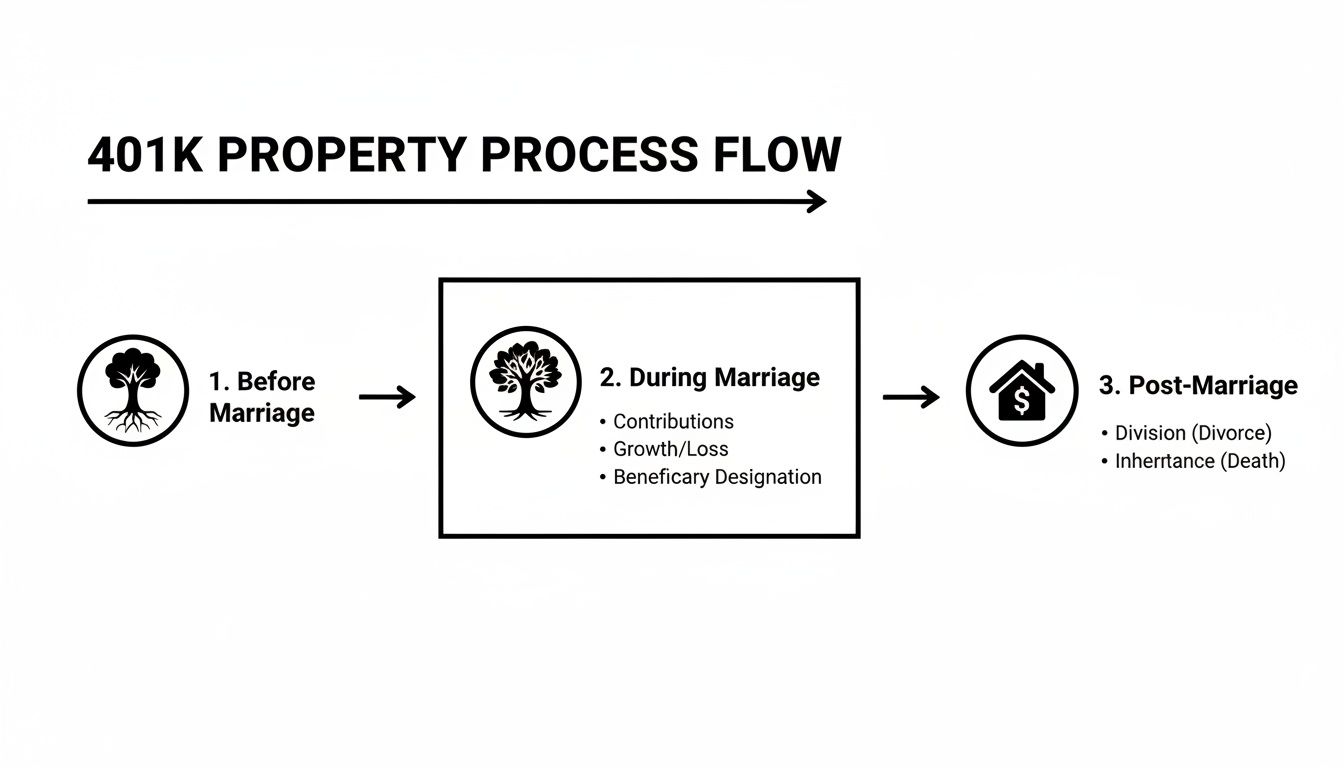
As you can see, the pre-marital "trunk" of your 401(k) stays yours. It's the "branches" that grew during the marriage that become marital property, which is what the QDRO is designed to divide.
The QDRO Process Step-By-Step
Getting a QDRO finalized involves several precise steps. Fumbling any part of this process can lead to serious delays and financial headaches. Here’s a general look at how we handle it for our clients in Pasco, Pinellas, and Hillsborough Counties.
- Negotiate the Terms: First things first, you and your spouse have to agree on the exact amount or percentage of the 401(k) being transferred. This is usually hammered out during mediation or spelled out in your Marital Settlement Agreement.
- Draft the QDRO: An experienced family law attorney then drafts the QDRO document. This is not a simple form. It requires highly specific language that complies with both Florida law and the unique, often rigid, rules of the 401(k) plan itself.
- Submit for Pre-Approval: This is a crucial, pro-level step. We almost always send a draft of the QDRO to the plan administrator for pre-approval. This lets us catch any language problems before it goes to a judge, preventing a frustrating rejection down the road.
- Get the Judge's Signature: Once the draft is solid, it's submitted to the court. A judge reviews it, and if it meets all legal requirements, signs it. At that point, it becomes an official court order.
- Final Submission to the Plan Administrator: The signed order goes to the 401(k) plan administrator for one last review. Once they confirm it complies with their plan rules and federal law, they will finally execute the division of funds.
A poorly drafted QDRO is one of the most common—and costly—mistakes we see in divorce. If the plan administrator rejects the document because of incorrect language or terms their plan doesn't allow, the whole process has to start over. This can lock up your funds for months.
Securing Your Financial Future
Splitting up retirement accounts is one of the most complex and high-stakes parts of any divorce settlement. It demands specialized legal knowledge to get it right. For the receiving spouse, the most tax-efficient move is almost always to roll the funds directly into their own individual retirement account (IRA). This simple step preserves the money’s tax-deferred status, potentially saving them thousands.
Because the rules are so intricate, having an attorney who truly understands the nuances of QDROs is essential. Our firm, which proudly serves all families including LGBTQ+ couples in Pasco, Pinellas, and Hillsborough Counties, makes sure this critical document is handled flawlessly.
Properly managing this process protects the retirement assets our clients have worked so hard to earn. To go deeper on this topic, you can learn more about dividing retirement accounts in our article.
Strategic Options For Dividing Retirement Assets

When you're figuring out what happens to a 401(k) in a divorce, it’s easy to think there's only one path: splitting the account. While using a QDRO to physically divide the funds is the most direct route, it's far from your only choice.
Florida law gives you and your spouse flexibility. Many couples we work with in Pasco, Pinellas, and Hillsborough Counties opt for a more creative solution called an asset offset or buyout.
This strategy involves looking at your entire marital estate like a balance sheet. Instead of slicing up every single asset, you can trade assets of equivalent value. It’s a practical way to reach a fair outcome that lets each person walk away with the assets they value most.
The Asset Offset Strategy Explained
The idea behind an asset offset is pretty straightforward. One spouse keeps their entire 401(k) untouched. In exchange, the other spouse gets different marital assets that are worth the same amount.
This approach keeps the retirement account whole, sidestepping the sometimes-complicated and lengthy QDRO process. It gives both of you more say in what your financial lives look like after the divorce is final.
Let’s say a couple’s main marital assets are a 401(k) with a marital value of $200,000 and $200,000 of equity in the family home. Instead of splitting both down the middle, they could agree to a different arrangement:
- Scenario A: One spouse keeps the entire $200,000 in the 401(k), while the other gets the full $200,000 in home equity.
- Scenario B: One spouse keeps the 401(k) and the other receives the same value from a mix of other assets—maybe a brokerage account, cars, or cash savings.
This method allows for a clean break. It can be a huge win if one person has a deep emotional attachment to the house, or if the other wants to keep their retirement savings consolidated in one account.
Weighing The Pros And Cons
There's no single right answer here. Deciding between a QDRO and an asset offset demands some serious thought about your personal finances and future goals.
Benefits of an Asset Offset:
- Simplicity and Speed: You completely avoid the QDRO process, which can often be slow and bureaucratic.
- Asset Preservation: The employee spouse gets to keep their retirement account intact, which can be a source of financial and psychological comfort.
- Immediate Access to Value: The spouse receiving other assets, like cash or the house, gets value they can use right away without retirement account rules and restrictions.
Potential Downsides of an Asset Offset:
- Tax Implications: This is the big one. A 401(k) is a pre-tax asset. Home equity or a bank account is post-tax. Receiving $100,000 from a 401(k) means you'll pay taxes on it later. Getting $100,000 in cash means you already have it, tax-free. You must account for future taxes to make sure the trade is truly equal.
- Valuation Disputes: This strategy only works if you both agree on the precise value of all the assets involved. Arguments over what the house or a family business is worth can derail the whole negotiation.
- Loss of Future Growth: The spouse who trades away their claim to the 401(k) also gives up any future tax-deferred growth on that money. That can be a significant amount over time.
For any asset trade-off to be equitable, it must be an "apples-to-apples" comparison. That means factoring in future taxes, potential market growth, and liquidity. A dollar in a pre-tax 401(k) is not worth the same as a dollar in a post-tax checking account.
For our clients across the Tampa Bay area, we stress that accurate valuation is absolutely non-negotiable. Whether you are part of a heterosexual or an LGBTQ+ couple, your financial security depends on getting these numbers right. A skilled family law attorney, often working alongside a financial expert, can analyze your complete financial picture. This teamwork ensures any trade-off is genuinely fair under Florida law and helps you reach your long-term goals.
Sometimes, these financial trade-offs can even become a key part of settlement talks around spousal support. To learn more, you can read our guide on how to avoid alimony in Florida.
Common Tax Pitfalls And Mistakes To Avoid
Dividing a 401(k) in a Florida divorce can feel like walking through a minefield. One wrong move can trigger devastating tax hits and jeopardize the retirement savings you’ve spent years building. Knowing where the traps are is the first step to protecting yourself.
The most important thing to remember is this: a Qualified Domestic Relations Order (QDRO) is your shield. This special court order allows for a tax-free transfer of funds from one spouse's retirement account to the other's. It's the mechanism that lets the receiving spouse roll their share into their own IRA, where it can keep growing tax-deferred, just as it was before.
The Dangers Of Cashing Out
The single biggest mistake we see is when a receiving spouse decides to cash out their portion of the 401(k). It’s easy to see the appeal of a lump sum of cash, but that decision comes with a very steep price tag.
The moment you cash out, that money is treated as ordinary income. You'll be taxed at your current income tax rate. But it gets worse. If you are under 59 ½, the IRS will slam you with an additional 10% early withdrawal penalty. Between federal taxes and that penalty, you could easily lose 30% or more of your retirement funds right off the top. A QDRO is specifically designed to avoid this exact outcome.
A QDRO isn’t just another piece of legal paperwork. It's the only tool authorized by federal law to split a 401(k) in a divorce without triggering immediate and severe tax penalties for the person receiving the funds.
Divorce can also bring hidden tax issues to the surface, especially from old joint tax returns. It's a good idea to understand concepts like seeking Innocent Spouse Relief, which can protect you from tax problems your ex-spouse created. It's a valuable layer of protection during a financially complicated time.
Critical Errors To Sidestep
Besides the massive tax hit from cashing out, several other preventable mistakes can put your financial settlement at risk. For our clients across Pasco, Pinellas, and Hillsborough Counties, sidestepping these issues is vital for building a secure post-divorce future. Making sure you don't fall into one of these common traps is crucial.
- Trying to Divide a 401(k) Without a QDRO: This is a problem because a divorce decree alone is not enough. Plan administrators legally cannot divide the account without a valid QDRO. The potential financial consequence is that the transfer could be treated as a taxable distribution, triggering immediate taxes and penalties for the account holder.
- Forgetting to Update Beneficiaries: This is an issue because after a divorce, your ex-spouse may still be listed as the primary beneficiary on your retirement accounts. This could lead to your retirement funds unintentionally going directly to your ex-spouse upon your death, overriding what your will says.
- Ignoring Outstanding 401(k) Loans: This is a mistake because a loan reduces the net value of the account. If it's not accounted for, the division will be based on an inflated number. As a result, the receiving spouse gets less than they are entitled to, or the account holder has to repay the loan from their share.
- Cashing Out the QDRO Distribution: This is a common pitfall when someone chooses immediate cash instead of a tax-free rollover into another retirement account. The consequence is severe: the entire distribution is taxed as ordinary income, plus a likely 10% early withdrawal penalty if under age 59 ½.
These financial details require a firm grasp of both family law and retirement plan rules. Our firm is committed to providing inclusive and knowledgeable guidance to all families in Pasco, Pinellas, and Hillsborough Counties, including LGBTQ+ couples, to protect everyone from these kinds of financial blunders. The best way to safeguard your future is to work with an experienced family law attorney who knows the terrain.
Preparing For Your Consultation: A Clear Path Forward
Knowledge is power, especially when you're trying to figure out what happens to a 401(k) in a divorce. Now that you have a handle on the key concepts, you can take a few proactive steps to make your legal consultation as productive as possible. Getting organized is the key to turning uncertainty into a clear, actionable plan for your financial future.
Walking into a lawyer's office can feel intimidating, but gathering a few key documents beforehand will make the meeting incredibly effective. It gives your attorney an immediate, clear picture of your finances so they can offer specific, tailored advice right from the start.
Your Document Checklist
Try to pull together as many of these items as you can before your consultation. Don't stress if you can't find everything—just bring what you're able to locate.
- 401(k) Statements: These are the most important. Find the statement from right around the date you were married and the most recent one you have.
- Other Retirement Account Info: If you or your spouse have pensions, IRAs, or other retirement plans, bring those statements, too.
- Prenuptial or Postnuptial Agreements: If you have one, this document is non-negotiable. It likely dictates exactly how your assets will be divided.
- Recent Tax Returns: Your jointly filed tax returns give a great overview of your combined financial landscape.
Having these papers on hand helps your attorney quickly size up the marital portion of your retirement assets and spot any potential roadblocks early on.
Taking the step to schedule a consultation isn't an admission of defeat. It's a strategic move to take back control of your future.
Questions To Ask Your Attorney
A consultation is a two-way street. This is your chance to interview a potential legal partner and make sure they're the right fit for your specific case. Thinking about how to choose a divorce attorney is a critical part of the process, and asking the right questions is the best way to make an informed decision.
Here are a few key questions to have in your back pocket:
- Looking at my documents, what are our immediate next steps for valuing the marital piece of my 401(k)?
- What is your specific experience with drafting and executing QDROs for clients here in Pasco, Pinellas, or Hillsborough Counties?
- Do you see any particular challenges in my case, like a 401(k) loan we need to deal with or separate property we need to trace?
- How do you typically communicate with clients, and what should I expect from you as we move forward?
Our firm is committed to serving all families with the respect and expertise they deserve. We proudly assist LGBTQ+ couples with their unique family law needs, including gay divorce, gay custody issues, and gay or transgender name change. We invite you to schedule a consultation with us—not as a hurdle, but as the first positive step toward achieving financial clarity and security for your new beginning.
Common Questions About Dividing a 401(k) in a Florida Divorce
When you're facing a divorce, questions about your retirement savings are bound to come up. It's one of the most significant assets many couples have. Here are some straightforward answers to the questions we hear most often from our clients in Pasco, Pinellas, and Hillsborough Counties.
Can We Just Agree To Split The 401(k) Ourselves?
Even if your divorce is completely amicable, you and your spouse can't just agree to move the money on your own. Retirement plans are governed by strict federal laws, and the plan administrator legally requires a Qualified Domestic Relations Order (QDRO) to divide the account.
Trying to transfer funds without a QDRO is a huge mistake. The plan will treat it as an early withdrawal, triggering a massive income tax bill and a painful 10% early withdrawal penalty. An attorney is absolutely essential for drafting this complex, non-negotiable legal order correctly.
Can I Protect My Entire 401(k) In A Divorce?
In Florida, any portion of your 401(k) that was earned, contributed, or grew during the marriage is considered a marital asset. That means it’s on the table for equitable distribution, and you can’t simply wall it off or "protect" it from being divided.
The best way to get a fair outcome is through smart negotiation. This might involve an asset offset—where you trade other marital assets of equal value to keep your 401(k) intact—or enforcing a valid prenuptial agreement if you have one that specifies how retirement funds should be handled.
How Long Does The QDRO Process Take?
Getting your share of a 401(k) isn't an overnight process; it takes patience. After your divorce is final, the QDRO has to be expertly drafted, signed by the judge, and then sent over to the 401(k) plan administrator for their formal review and approval.
The funds won't be transferred until the plan administrator gives the final sign-off. The whole sequence can easily take several months to complete. Getting the QDRO drafted professionally from the start is the single best thing you can do to avoid frustrating and expensive delays.
It's a common misconception that the divorce decree automatically divides a 401(k). It doesn't. The QDRO is a separate, critical step that happens after the divorce is finalized—without it, the funds are stuck.
Does It Matter Whose Name Is On The 401(k)?
Nope, not one bit. Florida law cares about when an asset was acquired, not whose name is on the monthly statement.
If the money was contributed or the account grew while you were married, that 401(k) is legally considered a marital asset. This is true no matter which spouse's employer sponsored the plan.
Understanding what happens to your 401(k) is the first step toward securing your financial footing after a divorce. If you're facing this process in Hillsborough, Pinellas, or Pasco County, the experienced team at Foley Family Law is here to give you the clear guidance you need. We are proud to serve all families, including LGBTQ+ couples, with dedicated legal support. Contact us to schedule a consultation and create a clear plan for your next chapter.


