

A prenuptial agreement isn't a prediction that your marriage will fail. Think of it as a legal contract that you and your future spouse create to map out your financial rights and responsibilities before you walk down the aisle. It simply pre-determines how specific assets, debts, and potential spousal support get handled if the marriage ever does end.
Understanding What a Prenup Protects Before Marriage
Let’s be honest: talking about a "prenup" can feel uncomfortable. But it's not a sign of distrust. It’s an act of practical, forward-thinking planning. Having these open, honest conversations about money before you tie the knot allows you both to enter the marriage with crystal-clear expectations.
This proactive approach is especially smart for anyone between 35 and 65 who might have built up significant assets, owns a business, or has children from a previous relationship. For those of us in Pasco, Pinellas, and Hillsborough Counties, a well-crafted Florida prenup offers a huge amount of security and peace of mind. We are proud to serve all members of our community, including handling all LGBTQ issues, and do not discriminate.
And it’s not just for the ultra-wealthy anymore. The numbers show a major shift in how couples view these agreements. A 2022 Harris Poll found that 15% of married or engaged couples had a prenup, a massive leap from just 3% in 2010. This trend highlights a modern move toward financial transparency in partnerships. You can read more about these trends and the growing acceptance of prenuptial agreements.
What Can a Florida Prenup Legally Cover?
Under Florida law, a prenuptial agreement gives you and your partner incredible control over your financial future. It lets you step outside the state's default "equitable distribution" rules and design a plan that truly fits your life.
A properly drafted prenup can typically protect:
- Separate Property: This covers assets you owned before the marriage, like real estate, bank accounts, or investments.
- Business Interests: You can protect your business from being divided or becoming a point of contention in a divorce.
- Future Inheritances and Gifts: A prenup ensures that family inheritances or significant gifts you receive during the marriage remain your separate property.
- Spousal Support (Alimony): You can define the terms—the amount, how long it’s paid—or even waive the right to alimony altogether.
- Responsibility for Debts: This clarifies who is on the hook for debts brought into the marriage and any new ones you might take on together.
A huge misconception is that prenups are only for millionaires. The reality? Anyone with assets, debts, a business, or even significant future earning potential can benefit from the clarity a prenup provides.
This image gives a great high-level overview of what a prenuptial agreement can and cannot protect.
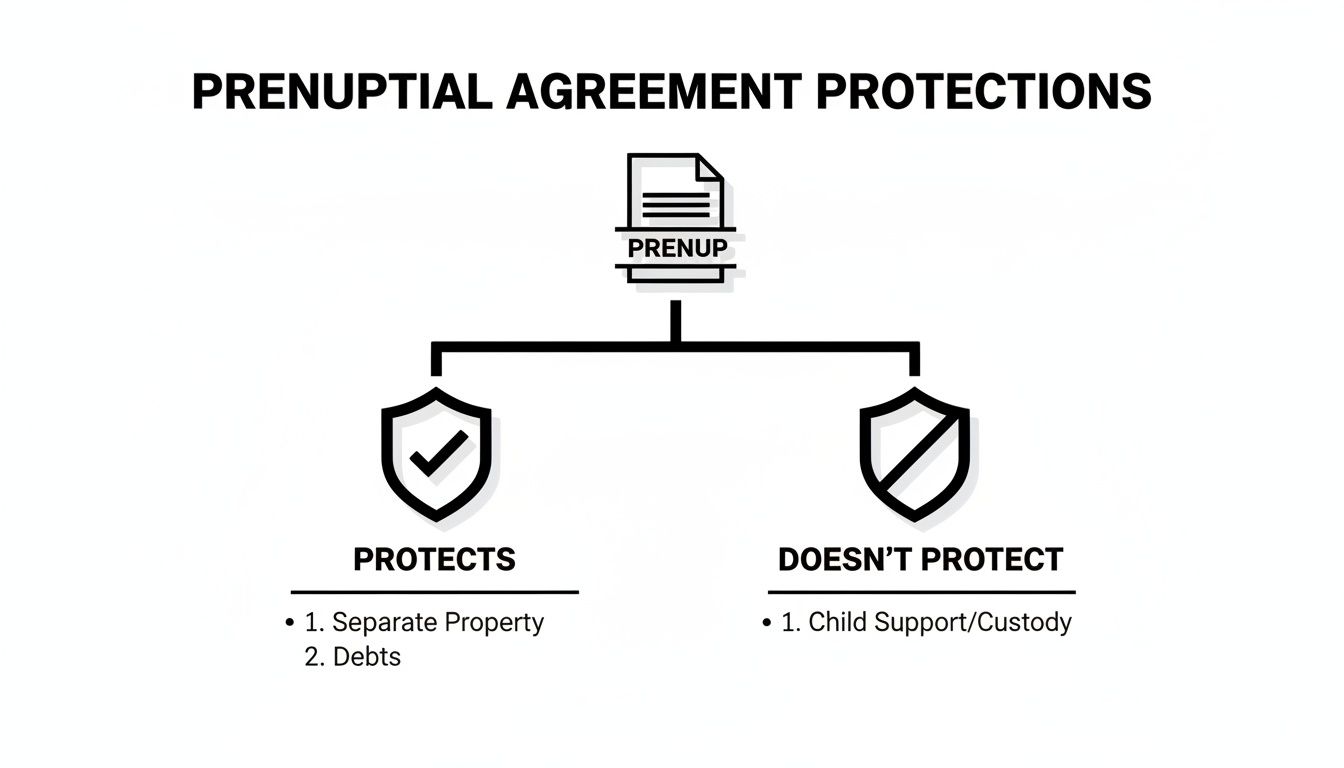
The visualization does a fantastic job of separating the financial issues a prenup can control from the child-related issues that, by law, it cannot.
To make it even clearer, here’s a quick summary of what a Florida prenuptial agreement can and cannot legally do.
Florida Prenuptial Agreements At a Glance
What a Prenup Can Protect:
- Separate Property (assets owned before marriage)
- Business Interests (protecting a company from division)
- Future Inheritances and Gifts (keeping family assets separate)
- Spousal Support/Alimony (defining or waiving it)
- Responsibility for Debts (assigning liability for pre-marital and marital debts)
- Retirement Accounts (how funds accrued during the marriage are handled)
- Real Estate (determining ownership of the marital home or investment properties)
What a Prenup Cannot Protect:
- Child Custody (parenting time or timesharing)
- Child Support (the amount, duration, or waiver of support)
- Anything Promoting Divorce (e.g., a "bonus" for filing)
- Unconscionable or Unfair Terms (provisions that are grossly one-sided)
- Illegal or Criminal Provisions (anything against public policy)
- Personal Matters (e.g., rules about household chores, weight gain, or how often in-laws can visit)
- Decisions Affecting a Child's Upbringing (like what religion they will be raised in or where they will go to school—these are decided based on the child's best interest)
Ultimately, a prenup is about setting the financial ground rules in a way that works for both of you. While it can't dictate personal or child-related matters, it offers powerful protection and clarity for nearly every financial aspect of your marriage.
Protecting Your Separate Property and Premarital Assets

One of the most powerful things a prenup can do is build a protective fence around the assets you bring into the marriage. Florida law makes a clear distinction between "marital property" (what you acquire together) and "separate property" (what you owned before the wedding). But without a prenup, that line can get blurry, fast.
Let's say you own a home in Pinellas County before you get married. Over the years, you use a joint bank account for renovations, or your spouse helps pay the mortgage. Slowly but surely, that once-separate house can become partially marital, putting it on the table for division in a divorce. A prenup stops that from happening.
Drawing a Clear Line in the Sand
Think of a prenuptial agreement as your financial blueprint. It clearly defines what stays yours, no matter what. This is especially critical for our clients in Hillsborough, Pinellas, and Pasco Counties. Many are between the ages of 35 and 65 and have spent decades building their financial independence before saying "I do."
A well-drafted prenup can explicitly declare certain assets off-limits. This protection goes far beyond just a house.
Key premarital assets a prenup can shield include:
- Bank and Investment Accounts: Any savings, stocks, or brokerage accounts in your name before the marriage can be designated as separate.
- Family Heirlooms: Sentimental items like jewelry, art, or family furniture can be kept from becoming part of the marital estate.
- Retirement Funds: The value of your 401(k) or IRA that you built up before the marriage can remain yours alone. You can find out more about how a prenup impacts what happens to a 401(k) in a divorce in our detailed guide.
This whole process is about preventing commingling—the legal term for mixing separate and marital assets so thoroughly that you can't tell them apart anymore.
A prenuptial agreement is your best defense against accidental commingling. It creates a clear record of your intentions, ensuring the assets you worked so hard for before your marriage don't unintentionally become marital property down the road.
By tackling this head-on, you and your partner start your life together on a foundation of financial transparency. We are proud to serve all members of our community in Pasco, Pinellas, and Hillsborough Counties, including gay, lesbian, and transgender individuals, to ensure everyone has the tools to protect their financial future with clarity and peace of mind. We handle all LGBTQ family and divorce issues and do not discriminate.
Safeguarding Business Interests and Future Inheritances

For anyone running a business in Pasco, Pinellas, or Hillsborough County, a prenup isn't just a smart move—it’s a business necessity.
Imagine you’ve poured years into building a company from scratch. Without a prenuptial agreement, Florida law often sees the growth in that business’s value during your marriage as marital property. That means it could be on the table for division in a divorce.
A well-crafted prenup acts like a corporate shield. It gives you the power to definitively classify your business—including its growth, assets, and profits—as your own separate property. This doesn't just protect your hard work; it also insulates your partners, employees, and the company's future from getting tangled up in divorce proceedings.
Securing Your Family Legacy and Inheritances
The same idea holds true for future inheritances and significant family gifts. While Florida law generally treats an inheritance as separate property, that protection is surprisingly easy to lose.
It often happens through something called commingling. For example, if you deposit inherited money into a joint bank account and use it for household bills, you risk converting that once-separate asset into a marital one.
A prenup solves this problem before it starts. You can specify that any inheritance or gift from your family will remain your non-marital property, no matter how it’s used. This is a critical point for anyone in the 35-to-65 age range who might expect to inherit family assets or real estate down the line.
A prenup ensures that assets meant for you and your lineage are preserved. It’s a powerful tool for honoring your family's wishes and protecting a legacy meant to be passed down through generations.
Practical Protections for Business Owners and Heirs
So, what does a prenup protect in these specific situations? A thoughtfully drafted agreement can lock in the following terms to safeguard your financial future:
- Business Valuation: You can pre-determine how your business will be valued if the marriage ends, or even state that your spouse has no claim to it at all.
- Asset Classification: The prenup can declare that all assets, profits, and appreciation related to your business remain your separate, individual property.
- Inheritance Shield: It can explicitly state that any inherited assets, property, or money will not be considered marital property under any circumstances.
- Gift Protection: The agreement can also cover substantial gifts from family, ensuring they stay with the person they were intended for.
When thinking about what a prenup can cover, many people want to specifically define how inheritances are handled, similar to how they might seek to protect your inheritance from divorce. Our firm proudly serves all members of the community in Pasco, Pinellas, and Hillsborough Counties, including our LGBTQ clients, ensuring everyone has the opportunity to safeguard their business interests and family legacies.
Defining The Terms Of Spousal Support And Alimony
The question of spousal support, or alimony, is often one of the most unpredictable and emotionally charged parts of any Florida divorce. Without a prenup, the decision of who pays, how much, and for how long is left entirely in the hands of a judge. A prenuptial agreement lets you and your partner take control of this sensitive issue, making a clear and mutual decision before you ever walk down the aisle.
This proactive approach is a powerful way to manage financial expectations from the start. Together, you can create fair terms that reflect your unique circumstances, whether you're in Pasco, Pinellas, or Hillsborough County. For instance, a prenup can protect a higher-earning spouse from an uncertain financial future while still providing a defined safety net for a partner who plans to step back from their career to support the family.
Tailoring Alimony to Your Agreement
A prenup gives you total flexibility to define the terms of spousal support. It’s not an all-or-nothing proposition. You and your partner can agree to a solution that feels fair and equitable to both of you—a crucial step for all couples, including our gay and LGBTQ clients.
Your options for handling alimony are wide-ranging:
- Waiving Alimony Entirely: Both of you can agree to completely give up the right to seek or receive spousal support.
- Setting a Specific Amount: You can decide on a fixed monthly payment to avoid future arguments over income and need.
- Defining the Duration: The agreement can specify exactly how long payments will last, such as for a set number of years.
- Creating a Formula: You could agree on a formula, like a percentage of the higher earner's income for a certain period.
Recent survey data shows that men and women often see financial protections differently. A 2022 Harris Poll found that 53% of women believed prenups needed stronger protections, compared to only 36% of men. This gap often comes down to women's concerns about financial security after a divorce, especially if they paused their careers for the family. You can dig into these prenuptial agreement research findings for more detail.
By defining alimony terms in your prenup, you replace a judge's guesswork with a plan you both agreed on. This single provision can dramatically reduce conflict and legal bills if your marriage ends.
Ultimately, deciding these terms together empowers you to create a financial roadmap that honors your partnership. You can learn more about the different types of alimony in Florida and see how a prenup gives you control over these outcomes.
Ensuring Your Prenuptial Agreement Is Enforceable in Florida
A prenuptial agreement is only as good as its legal foundation. Here in Florida, just having a signed document isn’t enough. The agreement has to meet specific legal hurdles to be considered valid and enforceable by a court if you ever need it.
Think of it like building a house—without a solid foundation poured to code, the whole structure is at risk.
For our clients in Pasco, Pinellas, and Hillsborough Counties, getting these rules right is the crucial first step. A simple mistake in how the prenup is drafted or signed could make the entire agreement useless, leaving your assets exposed to Florida's default equitable distribution laws.
Across the United States, prenups are widely recognized, but every state has its own specific procedural requirements. Over time, the legal standards have sharpened, focusing on fairness and transparency to make sure these agreements genuinely protect both people. You can discover more insights about the legal framework for prenups to see how these standards have evolved.
The Pillars of an Enforceable Florida Prenup
To hold up in court, a Florida prenup must be built on three critical pillars. If any one of these is missing, it can give the other party a reason to challenge the agreement's validity down the road.
These requirements are absolutely non-negotiable:
- It Must Be in Writing and Signed: A handshake deal or a verbal promise about finances won’t be recognized by a Florida court. The prenup must be a formal, written document signed by both of you before the wedding day.
- It Must Be Entered into Voluntarily: This means both individuals must sign freely, without being subjected to duress, coercion, or fraud. A classic example is springing the agreement on your partner minutes before the wedding ceremony—that could easily be seen as coercion.
- It Requires Full and Fair Financial Disclosure: Both of you have to lay all your financial cards on the table. That means a complete and honest picture of all assets, debts, and income. Hiding assets or fudging the numbers on your financial statement is one of the fastest ways to get a prenup thrown out.
The core principle of an enforceable prenup is transparency. A judge needs to see that both parties had all the necessary information and made a free and informed choice to sign.
The Crucial Role of Independent Legal Counsel
While it’s not a strict legal requirement in Florida, having separate attorneys is the single best way to ensure your prenup is enforceable. It’s a powerful signal to the court. When each person has their own lawyer, it clearly demonstrates that neither party was pressured or taken advantage of.
An experienced family law attorney does a lot more than just draft a document. They make sure your financial disclosure is complete, advise you on the long-term consequences of each clause, and confirm the terms are fair and not "unconscionable" or grossly one-sided. This is a critical safeguard for every person we serve in Pasco, Pinellas, and Hillsborough Counties, including gay and LGBTQ individuals and couples, ensuring all parties are protected.
Our firm can help you navigate the complexities of creating a legally sound agreement that stands the test of time. You can learn more about our approach to Florida prenuptial agreements and how we work to protect our clients' futures.
Ready to Protect Your Future? Here's the Next Step
A Florida prenuptial agreement isn't just a legal document—it's a tool for smart financial planning and, believe it or not, honest communication. It gives you the power to walk into a marriage with absolute clarity, knowing you and your partner are on the same page about your financial future.
Throughout this guide, we've walked through everything a prenup can do for you. From protecting your separate property and business interests to safeguarding inheritances and defining spousal support, it’s a powerful shield for the assets you've worked so hard to build.
Now it’s time to turn that knowledge into action. For folks in Pasco, Pinellas, and Hillsborough Counties, our firm is here to help you navigate this important process. We specialize in drafting and reviewing agreements for everyone, including business owners, high-net-worth individuals, and all members of the LGBTQ community. Our goal is simple: create an agreement that protects what's yours while honoring the unique partnership you're building.
Secure Your Financial Partnership
Taking the next step is actually pretty straightforward. We believe in clear, actionable guidance that helps you make informed decisions. An experienced family law attorney will make sure your agreement is fair, transparent, and—most importantly—legally sound. To get a feel for what's involved, you can start by looking over a reliable prenuptial agreement template.
A prenup is one of the most powerful financial planning tools a couple can use. It swaps guesswork for certainty, letting you build a future on a foundation of trust and transparency.
If you’re ready to create a solid financial plan for your marriage, we're here to guide you. You can learn more about the specifics in our article on how to get a prenup, or just reach out to us for a consultation. Let us help you craft an agreement that delivers peace of mind for years to come.
Frequently Asked Questions About Florida Prenups
We get a lot of the same great questions from clients across Pasco, Pinellas, and Hillsborough Counties. Below are some straightforward answers to the most common concerns we hear about prenuptial agreements in Florida.
Can We Create a Prenup Without a Lawyer?
While you technically can, it's a huge gamble. For a prenup to hold up in a Florida court, it has to meet some pretty strict legal standards.
Without an experienced family law attorney advising each of you, you're running a serious risk. You could easily include unfair terms or make a procedural mistake that a judge could use to throw out the entire agreement down the road.
What Happens If We Don’t Have a Prenup?
Without a prenup, your financial life falls under Florida's "equitable distribution" laws if you divorce. This means a judge will divide all the property and debt you acquired during the marriage in a way they decide is fair.
That outcome might be completely different from what you or your spouse would have wanted.
A prenup lets you replace the state’s one-size-fits-all rulebook with a personalized plan you both agree on. It puts you in control of your financial future instead of leaving it in a judge’s hands. We work with all members of our community in Pasco, Pinellas, and Hillsborough Counties, including our gay and LGBTQ clients, to ensure their agreements reflect their unique partnership.
Can We Change Our Prenup After We Get Married?
Yes, you can. It's possible to amend or even completely cancel a prenup after the wedding.
This is done with a separate written contract called a postnuptial agreement. To be valid, both of you have to sign it voluntarily, and it has to meet the same tough legal requirements for fairness and full financial disclosure as the original prenup.
Does a Prenup Protect Me From My Spouse’s Debt?
Absolutely. One of the most powerful things a prenup protects is your financial well-being from your spouse's debts. You can clearly define who is responsible for both pre-marital and marital debt.
You can include a clause stating that you are not on the hook for any debts your spouse brought into the marriage or for specific debts they take on during it. This shields your separate assets from their creditors. You can learn more about the lifespan of these protections in our related article.


