

When you and your spouse agree on all the big issues before a single piece of paper is filed with the court, you’re on the path to an uncontested divorce. It's a cooperative route, not a confrontational one. This guide will walk you through the essential uncontested divorce forms Florida requires and how to handle the process, potentially saving you a significant amount of time, money, and emotional energy. Our firm proudly serves clients in Pasco, Pinellas, and Hillsborough Counties.
What An Uncontested Divorce In Florida Really Means

At its heart, an uncontested divorce is all about agreement. Think of it less like a courtroom battle and more like two business partners dissolving their company. You and your spouse—not a judge—create a detailed, clear roadmap for how you’ll go your separate ways.
This approach is the polar opposite of a contested divorce, where disagreements over key issues force you into litigation. In a contested case, lawyers argue back and forth, which inevitably leads to higher legal bills, a much longer timeline, and a whole lot of stress for everyone.
The Foundation of Agreement
To even qualify for an uncontested divorce in Florida, you and your spouse have to be on the same page about everything. This isn't just a handshake deal or a casual conversation; it has to be a formal, written agreement that spells out every detail of your separation.
You must have a complete consensus on these key areas:
- Division of Property: A clear plan for how every asset will be split—from the house and cars to bank accounts and retirement funds.
- Division of Debts: An agreement on who is responsible for paying off the mortgage, credit card balances, and any other shared liabilities.
- Alimony (Spousal Support): A decision on whether one person will pay alimony, and if so, exactly how much and for how long.
- Parenting Plan: If you have minor children, this is non-negotiable. You need to agree on a time-sharing schedule, who makes major decisions, and the child support calculations.
This upfront agreement is the engine that makes an uncontested divorce run smoothly. It lets the legal process focus on making your decisions official, rather than having a judge decide your life for you.
An uncontested divorce isn't about winning or losing. It's about two adults recognizing their marriage is over and working together to build a new beginning for their separate lives in a way that's fair and respectful.
Who Is This Path Right For?
This process is a great fit for couples who can still communicate effectively and are willing to meet in the middle. It works best when there's still mutual respect and a shared goal of finalizing the divorce as efficiently as possible.
At Foley Family Law, we're committed to helping families find peaceful solutions. We proudly handle gay divorce, gay custody issues, and gay or transgender name changes, ensuring every member of the LGBTQ+ community in Pasco, Pinellas, and Hillsborough Counties gets the dedicated support they deserve. We do not discriminate and handle every family and divorce matter with compassion.
The Essential Forms for a Florida Uncontested Divorce
Trying to figure out the paperwork for an uncontested divorce can feel like you’re learning a whole new language. Don't worry, it's simpler than it looks. Think of each form as a specific puzzle piece. When you fill them all out correctly, they create the complete picture of your legal separation and pave the way for a smooth filing.
What you'll need depends on your family's unique situation, especially whether you have minor children. Let's walk through the core documents you'll be working with.
The Foundational Paperwork For All Uncontested Divorces
Whether you have kids or not, a few forms are non-negotiable for every uncontested divorce in Florida. These documents officially open the case with the court and lay out the exact terms you and your spouse have agreed to.
It all starts with the Petition for Dissolution of Marriage. This is the document that formally kicks off your divorce case. One spouse, the Petitioner, files it with the Clerk of Court, and the other spouse is known as the Respondent.
Next up is the Family Law Financial Affidavit. This form is a detailed snapshot of each person’s income, assets, expenses, and debts. Being completely honest and thorough here is critical—this is the bedrock for how you'll divide property and debt.
The real heart of a successful uncontested divorce is the Marital Settlement Agreement (MSA). This is a legally binding contract where you and your spouse spell out every single decision you’ve made about your separation.
Your MSA needs to cover everything, leaving no stone unturned:
- Equitable Distribution: How you plan to divide all your marital assets, from the house and cars down to bank accounts and retirement funds.
- Debt Allocation: Who is taking responsibility for paying off joint credit cards, car loans, and the mortgage.
- Alimony: A clear statement on whether one spouse will receive spousal support, including exactly how much and for how long.
A well-drafted MSA leaves no room for future arguments. It’s easily the most important document for preventing problems down the road. Because it's so vital, we've dedicated an entire article to it. You can learn more about a Marital Settlement Agreement in our detailed article.
To keep things clear, here’s a quick rundown of the most common forms and what they do.
Key Florida Divorce Forms and Their Purpose
- Petition for Dissolution of Marriage
- Purpose: Officially opens the divorce case with the court.
- Who Needs It?: Everyone.
- Family Law Financial Affidavit
- Purpose: Provides a complete picture of each spouse's financial situation.
- Who Needs It?: Everyone.
- Marital Settlement Agreement (MSA)
- Purpose: The binding contract detailing the division of assets, debts, and alimony.
- Who Needs It?: Everyone.
- Parenting Plan
- Purpose: Outlines the time-sharing schedule and decision-making for minor children.
- Who Needs It?: Couples with minor children.
- Child Support Guidelines Worksheet
- Purpose: Calculates the official child support amount based on a state formula.
- Who Needs It?: Couples with minor children.
- UCCJEA Affidavit
- Purpose: Confirms the court has jurisdiction by listing where the children have lived.
- Who Needs It?: Couples with minor children.
Understanding the role of each document helps demystify the process and puts you in control.
Additional Forms Required For Couples With Children
If you and your spouse share minor children, Florida law requires a few extra forms to make sure the kids' best interests are front and center. These documents become a legally enforceable part of your final divorce decree.
The big one here is the Parenting Plan. This is a comprehensive roadmap that details every aspect of how you will co-parent after the divorce. A standard Florida Parenting Plan must clearly address:
- Time-Sharing Schedule: A specific calendar showing when the children will be with each parent, including holidays, birthdays, and school vacations.
- Parental Responsibility: Who makes the major decisions about the child's health, education, and well-being. This can be shared or designated to one parent.
- Communication Methods: Sets the rules for how the parents will communicate with each other, and how each parent can communicate with the kids when they're with the other parent.
Along with the Parenting Plan, you'll have to file a Child Support Guidelines Worksheet. This form uses a specific state formula to calculate the right amount of child support based on both of your incomes, the time-sharing schedule, and key expenses like health insurance and childcare.
Finally, you'll need the Uniform Child Custody Jurisdiction and Enforcement Act (UCCJEA) Affidavit. This is a straightforward form where you state where the children have lived for the past five years, which helps the court confirm it has the authority to make decisions about them.
At Foley Family Law, we guide clients through this paperwork every single day in Pasco, Pinellas, and Hillsborough Counties. We know that every family, including our LGBTQ+ clients, has a unique story, and we make sure their agreements and forms reflect their specific needs with dignity and respect.
Your Step-by-Step Guide To Filing Divorce Papers
Okay, you’ve meticulously filled out all the required Florida uncontested divorce forms. Now what? The next phase is turning that stack of paper into an official court case. This isn't just about dropping off documents; it's a formal process where precision is key to avoiding frustrating delays.
Following these steps will get your completed forms filed correctly, moving you one step closer to the finish line.
This visual guide breaks down the three pillars of the divorce paperwork journey, from the initial petition to the final agreements.
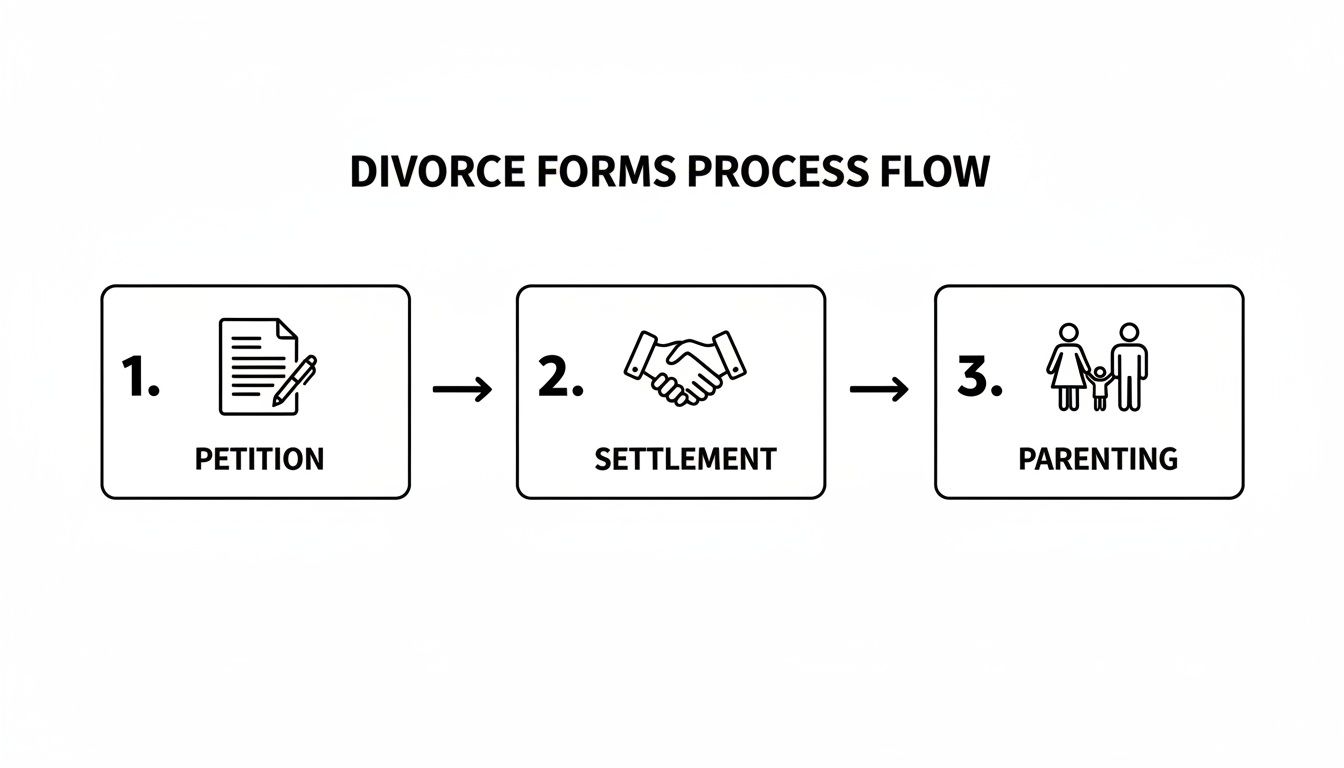
Think of it like building a case: each document supports the others, creating a complete package that tells the court exactly how you’ve agreed to finalize your divorce.
Step 1: Prepare Your Documents For Filing
Before you even think about heading to the courthouse, get organized. Gather every single document you’ve completed—the Petition for Dissolution of Marriage, both Financial Affidavits, and your fully signed Marital Settlement Agreement.
Accuracy is everything. Go through each page, line by line, and make sure there are no blank fields where information should be. One missed signature or a single missing piece of financial data is often all it takes for the Clerk of Court to reject your entire filing.
Step 2: Get Your Paperwork Notarized
Many of your divorce documents, like the Petition and the Settlement Agreement, aren’t legally valid until they’re signed in front of a Notary Public. The notary serves as an impartial witness, verifying your identity and confirming that you're signing everything willingly.
This is a non-negotiable step. Any form requiring a notary stamp that is submitted without one will be immediately deemed invalid by the court. Both you and your spouse will need to have your signatures notarized, though you can do this at separate times and with different notaries if needed.
Step 3: Make Complete Copies Of Everything
Once everything is signed, sealed, and notarized, it’s time to hit the copy machine. The court keeps the original documents for its official file, so you and your spouse will each need a complete copy for your own records.
Don't be tempted to skip this. These copies are your proof of what you filed and will be your go-to reference throughout the rest of the process. You'll want to make at least two full sets of copies—one for you and one for your spouse.
A common mistake is just copying the "important" pages. The safest bet is to copy every single page of every document, from the cover sheet all the way to the last signature page. You never know what you might need to refer back to.
Step 4: File The Forms With The Clerk Of Court
With your original packet and copies in hand, you're ready to file. You’ll do this at the Clerk of the Circuit Court in the Florida county where at least one of you has lived for the last six months.
For our clients in the Tampa Bay area, that means heading to your local courthouse in Pasco, Pinellas, or Hillsborough County.
You'll give the original packet to the clerk and pay the required filing fee. In return, the clerk will stamp your documents, give you a case number, and officially open your divorce case. For a deeper dive into this part of the journey, check out our guide on how to file for divorce in Florida.
Step 5: Formally Serve The Papers
Here's a step that trips people up, even in an amicable divorce. Florida law requires "service of process," which is the formal way of notifying the other spouse (the Respondent) that a case has been filed. It sounds confrontational, but it’s a legal box that has to be checked.
Luckily, in an uncontested case, this is simple. The easiest way to handle it is for the Respondent to sign a form called an "Answer, Waiver, and Request for Copy of Final Judgment of Dissolution of Marriage." By signing and notarizing this document, the Respondent is officially telling the court they've received the paperwork and agree to the divorce. This waives the need to have a sheriff or professional process server deliver the documents.
For cooperative couples, this is by far the most efficient and painless method.
Successfully navigating these steps gets your case on the judge's docket and moves you toward a final hearing. At Foley Family Law, we guide all of our clients, including our LGBTQ+ clients, through these procedural details with care, ensuring everything is handled correctly for a smooth and stress-free experience in Pasco, Pinellas, and Hillsborough Counties.
Understanding Divorce Costs And Timelines In Florida
When you start thinking about divorce, two questions usually jump to the front of the line: "How much is this going to cost?" and "How long is this going to take?"
Getting clear, realistic answers from the very beginning is one of the best things you can do for yourself. While an uncontested divorce is a world away from a drawn-out court battle in terms of speed and expense, it isn't instant, and it isn't free. Knowing what to expect helps you plan, and that planning is the key to a smoother, less stressful process.
Breaking Down The Financial Costs
Let's start with the good news. The biggest financial win in an uncontested divorce is dodging the massive expense of litigation. The difference is staggering.
In Florida, a do-it-yourself uncontested divorce might run you between $1,500 to $3,500. Compare that to a contested divorce with lawyers, where costs can easily balloon to $13,000 to $45,000—or even higher. This huge gap exists because Florida has a streamlined path for couples who have already worked everything out. For folks in Pasco, Pinellas, and Hillsborough Counties, choosing the uncontested route can literally save tens of thousands of dollars.
The one cost nobody can avoid is the court's filing fee. It’s set by the state, so it’s the same whether you’re in Pasco, Pinellas, or Hillsborough.
- Filing Fee: The standard fee to file a Petition for Dissolution of Marriage in Florida is about $409. This is what you pay the Clerk of Court just to open your case file.
- Summons Fee: A small piece of that fee, usually around $10, is for issuing a summons. Yes, you still need one even if you and your spouse are handling everything cooperatively.
A few other small costs might pop up:
- Notary Fees: Several of your forms will need to be notarized. This is usually a small fee for each signature.
- Copying Costs: You’ll need to make at least two full copies of everything you file—one for you, and one for your spouse.
If you want a more detailed look at where the money goes, check out our guide on the cost of divorce.
Navigating The Divorce Timeline
Just like it's cheaper, an uncontested divorce is also much faster. But there’s a catch: Florida law has a mandatory waiting period that applies to everyone, no matter how quickly you’ve reached an agreement.
Florida has a mandatory 20-day waiting period that begins the day after you file your Petition for Dissolution of Marriage. A judge cannot sign your Final Judgment of Dissolution of Marriage until this period has passed.
Think of it as a state-mandated "cooling-off" period. It’s designed to give couples one last moment to reflect before the marriage is legally over. This is the absolute minimum time your divorce can take.
So, what does the full timeline look like?
- Getting Your Paperwork Ready (1-4 weeks): This is the phase where you and your spouse gather financial documents, fill out all the required forms, and sign your Marital Settlement Agreement. How long this takes is really up to you.
- Filing and the Waiting Period (3-4 weeks): The moment your petition is filed, that 20-day clock starts ticking. The court system is processing your case in the background during this time.
- Final Hearing and Judgment (1-4 weeks): Once the waiting period is over, the court will either schedule a very brief final hearing or, in many uncontested cases, finalize the divorce based on your paperwork alone. The exact timing here often depends on how busy the judges are in your specific county.
All in, a smooth uncontested divorce in Pasco, Pinellas, or Hillsborough County can often be wrapped up in as little as four to twelve weeks from the day you file. This speed is one of the biggest rewards for working together, especially when you consider that contested cases can drag on for many months, if not years.
Common Paperwork Mistakes That Can Delay Your Divorce
You’ve done the hard part and reached an agreement. Filling out the forms feels like the last lap. But this is where tiny mistakes can create massive headaches, causing delays or even getting your entire case tossed out by the court clerk.
Think of your paperwork as the pre-flight check for your divorce. A single missing signature or an unchecked box can ground the whole process before it ever takes off. These mistakes are frustratingly common, but the good news is they are completely avoidable with a little extra attention to detail.
Incomplete Or Inaccurate Financial Disclosures
In Florida, both spouses are legally required to lay all their financial cards on the table. The Family Law Financial Affidavit isn’t just another form—it's a sworn statement that becomes the foundation of your entire settlement. One of the most frequent errors we see is people accidentally (or sometimes, intentionally) leaving out an asset or a debt.
This can blow up your entire agreement. If the court finds out later that something was hidden or misrepresented, it can invalidate the divorce decree. The goal here is total transparency. For a deeper dive into what this involves, our guide on discovery for divorce is a great resource.
Vague Language In Your Settlement Agreement
Your Marital Settlement Agreement (MSA) is the rulebook for your post-divorce life. Using fuzzy or ambiguous language is just asking for a fight down the road. Phrases like "reasonable parenting time" or "we'll split the household goods" are legal landmines waiting to detonate.
Your agreement needs to be crystal clear. Specificity is your best friend. A key part of mastering contract review is learning to spot and eliminate this kind of ambiguity, ensuring your MSA is bulletproof.
A solid MSA doesn't leave anything to chance. It should clearly spell out:
- Exact Dates: Don't just say "alternating holidays." Specify which parent has the kids on Christmas Eve in even-numbered years from 6 PM to Christmas Day at 10 AM.
- Specific Items: Instead of "personal property," list who gets the leather sofa, the 65-inch TV, and the dining room set.
- Clear Financials: State exact dollar amounts and payment due dates for alimony or child support, not vague percentages.
The strength of your uncontested divorce lies in the clarity of your agreement. Every detail you define now is a potential argument you prevent in the future.
Forgetting Signatures and Notarizations
This one seems obvious, but it trips people up constantly. Many of the required uncontested divorce forms Florida demands, like the Petition and the MSA, must be signed in front of a Notary Public. If you submit a document without a required signature or a proper notary stamp, the Clerk of Court will reject it flat out. No questions asked.
Before you even think about heading to the courthouse, go through every single page with a fine-tooth comb. Check for every signature line and notary seal. Remember, both you and your spouse need to have your signatures notarized, though you can do it at different times and with different notaries. This simple step confirms for the court that you both are agreeing to everything willingly, and it's a non-negotiable part of getting your divorce finalized.
When You Should Still Talk to a Divorce Lawyer
Even when a divorce is completely amicable, it's still a major legal event with consequences that ripple for years. It's easy to think that because you and your spouse agree on everything, you're in the clear. But that assumption can be a risky gamble with your future.
Certain situations, even in the friendliest of splits, hide legal complexities that really need a professional eye. Believing "we agree, so we don't need lawyers" can be a huge mistake, especially when there are significant assets or long-term financial ties on the line. A quick legal review makes sure the agreement you sign today is fair, enforceable, and won't cause problems down the road.
Red Flags That Signal You Need Legal Counsel
Even if you have all the right Florida uncontested divorce forms downloaded and ready to go, hit pause. If any of the following apply to your situation, it's time to at least consult with an attorney.
- Complex Assets: Does one of you own a business? Are there pensions, 401(k)s, stock options, or multiple properties involved? Valuing and dividing these assets correctly is far from simple. A lawyer ensures you're not accidentally giving up more than you should or agreeing to a split that isn't truly equitable.
- Significant Debt: If you have substantial marital debt—think large credit card balances, mortgages, or business loans—an attorney can structure the agreement to protect you. They help ensure liability is divided fairly and shield you from creditors if your ex-spouse later fails to pay their share.
- A Power Imbalance: It's common for one spouse to have handled all the finances while the other was less involved. This creates an unintentional power imbalance. A lawyer acts as your advocate, making sure you have a complete and accurate financial picture before you sign anything.
- Any Hint of Doubt: If you have even a small feeling that the agreement isn't quite right, or if there's a single clause in the Marital Settlement Agreement you don't fully understand, that's your cue. That gut feeling is telling you to get a professional review.
An attorney's role in an uncontested divorce isn't to create a fight. It's to prevent a future one. They're your legal safety net, spotting potential problems and making sure your agreement is ironclad.
An Investment In Your Future
Think of it this way: hiring a lawyer for a limited-scope review of your paperwork isn't an expense, it's an investment. It buys you peace of mind, knowing a trained professional has given your agreement the all-clear. This simple step can save you from incredibly expensive and emotionally draining legal battles down the road that often stem from a poorly drafted settlement.
We get that you're exploring your options, and doing your research is smart. For a deeper dive, you can read about divorcing without a lawyer right here on our blog.
If you’re in Pasco, Pinellas, or Hillsborough County, our team at Foley Family Law is here to help. We are proud to support all families, including our LGBTQ+ clients, with the compassion and professionalism they deserve. Contact us for a consultation to ensure your uncontested divorce is done right, from start to finish.
Common Questions About Florida Divorce Forms
When you're handling the paperwork for an uncontested divorce, a few practical questions always seem to pop up. Getting clear answers not only builds your confidence but also helps make sure you're filling everything out correctly. Here are some of the most common questions we hear from clients in Pasco, Pinellas, and Hillsborough Counties.
Do We Have to File in Person?
Not necessarily. While you can always go to the courthouse in person, many counties have moved online. Pinellas, Pasco, and Hillsborough counties all have an e-filing portal, which is a far more convenient way to submit your uncontested divorce forms Florida documents. Just be aware that you'll need to make sure everything is formatted correctly for their digital system.
Are the Forms Different for a Same-Sex Divorce?
Nope. The forms and the laws in Florida apply equally to all marriages. The process for a dissolution of marriage is identical for same-sex couples and opposite-sex couples. Our firm is proud to handle all LGBTQ+ family and divorce issues, ensuring every single client receives respectful and knowledgeable guidance.
What Happens If We Make a Mistake On a Form?
This is a big one. A tiny typo might be fixed with an amended filing, but more significant mistakes can get your entire case rejected by the court, forcing you to start all over again. This is exactly why a careful, thorough review is so important. One small error on a financial affidavit or your settlement agreement can trigger major delays.
The best way to handle divorce paperwork is to get it right the first time. Double-checking every signature, date, and dollar amount before you file can save you weeks—or even months—of frustration and extra court costs.
Does Every Single Form Need Both of Our Signatures?
No, but the most important ones absolutely do. Both spouses must sign the Marital Settlement Agreement and any Parenting Plan, and these signatures usually have to be notarized. For the initial filing, one spouse signs the Petition (becoming the "Petitioner"), while the other spouse (the "Respondent") signs an Answer and Waiver form.
At Foley Family Law, we know that even an "agreed-upon" divorce comes with its own set of questions and potential pitfalls. If you're in Pasco, Pinellas, or Hillsborough Counties and want the peace of mind that comes from knowing your uncontested divorce is being handled correctly, contact us for a consultation.


