

Termination of parental rights, or TPR, is without a doubt one of the most serious and final actions a Florida family court can take. It’s the legal equivalent of a final goodbye—permanently and completely severing the legal relationship between a parent and child. Once a TPR judgment is entered, all rights, responsibilities, and privileges that come with being a parent are gone forever. The right to see, speak with, or make any decisions for the child is extinguished. Our firm handles these sensitive matters in Pasco, Pinellas, and Hillsborough Counties.
Understanding The Permanent Nature Of This Legal Action
Think of the legal bond between a parent and child as a bridge. A TPR order isn’t just closing a gate on that bridge; it’s the complete and irreversible dismantling of the structure itself. The legal connection is gone forever. This not only ends a parent's right to custody and visitation but also terminates their obligation to provide financial support.
Because of this profound finality, Florida courts approach these cases with extreme caution. TPR isn't a tool for punishment or a simple solution to a custody dispute. It's reserved for the most severe circumstances where it is proven to be absolutely necessary for a child's safety, well-being, and chance at a stable life.
The court’s ultimate goal is to ensure every child has a permanent, safe home. This drastic measure is only taken when that goal simply cannot be met while keeping the parental relationship intact.
The Scope And Impact On Families
The impact of a TPR order is felt deeply by everyone involved. For the child, it can create a path to a more secure future. For the parent, it represents an irrevocable loss. The reality is that about 1 in 100 American children will experience the termination of parental rights by age 18. This figure has risen significantly over the past two decades, highlighting a growing trend within the child welfare system. Learn more about these TPR statistics and their implications.
At our firm, we understand the emotional weight these proceedings carry. We provide compassionate and expert guidance to families facing these difficult situations in Pasco, Pinellas, and Hillsborough Counties. Our commitment extends to all families, and we ensure that every client, including those in the LGBTQ community, receives dedicated and non-discriminatory representation. A TPR case often involves complex legal questions, sometimes even touching on foundational issues like establishing legal fatherhood. You can check out our guide on what is paternity to better understand these related concepts.
To give you a clearer picture, here’s a quick breakdown of the core concepts at play in a TPR case.
Key Aspects Of Parental Rights Termination
- Finality: The court's order is permanent and irreversible, ending all legal ties.
- "Last Resort" Doctrine: Courts only grant TPR in the most serious cases where no other remedy is viable.
- Manifest Best Interest: The primary legal standard; the decision must overwhelmingly benefit the child's well-being.
- High Burden of Proof: The party seeking termination must prove their case with "clear and convincing evidence."
- Statutory Grounds: The case must be based on specific grounds defined in Florida law, such as abandonment or abuse.
Navigating a TPR case requires a deep understanding of these principles and the significant emotional and legal stakes involved.
A termination of parental rights judgment is a final order that permanently severs all legal ties between a parent and a child. It is considered a last resort by Florida courts, used only when it is in the manifest best interest of the child.
Understanding Voluntary vs. Involuntary Termination
When it comes to the termination of parental rights in Florida, the conversation really splits down two very different roads: voluntary and involuntary. Although they both arrive at the same final destination—the legal end of the parent-child relationship—the journey to get there is completely different. Grasping this distinction is the first critical step for anyone caught in this life-changing legal process.
These two paths reflect the vastly different circumstances that can lead to a parent's rights being legally severed. One is by choice, but only under very strict conditions. The other is a court-ordered action taken against a parent's will, always with the goal of protecting a child. Our firm regularly helps families across Pasco, Pinellas, and Hillsborough Counties unpack these complexities, ensuring everyone, including members of the LGBTQ community, receives clear and compassionate guidance.
Voluntary Termination Explained
Let’s be clear: voluntary termination is not a simple "get out of jail free" card for parental responsibility. A parent can't just wake up one day, decide they're done paying child support or being involved, and sign away their rights. Florida law is incredibly strict about this.
Typically, this only happens when a parent knowingly and willingly agrees to end their legal rights. A common example is when a stepparent wants to adopt their stepchild. The biological parent who is no longer in the child’s life might agree to voluntarily terminate their rights.
The court will only greenlight a voluntary termination if it’s completely satisfied that there is a clear, stable, and permanent plan for the child's future. The law's number one priority is to ensure a child always has legally responsible parents, not to leave them in a state of legal limbo.
The process involves the consenting parent signing legal documents in front of a judge, confirming they fully understand the permanent and total consequences of their decision. The court has to be absolutely convinced that the consent is given freely—without any pressure or threats—and that this action truly serves the child’s best interests.
Involuntary Termination: A Court-Mandated Action
Involuntary termination is a whole different ballgame—and a much more contentious one. This is when a court must step in and sever a parent’s rights against their wishes because their actions (or lack thereof) have put the child in a dangerous or deeply unstable situation. It is always a measure of last resort, taken only when the court believes a child cannot be safely cared for by that parent.
Florida law lays out very specific grounds that can justify such a drastic step. We're not talking about minor disagreements over parenting styles; we're talking about serious, harmful patterns of behavior. Whoever files the petition must prove one or more of these grounds with clear and convincing evidence.
Common grounds for involuntary termination of parental rights include:
- Abandonment: This isn’t just being absent. It's legally defined as a parent making little to no effort to support or communicate with their child, showing a clear intention to walk away from their parental duties.
- Egregious Conduct: These are actions so harmful they shock the conscience, like severe abuse or chronic neglect that threatens the child's life, health, or overall well-being.
- Long-Term Substance Abuse: This applies when a parent's ongoing battle with drugs or alcohol makes it impossible for them to provide a safe and nurturing home.
- Parental Unfitness: This refers to a consistent pattern of behavior demonstrating an inability to meet the child’s most basic needs for safety, shelter, and emotional support.
These cases are incredibly complex and emotionally draining. For parents facing these allegations, it's a fight for their family. For those filing the petition, it's often a desperate move to guarantee a child's safety. The legal standards are incredibly high because the stakes simply couldn't be higher. It's also vital to understand how parental rights are established and protected from the start, particularly for unmarried couples. For a deeper look, you can learn more from our article about Florida's new custody law for unmarried parents. Our firm is committed to providing robust representation for all families navigating these difficult legal waters in Pasco, Pinellas, and Hillsborough Counties.
The High Legal Standard For Terminating Parental Rights
Florida courts don’t take the termination of parental rights lightly. Far from it. This is considered one of the most serious actions a judge can take, often called the "death penalty" of family law because it permanently and completely severs the legal bond between a parent and child.
Because the stakes are so incredibly high, anyone asking the court to grant an involuntary termination must clear an exceptionally high legal hurdle. This isn't a simple disagreement; it's a fight that requires powerful, compelling proof.
The standard of proof is “clear and convincing evidence.” This is a much heavier burden than the "preponderance of the evidence" standard used in most other civil cases, where you only need to show something is more likely than not (think 51%). Clear and convincing evidence means the judge must have a firm belief or conviction that the allegations are true. It's a standard designed to protect the fundamental right to parent.
The Two-Pronged Legal Test
To succeed with a petition to terminate parental rights in Florida, you have to prove two distinct things. It's a crucial two-part test, and failing either part means the petition fails. Both must be established with that same clear and convincing evidence.
First, you must prove that at least one of the specific, legally recognized grounds for termination exists. As we've discussed, these aren't vague complaints. Florida law lays out very specific situations like abandonment, egregious conduct toward a child, or long-term substance abuse that makes a parent unfit. Proving a statutory ground is the ticket into the courtroom—it’s the absolute minimum requirement.
But that's just step one. The second, and just as critical, part of the test is proving that termination is in the “manifest best interest of the child.” This is where the court’s focus shifts entirely from the parent’s past actions to the child’s current and future life.
The court's primary duty is to the child. Even if a parent has made serious mistakes, the judge must be convinced that permanently ending the relationship is the best possible path forward for that specific child's life.
Defining The Child’s Best Interests
So, what does "manifest best interest" actually mean in a Pasco, Pinellas, or Hillsborough County courtroom? It’s not just one thing. It’s a deep, comprehensive look at the child's entire world.
A judge will weigh several key factors to decide if severing the parental bond is truly the right move:
- The child's need for a stable, permanent home: Kids need predictability and security to thrive. The court looks at whether termination will finally give the child a safe, forever home.
- The emotional and physical well-being of the child: This involves looking at the child's current health, safety, and development. How would cutting ties with their parent affect them—for better or for worse?
- The bond between the parent and child: Is there a meaningful, positive relationship? The judge has to consider the potential harm of breaking that bond, even if the parent has made mistakes.
- The parent’s ability to actually change: Has the parent taken real, meaningful steps to fix the problems that led to the petition? Or is it just a pattern of empty promises?
To understand how this two-part test works in practice, it helps to see the concepts side-by-side. Proving a ground gets you in the door, but proving it's in the child's best interest is what wins the case. The first legal requirement is to Prove a Statutory Ground. This is the "what they did" part. You must present evidence proving one of the specific legal reasons for termination, like abandonment or abuse. For example, showing bank records and school contacts to prove a parent had no contact or financial support for a significant period. The second requirement is to Prove Manifest Best Interest. This is the "why it matters for the child" part. The focus shifts from the parent's failures to the child's future needs for safety, stability, and permanency. An example would be demonstrating that the child has bonded with a stable family, is thriving in their new school, and would suffer trauma if removed and returned to an unstable parent.
As you can see, the court must be convinced not only that the parent failed in their duties but also that moving forward without them is the only way to ensure the child’s well-being.
These proceedings are more common than many think. In the 2021 fiscal year, parental rights were terminated for roughly 61,000 children across the U.S., a number that highlights just how often the child welfare system must make these life-altering decisions. You can discover more insights about these national statistics on Statista.com.
Given the complexity, the high burden of proof, and what's at stake, trying to handle one of these cases alone is a monumental risk. Having a skilled family law attorney who understands the local courts is essential. At our firm, we provide dedicated legal support to all families, including LGBTQ+ individuals, facing these tough but critical proceedings in Pasco, Pinellas, and Hillsborough Counties.
Navigating The Legal Process Step By Step
The court process for the termination of parental rights can feel like an impossibly complex maze. For families in Pasco, Pinellas, and Hillsborough Counties, just understanding the path forward is the first step toward finding some clarity. The journey is structured and methodical for a reason—it’s designed to ensure every single decision is made with extreme care.
It all kicks off with filing a formal legal document called a Petition for Termination of Parental Rights. This isn't just filling out a form. It's a detailed legal argument that lays out the specific statutory grounds—the why—the petitioner believes termination is necessary. This document becomes the foundation of the entire case.
Once that petition is filed with the court, the next critical stage is the service of process. This is the formal, legal act of delivering the petition and a summons to the parent whose rights are at stake. It’s not just a courtesy; it’s a constitutional requirement ensuring they are officially notified and have a fair chance to respond and defend themselves in court.
The Two Critical Court Hearings
At the heart of the legal process are a pair of distinct hearings, and they each have a very different purpose. The court addresses the issues in a specific order to make sure the incredibly high legal standard is met before making a permanent, life-altering decision.
Adjudicatory Hearing: The "Fact-Finding" Phase
The first major event is the adjudicatory hearing. Think of this as the "fact-finding" part of the case.
Here, the judge has one job and one job only: listen to all the evidence presented—witness testimony, documents, expert reports—and decide one thing. Have the legal grounds for termination been proven by clear and convincing evidence? The focus is strictly on whether the parent’s conduct meets the statutory requirements. Nothing else matters at this stage.
Dispositional Hearing: The "Child's Best Interest" Phase
If, and only if, the judge finds that grounds for termination exist, the case moves to the second hearing: the dispositional hearing. This is where the focus shifts completely from the parent's past behavior to the child's future well-being.
The central question becomes: is terminating this parent's rights truly in the manifest best interest of the child? The judge weighs the child's need for a stable and permanent home, their emotional bonds, and what outcome will ultimately provide the safest future.
Florida's legal standard is a clear, two-step logic. First, the court must establish the legal grounds. Second, it must confirm that termination is what's best for the child.
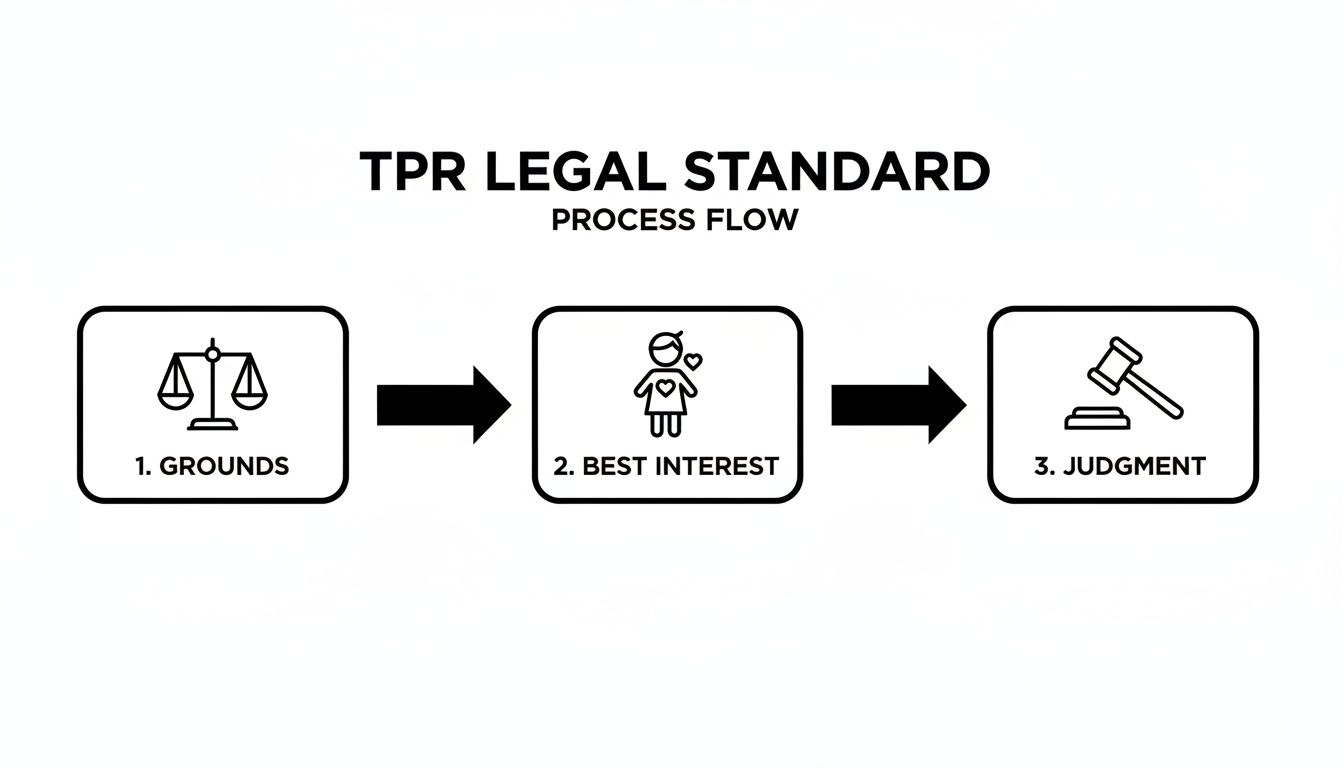
As you can see, proving a statutory ground is just the first hurdle. The ultimate decision always hinges on the child's future.
Evidence And Systemic Challenges
When you're dealing with highly sensitive family court documents, knowing how to maintain confidentiality is critical. That includes understanding things like securely redacting sensitive information in legal documents before you file them.
Unfortunately, the system itself isn't perfect. Troubling data on racial and ethnic disparities shows that American Indian/Alaska Native children face a cumulative risk of termination that is 2.7 times higher than that of White children. For African American children, that risk is 2.4 times higher.
The court process is designed to be deliberate and thorough. Each step, from filing the initial petition to the final judgment, serves a specific purpose in protecting both parental rights and, most importantly, the welfare of the child.
Ultimately, the process ends with a final judgment from the court. If the petitioner has proven both the grounds for termination and that it's in the child's best interest, the judge will issue an order terminating parental rights. This order is permanent and legally severs the parent-child relationship for good. Our firm is dedicated to guiding clients through this challenging process with clarity and compassion, serving all families in Pasco, Pinellas, and Hillsborough Counties without discrimination.
Common Defenses Against A Termination Petition
Getting served with a petition to terminate your parental rights is terrifying. It doesn't, however, mean your relationship with your child is automatically over. Florida law gives every parent the right to stand up and fight for their family. While this is one of the toughest legal challenges you can face, understanding your potential defenses is the first, most empowering step you can take.
This isn't a one-sided fight. The person petitioning the court has to meet an incredibly high standard of proof. A solid defense often starts by hitting their evidence head-on. Your attorney’s job is to show the court that the petitioner's claims simply don't rise to the level of “clear and convincing” evidence the law demands.
This means putting everything under a microscope—scrutinizing witness testimony, challenging the validity of documents, and presenting your own evidence to tell the other side of the story. The goal is to create enough doubt to show that the legal bar for such a permanent, life-altering decision has not been met.
Demonstrating Substantial Progress And Change
One of the most powerful ways to defend your rights is to show the court you've made real, tangible progress in fixing the problems that led to the petition in the first place. This isn’t about making promises for the future; it's about handing the judge concrete proof of positive change.
Courts want to see action, not just words. You can build a truly compelling case by proving you’ve actively and successfully completed everything asked of you, whether it was court-ordered or something you sought out yourself.
Examples of demonstrable progress include:
- Consistent Sobriety: Providing a solid history of clean drug tests, certificates from rehab programs, and proof of active participation in support groups like AA or NA.
- Stable Housing and Employment: Showing lease agreements or a mortgage for a safe home and pay stubs proving a steady income to support your child.
- Completed Counseling or Classes: Presenting certificates from parenting classes, anger management courses, or therapy sessions that prove you’ve addressed the underlying issues.
This kind of evidence tells the court that even if there were problems in the past, you are now a fit and capable parent who is committed to giving your child a safe, stable home.
Arguing Against The Child's Best Interest
Here's a critical point: even if a judge finds that a legal reason for termination exists, the case is far from over. The petitioner still has to prove that severing your parent-child bond is in the child’s manifest best interest. This opens up another powerful line of defense.
You can argue that despite any past mistakes, the emotional bond you share with your child is so strong that breaking it would cause far more harm than good. This defense shifts the focus entirely to your child’s emotional and psychological well-being.
A strong parent-child bond is a huge factor for the court. A judge has to weigh whether the potential trauma of a child permanently losing their parent is worse than the issues that led to the petition.
Proving that bond is key. You can use testimony from teachers, counselors, or family members who have seen your positive relationship with your child firsthand. Sometimes, a parent is up against false allegations or manipulation from the other parent. In those situations, it's vital to know your options, and you can learn more about how to prove parental alienation in our detailed guide.
Ultimately, every case is unique, and the right defense strategy will depend on the specific facts of your situation. Whether you're in Pasco, Pinellas, or Hillsborough Counties, knowing your rights is the first step toward protecting them.
Why An Experienced Family Law Attorney Is Essential

Trying to navigate a termination of parental rights case on your own is an enormous risk. The stakes—the permanent, irreversible loss of your child—are simply too high to go it alone. This isn't an area of law designed for DIY representation; it's a highly complex field built on strict statutes and demanding standards of proof.
An experienced family law attorney does so much more than file paperwork. Think of them as the architect of your entire case. They build a compelling story from the ground up, one designed to connect with a judge. They live and breathe the intricate rules of evidence, know how to dismantle the other side’s arguments through sharp cross-examination, and can craft powerful legal arguments anchored in solid Florida law.
Your Advocate In and Out of the Courtroom
Whether you’re a petitioner trying to give a child a safe, permanent home or a parent fighting with everything you have to keep your family intact, an attorney is your champion. They create a critical buffer between you and the raw emotion of the conflict, letting you focus on your family while they handle the complex legal chess match.
A good lawyer makes sure every deadline is hit, every document is filed correctly, and every one of your legal rights is fiercely protected. For those curious about how law firms reach out to help, understanding the strategies for family law firm marketing can offer a glimpse into how legal professionals connect with the people they serve. This kind of professional guidance is priceless in the pressure-cooker environment of a courtroom.
In a termination of parental rights case, your attorney is not just your legal counsel; they are your strategist, your voice, and your shield in what is likely the most significant legal battle of your life.
Finding the Right Legal Partner
Choosing the right attorney is one of the most important decisions you'll make, and it will absolutely shape the outcome of your case. You need someone who not only has deep experience in Florida family law but also knows the local court systems in Pasco, Pinellas, and Hillsborough Counties inside and out.
The process of finding the right fit is a critical first step. If you need some pointers, our firm put together a helpful guide on how to choose the right divorce lawyer, and the core principles apply to any family law situation.
Our firm is committed to providing this essential support to families throughout the Tampa Bay area. We proudly represent all members of our community, including handling LGBTQ+ family and divorce issues, and do not discriminate. If you are facing this difficult journey, contact our firm to ensure your rights are protected every step of the way.
Frequently Asked Questions About Parental Rights
Going through a legal battle over your children is one of the most stressful and confusing experiences a parent can face. The legal terms are dense, the process is intimidating, and everything feels personal because it is personal. To help you find some clarity, here are answers to some of the most common questions we hear about these proceedings in Florida.
Can A Parent Voluntarily Give Up Their Rights To Avoid Child Support?
No. This is probably the biggest myth out there. Under Florida law, you can't just sign away your parental rights to get out of your child support obligation.
Voluntary termination is a tool reserved for very specific situations. The court's number one priority is making sure the child is financially supported. They won't let a parent simply walk away from that fundamental duty.
How Long Does The Termination Process Take?
The timeline can vary dramatically. If everyone is in agreement—what we call an "uncontested" voluntary termination—it can be wrapped up relatively quickly, sometimes in a few months.
But a contested, involuntary termination case is a whole different ballgame. These are serious, complex legal battles that can easily stretch on for a year or more. They require in-depth investigations, multiple court hearings, and a mountain of evidence from both sides.
The legal process for terminating parental rights is deliberately slow and methodical. Courts in Pasco, Pinellas, and Hillsborough Counties move with extreme caution to ensure this permanent, life-altering decision is made only after every single fact has been thoroughly weighed.
Can A Termination Of Parental Rights Order Be Reversed?
Almost never. A final judgment terminating parental rights is meant to be just that—final and permanent. The entire point of the order is to create stability and certainty for the child's future.
For all practical purposes, it is irreversible.
Do I Absolutely Need A Lawyer For A TPR Case?
While you technically have the right to represent yourself in any court, trying to handle a TPR case on your own is a massive risk. The legal standard required—"clear and convincing evidence"—is incredibly high and difficult to meet.
On top of that, the rules of evidence and court procedure are a minefield for non-lawyers. Without a deep understanding of Florida family law, you're at a severe disadvantage, whether you're the one filing the petition or the one defending against it.
Our firm is committed to guiding families in Pasco, Pinellas, and Hillsborough Counties through these tough situations with the skill and compassion they deserve. We handle all family law matters, including those affecting the LGBTQ+ community, and we never discriminate. Protecting your family’s future is what we do.
If you're facing a petition to terminate your parental rights or believe you need to file one, you need experienced legal guidance right away. Contact Foley Family Law to schedule a consultation and build a plan to protect your rights and your child's future.


