

TL;DR:
- Florida extended family members can petition for temporary custody using Form 970(a), but contested cases require clear proof of parental unfitness. The process depends on whether parents consent, caregiving role, or abuse allegations, with legal representation often necessary. Proper preparation, documentation, and understanding jurisdiction are critical to success.
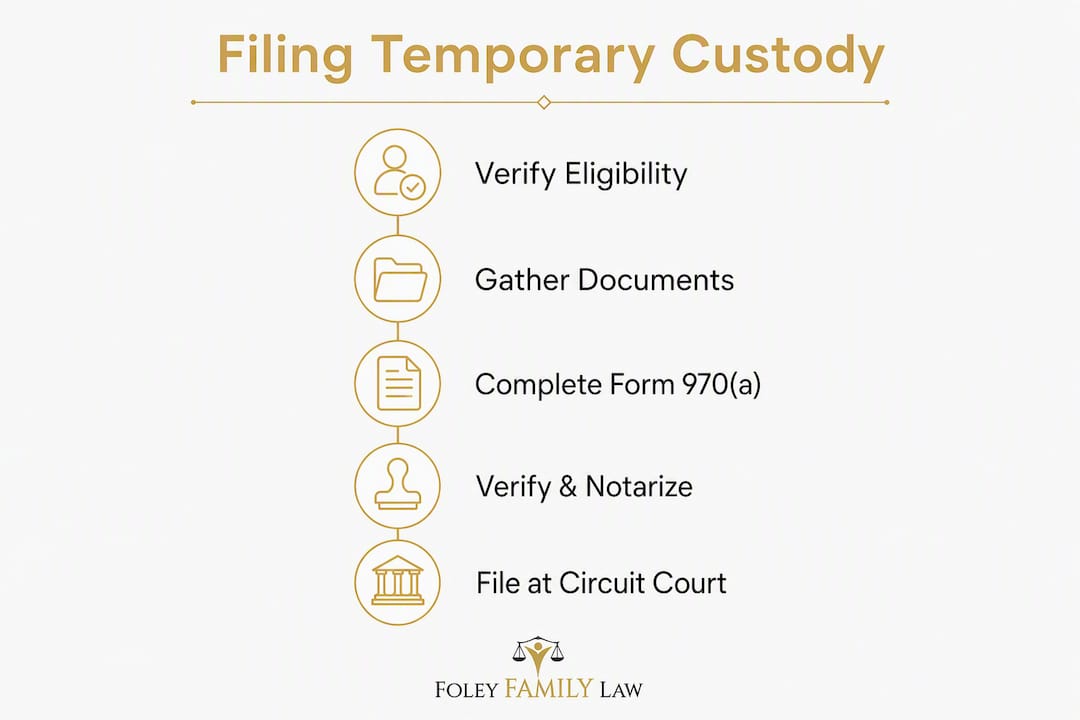
Yes, an eligible extended family member can petition a Florida court for temporary custody of a minor child under Chapter 751 of the Florida Statutes. Your first move is to confirm you qualify, then download the official Florida Courts Petition for Temporary Custody by Extended Family (Form 970(a)) and begin assembling your supporting documents.
Before you file, gather these items:
- A valid government-issued photo ID for yourself
- The child’s birth certificate (establishes parentage and residence)
- Proof that the child currently lives with you in Florida
- Signed, notarized parental consent forms, if the parents are willing to provide them
- Any existing court orders affecting the child (support, protection, prior custody)
If parents are not consenting or the situation involves abuse, neglect, or abandonment, the evidentiary bar is significantly higher. In those cases, scheduling a consultation with Foley Family Law before you file is the most practical step you can take. Contested petitions require litigation skills that go well beyond completing a form.
What Florida law authorizes and who qualifies as extended family
Florida’s Chapter 751 exists specifically to protect child welfare by giving qualifying relatives a legal path to obtain custody when parents cannot or will not care for a child. The statute creates two distinct types of orders: temporary custody and concurrent custody. Understanding which one applies to your situation before you file matters more than most petitioners realize.
Who counts as an “extended family member”
Under Chapter 751, an extended family member is any person within the third degree of blood or marriage to the child’s parent. That includes great-grandparents, grandparents, aunts, uncles, adult siblings, nieces, nephews, and cousins. A stepparent who is currently married to the child’s parent and is not an adverse party in the proceedings also qualifies. Petitions filed by individuals outside this definition are routinely dismissed on jurisdictional grounds, so confirming your relationship before filing is not optional.
For grandparents specifically, Florida’s grandparent custody rights framework intersects with Chapter 751 in important ways worth reviewing separately.
Jurisdiction and residency
The circuit court in the county where the child currently resides has jurisdiction. Many county clerks also require proof that the child has lived in Florida with the petitioner for a minimum period, often six months, before filing to establish proper jurisdiction. Failing to document this is one of the most common reasons petitions are delayed or returned.

Temporary custody vs. concurrent custody
| Feature | Temporary Custody | Concurrent Custody |
|---|---|---|
| Who can seek it | Extended family member caring full-time for child, or with parental consent | Extended family member with current or recent physical custody |
| Parental rights | Parental rights remain intact | Parental rights remain intact |
| Residency threshold | Child must be living with petitioner | Physical custody requirement (current or recent) |
| Evidentiary burden (contested) | Clear and convincing evidence of parental unfitness under Chapter 39 | Lower threshold; consent-based route available |
| Outcome | Court order granting temporary custody | Shared legal authority for specific care decisions |
| Best for | Crisis situations; parental incapacity or instability | Ongoing caregiving where parents remain partially involved |
Key statute sections at a glance
| Statute Section | What It Covers | Where to Find It |
|---|---|---|
| — | Definitions, including “extended family member” | flsenate.gov |
| 751.02 | Who may file and jurisdiction/residency requirements | flsenate.gov |
| 751.03 | Required petition contents and what the court must consider | flsenate.gov |
| 751.05 | Standards for granting orders; contested hearing requirements | flsenate.gov |
When you can file: consent, substitute care, and contested grounds
Florida Statute 751.02 sets out two clear pathways to file, and a third more difficult route when parents object.
Pathway 1: Parental consent. You have the signed, notarized consent of all of the child’s legal parents. This is the most straightforward route and typically results in an uncontested hearing.
Pathway 2: Substitute parent care. You are already caring for the child full-time in the role of a substitute parent, and the child is presently living with you. No parental consent is required to file, but you must be able to document the living arrangement.
Pathway 3: Contested filing without consent. If parents do not consent and you are not yet the child’s full-time caregiver, you must prove abuse, abandonment, or neglect as defined in Chapter 39. The burden of proof is clear and convincing evidence of parental unfitness. That is a demanding legal standard, not simply showing that a parent is struggling financially or going through a difficult period.
Eligibility checklist
- You are within the third degree of blood or marriage to the child’s parent (or are a qualifying stepparent)
- The child currently lives in Florida
- You can document one of the three pathways above
- You are not an adverse party in existing proceedings involving the child
- You can show the child has resided with you or in Florida for the period your county requires
Evidence for contested cases
When parents object, courts expect documentary corroboration. Useful evidence includes police reports, Department of Children and Families (DCF) investigation records, medical records showing neglect or injury, school attendance records, and sworn witness statements from teachers, neighbors, or healthcare providers.
Pro Tip: Include a written transition plan in your petition even when parents consent. Courts expect a concrete description of how and when custody could return to the parents. A petition without one signals to the judge that the petitioner has not thought through the child’s long-term stability, and it can limit the order you receive.
Non-qualifying petitioners, meaning those who are not within the third degree of relation and do not meet the stepparent exception, should not attempt to file under Chapter 751. The case will likely be dismissed, and the delay can harm the child.
Exact forms to use and how to file in Florida
The official form is Florida Courts Form 970(a), titled “Petition for Temporary Custody by Extended Family.” Download it directly from the Florida Courts website. Many county clerks also distribute a local pro se packet that includes the form along with filing instructions specific to that circuit.
What the petition must contain
Section 751.03 specifies the required elements. A complete petition includes:
- Full name, address, and relationship of the petitioner to the child
- Full name, date of birth, and current address of the child
- Names and addresses of the child’s legal parents
- The specific reasons custody is being requested and the factual basis
- The period of custody requested (temporary or concurrent)
- A reasonable transition plan describing how custody could be returned to the parents
- A verification section signed under oath by the petitioner
- All required attachments
Verification and notarization
The petition must be verified, meaning the petitioner signs a sworn statement that the facts are true to the best of their knowledge. This is not the same as a simple signature. The verification must be notarized. Missing or improperly executed verification is one of the most common clerical defects that causes clerks to return filings.
Where and how to file
File in the circuit court of the county where the child currently resides. Submit the completed packet to the clerk of court’s family law division. Some counties accept e-filing through the Florida Courts E-Filing Portal; check with your local clerk before assuming that option is available. After filing, you must serve copies on the child’s legal parents and any other interested parties named in the petition according to Florida Rules of Civil Procedure.
Common attachments and why they matter
| Attachment | Purpose |
|---|---|
| Child’s birth certificate | Establishes parentage, age, and residence |
| Petitioner’s photo ID | Confirms identity and relationship eligibility |
| Signed, notarized parental consent (if available) | Satisfies Pathway 1 eligibility; simplifies hearing |
| Existing support or protection orders | Required disclosure; affects court’s jurisdiction analysis |
| Prior custody orders | Prevents conflicting orders; required by statute |
| Proof of child’s Florida residence | Establishes jurisdiction; many counties require 6 months |
| DCF or police reports | Supports contested grounds (abuse, neglect, abandonment) |
| Medical or school records | Corroborates claims of neglect or incapacity |
County-specific packet instructions, such as those from Okeechobee County, illustrate how local clerks supplement the state form with additional checklists and local cover sheets.
A practical checklist from drafting to hearing
Getting from the decision to file to a signed court order involves more steps than most petitioners expect. Here is the sequence, with realistic timing for each phase.
- Confirm eligibility and gather documents (1–2 weeks). Verify your relationship to the child, confirm the child’s Florida residency, and collect all attachments listed above.
- Download and complete Form 970(a) (1–3 days). Fill out every field. Draft your transition plan carefully. Have the verification section notarized before you go to the clerk.
- Obtain parental consent signatures, if applicable (varies). Both legal parents must sign and have their consent notarized. If one parent is unavailable or refuses, you are moving to a contested filing.
- File with the circuit court clerk (1 day). Bring the original plus at least two copies. Pay the filing fee or submit a fee-waiver application at the same time.
- Serve all required parties (within the timeframe set by local rules, typically 20 days). Use a process server or the sheriff’s office. Keep proof of service for the court file.
- Attend the hearing (typically scheduled within 30–60 days of filing for standard petitions). For emergency or ex parte relief, the timeline compresses significantly.
- Post-order steps. Obtain certified copies of the order. Provide copies to the child’s school, healthcare providers, and any other institutions that need documentation of your legal authority.
Filing fees
County filing fees for a petition for temporary custody vary. Manatee County’s fee schedule shows fees for contested petitions that can be substantial and vary by county. Fees differ by county, so check the clerk’s published fee schedule for the county where you are filing. If you cannot afford the filing fee, ask the clerk for an Application for Determination of Civil Indigent Status. Courts can waive fees for petitioners who meet income thresholds.
Emergency and ex parte relief
If the child faces immediate danger, you can request an emergency hearing or ex parte temporary order. This requires a separate motion explaining the specific, immediate threat and why waiting for a standard hearing would harm the child. Judges grant ex parte relief sparingly; the evidence must be concrete and urgent, not speculative.
What the court will want to see at the hearing
The judge’s primary question at any temporary custody hearing is whether granting the order serves the best interests of the child. For uncontested petitions, the court generally reviews the paperwork, confirms the facts, and enters the order. Contested hearings are a different matter entirely.
In a contested case, Section 751.05 requires the court to find by clear and convincing evidence that the parent abused, abandoned, or neglected the child as defined under Chapter 39. That is a high bar, and the petitioner carries the burden of meeting it.
Evidence the court looks for
| Evidence Type | What It Supports | Preparation Tips |
|---|---|---|
| DCF investigation records | Abuse, neglect, or abandonment findings | Request records early; subpoena if necessary |
| Medical records | Physical neglect, untreated injuries, substance abuse | Obtain releases or subpoenas before the hearing date |
| School attendance and performance records | Neglect, instability, lack of supervision | Request directly from the school or subpoena |
| Police reports | Domestic violence, substance abuse incidents | Obtain certified copies from the relevant agency |
| Witness testimony (teachers, doctors, neighbors) | Corroborates documentary evidence | Prepare witnesses in advance; confirm availability |
| Photographs or videos | Documents living conditions, injuries | Authenticate with metadata or witness testimony |
| Expert reports (psychologist, social worker) | Parental fitness, child’s emotional state | Engage experts early; reports take time to prepare |
Preparing witnesses
Lay witnesses, meaning non-experts like teachers or neighbors, can testify only to what they personally observed. They cannot offer opinions about parental fitness or predict future behavior. Brief each witness on this distinction before the hearing. A teacher can describe specific incidents of a child arriving hungry, unwashed, or distressed. They cannot testify that the parent is unfit as a general conclusion.
Pro Tip: Organize your exhibits in a tabbed binder with a numbered exhibit list. Bring four copies: one for the judge, one for opposing counsel, one for any guardian ad litem appointed for the child, and one for yourself. Judges notice when a petitioner is organized, and it signals that the case is serious and well-prepared.
The child’s preference
Florida courts may consider a child’s preference when the child is old enough and mature enough to form an intelligent opinion. There is no fixed age cutoff. The judge weighs the child’s preference as one factor within the broader best-interest analysis, not as a deciding vote. In most temporary custody hearings, the child does not testify directly; the court may appoint a guardian ad litem to represent the child’s interests instead.
When hiring an attorney is the right call
Some petitions are straightforward. A grandparent with both parents’ notarized consent, a child already living in their home, and a clean paper trail can often navigate the process with the official form and a county pro se packet. But that scenario is the exception, not the rule.
You should strongly consider retaining a family law attorney if any of the following apply:
- Parents are not consenting and you need to prove abuse, neglect, or abandonment
- There is an active DCF investigation or prior court involvement
- The child is at immediate risk and you need emergency relief
- A parent is contesting the petition and plans to appear at the hearing
- Jurisdictional questions exist (child recently moved, multiple states involved)
- Existing custody, support, or protection orders complicate the filing
- You are unsure whether you qualify as an extended family member under the statute
An attorney handling a temporary custody matter will draft and verify the petition, identify the correct legal grounds, gather and subpoena evidence, prepare and coordinate witnesses, represent you at the hearing, and negotiate a transition plan that satisfies the court. In contested cases, the difference between a well-prepared petition and a poorly prepared one is often the difference between an order and a dismissal.
Foley Family Law handles temporary custody petitions for extended family members in Hillsborough, Pinellas, and Pasco counties. The firm’s practice is exclusively family law, which means every attorney on the team works with these statutes regularly. When you schedule a consultation, bring your ID, the child’s birth certificate, any existing court orders, and a written summary of the facts you plan to allege.
What filing and legal costs to expect
Cost transparency matters when you are already managing a difficult family situation. Here is a realistic breakdown.
| Cost Item | Typical Range | Where to Verify |
|---|---|---|
| County filing fee | Up to approximately $400 (varies by county) | County clerk’s published fee schedule |
| Process server / sheriff service fee | varies by county | County sheriff or private process server |
| Certified copies of order | $1–$2 per page (varies) | Clerk’s fee schedule |
| Subpoena fees (if needed) | Varies by county and number of subpoenas | Clerk’s fee schedule |
| Attorney fees, uncontested matter | Varies; flat-fee arrangements sometimes available | Firm consultation |
| Attorney fees, contested hearing | Hourly billing; total depends on complexity | Firm consultation |
The Manatee County fee schedule is a useful reference point, though fees differ across Florida’s 67 counties. Always confirm the current fee with the specific clerk’s office before you file.
Fee waivers
If you meet the court’s indigency threshold, you can apply to have filing fees waived. Ask the clerk for the Application for Determination of Civil Indigent Status at the time of filing. You will need to document your income, assets, and household size. Approval is not automatic, but the process is straightforward for petitioners who genuinely qualify.
Low-cost legal help
Florida’s circuit courts maintain self-help centers where court staff can answer procedural questions (though not give legal advice). Many counties also have legal aid organizations that provide free or reduced-cost representation for qualifying petitioners. The Florida Bar’s Lawyer Referral Service can connect you with a family law attorney for an initial consultation.
Key Takeaways
An extended family member in Florida may petition for temporary custody under Chapter 751 using the official Form 970(a), but contested cases require clear and convincing evidence of parental unfitness and almost always benefit from legal representation.
| Point | Details |
|---|---|
| Confirm eligibility first | You must be within the third degree of blood or marriage, or qualify as a stepparent, before filing. |
| Use the official form | Florida Courts Form 970(a) is the required petition; download it from flcourts.gov or your county clerk. |
| Contested cases carry a high burden | Without parental consent, you must prove abuse, abandonment, or neglect by clear and convincing evidence under Chapter 39. |
| Include a transition plan | Petitions without a concrete plan for returning custody to the parents risk denial or a limited order. |
| Foley Family Law serves Hillsborough, Pinellas, and Pasco | The firm handles petition drafting, evidence collection, emergency motions, and hearing representation for extended family petitioners. |
What we see most often go wrong with these petitions
The petitions that run into trouble are rarely the ones with the most difficult facts. They are the ones with the most preventable mistakes. Incomplete verification sections, parental consent forms that were signed but never notarized, transition plans that say nothing more than “we will return the child when things improve,” and service packets that missed a required party. These are fixable problems before filing. After filing, they cause delays, returned documents, and sometimes dismissals that set the case back by weeks.
The emotional weight of these situations is real. When a grandparent or aunt or uncle steps forward to protect a child, they are doing something genuinely difficult, often while managing their own grief about what the child has been through. Getting the legal process right is how that effort actually protects the child. A well-prepared petition, filed correctly, with a credible transition plan and organized evidence, gives the court what it needs to act quickly.
Foley Family Law’s focus is exclusively family law. That means the team understands not just the forms, but the evidentiary standards, the local court expectations in Hillsborough, Pinellas, and Pasco counties, and the practical difference between a petition that moves forward and one that stalls.
How Foley Family Law helps extended family petitioners in Florida
Navigating a temporary custody petition without legal support is possible in straightforward, consent-based cases. In contested matters, or any situation involving allegations of abuse, neglect, or parental incapacity, having experienced counsel is the most direct path to protecting the child quickly and correctly.

Foley Family Law provides legal support for extended family custody matters that are unconnected to divorce, including petition drafting, evidence collection, emergency motion practice, hearing representation, and post-order modification work. The firm serves clients in Hillsborough, Pinellas, and Pasco counties and focuses exclusively on family law, which means every case benefits from attorneys who work with Chapter 751 petitions regularly.
To schedule a consultation, contact Foley Family Law directly. Bring your photo ID, the child’s birth certificate, any existing court orders, and a written summary of the facts. Understanding what family law attorneys do in custody matters can help you prepare for that first conversation and make the most of your time with counsel.
Useful sources and official downloads
The resources below are the authoritative starting points for any extended family custody petition in Florida.
- Florida Statutes Chapter 751 (all sections): flsenate.gov/Laws/Statutes/2025/Chapter751/All — the complete statutory authority for extended family custody proceedings
- Section 751.02 (who may file): flsenate.gov/Laws/Statutes/2025/751.02 — eligibility and jurisdiction requirements
- Section 751.03 (petition contents): flsenate.gov/Laws/Statutes/2025/751.03 — required elements of the petition
- Florida Courts Form 970(a) — Petition for Temporary Custody by Extended Family: flcourts.gov (PDF) — the official state petition form
- Florida Courts Form 970(a) landing page: flcourts.gov — Custody by Extended Family forms — full form set including related forms (a through f)
- Sample county pro se packet (Okeechobee County): myokeeclerk.com (PDF) — example of a county clerk packet with local filing instructions
- Twelfth Circuit pro se packet instructions (Packet 19): jud12.flcourts.org (PDF) — detailed instructions including transition plan guidance
- Hernando County temporary custody checklist: hernandoclerk.com (PDF) — residency and documentation checklist example
- Manatee County family law filing fees: manateeclerk.com — example fee schedule for verifying county-specific costs
FAQ
How does temporary custody work in Florida for extended family?
An extended family member files a verified petition under Chapter 751 with the circuit court in the county where the child lives. If parents consent, the court typically holds a brief hearing and enters the order; if parents contest, the petitioner must prove parental unfitness by clear and convincing evidence.
How much does it cost to file for temporary custody in Florida?
Filing fees vary by county and can reach approximately $400 for a contested petition, based on published county fee schedules. Additional costs include process server fees and, if you retain counsel, attorney fees. Fee waivers are available for petitioners who qualify under the court’s indigency standard.
How long does a temporary custody order last in Florida?
A temporary custody order under Chapter 751 remains in effect until the court modifies or terminates it, or until the circumstances that justified the order change. The order is not automatically permanent, and courts expect petitioners to include a transition plan for eventually returning custody to the parents.
Who qualifies as extended family under Florida law?
Florida law defines an extended family member as any person within the third degree of blood or marriage to the child’s parent, including grandparents, great-grandparents, aunts, uncles, adult siblings, and cousins, as well as a stepparent currently married to the parent who is not an adverse party.
What is the difference between temporary custody and concurrent custody in Florida?
Temporary custody gives the petitioner primary legal authority over the child’s care and is typically sought in crisis situations. Concurrent custody shares legal authority with the parents and is available when the petitioner has current or recent physical custody of the child, generally with a lower evidentiary threshold than a contested temporary custody petition.
This article provides general legal information about Florida’s Chapter 751 custody process and is not a substitute for legal advice. For guidance specific to your situation, consult a qualified Florida family law attorney or contact the clerk of court in your county.


