

When you're looking for a Tampa military divorce attorney, you quickly realize this isn't standard-issue family law. You need someone who gets the unique rules that apply to military families. A military divorce is a complex blend of Florida law and very specific federal regulations, demanding a level of know-how that goes way beyond a typical civilian case. We proudly serve clients throughout Pasco, Pinellas, and Hillsborough Counties.
This guide is designed to bring some clarity to these unique challenges for service members and their spouses.
The Unique Terrain Of Military Divorce In Florida
Going through a divorce is tough enough. But when one or both of you serve in the armed forces, a whole other layer of federal law comes into play that can dramatically change the outcome. A military divorce isn't just a regular dissolution of marriage with a few extra forms; it's a specialized legal field with its own playbook.

This is especially true for families stationed at MacDill Air Force Base and living across Hillsborough, Pinellas, and Pasco Counties. The realities of military life—deployments, relocations, and constant uncertainty—add unique pressures to a marriage. The numbers back this up: in 2022, a staggering 19,689 active-duty service members and 7,951 reservists went through a divorce. That’s a rate much higher than the civilian average, highlighting why finding the right legal guidance here in the Tampa Bay area is so critical. You can discover more insights about these divorce statistics and what they mean for military families.
Why Military Divorce Requires Special Attention
A handful of powerful federal laws create specific rights and protections that have to be balanced with Florida’s divorce laws. Getting a handle on these key differences right from the start is the first step toward protecting your rights and getting a fair outcome.
Two of the biggest federal laws you'll encounter are:
- The Servicemembers Civil Relief Act (SCRA): This law is built to protect active-duty personnel from being put at a legal disadvantage while they're serving. It can, for instance, pause divorce proceedings if a service member is deployed and can't participate.
- The Uniformed Services Former Spouses’ Protection Act (USFSPA): This is the big one for finances. It’s the federal law that gives state courts, like those in Florida, the authority to treat military retirement pay as a marital asset that can be divided in a divorce.
Military divorce is its own distinct area of family law. It demands an attorney who is fluent in both Florida law and the complex language of federal military regulations to truly protect your future.
It's also important to note that for our diverse community, including LGBTQ+ service members and their families, these rules apply equally. Our firm handles all LGBTQ+ issues, including gay divorce, gay custody matters, and name changes, and we do not discriminate. We're committed to providing inclusive, knowledgeable representation for all families facing these hurdles.
To give you a clearer picture, here’s a quick breakdown of how these cases differ from a standard civilian divorce in Florida.
Key Differences Between Civilian and Military Divorce in Florida
In a Civilian Divorce, the process is governed strictly by Florida law. Residency is based on one spouse living in the state for six months. Serving divorce papers and court timelines are straightforward. Retirement assets like 401(k)s are divided under state equitable distribution rules, and parenting plans focus on the "best interest of the child" standard.
In a Military Divorce, federal regulations add layers of complexity.
- Residency & Filing: Jurisdiction can be more flexible, based on where a service member is stationed or their legal "home of record," even if they are overseas.
- Case Timing: The SCRA allows active-duty members to request a "stay" or pause on proceedings if their service interferes, which can delay the case.
- Retirement Division: The division of military retirement is governed by the USFSPA, which has its own unique rules like the "10/10 Rule" that do not apply to civilian pensions.
- Parenting Plans: Custody agreements must be built to withstand deployments and frequent relocations, requiring highly detailed provisions for long-distance co-parenting.
- Healthcare Benefits: Former spouses may be eligible for continued TRICARE benefits under the strict "20/20/20 Rule," a benefit not available in civilian cases.
These differences illustrate how military service impacts nearly every aspect of the divorce process, requiring a strategy tailored to these specific rules.
Navigating The Path Ahead
Ultimately, the core issues in a military divorce circle back to a few key areas that require careful planning and an experienced legal guide. The biggest challenges usually involve figuring out where to file (jurisdiction), correctly dividing the military pension, and creating a stable, long-distance parenting plan that can withstand deployments and relocations.
This guide will serve as your roadmap. We'll break down each of these topics to give you the clarity and confidence you need to prepare for the journey ahead.
Where Can We File, And What If Someone Is Deployed? Jurisdiction and the SCRA
Right out of the gate, nearly every military divorce conversation starts with two questions: "Where can we even file this?" and "What happens if one of us is deployed?" Getting the answers to these right is the bedrock of your entire case. This is where Florida law and federal military protections really start to interact.
For families here in Pasco, Pinellas, and Hillsborough Counties, nailing these concepts down is the first step toward a fair and orderly process. Let's walk through what it takes to file in Florida and how the powerful Servicemembers Civil Relief Act (SCRA) protects service members.
Establishing A Florida Connection For Your Divorce
Before a Florida court can even look at your divorce case, you have to meet the state's residency requirement. The rule itself is simple: at least one spouse must have lived in Florida for the six months leading up to the day the divorce petition is filed.
For a civilian couple, proving this is usually a non-issue. But for military families, things get complicated. A service member might be stationed at MacDill Air Force Base and physically live in Tampa, but their legal residence—their "home of record"—could be Texas, Ohio, or anywhere else.
Thankfully, Florida law accounts for this. You can satisfy the residency requirement in a couple of ways:
- Physical Presence: You or your spouse have physically lived in Florida for the last six months. Simple enough.
- Legal Residency: A service member can file for divorce in Florida if it's their state of legal residence, even if they're currently on the other side of the world on assignment.
This flexibility is absolutely critical. It ensures service members aren’t boxed out of their legal options just because of their duty station. Picking the right state to file in can dramatically shape the outcome of your case, which is why it's so important to talk with a Tampa military divorce attorney who can map out the best strategy.
Understanding The Servicemembers Civil Relief Act (SCRA)
Once you've locked down jurisdiction, the next big piece is timing, especially if a service member is on active duty. This is where the Servicemembers Civil Relief Act (SCRA) steps in. The easiest way to think of the SCRA is as a federal "pause button." It’s designed to protect active-duty personnel from being blindsided by legal action when they can't fairly respond.
The entire point of the SCRA is to make sure that military duties—like a deployment or an intensive training rotation—don't strip a service member of their legal rights. In any court case, using a court audio transcription service can be invaluable for ensuring every word is captured accurately, but it's especially important when timelines get complicated by SCRA stays.
The SCRA prevents a court from entering a default judgment against a service member who can't show up to court because of their military service. It keeps the process fair, even when one person is serving the country thousands of miles away.
Under the SCRA, an active-duty service member who gets served with divorce papers can request a "stay," which is just a legal term for a temporary delay. The court will almost always grant an initial stay for 90 days. This gives the service member a window to find a lawyer and get their bearings. If their military duties continue to make it impossible to participate, they can ask for further extensions.
This isn't a get-out-of-divorce-free card. It's a fairness tool. For the non-military spouse, it’s important to know that these delays are a normal part of the process. A good lawyer can help you manage expectations, work within these timelines, and keep your case moving forward as smoothly as possible.
Dividing Military Retirement and Other Key Benefits
For military families facing divorce, the pension is often the single most valuable asset built during the marriage. It's not just a line item on a spreadsheet; it represents years of service and is the foundation of your financial future. How this retirement pay gets handled in a Florida divorce is governed by a critical federal law: the Uniformed Services Former Spouses’ Protection Act (USFSPA).
The USFSPA is what gives Florida courts the green light to treat the portion of military retirement earned during the marriage as a marital asset. Think of it just like any other shared investment, like a 401(k) or the equity in your home. The value you both built up together is subject to a fair division. Getting this complex calculation right in the courts of Pasco, Pinellas, and Hillsborough Counties is exactly why you need a seasoned Tampa military divorce attorney in your corner.
Before we can even talk about dividing assets, though, we have to clear a few initial hurdles specific to military cases.
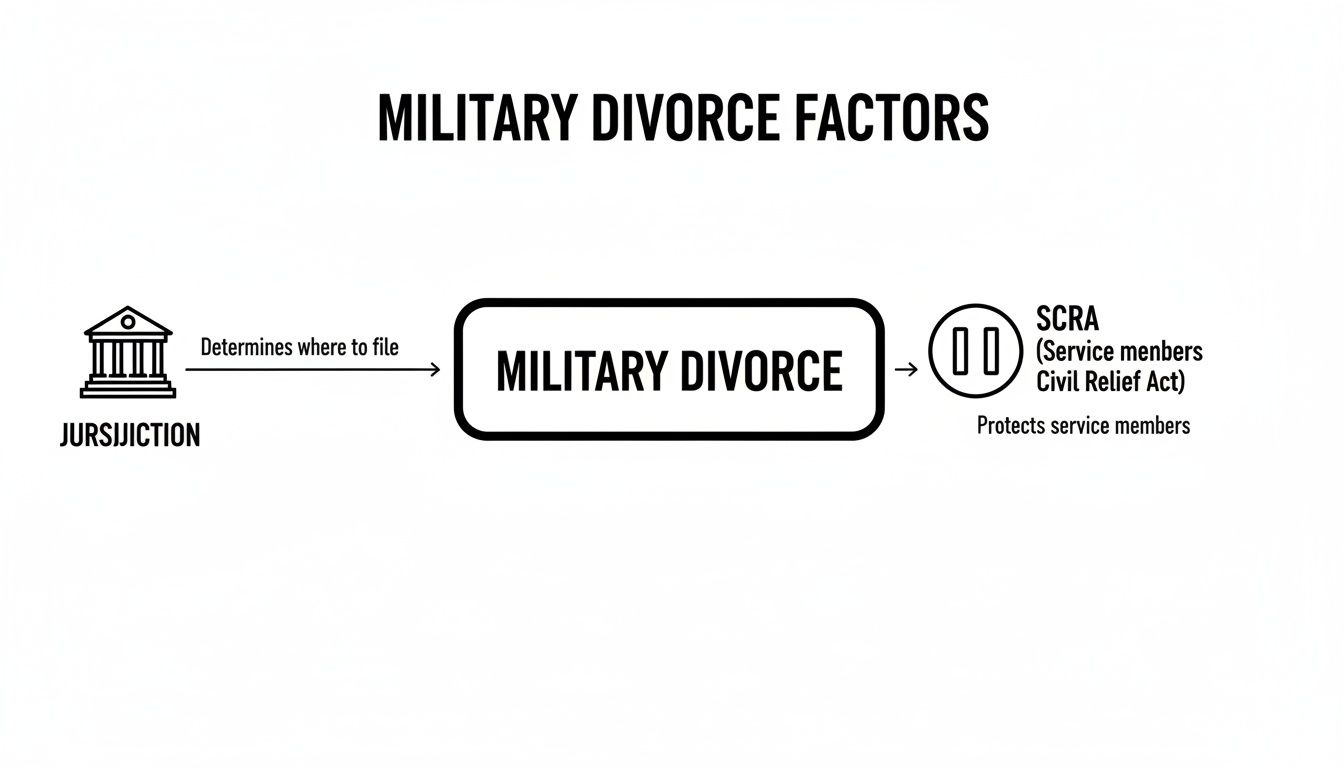
As you can see, simply figuring out where to file and dealing with potential delays for active-duty members are foundational steps we must address right from the start.
Decoding The Confusing 10/10 Rule
This is easily one of the most misunderstood parts of military divorce. A lot of people incorrectly believe the "10/10 Rule" determines if a former spouse gets a piece of the pension. That's a myth.
The 10/10 Rule is purely an administrative tool. It’s all about how the former spouse gets paid, not whether they are entitled to payment. To meet the rule, the marriage must have lasted for at least 10 years, and those 10 years must overlap with at least 10 years of creditable military service.
If you meet the 10/10 Rule, the Defense Finance and Accounting Service (DFAS) can pay the former spouse's share directly out of the service member's retirement check. It’s convenient, and it guarantees payment is made on time.
The 10/10 Rule is about the payment method, not entitlement. A former spouse can be awarded a share of the pension even if the marriage was shorter than 10 years; the payment will just have to come directly from the service member instead of the DFAS.
What if your marriage doesn't meet that 10-year threshold? A Florida court can still absolutely award a portion of the pension. The only difference is that the responsibility for making those monthly payments falls directly on the military retiree. This makes the specific language in your final divorce decree absolutely critical to ensure the order is enforceable down the road.
Beyond The Pension: Other Important Benefits
While the pension gets most of the spotlight, don't overlook other valuable military benefits. Forgetting to account for these can mean leaving a significant amount of money on the table.
Two of the most important are:
- Thrift Savings Plan (TSP): This is the military’s version of a 401(k). Just like the pension, any contributions and earnings that built up during the marriage are considered marital property and have to be divided equitably. A special court order is required to split a TSP account.
- Survivor Benefit Plan (SBP): The SBP is essentially an annuity that ensures a former spouse continues to receive their portion of the retirement pay if the service member passes away. It’s a life insurance policy protecting that pension share. A court can require a service member to elect SBP coverage for their former spouse, with the premium cost often shared between them.
These are just a couple of the key financial pieces in a military divorce puzzle. You can find a more in-depth discussion in our guide on dividing a military pension in a Tampa divorce.
Creating A Stable Parenting Plan For Military Families
Co-parenting is a delicate balance on a good day. But when you throw in the realities of military life—deployments, surprise training exercises, and frequent Permanent Change of Station (PCS) moves—it adds a layer of complexity that demands serious foresight. For military families, a cookie-cutter parenting plan just won't cut it. You need one that's both tough as nails and incredibly flexible.

The number one goal is creating stability for the kids, even when the parents’ lives are constantly in motion. A well-crafted plan acts as a roadmap, anticipating future moves and long stretches of distance. It provides clear answers before the questions even come up, which is key to cutting down on conflict and anxiety for everyone. For families in Pasco, Pinellas, and Hillsborough Counties, we make it our mission to build these resilient plans from the ground up.
Building A Deployment-Proof Plan
One of the most critical pieces of a military parenting plan is spelling out exactly what happens during a deployment. This isn't just about timesharing; it's a temporary but massive shift in parental responsibilities. A vague "we'll figure it out" agreement is a recipe for a fight down the road.
Your plan needs to be explicit about the following:
- Temporary Custody: Clearly name who will have primary timesharing with the kids while the service member is deployed. Florida law has specific protections for a service member's parental rights, making sure that these deployment arrangements are temporary and don't permanently mess with the original custody order.
- Communication Protocols: Lock down clear and consistent ways to stay in touch. This could mean scheduled video calls, emails, and phone calls, and it should account for wild time zone differences and potential communication blackouts.
- Third-Party Contact: If it makes sense for your family, the plan can authorize a trusted relative, like a grandparent, to help with communication or even step in to use some of the deployed parent's timesharing on their behalf.
A strong military parenting plan acts like a pre-flight checklist. It addresses potential turbulence—like deployments and relocations—before you ever leave the ground, ensuring a smoother journey for your children.
These details are essential for every family we serve, including LGBTQ+ service members who face the exact same unique challenges. Whether you're navigating a gay divorce or a custody battle, the need for a clear, forward-thinking plan is universal. Our goal is to ensure that a parent's service to our country never comes at the cost of their relationship with their child.
Handling Relocation And Long-Distance Parenting
Permanent Change of Station (PCS) moves are a fact of military life, not a possibility. Florida law is very strict about relocating with a child more than 50 miles away, and your parenting plan absolutely must be built with this in mind. Because military life is so transient, one parent or the children will almost certainly move eventually. Getting a handle on how to plan a cross country move can be a practical first step when thinking through these logistics.
Planning for this ahead of time makes a future relocation much, much smoother. Your plan should lay out provisions for out-of-state timesharing schedules, like who pays for travel and how holidays and summer breaks will be split.
Calculating Child Support With Military Pay
Finally, getting child support right means understanding how military pay actually works. A service member’s income is way more than just base pay. Florida’s child support guidelines demand that most allowances—many of which are non-taxable—be included in the calculation.
This includes two big ones:
- Basic Allowance for Housing (BAH): This is a significant, non-taxable allowance meant to cover housing costs.
- Basic Allowance for Subsistence (BAS): This non-taxable allowance is for food expenses.
Forgetting to properly account for BAH, BAS, and other special pays will lead to a child support calculation that's just plain wrong. An experienced Tampa military divorce attorney will ensure the financial affidavits reflect the service member's true income, resulting in a fair and accurate support order that truly provides for the children's needs.
Contested vs. Uncontested: Choosing Your Divorce Path
Every divorce travels down one of two roads. The path you take will dictate how much time, money, and emotional energy you’ll spend, so understanding the difference between a contested and an uncontested divorce is the first step toward knowing what to expect.
An uncontested divorce is the smoother, more cooperative route. It’s possible only when you and your spouse agree on everything. I mean every single detail—how to divide property and debts, the specifics of a parenting plan and timesharing schedule, and any agreements on child support or alimony.
Once you’ve settled these terms, they are put into a formal Marital Settlement Agreement and filed with the court. For families in Hillsborough, Pasco, and Pinellas Counties, this approach is almost always faster, cheaper, and far less stressful.
The Uncontested Divorce Process
The biggest win in an uncontested divorce? You stay in control. You and your spouse make the big decisions together, rather than leaving your future in the hands of a judge who doesn't know you. This spirit of cooperation also tends to set a much healthier tone for co-parenting down the road.
But even the most amicable splits need a professional eye. It’s vital to have a skilled Tampa military divorce attorney review or help draft your agreement. An attorney makes sure your rights are protected and that the final document is ironclad, legally enforceable, and properly addresses all the unique rules for dividing military benefits.
An uncontested divorce doesn’t mean you skip legal advice. It just means you’re solving problems at a negotiation table instead of in a courtroom—and that requires a solid, well-drafted agreement to protect what matters most.
What to Expect in a Contested Divorce
A divorce becomes contested the moment you and your spouse can’t agree on one or more key issues. This disagreement kicks off a more structured legal process designed to get you to a resolution. It rarely means you’re headed for a dramatic courtroom battle; in reality, the vast majority of contested cases settle long before a trial ever happens.
The process usually unfolds in a few key stages:
- Financial Discovery: This is where everything comes out on the table. Both sides formally exchange detailed financial records—bank statements, tax returns, pay stubs, retirement account info—to build a complete and honest picture of the marital finances.
- Mediation: In Florida, mediation is a required pit stop for almost every contested divorce. You, your spouse, and your respective attorneys sit down with a neutral third-party mediator whose entire job is to help you find common ground and negotiate a settlement. It’s an incredibly effective tool for resolving disputes without a judge’s intervention.
- Litigation and Trial: If you can't reach an agreement in mediation, the case moves toward litigation. This could involve hearings on temporary matters and, if all else fails, a trial. At trial, a judge will hear testimony and review evidence before making the final decisions for you.
In a contested case, a sharp attorney is your greatest asset, whether they are fighting for you in mediation or representing you in court. While trying to save money by going it alone might seem tempting, it’s a gamble that can backfire badly. You can read more about those risks in our article on how to divorce without a lawyer. Our firm knows how to handle these tough situations, making sure our clients’ interests are protected at every single turn.
Choosing The Right Attorney For Your Military Divorce
Picking the right legal partner is probably the single most important decision you'll make in a military divorce. It’s one thing to understand the laws, but it's another thing entirely to find the right person to guide you through them. This isn't just about hiring a lawyer; it's about finding an advocate who gets the military culture, understands the unique pressures you’re under, and knows how to protect your future.
A dedicated family law firm is almost always the best bet. The stakes in a military divorce are incredibly high, both financially and emotionally. The data on military divorce rates reveals some tough realities, especially for younger spouses, and the toll of service-related stressors like PTSD can't be ignored. You can read more about these military divorce statistics and see just how complex these situations can get. An attorney who already understands these dynamics is essential.
Questions To Ask A Potential Attorney
When you sit down with a potential Tampa military divorce attorney, your mission is to gauge their specific expertise in this niche. Don't be shy about asking tough, direct questions. Their answers will tell you everything you need to know about whether they can handle the unique blend of Florida and federal law your case requires.
Here’s a checklist of questions to bring to your consultation:
- Military Pension Division: "How do you typically handle the division of a military pension? Can you explain the USFSPA and the 10/10 Rule like I'm not a lawyer?"
- Local Court Experience: "How much of your work is in the family courts here in Hillsborough, Pinellas, and Pasco Counties?"
- High-Conflict Cases: "What’s your game plan for a high-conflict divorce if my spouse is being completely uncooperative?"
- Communication: "How will I be kept in the loop on my case? Will I be talking to you directly or a paralegal?"
- LGBTQ+ Family Law: "Do you have experience with gay divorce or custody issues for LGBTQ+ service members?" Our firm is proud to handle all LGBTQ+ family law issues and does not discriminate.
Finding the right attorney is like choosing a skilled navigator for a difficult journey. You need someone who not only knows the map—the law—but also understands the terrain—the military lifestyle—to guide you to a safe harbor.
Why Specialized Experience Matters
An attorney who lives and breathes family law brings a level of insight a general practitioner just can't offer. For military families, that specialization is even more critical.
A lawyer who handles these cases day-in and day-out is already familiar with drafting precise Military Pension Division Orders and creating deployment-ready parenting plans that a judge will actually approve. They won't be learning the ropes on your time or your dime.
Ultimately, your choice of lawyer will shape the entire outcome of your divorce. For a deeper dive, check out our article on how to choose the right divorce lawyer. Making an informed decision now is the best investment you can make in your own future stability and peace of mind.
Got Questions About Military Divorce in Florida?
When you're dealing with a military divorce, a lot of specific questions come up. It's totally normal. To cut through the noise, here are some straight answers to the most common concerns we hear from service members and their spouses right here in the Tampa Bay area.
Can I File For Divorce If My Spouse Is Deployed?
Yes, you absolutely can start the divorce process in Florida even if your spouse is deployed. But there's a big "however" you need to know about: the Servicemembers Civil Relief Act (SCRA). This federal law gives a deployed service member the right to ask the court for a temporary pause—called a "stay"—if their military duties genuinely prevent them from participating in the case.
This doesn't stop the divorce, it just puts it on hold. An experienced attorney knows how to manage this, ensuring the case moves forward when it's fair for everyone involved. We handle these exact situations all the time for clients across Hillsborough, Pasco, and Pinellas Counties, striking the right balance for both spouses.
Does My Spouse Automatically Get Half Of My Military Pension?
No, it's definitely not an automatic 50/50 split. Florida law views the portion of your pension earned during the marriage as a marital asset. That asset then gets divided through "equitable distribution," which means it will be split fairly—but not always equally.
And that "10/10 Rule" you hear about? It doesn't decide if your ex-spouse gets a share. It only controls whether the Defense Finance and Accounting Service (DFAS) can pay them directly. If you want to protect your retirement, you need a sharp Tampa military divorce attorney who lives and breathes these details.
One of the biggest myths out there is that a marriage under ten years automatically protects a military pension from being divided. That's flat-out wrong. A Florida court can still award a portion of the pension earned during the marriage, no matter how long you were married.
How Is Child Support Calculated With Military Pay?
When Florida calculates child support, it looks at the total income of both parents. For military members, "income" is a lot more than just base pay. It also includes non-taxable income like your Basic Allowance for Housing (BAH) and Basic Allowance for Subsistence (BAS).
Getting those numbers right is critical for a fair child support order. It’s one of those details that can make a huge difference, and our firm is obsessive about making sure the calculations are done correctly for our clients.
What Happens To TRICARE Health Insurance After A Divorce?
Keeping TRICARE benefits after a divorce is tough and comes with very strict rules, often called the "20/20/20 Rule." For a former spouse to stay eligible, three things must be true:
- The marriage lasted at least 20 years.
- The service member has at least 20 years of service.
- The marriage and the military service overlapped by at least 20 years.
If you don't meet all three of those conditions, you might still be able to buy temporary continuation coverage to bridge the gap.
If you're facing the tough realities of a military divorce in the Tampa Bay area, you don't have to figure it all out on your own. The team at Foley Family Law has the specialized experience to guide you and the strength to advocate for you, protecting your rights and your future. Contact us today to schedule a consultation and get on a clear path forward.


