

When you're facing a separation in Florida, the biggest question is always about the kids. How do you protect their future and create stability when everything feels like it's changing?
Many people throw around the terms "sole custody" and "joint custody," but it's important to know that Florida law uses its own specific language. The state focuses on two key concepts: "parental responsibility" for decision-making and "time-sharing" for the actual schedule of when a child is with each parent.
This guide will break down what these arrangements really mean, helping parents in Pasco, Pinellas, and Hillsborough Counties make informed, confident decisions. We'll explore how each model impacts your child’s life, from day-to-day routines to the big life choices down the road. At Foley Family Law, our goal is to provide clear, compassionate guidance to all families, including those in the LGBTQ community, as we do not discriminate. We handle all LGBTQ issues, family, and divorce matters.
Navigating Florida Custody: Sole Vs. Joint Responsibility

The core difference between sole and joint arrangements comes down to one thing: control.
With sole parental responsibility, one parent gets the ultimate say in major decisions and is typically the primary residential parent. In contrast, shared parental responsibility (what most people call joint custody) means both parents are involved in decision-making and the child spends significant time with each of them.
Your family's unique situation will determine whether you need a single, stable authority figure or if you can thrive with a cooperative co-parenting approach. Our firm practices in Pasco, Pinellas, and Hillsborough Counties.
Key Differences at a Glance
Before we dive deeper, let's look at a direct comparison of these two models. Understanding these distinctions is the first step toward building a stable future for your child. For more specific language and structure, you can also check out our detailed guide on creating a child custody agreement template.
Sole Parental Responsibility
- Decision-Making: One parent makes all major decisions (health, education, etc.) without having to consult the other.
- Commonality in FL: Extremely rare. A judge will only grant this in specific, severe situations where shared parenting would be detrimental to the child.
- Communication Need: Minimal co-parenting communication is required for major decisions, as one parent has the final say.
Shared Parental Responsibility
- Decision-Making: Both parents must confer and agree on major decisions affecting the child.
- Commonality in FL: This is the legal standard and strong presumption in Florida courts.
- Communication Need: Requires ongoing, effective communication and a genuine willingness to cooperate.
Florida isn't alone in this trend. Nationally, there's been a clear and sustained shift toward shared parenting arrangements. While mothers historically secured sole custody far more often, joint custody has surged. Recent data shows that about 60% of custody cases now involve joint setups—that's a 20% increase over the last decade alone.
Understanding Florida’s Legal Framework
If you’re trying to navigate the difference between "sole custody" and "joint custody," the first thing to know is that Florida law uses its own unique language. The state has intentionally moved away from those traditional terms, focusing instead on two modern concepts that define a parent's rights and duties: parental responsibility and time-sharing.
These two ideas are the foundation of every parenting plan in Florida. Getting a handle on them is the first step toward building a stable, predictable future for your child, whether you're in Pasco, Pinellas, or Hillsborough County.
The Two Pillars of Florida Parenting Plans
At its core, parental responsibility is all about decision-making authority. Time-sharing, on the other hand, is the actual, physical schedule that lays out where your child lives and when.
- Parental Responsibility: This is the legal right to make major decisions affecting your child's life. We're talking about crucial choices related to their healthcare, education, religious upbringing, and overall welfare.
- Time-Sharing: This is the detailed calendar that dictates the specific overnights and days the child will spend with each parent. It covers everything from the regular school week to holidays and summer vacations.
This framework is designed to make sure both the big-picture decisions and the day-to-day routines are clearly defined, which goes a long way toward minimizing conflict down the road. It’s a practical approach that values clarity over old, outdated labels. Our firm is committed to helping all families, including those in the LGBTQ community, craft parenting plans that genuinely work.
Shared Parental Responsibility Is the Standard
In Florida, the starting point for almost every single case is shared parental responsibility. This means the court begins with the presumption that it's in a child’s best interest for both parents to talk to each other and make major decisions together. It’s a model that demands cooperation and open communication.
A judge will only deviate from this standard if they find that shared responsibility would be actively detrimental to the child. This is a very high legal bar to clear.
This approach aligns with Florida's no-fault divorce system, where the goal is to create a functional co-parenting relationship moving forward. For a deeper dive into this philosophy, you can learn more about Florida no-fault divorces in our detailed guide.
When Sole Parental Responsibility Is Granted
Sole parental responsibility is the exception, not the rule. It gives one parent the exclusive authority to make all major decisions without needing to consult the other parent.
A Florida court will only order this in very serious situations. To get there, a judge must find evidence that shared decision-making would actually cause harm to the child. This usually involves documented proof that makes cooperative parenting not just difficult, but potentially dangerous for the child. It is not something granted lightly or just because parents can't agree on everything. We practice in Pasco, Pinellas, and Hillsborough Counties.
Comparing Decision-Making Authority In Custody Models
When we talk about custody, the core difference between sole and shared arrangements comes down to one thing: who makes the big decisions for your child? It's not just about where the child lays their head at night; it’s about who has the final say on their education, healthcare, and upbringing.
Let's break down how this authority works in the real world. One model is built on teamwork, while the other puts the entire weight of decision-making on a single parent. Understanding how each approach plays out day-to-day is the only way to know which path makes sense for your family.
Shared Parental Responsibility: The Florida Standard
In Florida, shared parental responsibility is the starting point. The law presumes it’s in a child’s best interest for both parents to stay actively involved, which means you are legally required to work together on major decisions.
Think about it this way: your child needs braces. With shared responsibility, you and your co-parent have to agree on the orthodontist, the treatment plan, and how the bill gets paid. One parent can't just book an appointment and expect the other to pay half.
This applies across the board to the most important parts of your child's life:
- Education: You must both agree on which school your child attends. Decisions about tutors or special programs are also a joint effort.
- Non-Emergency Healthcare: Choosing pediatricians, therapists, or consenting to elective medical care requires a consensus.
- Extracurricular Activities: You have to decide together whether your child plays travel soccer, takes piano lessons, or goes to summer camp.
- Religious Upbringing: Decisions about religious instruction and participation must be made jointly.
The success of shared parental responsibility hinges on communication. It doesn't mean you have to be friends, but you do need a baseline of respect and the ability to put your child’s needs first.
This collaborative model isn't just a Florida trend. Research from around the world consistently shows that children in joint arrangements often have better outcomes. While the exact numbers vary, courts and parents are clearly moving toward shared models whenever possible. You can explore some of the research on global custody trends to see the data for yourself.
Sole Parental Responsibility: The Exception
Sole parental responsibility is extremely rare in Florida. A judge will only grant it if there's clear proof that shared decision-making would actually harm the child. This is a very high bar to clear.
To get sole responsibility, you must prove the other parent is unfit to make decisions for the child. This usually involves documented evidence of serious issues that directly impacts their parenting ability.
If a judge in Pinellas, Pasco, or Hillsborough County grants you sole parental responsibility, you alone have the power to make all major decisions without getting the other parent's input.
This flowchart helps clarify how Florida parenting plans separate the two key components: Parental Responsibility (who decides) and Time-Sharing (the schedule).
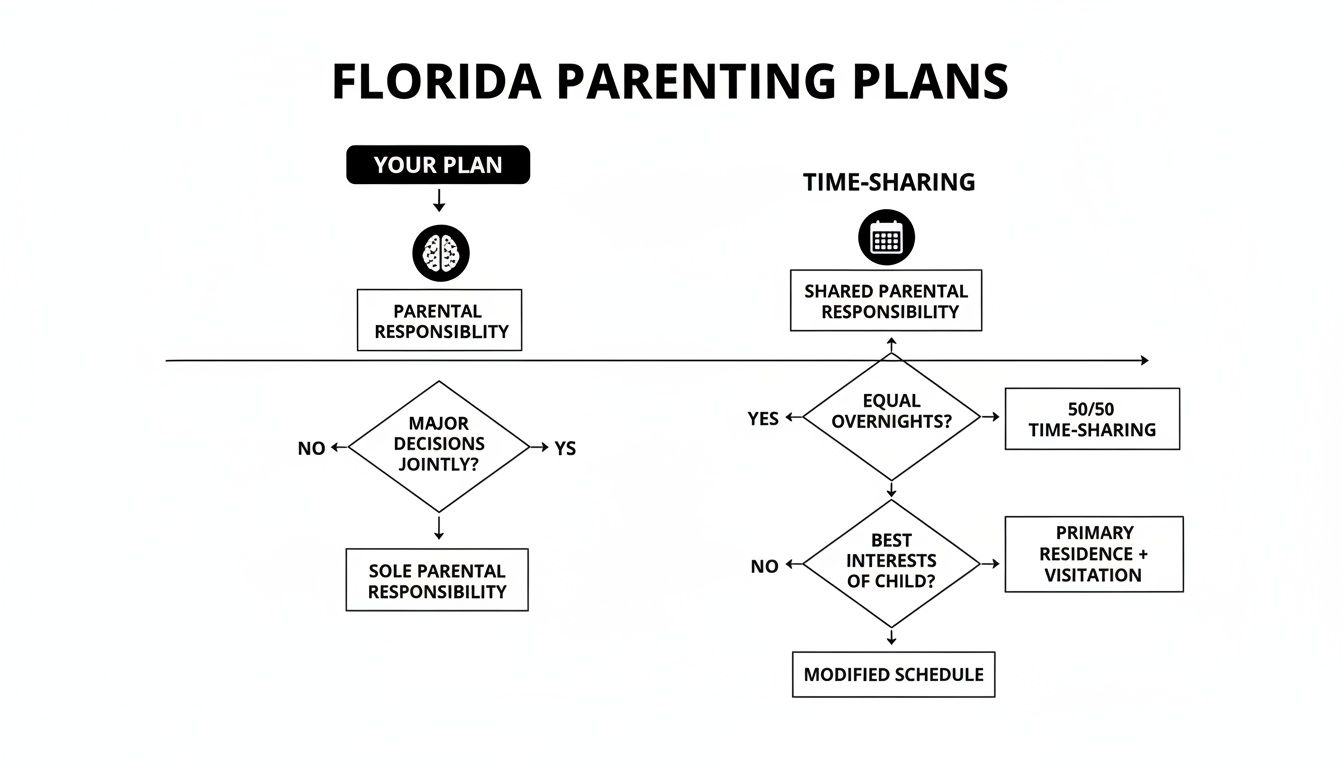
As the chart shows, these are two distinct parts of every parenting plan. Even if one parent has sole decision-making authority, the other parent almost always keeps their rights to time-sharing and access to their child's school and medical records.
A Side-by-Side Look At Decision-Making Power
To make it even clearer, here is a breakdown of how common decisions are handled under each model. It highlights just how different the day-to-day reality is for parents in each situation.
Shared Parental Responsibility (The Norm)
- Education: Both parents must agree on school choice, tutoring, and special programs.
- Healthcare: Both parents must agree on doctors, treatments, and non-emergency procedures.
- Extracurriculars: Decisions about sports, arts, and camps are made jointly.
- Travel: Both parents must agree on out-of-state or international travel plans.
- Communication: Constant communication and compromise are legally required.
Sole Parental Responsibility (The Exception)
- Education: One parent makes all school-related decisions without consulting the other.
- Healthcare: One parent has the authority to make all healthcare choices.
- Extracurriculars: One parent decides which activities the child participates in.
- Travel: The parent with sole authority can typically make travel decisions alone.
- Communication: No legal requirement to consult the other parent on major life decisions.
This comparison shows why Florida courts start with a presumption of shared responsibility. It keeps both parents invested and involved, which is almost always what's best for the child.
Ultimate Decision-Making Authority: A Hybrid Approach
What happens when parents with shared responsibility just can't agree on one specific issue, over and over again? In these cases, a court can create a hybrid solution. A judge might grant one parent ultimate decision-making authority over a single, specific area.
For example, if two parents in our practice area of Pasco, Pinellas, or Hillsborough can agree on everything except education, a judge might give the parent who has historically handled school matters the final say in that area alone. All other decisions would still require them to work together.
This targeted approach helps break through recurring gridlock while keeping the benefits of shared responsibility for everything else. Building these specific details into your agreement is a crucial part of creating a workable parenting plan in a divorce.
Ultimately, the goal is always to create a stable, predictable, and supportive environment for the child. At Foley Family Law, we have deep experience helping clients, including members of the LGBTQ+ community, find the right path for their unique family, whether that’s a robust shared plan or a more tailored solution.
How Florida Courts Define a Child's Best Interests
When it comes to sole custody versus joint custody, every decision a Florida judge makes boils down to one guiding principle: the best interests of the child. This isn't just a sentimental phrase; it's a specific legal standard that courts in Pasco, Pinellas, and Hillsborough Counties must meticulously apply. The court's entire job is to look at the family's unique situation and figure out which arrangement will truly support the child’s happiness, security, and overall well-being.
This evaluation is far from a simple checklist. It's a deep and careful review of many different parts of a child's life and each parent's ability to meet their needs. Forget old myths—there is no automatic preference for mothers or fathers. The law is completely neutral and focuses only on the facts of the case.
Key Factors in the Best Interest Analysis
When a judge weighs what is best for a child, they work through a specific list of factors outlined in Florida law. Each piece helps build a complete picture of the family dynamic, ensuring the final time-sharing schedule and parenting plan are genuinely right for that child. Knowing these factors helps you focus your case on what really matters to the court.
Some of the most critical factors include:
- Promoting the Relationship: The court looks very closely at which parent is more likely to encourage a close, loving, and continuous relationship between the child and the other parent. Any actions that undermine the other parent are seen as a major red flag.
- Meeting the Child's Needs: This is all about evaluating each parent's capacity and willingness to provide for the child’s needs—like food, shelter, clothing, and medical care—ahead of their own wants.
- The Child's Health and Safety: The physical and mental health of each parent is on the table, as is any history of domestic violence, child abuse, or substance abuse. A stable, safe home is non-negotiable.
- Continuity and Stability: Kids thrive on routine. Maintaining a stable environment is crucial for a child's development, so the court will consider the child’s current school, community connections, and daily schedule.
The Parent's Role in Decision-Making
A huge part of the analysis involves looking at how each parent has actually participated in the child's life up to this point. The court wants to know who has been the one taking the child to doctor's appointments, showing up for parent-teacher conferences, and helping with homework. This track record of involvement is powerful proof of a parent's ability and commitment to act on the child's behalf.
A parent's willingness to be reasonable and shield the child from conflict is one of the most powerful indicators of their ability to act in the child's best interest. A court will favor the parent who can put their child's emotional health above their own feelings about the other parent.
When determining a child's best interests, Florida courts consider a wide range of factors, often looking at the characteristics of a good parent to ensure a nurturing and stable environment. This holistic view helps judges make decisions that support a child's positive development for the long haul.
What About the Child's Preference?
As children get older, their own wishes might come into play. If a judge finds that a child is of sufficient intelligence, understanding, and experience to express a preference, their opinion will be considered as one of the many factors.
But make no mistake, a child's preference is never the only factor. The court has a duty to weigh their stated desires against all the other evidence to ensure the final decision is truly in their best interest, not just a reflection of a temporary wish or, worse, outside influence.
In complex cases where these factors are heavily disputed, a court might appoint a neutral third party to help. You can learn more about what a Guardian ad Litem is in Florida custody cases and the critical role they play in representing the child’s interests directly to the court.
Ultimately, every single piece of evidence, from a parent’s demonstrated capacity for co-parenting to the child’s need for stability, is filtered through this "best interests" lens. At Foley Family Law, we help all our clients, including those in the LGBTQ community, in Pasco, Pinellas, and Hillsborough Counties build a case that clearly shows how their desired outcome aligns with their child's long-term health and happiness.
The Financial Realities of Parenting Plans
When parents work through a custody arrangement, whether it's sole or joint, the focus is usually on schedules and who makes the big decisions. But what often gets overlooked until it’s too late are the direct and significant financial consequences tied to that plan. Getting a handle on how your parenting plan will impact your wallet is non-negotiable for the long-term stability of you and your children.
A huge misconception I see all the time in Pasco, Pinellas, and Hillsborough Counties is the belief that a 50/50 time-sharing schedule automatically eliminates child support. That’s just not how it works in Florida. While the number of overnights each parent has is a major piece of the puzzle, it's only one part of a much more complex calculation. Florida law mandates that courts look at both parents' net incomes, health insurance costs, and any work-related childcare expenses.
Think of it this way: even with a perfectly equal time-share, if one parent earns significantly more than the other, they will almost certainly still pay some amount of child support. The system is designed to ensure the child enjoys a similar standard of living in both homes. It's about balancing the financial reality, not just the calendar days.
How Child Support Calculations Work
Florida’s child support guidelines are built on a specific formula to keep the process as fair and predictable as possible. It takes several key financial data points and plugs them in to establish a baseline support amount.
Here are the main ingredients that go into the final number:
- Each Parent's Net Income: This is the foundation of the entire calculation and carries the most weight.
- Number of Overnights: The time-sharing schedule directly impacts the support obligation. The more overnights a parent has, the lower their potential support payment might be, since they're covering more of the child's daily expenses out-of-pocket.
- Childcare Costs: Any necessary, work-related daycare or after-school care expenses are factored into the formula.
- Health Insurance Premiums: The cost for the child's slice of health and dental insurance is also included, and the parent who pays for it gets a credit.
It's critical to remember that child support isn't a penalty or a prize; it is a legal right of the child. The financial support ensures their needs are consistently met, no matter which parent’s house they're sleeping at on any given night.
For families in our community, including first responders and high-net-worth individuals, getting these figures right is vital. At Foley Family Law, we're deeply experienced in navigating the complex financial details that define these parenting plans for all types of families, including those in the LGBTQ community. If you have questions about whether child support payments are taxable, we cover that in our detailed guide on the tax implications of child support.
Beyond Child Support: Major Expenses
Your parenting plan needs to go beyond just the monthly support check. It should also spell out who is responsible for significant, non-recurring expenses. When parents have shared parental responsibility, the norm is for both to agree on and contribute to major costs like private school tuition, specialized medical treatments, or expensive extracurriculars.
If one parent holds sole parental responsibility, they might make these decisions on their own, but the court can still order the other parent to share in the cost. Getting these details explicitly outlined in your final agreement is one of the best ways to head off future conflicts.
It's interesting to see how this plays out globally. While the trend is moving toward shared parenting, its use varies. In Europe, for example, while 20.7% of children in separated families live in some form of joint physical custody, sole custody is still the reality for the vast majority of the youngest children (84.8% for ages 0-5). This shows how developmental stages can shape custody arrangements, a factor Florida courts also weigh heavily when deciding what’s in a child's best interests.
Creating a Durable and Effective Parenting Plan

A well-crafted parenting plan is the single most important document you will create for your family’s future. It’s not just a schedule; it's a detailed roadmap designed to head off future fights, give your child stability, and make the terms of your custody arrangement crystal clear and enforceable. The more specific you are from the start, the less likely you are to wind up back in court.
At Foley Family Law, we guide families throughout Pasco, Pinellas, and Hillsborough Counties in building these crucial documents. Whether you’re working through negotiations, mediation, or the court has to step in, our focus is on creating a plan that is practical, durable, and truly serves your child’s best interests. This commitment extends to all families we serve, including our LGBTQ clients navigating unique family structures.
The goal here is simple: anticipate potential disagreements and solve them before they ever happen. A vague plan is a recipe for constant arguments, while a detailed one provides the answers when you need them most.
Essential Components of a Florida Parenting Plan
Every parenting plan a Florida court approves must cover several key areas to even be considered complete. Think of these as the non-negotiable building blocks of your family's new structure. If you leave any of these out, you’re creating ambiguity that can lead to serious problems down the line.
Your plan absolutely must outline:
- Parental Responsibility: It has to specify whether responsibility will be shared or if one parent will have the final say. If it's shared, the plan needs to describe how you'll talk through major decisions together.
- Time-Sharing Schedule: This needs to be a detailed schedule that specifies exactly when the child will be with each parent. It must cover the school year, all major holidays, school breaks, and summer vacation.
- Healthcare Provisions: The plan must name who is responsible for providing health insurance and spell out how you’ll split any medical expenses that insurance doesn't cover.
- School Designation: The document has to state which parent’s address will be used for school zoning and registration purposes.
A strong parenting plan is your best conflict-prevention tool. By hammering out the details upfront—from holiday handoffs to communication rules—you are investing in a more peaceful and stable future for your child.
Going Beyond the Basics for a Conflict-Proof Plan
While the basics are mandatory, a truly effective plan goes much deeper to cover the unique realities of your family’s life. Specificity is your best defense against future litigation. A plan that anticipates real-world scenarios is worth its weight in gold.
Consider including detailed protocols for things like:
- Communication: How will you and the other parent communicate about your child? Be specific. Name the method (like a co-parenting app or email) and set an expected response time for non-emergencies.
- Travel: Lay out the rules for out-of-state and international travel. This includes how much notice is required and who holds the child's passport.
- Extracurricular Activities: Decide how you’ll choose and pay for activities like sports or music lessons. You can even set a cost limit that requires mutual agreement before signing up for anything more expensive.
- First Right of Refusal: This is a popular clause that requires one parent to offer the other parent the chance to care for the child before calling a babysitter if they’ll be away for a certain number of hours.
- Dispute Resolution: What happens when you inevitably disagree? Requiring mediation before going back to court can save you an immense amount of time, money, and stress.
By thoughtfully addressing these points, you create a comprehensive guide that provides clarity and predictability. This framework allows your child to thrive by making sure both parents are on the same page, fostering a cooperative environment that supports their well-being long after the legal process is over.
Common Questions About Florida Custody
Navigating parental responsibility and time-sharing can feel like a maze. I've found that most parents I work with in Pasco, Pinellas, and Hillsborough Counties share many of the same questions as they try to map out a stable future for their kids. Here are some clear, direct answers to the concerns that come up most often.
Think of this as a way to clear up any lingering doubts and reinforce the key topics we've covered, from the sole vs. joint custody debate to the nuts and bolts of changing a plan down the road.
Does Florida Law Prefer 50/50 Time-Sharing?
Yes, these days it does. Florida law now starts with a "rebuttable presumption" that equal, 50/50 time-sharing is in a child's best interest. This is the new starting line for every judge.
However, "presumption" is the key word here—it can be challenged. If one parent can prove with solid evidence that a 50/50 schedule would actually be harmful to the child's well-being, the court will absolutely create a different schedule. The final decision always comes down to the unique facts of the case and the statutory "best interest" factors, not a one-size-fits-all formula.
Can We Change a Parenting Plan Later?
Yes, a parenting plan can be modified, but don't expect it to be easy. The parent asking for the change has to meet a tough legal standard.
You're required to prove that a substantial, material, and unforeseen change in circumstances has occurred since the original order was signed. On top of that, you must also show that your proposed modification is in the child’s best interests. This is a high bar to clear, which is why it's so critical to create a detailed, forward-thinking plan from day one.
The court system makes it hard to modify parenting plans on purpose. The goal is to provide stability for the child and prevent parents from engaging in endless litigation over every little change.
What if We Disagree on a Major Decision for Our Child?
Disagreements are inevitable, even for co-parents who get along great. If you share parental responsibility and hit a wall on a big decision, the first thing you should do is pull out your parenting plan.
A well-drafted plan will have a roadmap for this exact scenario, often requiring you to try mediation before either of you can head back to court. If that process still doesn't resolve the issue, a judge may have to make the decision for you, looking only at what's best for the child. To avoid these deadlocks, some parents build in "ultimate decision-making authority" for one parent over specific areas (like education or non-emergency healthcare) while keeping everything else shared.
How Does Relocating Affect Our Time-Sharing Plan?
Moving with your child is a very serious legal issue in Florida. You can't just pack up and move more than 50 miles from your current home for 60 consecutive days or more. To do so, you need either the other parent's written, notarized agreement or a court order granting permission.
Florida's relocation law is incredibly specific, with strict steps that must be followed perfectly. Trying to move without getting the proper legal green light can lead to severe consequences. A judge could order the child's immediate return and even change your existing time-sharing rights. If a move is on the horizon for either you or the other parent, talking to an experienced family law attorney is not just a good idea—it's essential.
Finding your way through the complexities of sole and joint custody requires clear advice and a strong advocate. At Foley Family Law, we're dedicated to helping families in Pasco, Pinellas, and Hillsborough Counties build stable, secure futures. Whether you're creating a parenting plan from scratch or need to modify an old one, our team is here to protect your rights and what matters most—your child's best interests.
Contact us today to schedule a consultation and let's create a plan of action together.


