

When you're thinking about separating from a spouse in Florida, there's one critical fact you need to know right from the start: our state has no such thing as "legal separation." In the eyes of the court, you are either married or you are divorced. Understanding this distinction is the first step in navigating what comes next.
What Separation Really Means In Florida
Think of this initial separation period less as a formal legal status and more as the crucial time before a potential divorce begins. The actions you take right now can—and often do—set the stage for the final outcome of your case. While you won't file a petition for "separation," the moves you make lay the groundwork for everything from your finances to your parenting arrangements.
This is your opportunity to prepare, get organized, and build a foundation for your new reality. It’s a chance to bring some clarity and control to a chaotic situation before the official court process even starts. For anyone in Pasco, Pinellas, and Hillsborough Counties, using this time wisely is the key to protecting your future.
The Common Misconception About "Legal Separation"
Many people understandably believe they can go to court to become "legally separated," establishing a formal status that’s one step short of divorce. This is simply not an option in Florida. You cannot ask a judge to grant you a legal separation that defines rights and responsibilities outside of an active divorce case.
This means that until a Petition for Dissolution of Marriage is actually filed with the court, you and your spouse are still legally married, with all the rights and duties that come with it. That’s why your choices during this informal separation period carry so much weight.
A good way to think about it: Without a court case, your separation is like a handshake deal. It relies entirely on goodwill and mutual understanding, which can disappear fast under stress. Filing for divorce, however, turns that handshake into an enforceable plan overseen by a judge.
The Practical Purpose Of Physically Separating
So, if it’s not a formal legal step, what’s the point of physically separating? The purpose is to prepare, organize, and create a new "status quo" that can serve as a baseline for future court orders. This is your chance to:
- Establish a Financial Baseline: How you manage money and pay bills after separating can heavily influence later decisions about alimony and how assets are divided.
- Create a Parenting Routine: If you have children, the schedule you live by now could easily become the foundation for a temporary or even final timesharing plan.
- Gather Critical Information: This is the perfect time to collect the financial documents, bank statements, and other records that will be absolutely essential down the road.
Before taking any of these steps, it's wise to have a plan. Taking the following actions provides a measure of control and helps you prepare for the legal process, should you choose to begin one.
Immediate Actions When Separating In Florida
Safety & Well-Being
Recommended Action: Secure a safe living situation for yourself and your children. If there's any risk of harm, act immediately.
Why It Matters: Your physical and emotional safety is the absolute top priority. A stable environment reduces stress for everyone involved.
Finances
Recommended Action: Open a separate bank account in your own name. Consider getting a credit card in your name only.
Why It Matters: This creates financial independence and a clear record of your post-separation income and expenses, which is crucial for support calculations.
Documentation
Recommended Action: Quietly and securely gather copies of key financial documents: tax returns, bank/investment statements, deeds, and loan documents.
Why It Matters: Having these documents ready prevents them from "disappearing" later and gives your attorney the information needed to protect your rights.
Parenting
Recommended Action: If you have children, try to establish a consistent and predictable schedule for them as soon as possible.
Why It Matters: Courts prioritize stability for children. The routine you create now can heavily influence temporary and final custody orders.
While Florida is a no-fault state—meaning you don't have to prove wrongdoing to get divorced—the personal reasons for the split still matter. To learn more, you can read our guide on Florida's no-fault divorce laws. Grasping the emotional context, including sensitive issues like what counts as cheating, is part of understanding what separation truly means for you. Our law firm is committed to serving all members of our community in Pasco, Pinellas, and Hillsborough Counties. We do not discriminate and handle all LGBTQ issues, family and divorce issues, and do not discriminate.
Your First Financial And Personal Steps
The first few days after deciding to separate are often a haze of raw emotion. But this is also a critical time to start building your personal and financial stability. Taking a few smart, practical steps right now can go a long way in protecting your interests and giving you a sense of control before any formal legal process even begins.
Think of it as battening down the hatches before a storm. You’re setting up a secure foundation for yourself, no matter what comes next. For anyone facing this in Hillsborough, Pinellas, or Pasco Counties, these early moves are crucial for a less turbulent transition.
Secure Your Personal and Digital Life
Your immediate priority is creating a private, independent space—both in the real world and online. This isn't about being sneaky; it’s about safeguarding your privacy and personal information when you are at your most vulnerable.
Start by changing the passwords on all your personal accounts. This should include:
- Email Accounts: Personal and, if your spouse has access, work email.
- Social Media Profiles: Facebook, Instagram, LinkedIn, and anything else you use.
- Banking and Financial Apps: Individual credit cards, investment apps, and any personal financial portals.
Creating this digital boundary is a vital act of self-preservation. It ensures your communications with friends, family, or an attorney stay confidential.
Establish Financial Independence
One of the most important things you can do right now is to create financial separation. Opening a new bank account in your name only isn't just a good idea—it’s a non-negotiable first step.
Have your paycheck direct-deposited into this new account. You should also consider opening a new credit card in your sole name to begin building your independent credit history.
This one move creates a clear financial line in the sand. It gives you access to funds for your own expenses and creates a clean record of your income and spending after the separation—essential information for any future talks about support.
This infographic lays out the core stages of getting ready for divorce once you’ve decided to separate.
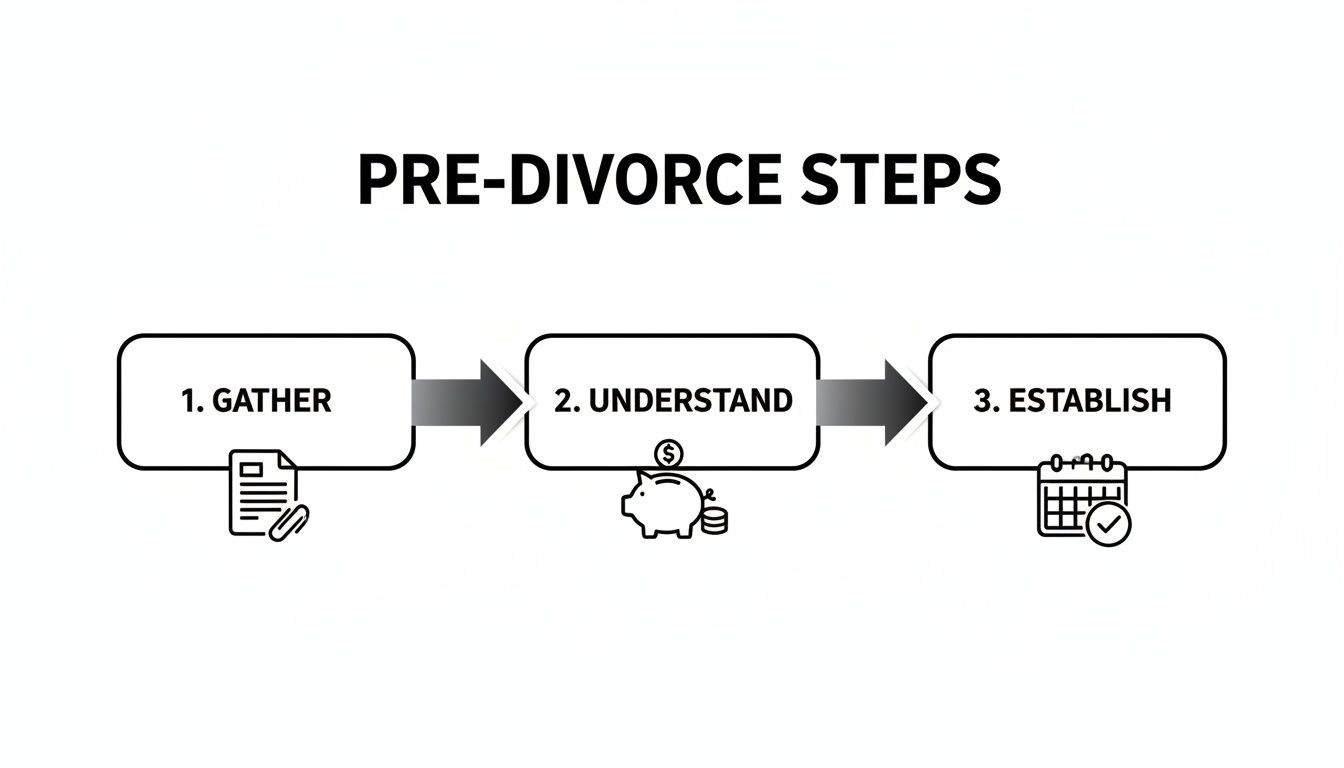
The process it shows is simple but powerful: gather your information, get a clear picture of your finances, and lock in your date of separation to establish a firm timeline.
Gather and Document Everything
Knowledge is power, especially when you are separating from a spouse. Start quietly collecting and making copies of all essential financial and personal documents. The key is to store these copies somewhere safe outside the marital home—with a trusted friend, at your office, or in a new safe deposit box.
Your document checklist should include:
- Personal Identification: Copies of passports, driver's licenses, social security cards, and birth certificates for yourself and your children.
- Financial Records: At least three years of tax returns, recent pay stubs for both you and your spouse, and statements from all bank, investment, and retirement accounts.
- Property Documents: Deeds to any real estate, vehicle titles, and statements for any mortgages or large loans.
- Insurance Policies: Life, health, auto, and homeowners insurance policies.
Along with these papers, start a simple inventory of major assets (furniture, art, jewelry) and all known debts (credit cards, personal loans). Finally, document the exact date you physically separated. Even a simple, clear email to your spouse stating, "As of today, [Date], we are separating," can serve as important evidence later.
It also helps to get a realistic sense of what lies ahead financially; you can learn more by reading our guide on how expensive divorce can be.
Our firm proudly serves all families in Pasco, Pinellas, and Hillsborough Counties, including those in the LGBTQ+ community. We handle gay divorce, gay custody issues, and gay or transgender name change issues with the respect and diligence every client deserves.
Securing Stability With Temporary Court Orders

When you’re separating, the time between filing for divorce and getting that final judgment can feel like you’re stuck in limbo. Bills keep coming, the kids need care, and your future feels uncertain, all without any clear rules to follow. Thankfully, you don’t have to wait months for a final decree to get much-needed help with finances or parenting.
Once a Petition for Dissolution of Marriage is filed in Florida, you can ask the court for what’s known as “temporary relief.” Think of these temporary orders as a set of legally enforceable ground rules for you and your spouse to live by while the divorce is ongoing. Their entire purpose is to create stability and predictability during an incredibly unstable time.
These court orders build a vital bridge, making sure one spouse doesn’t hold all the financial power and that your children’s lives stay as consistent as possible. They establish a temporary status quo so everyone can function until a permanent agreement is reached or a final judgment is entered by the judge.
What Can A Temporary Order Cover?
A motion for temporary relief can address the most pressing issues that pop up the moment a couple separates. The scope is intentionally broad, designed to tackle the immediate challenges families run into. A judge can issue orders that dictate several key aspects of your new, separate lives.
These orders aren't permanent, but they are absolutely critical for managing day-to-day life. For families in Pasco, Pinellas, and Hillsborough Counties, seeking temporary relief is often one of the very first strategic steps in the divorce process.
Common issues a judge can decide on a temporary basis include:
- Temporary Timesharing and Parenting Plan: This establishes a set schedule for when the children will be with each parent, giving them a much-needed sense of routine and predictability.
- Temporary Child Support: An order for one parent to pay a specific amount of child support based on Florida's guidelines, ensuring the children’s financial needs are covered.
- Temporary Alimony (Spousal Support): This can require the higher-earning spouse to provide financial support to the lower-earning spouse while the divorce case is active.
- Exclusive Use of the Marital Home: A judge can decide which spouse gets to live in the family home while the divorce is pending. This is often granted to the parent who has the majority of the timesharing with the children.
- Payment of Bills and Debts: The order can specify who is responsible for paying the mortgage, car payments, insurance, and other joint liabilities.
These orders are all designed to maintain the family’s financial footing and protect the well-being of any children involved.
How A Judge Decides
When a Florida judge looks at a request for temporary relief, their decision-making is guided by specific legal principles. The number one focus is always the best interests of the children and the financial realities of the family. A judge will look at the family’s historical standard of living and each spouse’s current ability to earn an income.
The court's main objective with temporary orders is to keep things as stable as possible. A judge tries to ensure that children's lives are disrupted minimally and that neither spouse is left in a dire financial situation while the legal case unfolds.
The process involves filing a formal motion and attending a hearing where both sides present their case with evidence, like financial affidavits and testimony. It is absolutely essential to provide accurate and thorough information to the court. An experienced attorney can help you prepare your motion and evidence to effectively demonstrate your needs and the family’s circumstances.
Our firm is committed to serving all families in Pasco, Pinellas, and Hillsborough Counties with the professionalism and care they deserve. We proudly handle all LGBTQ issues, family and divorce issues, and do not discriminate. Sometimes, a parent needs to act faster than a standard temporary relief motion allows. To learn more about those urgent options, you can read our article about how to get an emergency custody order in Florida.
Using A Separation Agreement To Control Your Future
Florida doesn't have a formal, court-ordered status called "legal separation." But that doesn't mean you and your spouse have to live in a state of chaos while you're apart. You have a powerful tool at your disposal to bring order and predictability to this difficult time: a private contract.
This document, often called a Postnuptial Agreement, works just like a detailed separation agreement. It lets you and your spouse—not a judge—define the rules of your separation. It's like creating your own personalized roadmap for the split. Instead of relying on verbal promises that can be forgotten or disputed, you create a legally binding document that clearly spells out everyone's rights and responsibilities.
This is a fantastic option for couples who need space and time before deciding on a divorce, or for those who plan to live apart indefinitely but need financial clarity and structure. You stay in the driver's seat, handling sensitive matters privately and on your own terms.
What Goes Into A Separation Agreement
A well-written Postnuptial Agreement can address almost every aspect of your separated lives. It’s your chance to answer the tough questions upfront, which goes a long way in preventing future conflict. The more you can agree on now, the less you'll have to argue about later.
The agreement can be as simple or as detailed as your family’s situation requires. Some of the most critical issues we help clients address include:
- Financial Responsibilities: Who is going to pay the mortgage? What about the car payments, credit cards, and other joint debts? Put it in writing.
- Asset and Property Use: Decide who gets to live in the marital home, who drives which car, and how other important assets are managed during the separation.
- Support Arrangements: Will one spouse pay the other temporary alimony (spousal support) during the separation? This is the place to define it.
- Parenting and Timesharing: A detailed parenting plan is a must. It should outline a specific timesharing schedule, how holidays will be handled, and who makes major decisions for the children.
- Child Support: Settle on a child support amount, typically based on Florida’s guidelines, to ensure your children are financially supported without interruption.
A Postnuptial Agreement is essentially a private rulebook for your family. It gives you the structure and enforceability of a court order but with the privacy and flexibility that only a private contract can offer—one designed by the two people who know the situation best.
The Importance Of Legal Counsel
While it’s tempting to try and work this out on your own to save money, drafting this kind of agreement without an attorney is a huge risk. A Postnuptial Agreement is a serious legal document with lasting financial and parental consequences. For a Florida court to consider it valid, it must be drafted correctly, signed freely and without coercion, and based on a full and honest financial disclosure from both spouses. You can see how these agreements are structured by reading about what a marital settlement agreement entails in our related guide.
Having an experienced family law attorney is non-negotiable. Your lawyer's job is to make sure the agreement is ironclad, that your rights are protected, and that the final document truly reflects what you both intended. At our law firm, we regularly guide clients across Pasco, Pinellas, and Hillsborough Counties in crafting these vital agreements. We are committed to making sure all our clients, including gay, lesbian, and other LGBTQ+ individuals separating from a spouse, have a strong, enforceable contract that provides security and much-needed peace of mind.
How Separation Impacts Your Assets, Debts, And Retirement

When you separate from a spouse, the financial stakes become very real, very quickly. In Florida, the legal "finish line" for accumulating marital property is the day one spouse files a Petition for Dissolution of Marriage. That single action starts the clock and draws a bright line with massive implications for your money, property, and future.
Think of everything you both built together as a shared financial pie. Everything earned, bought, or paid down during the marriage—from the wedding day until the day of filing—is generally considered part of that pie. Understanding how a judge will eventually slice it is crucial, and that process starts the moment you part ways.
This time between physically separating and legally filing can be a financial minefield. Any large purchases, new debts, or major withdrawals made by either spouse will be put under a microscope. Bad financial decisions now can seriously complicate your case and hurt you in the final division of assets.
Defining The Marital Estate
Florida is an equitable distribution state. This doesn't mean everything is split 50/50. It means a judge will divide your assets and debts in a way they consider fair. The first step is figuring out what’s on the table—what’s marital and what’s not.
- Marital Assets: These are things acquired by either spouse during the marriage. This bucket includes income, real estate, cars, bank accounts, investments, and even the increase in value of a pre-marital asset if marital labor or money contributed to it.
- Non-Marital Assets: This is generally anything you owned before the marriage, plus inheritances or specific gifts given to just one spouse. The key is that these assets must have been kept separate and not commingled with marital funds.
Once you’re living apart, every dollar matters. Draining a joint savings account for personal expenses or racking up a new credit card will not be looked upon kindly by a judge. This is why financial caution and smart planning are so important from day one. You might also need to get a handle on the complexities of selling your house during divorce.
Complex Assets And High-Net-Worth Situations
For many couples in the Tampa Bay area, the financial picture is far more complex than a single home and a couple of bank accounts. High-net-worth individuals and those in long-term marriages often have sophisticated portfolios that demand a specialized approach.
A key takeaway: The court's goal is a fair division. For complex assets, fairness requires an accurate valuation. You cannot divide what you cannot properly value.
Our firm regularly guides clients in Pasco, Pinellas, and Hillsborough Counties through these high-stakes situations. This work requires a meticulous, detailed approach to ensure nothing is missed.
Common complex assets we handle include:
- Business Valuations: Finding the true value of a family-owned or closely held business.
- Investment Portfolios: Dividing stocks, bonds, mutual funds, and other intricate investments.
- Real Estate Holdings: Equitably dividing multiple properties, from rentals to vacation homes.
- Executive Compensation: Properly accounting for stock options, restricted stock units (RSUs), and deferred compensation.
Our firm is committed to protecting the rights of all our clients, including gay and transgender individuals and those in the LGBTQ+ community. We make sure every asset is identified and correctly valued, fighting for a fair outcome no matter how complex the estate.
Dividing Retirement And Pensions
For most people, a retirement account is the single largest asset they own besides their home. For our first responders, law enforcement officers, and military service members, those specialized pensions represent years of dedication and are a massive part of the financial picture.
Here's the critical point: the portion of any retirement account or pension that was earned during the marriage is a marital asset and is subject to division.
Figuring out how to split these accounts is a technical process. It almost always requires a specific court order known as a Qualified Domestic Relations Order (QDRO). A QDRO is a special directive sent to the plan administrator, telling them exactly how to divide the benefits and pay the non-employee spouse their share.
We have deep experience with every kind of retirement plan, from standard 401(k)s and IRAs to the intricate pension systems for military members and first responders. To get a better feel for this, we invite you to read our guide on dividing retirement accounts in a Florida divorce. Protecting your future starts with protecting your share of these hard-earned benefits today.
Taking the First Step with a Florida Family Law Attorney
Deciding to separate is one of the hardest choices you’ll ever make. But once that decision is made, you don't have to figure out what comes next by yourself. The path forward isn't just about waiting to see what happens; it’s about making smart, proactive choices to protect yourself and your family.
Your first, most important move is to talk with an experienced Florida family law attorney. This is how you shift from feeling lost and worried to having a clear, strategic plan. A confidential consultation is your chance to get real answers and build a roadmap designed for your unique situation—one that protects your rights, your finances, and your children.
Your Path to Clarity
Think of a consultation with our firm as a private, strategic meeting that’s all about you. We’re here to listen to your story, answer your most pressing questions, and lay out a clear path forward. You’ll walk away with a solid understanding of your rights and options under Florida law.
Our job is to cut through the legal jargon and give you concrete, actionable steps. That might mean filing for divorce right away, negotiating a separation agreement, or asking the court for temporary relief. We want you to feel informed and in control, not overwhelmed by the process.
Navigating a separation is more than a legal process—it's a personal journey. The right legal partner doesn't just give you expert advice; they provide the compassionate support you need to make sound decisions during one of life's most stressful times.
Serving Our Entire Community
We are proud to serve families throughout Pasco, Pinellas, and Hillsborough Counties. Our firm was built on the principle that everyone deserves a strong, skilled advocate in their corner, regardless of their background or how their family is structured.
This commitment is at the heart of everything we do, and we’re dedicated to serving every client, including:
- Military families and first responders who face unique challenges with pensions, benefits, and demanding schedules.
- LGBTQ+ individuals and couples, offering knowledgeable guidance on everything from gay divorce and gay custody matters to gay or transgender name changes.
- Anyone who needs compassionate, no-nonsense representation for their family law issue.
We handle all family and divorce matters without discrimination. Your family’s well-being is our top priority. The next step is simple: contact us. Let us provide the guidance you need to protect your future.
Your Top Questions About Separation in Florida
When you're facing a separation, your mind is probably racing with very specific, urgent questions. You need clear answers. Here are some of the most common questions we hear from clients across Florida, answered directly.
Can I Make My Spouse Move Out Of The House?
This is one of the first questions people ask, and the answer is almost always no—at least not on your own. As long as you're married, you both have a legal right to live in the marital home.
To get what's called exclusive use and possession, you must first file for divorce. Then, you can ask a judge to grant you a temporary order to have the house to yourself. But you’ll need a compelling reason. A judge won't grant this just because things are uncomfortable. It’s typically reserved for serious situations, like proven domestic violence or a clear need to protect the best interests of your children. We regularly guide clients in Pinellas, Pasco, and Hillsborough Counties through the specific steps needed to petition the court for exclusive use.
Does the Date We Separated Matter for Dividing Assets?
This is a common point of confusion. The most important date for identifying what is and isn't a marital asset is typically the day the Petition for Dissolution of Marriage is filed—not the day you physically moved apart.
However, how you both act and what you do with your money after you separate absolutely matters. A judge has the discretion to look at your conduct during the separation when deciding on the final equitable distribution, alimony, and even who pays for the attorneys' fees. Bad financial decisions can come back to haunt you.
What If I Think My Spouse Is Hiding Money?
If you have even a hint of suspicion that your spouse is hiding assets, you need to tell your attorney right away. Don't wait. Florida law is very clear: both sides are required to provide complete and honest financial disclosure.
An experienced family law attorney has powerful tools to uncover the truth. We can use formal discovery methods—like subpoenas for bank records, depositions under oath, and even forensic accountants—to track down hidden funds, find undisclosed income, or trace property that was improperly moved. Our firm is skilled in handling these complex financial deep dives to ensure every marital asset is accounted for.
Do We Have to Be Separated for a Certain Amount of Time Before We Can Divorce?
No. Florida has no mandatory separation period before you can file for divorce.
The only time-based rule is for residency. At least one of you must have lived in Florida for the six months immediately before filing the divorce petition. You can even be living in the same house when you file the paperwork.
Navigating the immediate aftermath of a separation requires a clear head and a strategic plan. The attorneys at our law firm are here to build that plan with you, protecting your rights and your future from day one. Contact us for the professional support you need by visiting https://wfoleylaw.com.


