

TL;DR:
- Hiring an experienced Florida prenuptial agreement lawyer ensures your contract meets legal enforceability standards.
- Starting the process early and providing full financial disclosures help protect your agreement from future challenges.
Hire an experienced Florida prenuptial agreement lawyer to draft, review, or negotiate your prenup. Under Fla. Stat. §61.079, a premarital agreement must be in writing, signed by both parties, and executed voluntarily with full financial disclosure. Skipping qualified legal help exposes you to enforceability risks that no template can fix.
Before your consultation, have these ready:
- A complete list of your assets, debts, and income sources
- Two to three years of tax returns and recent bank or brokerage statements
- Any business ownership documents or real estate deeds
- A clear sense of what you want the agreement to cover
Ready to take the next step? Contact Foley Family Law to schedule a prenup consultation. Foley Family Law serves clients in Hillsborough, Pinellas, and Pasco counties.
Pro Tip: Call at least three to four months before your wedding date. Agreements signed too close to the ceremony face heightened duress scrutiny in Florida courts.
What does Florida law say a prenuptial agreement actually is?
Under Florida’s Uniform Premarital Agreement Act, a premarital agreement is a written contract between prospective spouses, made in contemplation of marriage and effective upon marriage. The statute, codified at §61.079, sets the baseline every prenup must meet: it must be in writing, signed by both parties, and requires no consideration beyond the marriage itself.
What prenups commonly address in Florida:
- Classification of separate versus marital property
- Modification or waiver of spousal support (alimony)
- Protection of business interests and professional practices
- Coordination with wills, trusts, and beneficiary designations
- Debt allocation and financial responsibilities during marriage
What prenups cannot do is equally important. Florida courts will not enforce child support or custody arrangements set in a prenup. Those matters are always decided by the court based on the child’s best interests at the time of any proceeding. A prenup that attempts to predetermine custody or waive child support is unenforceable on those specific points, regardless of how well the rest of the agreement is drafted.
When will Florida courts uphold or void your prenup?
Enforceability is where most prenup disputes actually play out. Florida courts apply a specific set of tests drawn from §61.079, and failing any one of them can unravel an otherwise well-drafted agreement.
The primary grounds for voiding a prenup in Florida:
- Involuntary execution: One party signed under duress, pressure, or coercion
- Inadequate financial disclosure: A party was not given fair and reasonable disclosure of the other’s assets, liabilities, and financial obligations, and did not voluntarily waive that disclosure in writing
- Unconscionability at execution: The agreement was so one-sided at the time of signing that enforcing it would be fundamentally unfair
- Conflict of interest: One attorney represented both parties without a clear, documented waiver
Timing is one of the most underappreciated risk factors. Signing too close to the wedding is a primary basis for duress challenges. When deposits are paid, travel is booked, and guests are invited, courts recognize that a party may feel they have no real choice but to sign. Signing at least 30 days before the wedding substantially reduces that exposure.
Disclosure is the other major battleground. Detailed disclosure schedules with supporting documents, such as tax returns, bank statements, and appraisals, are often the deciding evidence in enforcement disputes. A simple asset list is far weaker than a documented paper trail attached directly to the agreement.

Pro Tip: Date-stamp every exchange of financial documents and keep copies. If a challenge arises years later, that paper trail is your strongest defense.
What can and cannot go into a Florida prenup?
Florida law gives couples significant flexibility in what they can address, but there are firm limits.
Permissible clauses under §61.079:
- Division of property upon divorce or death
- Modification, limitation, or waiver of spousal support
- Disposition of property upon separation, dissolution, or death
- Protection of business interests and professional goodwill
- Choice-of-law and forum selection provisions
- Coordination with estate plans, trusts, and life insurance beneficiaries
Prohibited or limited provisions:
- Child support amounts or child custody arrangements (courts always decide these)
- Any provision that would leave a spouse eligible for public assistance at the time of dissolution
That last point catches many people off guard. Under §61.079, if a spousal support waiver would cause one party to qualify for public assistance at the time of separation or divorce, a court may override that waiver and require support to the extent necessary to avoid that outcome.
Vague language is a separate risk. Terms like “all property owned before marriage” without attached schedules and appraisals invite litigation over what was actually meant. Specificity, supported by documentation, is what separates a durable agreement from one that falls apart under cross-examination.
Do you actually need a lawyer to get a prenup in Florida?
Florida law does not require either party to have an attorney for a prenup to be valid. That said, independent legal representation is one of the most consequential decisions you can make about the agreement’s long-term enforceability.
Courts view prenups significantly more favorably when each party had separate counsel who explained the agreement’s terms, advised on their rights, and confirmed the signing was voluntary. When one attorney represents both parties, that creates a conflict of interest that courts scrutinize heavily. The unrepresented party can later claim they did not understand what they signed or felt pressured to agree.
Questions to ask when evaluating a prenup attorney:
- Do you recommend I retain separate counsel, or will you represent both of us?
- How do you handle financial disclosure schedules?
- What is your experience with prenup challenges in Hillsborough, Pinellas, or Pasco county courts?
- Do you offer flat-fee pricing, and what does it include?
If one party declines independent counsel, the drafting attorney should document a signed written waiver that explicitly states the party was advised to seek counsel, chose not to, and understands the agreement’s terms. Even with that waiver, courts still examine whether the disclosure was adequate and the terms were fair.
Pro Tip: Even if your partner declines their own attorney, insist on the written waiver language. It does not eliminate scrutiny, but it creates a record that the option was offered and declined.
How much does a Florida prenup cost, and how long does it take?
Cost and timeline are the two questions most couples ask first, and both depend heavily on the complexity of your assets.
Common fee structures:
- Flat fee: Offered by most attorneys for straightforward agreements with limited assets and minimal negotiation
- Hourly billing: Standard for complex matters involving business valuations, multiple properties, or high-net-worth situations
- Review-only fee: A lower flat fee for the second party’s attorney to review and negotiate a draft prepared by the other side
Market ranges for Florida prenups:
Attorney-drafted agreements for straightforward situations start around $3,000 and rise with complexity. For high-asset matters involving business interests, multiple properties, or blended families, costs commonly reach $5,000–$10,000 or more per party. DIY templates cost far less upfront but carry real unenforceability risk under Florida’s technical requirements. For readers managing significant assets, the high net worth divorce context makes that risk especially costly.
Recommended timeline:
- Start the process at least three to four months before the wedding
- Complete the initial consultation and asset inventory in week one or two
- Exchange full financial disclosure documents within two to three weeks
- Allow four to eight weeks for drafting and negotiation on a straightforward agreement
- Allow two to four months for complex agreements involving businesses or trusts
- Sign at least 30 days before the wedding to reduce duress exposure
Starting the process early is not just practical advice. It is a legal protection. Courts look at the gap between signing and the wedding date when evaluating whether a party had a genuine opportunity to review, negotiate, and decline.

What does the drafting process look like from start to finish?
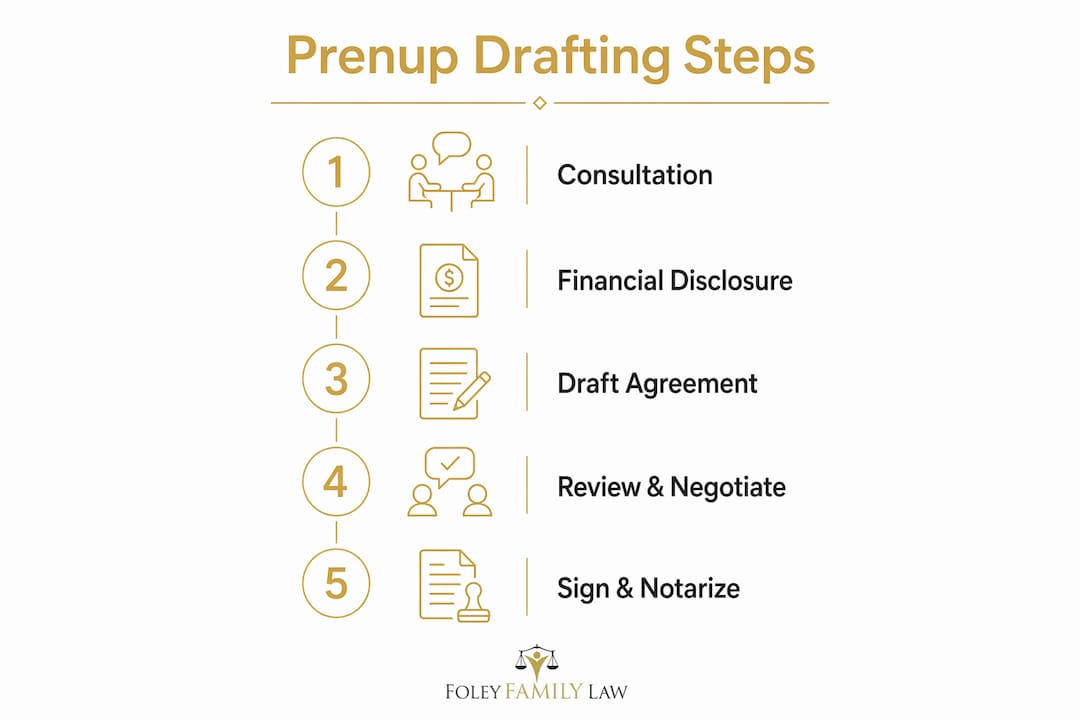
Knowing what to expect at each stage makes the process less stressful and helps you prepare the right documents at the right time.
Step-by-step process:
- Initial consultation: You and your attorney discuss your goals, identify assets and liabilities, and assess which provisions matter most to your situation.
- Financial disclosure exchange: Both parties provide complete documentation. This includes tax returns, bank and brokerage statements, real estate deeds, appraisals, and business financial statements where applicable. Each schedule should be attached directly to the final agreement.
- First draft: The drafting attorney prepares an initial agreement based on the client’s goals and Florida statutory requirements.
- Review and negotiation: The other party and their independent attorney review the draft, propose revisions, and negotiate terms. Expect multiple rounds.
- Final review: Both attorneys confirm the agreement complies with §61.079, addresses all major financial issues, and uses clear language.
- Signing: Both parties sign in person, ideally before a notary. Florida law does not require notarization, but it creates additional evidence of authenticity.
Documents to bring to your first meeting:
- Two to three years of federal tax returns
- Recent bank, brokerage, and retirement account statements
- Real estate deeds and mortgage statements
- Business ownership documents, operating agreements, or financial statements
- A list of significant debts, including student loans and credit lines
- Any existing estate planning documents (wills, trusts, beneficiary designations)
Attaching disclosure schedules with supporting documents to the agreement itself is one of the most practical steps you can take. It converts a list of claims into a documented record.
What if you are already married, or need to update an existing prenup?
Missing the prenup window before the wedding does not leave you without options. Florida law allows couples to enter a postnuptial agreement after marriage, addressing many of the same subjects a prenup would cover. The same enforceability standards apply: the agreement must be in writing, signed by both parties, and supported by adequate disclosure.
Under §61.079(6), an existing prenup can be amended, revoked, or abandoned after marriage only by a written agreement signed by both parties. No consideration beyond the agreement itself is required.
When to revisit your prenup or consider a postnuptial agreement:
- Birth of children or stepchildren entering the family
- Starting or acquiring a business
- Significant changes in income, inheritance, or asset values
- A major legal update that affects how the agreement would be interpreted
- Relocation to a different state with different marital property laws
Prenups are living documents in a practical sense. Major life events typically trigger a review, and an agreement that was fair and complete at signing may become outdated within a few years. For couples who want to understand how prenups and postnuptial agreements compare before deciding which path fits their situation, Foley Family Law’s comparison guide covers the key differences. Attorneys in New Hampshire similarly advise clients to revisit prenups after major life changes, reflecting a broadly shared best practice across jurisdictions.
What mistakes and red flags should you watch for?
Most prenup challenges trace back to a small set of avoidable errors, either in how the agreement was drafted or in how the attorney was chosen.
Drafting mistakes that invite challenges:
- Signing within days or weeks of the wedding
- Incomplete or undocumented financial disclosure
- Single-attorney representation without a clear written waiver
- Vague asset descriptions without attached schedules
- Provisions that attempt to govern child support or custody
- Missing signatures or improperly executed documents
Red flags when hiring a prenup attorney:
- Unwillingness to recommend independent counsel for the other party
- No clear fee estimate or refusal to discuss flat-fee options
- Reliance on generic templates without customization to your specific assets
- Pressure to sign quickly without adequate review time
- No discussion of financial disclosure requirements
If an attorney tells you a template is “good enough” without asking detailed questions about your assets, business interests, or family situation, that is a signal to look elsewhere. Tailored drafting and attached disclosure schedules are what separate agreements that hold up from those that do not.
How Foley Family Law handles prenups in Hillsborough, Pinellas, and Pasco counties
Foley Family Law focuses exclusively on family law, which means prenuptial and postnuptial agreements are not a side service. They are a core part of the practice. The firm serves clients across Hillsborough, Pinellas, and Pasco counties, and that local experience matters. Local court familiarity affects how prenup challenges play out, and attorneys who know the procedural expectations of county courts can anticipate issues before they arise.
William S. Foley leads the team with a client-centered approach that prioritizes transparent communication and realistic cost estimates from the first consultation. The firm’s process includes a document checklist, clear guidance on financial disclosure requirements, and a standing recommendation that both parties retain independent counsel.
What clients can expect from Foley Family Law:
- A thorough initial consultation covering goals, assets, and risk factors
- Transparent fee estimates, including flat-fee options for straightforward agreements
- A structured disclosure process with document checklists
- Consistent recommendation of independent counsel for the other party
- Guidance on timing to avoid duress exposure
- Ongoing availability for amendments, postnuptial agreements, and related family law matters
For clients with complex financial situations, the firm’s experience with high-profile and complex divorce matters translates directly into prenup drafting. Understanding how courts analyze asset division in contested divorces informs how a strong prenup should be structured before marriage.
Pro Tip: Ask your attorney how they handle the financial disclosure exchange. A firm with a clear, documented process for this step is far better positioned to defend the agreement if it is ever challenged.
Key Takeaways
A Florida prenup is only as strong as the process behind it. Hire an experienced prenuptial agreement lawyer early, exchange complete financial disclosure, and sign well before the wedding to protect enforceability under Fla. Stat. §61.079.
| Point | Details |
|---|---|
| Statute governs all prenups | Fla. Stat. §61.079 requires writing, signatures, voluntary execution, and full financial disclosure. |
| Sign at least 30 days early | Signing at least 30 days before the wedding substantially reduces duress claims in Florida courts. |
| Attorney-drafted costs | Straightforward agreements start around $3,000; complex or high-asset matters commonly reach $5,000–$10,000 or more. |
| Independent counsel matters | Courts view prenups far more favorably when each party had separate legal representation. |
| Foley Family Law | Serves Hillsborough, Pinellas, and Pasco counties with transparent fees, document checklists, and local court experience. |
Why prenups deserve more credit than they usually get
Most people approach a prenuptial agreement as a worst-case document, something you draft hoping you will never need. That framing misses the real value. A well-drafted prenup is one of the clearest acts of financial honesty a couple can undertake before marriage. It forces both parties to put their full financial picture on the table, discuss expectations about money and property, and reach a mutual agreement while the relationship is at its strongest.
What gets underestimated is how much the process itself matters, separate from the document. Couples who go through a thorough prenup negotiation with independent counsel on both sides tend to enter marriage with fewer financial surprises and more clearly defined expectations. The agreement is the output. The conversation is the real work.
The conventional wisdom that prenups are only for the wealthy is also worth questioning. Protecting a small business, a family inheritance, or a retirement account built over years of work is just as legitimate a reason to have one as protecting a real estate portfolio. Florida courts do not distinguish based on the size of the estate when evaluating enforceability. The same standards apply regardless of the dollar amounts involved.
Schedule a prenup consultation with Foley Family Law
Foley Family Law offers focused prenuptial agreement representation for couples in Hillsborough, Pinellas, and Pasco counties. The firm provides transparent fee estimates from the first call, a clear document checklist so you arrive prepared, and flat-fee options for straightforward agreements. For clients with complex assets, the team brings direct experience with high-asset family law matters that informs every stage of the drafting process.

Scheduling a consultation is the practical next step, whether you are three months from your wedding or just starting to think about a prenup. You can reach Foley Family Law by phone, through the online contact form, or by visiting the office. Learn more about what a family law attorney does and how Foley Family Law can help you protect your financial future before you say “I do.” Book your consultation at wfoleylaw.com/florida-prenuptial-agreement-lawyer.
This article provides general legal information about Florida prenuptial agreements and is not a substitute for advice from a qualified attorney about your specific situation. Confirm current statutory requirements with a licensed Florida family law attorney.
Useful sources
The following primary and practice sources support the information in this article and are worth reviewing directly.
- Fla. Stat. §61.079 (Florida Senate): The governing statute for all Florida prenuptial agreements. Read this to understand the exact formality, disclosure, and enforceability requirements your agreement must meet.
- Foley Family Law: Florida prenuptial agreement lawyer: The firm’s service page covering the prenup process, local experience, and how to schedule a consultation in Hillsborough, Pinellas, or Pasco counties.
- How to get a prenup: Florida guide for couples: A step-by-step guide from Foley Family Law covering timelines, required documents, and next steps for Florida couples.
- Postnuptial agreement in Florida: Practical guidance on postnuptial agreements and amendments for couples who marry without a prenup or need to update an existing one.
- Online prenuptial agreements in Florida: Explains the risks and limitations of DIY prenup services under Florida law, useful for understanding why attorney drafting matters.
FAQ
How much does a prenup lawyer cost in Florida?
Attorney-drafted prenups in Florida start around $3,000 for straightforward agreements and commonly reach $5,000–$10,000 or more for complex matters involving business interests or significant assets. There are no court filing fees since prenups are private contracts.
Do you need a lawyer for a prenup in Florida?
Florida law does not require either party to have an attorney, but independent legal representation significantly strengthens enforceability. Courts scrutinize agreements where one attorney represented both parties or where one party had no counsel and later claims they did not understand the terms.
What voids a prenup in Florida?
Under Fla. Stat. §61.079, a prenup can be voided if one party proves it was signed involuntarily, that financial disclosure was inadequate without a valid written waiver, or that the agreement was unconscionable at the time of execution. Signing under time pressure close to the wedding is a common basis for duress challenges.
What cannot be included in a prenup?
Florida prenups cannot set child support amounts or determine child custody and time-sharing arrangements. Courts always decide those matters based on the child’s best interests at the time of any proceeding. A spousal support waiver may also be partially overridden if enforcing it would leave one spouse eligible for public assistance.
When should you start the prenup process in Florida?
Start at least three to four months before your wedding date. The full drafting and negotiation process for a straightforward agreement typically takes four to eight weeks, and signing at least 30 days before the wedding substantially reduces the risk of a duress challenge in Florida courts.
Recommended
- Florida Prenuptial Agreement Lawyer Cost Explained – Foley Family Law
- Tampa Prenuptial Agreements Lawyer – Prenuptial Agreement in Florida: Ensuring Clarity & Security Before Marriage
- Finding A Florida Prenuptial Agreement Lawyer – Foley Family Law
- Postnuptial Agreement Florida: A Practical Guide To Protecting Your Assets – Foley Family Law


