

TL;DR:
- A prenup is signed before marriage, and a postnup is signed after a marriage has occurred.
- Both require full financial disclosure, independent legal counsel, and fair terms to be enforceable.
A prenup is the agreement you sign before marriage; a postnup is the one you sign after. If you are engaged and have time to plan, a prenuptial agreement is almost always the stronger legal choice. If you are already married and facing a major financial change, a postnuptial agreement is your practical path forward.
- Choose a prenup if you are engaged, own a business, expect an inheritance, or have significant assets or debts you want to protect before the wedding.
- Choose a postnup if you are already married and a major life event has changed your financial picture, or if you missed the window to do a prenup.
- Consult an attorney first if either spouse is under pressure, if the financial picture is complex, or if a divorce has been threatened recently.
Pro Tip: Sign a prenup well before the wedding. Courts in many states view last-minute signing as evidence of duress, which can void the agreement entirely.
What does a prenuptial agreement actually cover?
A prenuptial agreement is a written contract signed by two people before they marry. It takes effect the moment the marriage is legally recognized and governs how property, debts, and financial rights are handled if the marriage ends in divorce or death.
Common clauses include:
- Separate property protection: Keeps pre-marital assets, real estate, or investments in the name of the original owner.
- Division of marital assets: Sets a formula or specific allocation for property acquired during the marriage.
- Debt allocation: Clarifies which spouse is responsible for existing student loans, credit card balances, or business liabilities.
- Business protection: Shields a privately held business or professional practice from being treated as marital property.
- Spousal support terms: Waives, limits, or defines alimony in the event of divorce.
- Inheritance and estate coordination: Protects children from a prior relationship or aligns the agreement with an existing estate plan.
One firm limit applies regardless of what the agreement says: neither a prenup nor any other private contract can predetermine child support or custody. Family courts decide those matters based on the child’s best interests at the time of the dispute, not on what two people agreed to years earlier.
What makes a prenup enforceable? Courts look for full financial disclosure from both parties, independent legal counsel for each spouse, voluntary signing without pressure, and terms that are not grossly one-sided. Signing well before the wedding, rather than the night before, also matters. The Uniform Premarital Agreement Act, adopted in some form by many states, provides a statutory framework for these requirements, though the specifics vary by jurisdiction.

What is a postnuptial agreement and why do courts scrutinize them more?
A postnuptial agreement is a written contract signed by two people who are already married. The structure looks similar to a prenup, covering property division, debt allocation, spousal support, and estate coordination. The critical difference is the legal context in which it is signed.
Common reasons couples turn to postnups:
- A spouse receives a significant inheritance or gift after the wedding.
- One spouse starts, acquires, or sells a business during the marriage.
- The couple missed the opportunity to do a prenup and wants financial clarity now.
- The couple is working through a rough patch and wants to formalize a reconciliation plan.
- Estate planning needs have changed, particularly when blended families are involved.
Courts apply stricter scrutiny to postnups than to prenups because married spouses owe each other fiduciary duties. That relationship is fundamentally different from the arm’s-length bargaining that engaged couples can more easily demonstrate. A judge reviewing a postnup will look hard at whether one spouse had meaningful independent advice, whether full financial disclosure actually happened, and whether the terms are fair given the couple’s circumstances at the time of signing.
The practical consequence: procedural shortcuts that might survive a prenup challenge can sink a postnup. Sloppy disclosure, shared attorneys, or signing during a marital crisis all raise red flags that courts take seriously.

How do prenups and postnups compare side by side?
The table below captures the dimensions that most directly affect which agreement is right for your situation.
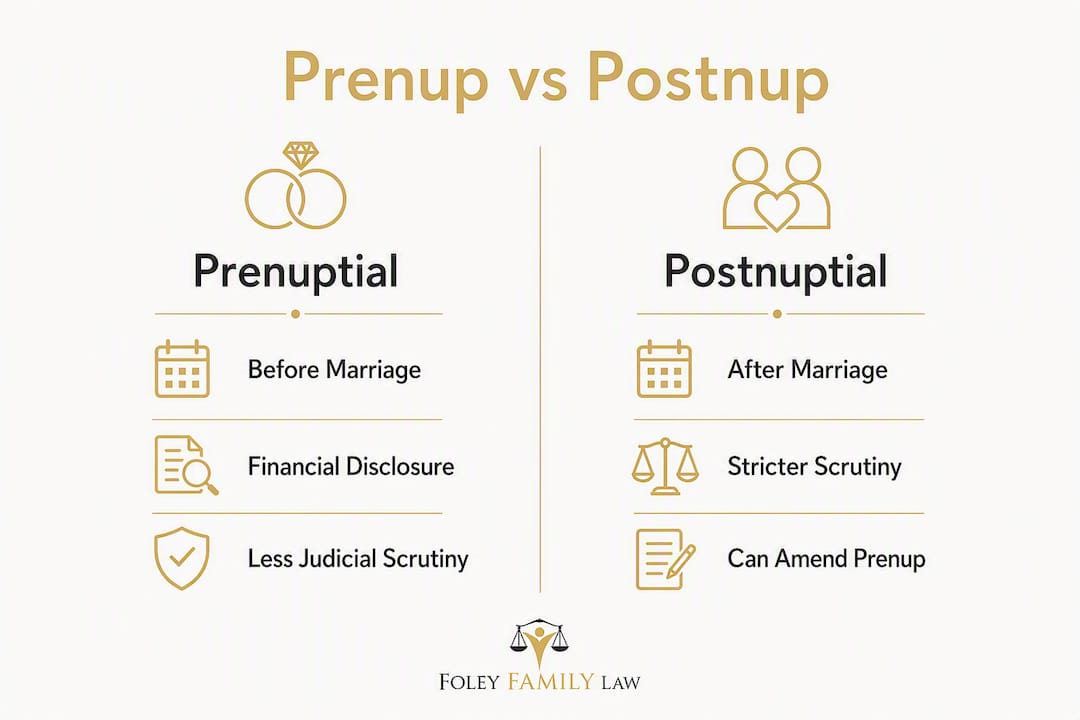
| Dimension | Prenuptial Agreement | Postnuptial Agreement |
|---|---|---|
| Timing | Signed before marriage | Signed after marriage |
| Typical motivation | Asset protection, debt separation, business shielding, estate planning | Major life event post-marriage, missed prenup, reconciliation planning |
| Enforceability standard | Lower judicial scrutiny; arm’s-length bargaining presumed | Higher judicial scrutiny; fiduciary duty between spouses applies |
| Disclosure required | Full financial disclosure from both parties | Full financial disclosure; courts examine it more closely |
| Independent counsel | Strongly recommended; required in some states | Strongly recommended; often treated as near-mandatory |
| Ability to modify a prior agreement | N/A (is the original agreement) | Can amend or replace a prenup if both spouses consent and state requirements are met |
| Common provisions | Separate property, asset division, debt, business, spousal support | Same as prenup; also inheritance events, business changes |
| Child support / custody | Cannot be predetermined | Cannot be predetermined |
| Typical U.S. cost | $1,500–$7,500; higher for complex estates | $1,500–$7,500; higher for complex estates |
Three realistic scenarios:
- Engaged with a family business: A prenup is the clear choice. You have time, you are bargaining at arm’s length, and the agreement will face less judicial resistance if challenged later.
- Married five years, just inherited property: A postnup addresses the changed circumstances directly. Work with separate attorneys and sign during a stable period, not during any active dispute.
- Married and now reconsidering a prenup you signed quickly: A valid postnup can amend or replace the earlier agreement, but it must independently satisfy your state’s postnup requirements. It does not simply “update” the prenup; it is a new contract with its own enforceability standards.
Pro Tip: Signing a postnup during a calm, financially stable period is not just good practice. It is evidence a court can use to confirm the agreement was voluntary, which is one of the first things a judge will examine.
When should you actually get one?
The right time depends on where you are in your relationship and what has changed financially.
Consider a prenup if you:
- Are engaged and have not yet married
- Own a business, professional practice, or significant investment portfolio
- Expect to receive an inheritance or are already named in a will
- Have children from a prior relationship whose inheritance you want to protect
- Are entering the marriage with substantial debt you do not want your spouse to absorb
Consider a postnup if you:
- Are already married and a major financial event has occurred
- Missed the window for a prenup and want similar protections now
- Are working through a difficult period and want financial terms formalized as part of a reconciliation
- Have started or sold a business since the wedding
Quick diagnostic: should you act now?
- Do you or your spouse own a business or hold significant separate assets? → Yes: consult an attorney this month.
- Has a major financial event (inheritance, business sale, funding round) occurred since you married? → Yes: a postnup is worth discussing now.
- Are you engaged with a wedding date set? → Yes: start the prenup process immediately, well before the 30-day mark.
- Is one spouse currently threatening divorce? → Stop. Do not sign anything. Get independent legal advice before proceeding.
If you answered yes to any of the first three questions, the right move is to schedule a consultation with a family law attorney. If you answered yes to the last question, that is even more urgent.
What makes these agreements vulnerable in court?
Courts evaluate both types of agreements against the same core factors, though postnups face a higher bar on each. Understanding these tests helps you avoid the mistakes that most commonly lead to invalidation.
The five enforcement tests:
- Voluntariness: Both spouses must sign freely, without pressure or coercion. A postnup signed while one spouse is actively threatening divorce can be treated as evidence of duress and voided by a court.
- Full financial disclosure: Each party must fully disclose assets, debts, income, and liabilities. Hiding a retirement account or undervaluing a business interest is grounds for invalidation.
- Independent counsel: Each spouse should have their own attorney review the agreement. A single attorney representing both parties creates a conflict of interest that courts notice.
- Substantive fairness: Terms that are grossly one-sided, stripping one spouse of nearly all marital rights, can be found unconscionable and unenforceable.
- Proper execution: The agreement must be in writing, signed by both parties, and in many states notarized. Verbal agreements and unsigned drafts have no legal standing.
State-law variations matter. Minnesota, for example, presumes under Minn. Stat. § 519.11 that a postnup signed less than two years before a divorce filing is unenforceable in certain circumstances. Florida and Colorado differ in how they treat the consideration requirement for marital agreements. Enforceability rules in Utah differ again, as outlined in state-specific prenuptial agreement guidance for that jurisdiction. The point is that no two states are identical, and what works in one may fail in another.
Common pitfalls to avoid:
- Rushing a prenup in the final days before the wedding
- Signing a postnup during an active marital dispute or separation
- Failing to attach a complete financial disclosure schedule to the agreement
- Using one attorney for both spouses
- Including punitive terms designed to punish rather than protect
How do you create a valid prenup or postnup?
The process is straightforward when you follow it in order. Skipping steps is where agreements fall apart.
- Start early. For a prenup, begin well before the wedding. For a postnup, initiate the process during a stable period, not during a dispute.
- Compile a complete financial picture. List all assets, debts, income sources, and liabilities for both spouses. Attach this as a formal disclosure schedule to the agreement.
- Hire separate attorneys. Each spouse retains independent counsel to review and negotiate the terms. This is the single most important procedural step for enforceability.
- Draft with precision. Clauses should be specific: named accounts, described properties, defined formulas for division. Vague language invites litigation.
- Review and negotiate. Both attorneys review the draft. Revisions are normal and healthy; they demonstrate that both parties engaged meaningfully with the terms.
- Sign with proper formalities. Both spouses sign in front of a notary. Some states require witnesses as well. Check your state’s specific requirements.
- Keep copies and documentation. Store signed originals securely. Retain the financial disclosure schedules, attorney correspondence, and any drafts that show the negotiation process.
- Review periodically. Major life changes (children, business growth, inheritance) may warrant revisiting the agreement. A postnup can update a prenup when circumstances shift significantly.
On cost: most prenups and postnups in the U.S. run from $1,500 to $7,500 for standard matters. High-net-worth situations involving business valuations, multiple properties, or complex investment portfolios push costs higher. For readers managing significant assets, the drafting cost is a fraction of what contested litigation over those assets would cost later. For additional perspective on managing legal costs, Foley Family Law’s divorce financial preparation guide covers practical budgeting strategies.
When should you call a family law attorney?
Some situations call for professional guidance before you take any other step. If any of the following apply, do not rely on a template or online form.
- You or your spouse owns a business, professional practice, or equity stake in a company.
- There is a significant income or asset disparity between spouses.
- Either spouse expects a substantial inheritance or is already named in an estate plan.
- Children from a prior relationship have inheritance interests that need protection.
- One spouse has previously threatened divorce or separation.
- You have an existing prenup you want to modify or replace.
- There are existing court orders (support, custody, property) that intersect with the proposed agreement.
A family law consultation typically covers a review of your financial disclosures, an assessment of what a court in your state would likely enforce, and a discussion of drafting strategy. Foley Family Law handles prenuptial and postnuptial agreement drafting, negotiation, and enforceability assessments for clients in Hillsborough, Pinellas, and Pasco counties. If you fall into any of the categories above, understanding what a family law attorney does is a practical first step before you commit to any agreement.
Key Takeaways
A prenup is almost always easier to enforce than a postnup because engaged couples bargain at arm’s length, while married spouses owe each other fiduciary duties that courts scrutinize closely.
| Point | Details |
|---|---|
| Timing is the core difference | A prenup is signed before marriage; a postnup is signed after. Earlier is generally stronger legally. |
| Enforceability requires four things | Voluntariness, full financial disclosure, independent counsel for each spouse, and fair terms are non-negotiable. |
| Postnups have common triggers | Inheritance, a business event, or a missed prenup are the most frequent reasons couples draft a postnup after marriage. |
| Child support and custody are off-limits | Neither agreement can predetermine child support or custody; courts decide those based on the child’s best interests. |
| Foley Family Law serves local clients | Foley Family Law drafts, negotiates, and assesses prenups and postnups for clients in Hillsborough, Pinellas, and Pasco counties. |
The agreement that actually holds up is the one drafted carefully
Most couples who contact Foley Family Law about a prenup or postnup are not in crisis. They are planning ahead, or they have just experienced a financial change that made them realize they need clarity. That is exactly the right time to act.
What the firm consistently sees is that the agreements that fail in court share the same problems: rushed timelines, incomplete disclosure, and one attorney trying to serve both spouses. The agreements that hold up are the ones where both parties had independent advice, the financial picture was fully documented, and no one signed under pressure.
There is also a common misconception worth addressing directly. Many couples assume a postnup is a weaker, second-best option compared to a prenup. That is not accurate. A carefully drafted postnup, signed during a stable period with full disclosure and independent counsel, can be just as protective as a prenup. The higher judicial scrutiny postnups face is a reason to be more careful in drafting, not a reason to avoid them. If you are already married and need financial clarity, a postnup is the right tool. Use it correctly.
Foley Family Law helps couples in Tampa Bay get these agreements right
Couples in Hillsborough, Pinellas, and Pasco counties who need a prenuptial or postnuptial agreement drafted, reviewed, or assessed for enforceability have a local option that handles exactly this kind of work.

Foley Family Law provides prenup and postnup drafting, negotiation support, and enforceability assessments tailored to Florida law. The firm’s approach prioritizes full financial disclosure, independent representation for each spouse, and agreements built to withstand judicial review. For clients with complex assets, the firm also handles high-net-worth divorce matters where these agreements are most consequential. Enforceability always depends on the specific facts of your situation and the law of your state. To find out where your situation stands, schedule an initial consultation with Foley Family Law directly through wfoleylaw.com.
This article is general information, not legal advice. Consult a qualified family law attorney to evaluate your specific circumstances under applicable state law.
Useful sources
The following sources provide authoritative background on prenuptial and postnuptial agreements. State-specific rules vary significantly; always confirm current requirements with an attorney licensed in your state.
- Uniform Premarital Agreement Act — Cornell Law School Legal Information Institute: The federal statutory framework adopted in varying forms across many states.
- Prenup vs. Postnup: Pros, Cons, and What You Need to Know — Nolo: Plain-language overview of enforceability standards and state-law variations, including Minnesota’s timing rule.
- Prenup vs Postnup: Differences & Costs — PrenupByState: Covers cost ranges, enforceability factors, and the fiduciary-duty distinction between the two agreement types.
- Prenup vs. Postnup: Differences, Use Cases, and How Courts Treat Each — The Complete Lawyer: Detailed analysis of the four enforcement factors courts apply to both agreement types.
- Prenup vs. Postnup: Key Differences in California — Provinziano: State-specific perspective useful for understanding how courts apply child-support limits and fiduciary standards.
- Foley Family Law — Prenuptial Agreement vs Postnuptial Agreement: Florida-focused comparison with practical guidance for couples in Hillsborough, Pinellas, and Pasco counties.
These resources are for background research. For advice specific to your situation and state, consult a licensed family law attorney.
FAQ
Is it better to get a prenup or a postnup?
A prenup is generally easier to enforce because engaged couples bargain at arm’s length, while married spouses face higher judicial scrutiny due to fiduciary duties. If you are still engaged, a prenup is the stronger choice; if you are already married, a carefully drafted postnup with independent counsel for each spouse can provide comparable protection.
Can a postnup override a prenup?
Yes. A valid postnuptial agreement can amend or replace an earlier prenup, but both spouses must consent and the postnup must independently satisfy your state’s postnup requirements. It is a new contract, not a simple amendment, and it carries its own enforceability standards.
What are the disadvantages of a postnuptial agreement?
Postnups face stricter judicial scrutiny than prenups because courts presume that married spouses may have unequal bargaining power. A postnup signed during a marital dispute or while one spouse is threatening divorce is particularly vulnerable to being voided for duress.
What can neither a prenup nor a postnup decide?
Neither agreement can predetermine child support or custody arrangements. Family courts retain authority over those matters and will decide them based on the child’s best interests at the time of the proceeding, regardless of what any private contract says.
How much does a prenup or postnup typically cost in the U.S.?
Most prenups and postnups in the U.S. cost between $1,500 and $7,500 for standard matters, with higher fees for complex situations involving business interests, multiple properties, or high-net-worth estates.


