

You’ve heard of a prenup, but what about its lesser-known cousin, the postnup? A postnuptial agreement is a legal contract you and your spouse sign after you’re already married. It lays out the ground rules for how your assets and debts will be handled if you divorce or one of you passes away.
Unlike a prenup, a postnup is created when your financial lives are already tangled together. This makes it an incredibly useful tool for couples who go through big financial shifts during their marriage. It’s not about planning for a breakup; it’s about smart, proactive financial planning for the future you’re building together.
What Is A Postnuptial Agreement In Florida

Think of a postnuptial agreement as a financial roadmap for your marriage. It’s a written contract you and your spouse create to clarify your financial rights and responsibilities from this point forward. This has become especially relevant for couples navigating the complexities of modern life, particularly those in the 35 to 65 age range.
While most people think of marital agreements as something you sign before the wedding, a postnup addresses your financial reality as it stands today. Life happens. The financial picture you had on your wedding day can look completely different a decade later, and a postnup acknowledges that evolution. For couples here in Pasco, Pinellas, and Hillsborough Counties, taking this step provides clarity and security.
Why Couples Create Postnups
Couples decide to create a postnuptial agreement for all sorts of reasons, usually tied to major life events that shake up their finances. This isn’t about a lack of trust. It’s about a commitment to open communication and protecting each other.
Common reasons we see include:
- A big change in assets: Maybe one spouse gets a large inheritance or starts a business that takes off.
- Career shifts: One spouse might step back from their career to raise children or support the other’s ambitions, which impacts their own earning potential down the road.
- Protecting a family legacy: An agreement can ensure that family assets, like a business or heirloom property, are kept safe for future generations.
- Putting financial arguments to rest: Sometimes, just creating a clear plan for managing money can resolve ongoing tension and actually make a marriage stronger.
The demand for these agreements has been growing across Florida. Family law attorneys in metro areas like Tampa are reporting more and more couples creating postnups after a major financial event, like launching a new company or inheriting family wealth.
At its core, a postnuptial agreement is an exercise in transparency. It forces honest conversations about money, expectations, and the future, making sure both partners are on the same page.
Our firm is committed to serving all families. This includes LGBTQ couples, who may have unique financial and family structures that really benefit from the kind of clarity a postnup provides. We handle all LGBTQ issues, family and divorce issues, and do not discriminate.
While a postnup serves a similar purpose to a prenup, it’s important to understand the critical differences between a prenup and postnup to figure out which one, if any, is right for you.
Crafting An Enforceable Florida Postnup

For a postnuptial agreement in Florida to actually protect you, it needs to be built with precision, meeting some very specific legal standards. This isn’t like a standard business contract. A postnup is an agreement between two people who already owe a legal and financial duty to each other as spouses.
Because of this existing relationship, Florida courts don’t just rubber-stamp these documents. They look at them under a microscope to make absolutely sure everything is fair and transparent. Think of it like building a house in a hurricane zone—you can’t just toss up some walls and hope for the best. It needs a rock-solid foundation and has to meet strict building codes, or it will crumble under pressure. A postnup is no different.
The Foundation Must Be In Writing
The most basic requirement is simple: a postnuptial agreement has to be a written document. A verbal promise or a casual chat over dinner about “what would happen if” means nothing in a Florida courtroom. It won’t hold up.
This written document must also be signed voluntarily by both you and your spouse. And “voluntarily” is the key word here. It means nobody was pressured, tricked, or forced into signing. The decision has to be completely free from any kind of coercion. A judge will want to be certain that both of you signed with clear eyes and a willing heart. But this is just the first step. The legal requirements go much deeper to protect everyone involved.
Full Financial Disclosure: The Cornerstone Of Fairness
This is the big one. The single most critical element of a postnup that will actually hold up in court is full and fair financial disclosure. Once you’re married, Florida law says you owe each other a duty of complete honesty, especially when it comes to money. You can’t hold anything back.
Both of you must provide a complete, accurate inventory of your financial lives. This isn’t a high-level summary; it’s a detailed list that includes everything:
- Assets: Every bank account, piece of real estate, investment portfolio, retirement fund, business interest, and valuable item you own.
- Liabilities: Mortgages, car loans, credit card balances, student debt, and any other money you owe.
- Income: Your salary, bonuses, business profits, investment returns—every dollar coming in.
Trying to hide an asset or lowball the value of a business is the fastest way to get your agreement thrown out by a judge. This level of transparency ensures both of you are making informed decisions based on the complete financial picture. The same strict standards of honesty apply when evaluating prenuptial agreements, a topic we cover in our guide on how to determine if your prenup is valid.
Florida law recognizes postnuptial agreements, but courts subject them to closer judicial scrutiny because spouses owe one another fiduciary-type duties after marriage. This means an agreement must not be the product of coercion, must include full disclosure, and must be fair when it is executed.
The Importance Of Separate Legal Counsel
While it isn’t legally required in every single scenario, having separate and independent attorneys is one of the strongest moves you can make to protect your postnup’s validity. When each spouse has their own lawyer, it sends a clear signal that the agreement was negotiated fairly and that both people received advice focused solely on their own best interests.
Hiring one attorney to represent both of you is a major red flag and creates an immediate conflict of interest. At our firm, serving clients across Pasco, Pinellas, and Hillsborough Counties, we insist that each spouse retain their own counsel. It’s a simple step that goes a long way toward proving the agreement was signed willingly and without undue influence, making it far more likely to be upheld by a Florida court.
What You Can And Cannot Include In Your Agreement
Think of a postnuptial agreement as the financial rulebook for your marriage, written by you and your spouse after you’ve already tied the knot. It’s your chance to create a clear, agreed-upon blueprint for how you’ll handle your finances from this point forward. This isn’t about planning for failure; it’s about providing certainty and preventing misunderstandings down the road.
The core purpose of a postnuptial agreement in Florida is to draw a bright line between what’s “yours,” “mine,” and “ours.” Instead of letting a court decide how to classify property or manage debts years from now, you take control. This is especially vital for couples here in Pasco, Pinellas, and Hillsborough Counties who may have built up significant assets together and want clarity on how they’re managed.
Defining Your Financial Landscape
One of the most powerful things a postnup does is define and protect property. You get to decide, in black and white, which assets are separate and which are marital.
Here’s a look at what that usually covers:
- Separate Property: You can formally designate specific assets as belonging to just one spouse. This is perfect for things like a family business, an inheritance that came through during the marriage, or a pre-marital investment that has since ballooned in value.
- Marital Property: The agreement clarifies how assets and debts acquired together from the day you sign it will be handled if the marriage ends. This can cover everything from the house you bought last year to investment accounts and retirement funds.
- Spousal Support (Alimony): You have the power to pre-determine the terms of alimony. You can set a specific amount, decide how long payments would last, or even waive the right to alimony entirely—as long as that waiver is fair and doesn’t leave one spouse destitute.
- Debt Responsibility: A postnup can make it crystal clear who is on the hook for which debts. This is a huge benefit, as it can shield one partner from the other’s financial liabilities, like student loans or business debt.
This level of detail is quite similar to what you’d find in a prenuptial agreement, just with a different starting point. You can read more about what’s typically covered in a Florida prenuptial agreement to see the parallels.
The Lines Florida Law Will Not Let You Cross
While a postnup gives you significant control over your financial future, its authority isn’t absolute. Florida law draws a hard line around certain issues, refusing to let couples make decisions that involve the well-being of others or go against public policy.
The most important restriction involves children. A postnuptial agreement cannot—under any circumstances—determine child custody, parenting time, or child support. These matters must be decided by a court based on the “best interests of the child” at the time of a potential separation or divorce.
A judge must always have the final say on matters involving minor children because their needs are constantly evolving. This principle is a cornerstone of Florida family law and is completely non-negotiable.
It’s crucial to understand that postnuptial agreements in Florida are designed to address marital assets and debts. They legally cannot dictate child custody or support, which are handled through separate legal tools like joint custody agreements.
Furthermore, you cannot include any terms that seem to encourage or incentivize divorce. A postnup is meant to organize finances within the marriage, not to create a financial windfall for one spouse if they decide to leave. Any clause a court views as undermining the marriage could be thrown out, potentially putting the entire agreement at risk. Our firm, which serves all members of the community, including handling all LGBTQ issues, makes certain every agreement we draft adheres strictly to these legal and ethical boundaries.
The Step-By-Step Process For Creating Your Postnup
Figuring out how to create a postnuptial agreement here in the Tampa Bay area might seem overwhelming, but it doesn’t have to be. Let’s walk through the journey, turning what feels like a dry legal task into what it really is: a collaborative financial planning session for your marriage.
The entire process is built on a foundation of open communication and transparency. The goal is to make sure both you and your spouse feel secure and respected every step of the way.
It all starts with a simple conversation. Before any lawyers get involved, you and your spouse need to talk honestly about your goals. What are you hoping to achieve with this agreement? Are you trying to protect a new business venture, shield an inheritance, or just bring some much-needed clarity to your shared finances? This initial discussion sets the tone for a productive, cooperative process.
Securing Independent Legal Counsel
Once you’ve decided to move forward, the next step is non-negotiable: each of you must hire your own family law attorney. I can’t stress this enough—you cannot share a lawyer.
In Florida, it’s a hard-and-fast rule that each spouse needs independent legal representation. This ensures that your individual interests are protected and prevents any claims of coercion or unfairness down the road, which could get the entire agreement thrown out.
Your attorney is your advocate. They’ll explain the ins and outs of Florida law, advise you on your rights, and help you articulate what you want out of the agreement. This is a vital part of making sure the final document is both fair and legally sound. When you’re getting ready for that first meeting, it helps to gather your thoughts and key documents. Many of the preparation steps are similar to what you’d do for an initial divorce consultation; you can learn more in our guide on preparing for your first meeting with a Tampa divorce attorney.
The Financial Disclosure Phase
With your attorneys in place, you’ll move into the financial disclosure phase. This is the absolute heart of creating a valid postnuptial agreement in Florida. Both you and your spouse will need to provide a complete and honest picture of all your assets, debts, and income.
Being upfront here is critical. Hiding assets or misrepresenting your finances is the fastest way to invalidate the entire agreement later on.
This stage involves gathering documents like:
- Bank and investment statements
- Recent tax returns
- Property deeds and mortgage statements
- Any business valuations
- Retirement and 401(k) account information
- Credit card and loan statements
This flowchart can help you visualize what you can and can’t include in a Florida postnup.
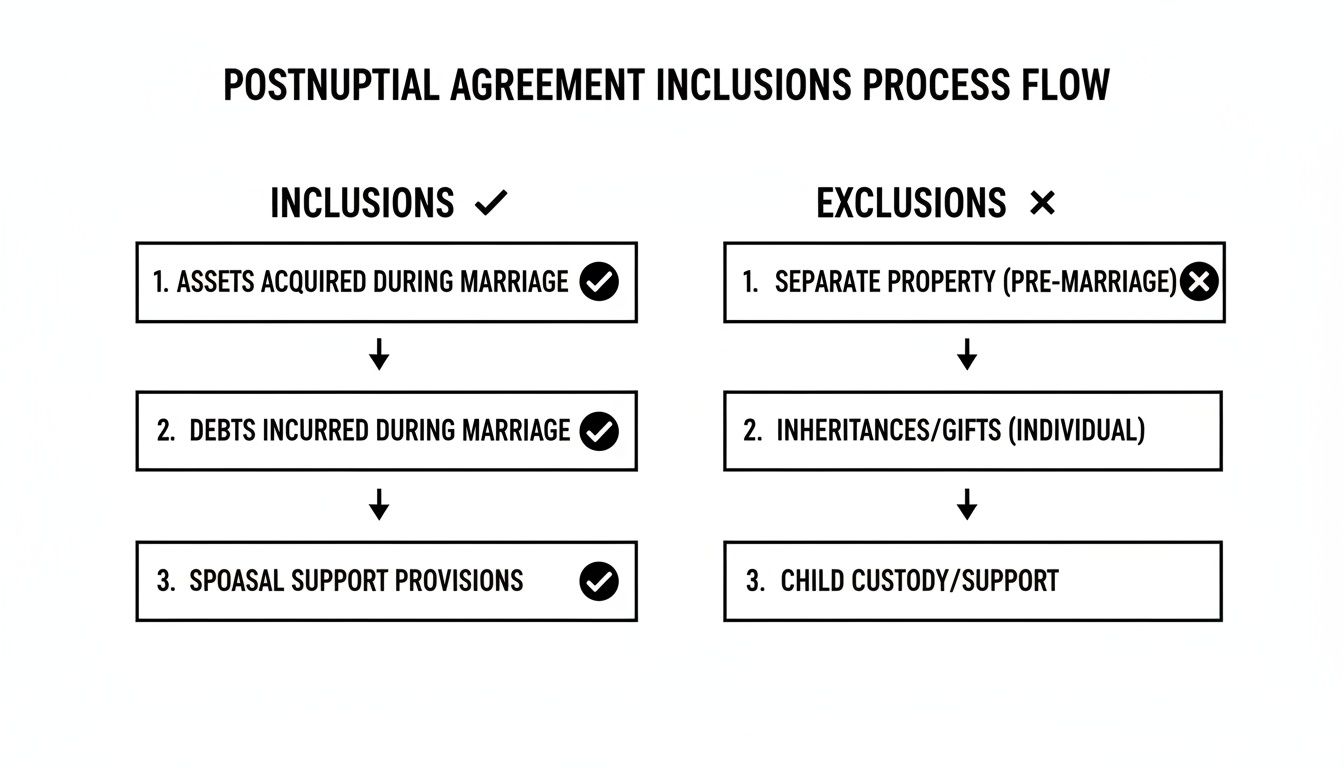
As you can see, it clearly separates financial matters like asset division from personal matters like child custody, which legally cannot be decided in a postnup.
Drafting, Negotiating, And Finalizing The Agreement
Once everyone has laid their financial cards on the table, the attorneys get to work drafting the agreement based on your goals. One lawyer will typically prepare the first draft, which then gets reviewed by the other party and their attorney.
This usually leads to a negotiation period where the terms are tweaked and refined until both of you are satisfied. Your lawyer will handle the back-and-forth on your behalf, working to shape a final document that aligns with Florida law and what you set out to accomplish.
The final step is the review and signing. You’ll sit down with your attorney and go through the final version of the agreement, line by line, to make sure you understand every single clause.
Once both of you give the green light, you’ll sign the document, usually in the presence of a notary to make it official. At our firm, serving Pasco, Pinellas, and Hillsborough Counties, we guide our clients—including all members of the LGBTQ community—through this process with care, ensuring the final agreement is a proactive step toward a secure financial future together.
Common Mistakes That Can Invalidate Your Agreement
A postnuptial agreement is a powerful financial tool, but it’s only as strong as its legal foundation. A simple mistake during its creation can render the entire document useless, leaving you without the protections you thought you had. Understanding these common pitfalls is the first step toward building an agreement that can actually withstand legal scrutiny in Florida.
Think of it like this: you wouldn’t build a house on unstable ground. Similarly, your postnup must be built on a bedrock of fairness, transparency, and proper legal procedure. If any of those elements are missing, the whole structure can collapse right when you need it most.
The goal is to create a document that a court will look at and see as a fair and willing pact between two informed adults. Let’s walk through the critical errors that can put your agreement in jeopardy and, more importantly, how to avoid them.
The Red Flag Of Incomplete Financial Disclosure
The single fastest way to invalidate a postnuptial agreement in Florida is through incomplete or dishonest financial disclosure. Once you are married, Florida law imposes a fiduciary duty on spouses—a high standard of honesty and good faith. Hiding an asset or downplaying the value of a business isn’t just a small oversight; it’s a direct violation of that duty.
If one spouse discovers that the other wasn’t truthful about their finances when the agreement was signed, they have incredibly strong grounds to challenge its validity. A judge could throw the entire document out, returning you to square one where state law—not your agreement—dictates the division of your assets.
This is precisely why the disclosure phase is so rigorous. It’s not just about listing assets; it’s about providing proof and ensuring both parties have a complete and accurate financial picture before making any long-term decisions.
Pressure, Coercion, And Duress
For a postnup to hold up in court, it must be signed voluntarily. This means both spouses entered into the agreement of their own free will, without being pressured, threatened, or manipulated. Any hint of coercion or duress can be fatal to the agreement’s validity.
So, what does coercion actually look like? It could be one spouse threatening to file for divorce if the other doesn’t sign. It could also be springing the document on them with an ultimatum, leaving no time for careful consideration. A court will examine the circumstances surrounding the signing to ensure the process was fair from start to finish.
A key factor in proving voluntariness is whether each spouse had adequate time to review the document and, crucially, whether they had the opportunity to consult with their own independent legal counsel. This is why having separate attorneys is a best practice we strongly recommend to all our clients in Pasco, Pinellas, and Hillsborough Counties.
The Dangers Of Vague Language And DIY Templates
In the world of legal documents, clarity is everything. Using vague, ambiguous, or confusing language is a recipe for disaster. If a clause can be interpreted in multiple ways, it just opens the door for expensive and time-consuming legal battles down the road.
This is the primary danger of using generic, one-size-fits-all templates downloaded from the internet. Those documents aren’t tailored to your specific financial situation or to the nuances of Florida law. They often contain boilerplate language that may not accurately reflect your intentions or could even conflict with state legal principles.
Your financial life is unique. Your postnuptial agreement should be a custom-drafted document created by an experienced family law attorney who understands your goals. This customized approach ensures every clause is clear, specific, and designed to protect your assets and intentions, providing the only real security for your financial future. Our firm serves all members of the community, including all LGBTQ family and divorce matters, ensuring every agreement is meticulously drafted to be legally sound.
Understanding The Cost And Timeline Involved
When you start thinking about a postnuptial agreement in Florida, two very practical questions usually pop up right away: How much is this going to cost, and how long is it going to take? It helps to think of this not as just another bill, but as a strategic investment in your financial clarity and peace of mind.
There’s no one-size-fits-all price tag. The cost is tied directly to the complexity of your financial life. A couple with straightforward W-2 jobs and a single house will have a much different experience than a couple who needs to account for business valuations, multiple properties, and complicated investment portfolios.
Factors Influencing Legal Fees
The biggest driver of cost is the attorney’s time. The more intricate your finances are and the more back-and-forth is needed to get on the same page, the more time it will take to draft a fair, solid, and enforceable agreement.
- Financial Complexity: Simple asset structures mean lower costs. Complex estates involving businesses, trusts, or inherited assets require a much deeper dive.
- Level of Negotiation: If you and your spouse are mostly in agreement from the start, the process is quicker and less expensive. If there are major disagreements on key terms, your attorneys will need more time to negotiate a resolution.
- Fee Structure: For very simple, uncontested agreements, an attorney might offer a flat fee. More often, they will bill hourly for complex cases with a lot of negotiation. It’s critical to understand how you’ll be billed upfront. You can get a better handle on this by reviewing our guide on Florida family law attorneys’ fees.
While a basic review of a simple document might only be a few hundred dollars, a full drafting and negotiation project typically starts in the low thousands. For cases with really intricate financial details, that number can rise significantly. You can discover more insights about Florida postnuptial agreement costs to get a broader market perspective.
Setting Realistic Timeline Expectations
The timeline for getting a postnup done is also a moving target. If the agreement is simple and both spouses are working together collaboratively, you could have a finalized document in just a few weeks. This assumes everyone provides their financial information promptly and there isn’t much to negotiate.
However, for agreements that require deep financial analysis, professional valuations (like for a business), or extensive negotiation, the process can easily stretch out over several months.
It’s absolutely crucial to allow enough time for careful drafting and a thorough review by both sides. Rushing the process is a classic mistake that can lead to costly errors or oversights down the road. At our firm, serving Pasco, Pinellas, and Hillsborough Counties, we guide you through the process at a pace that ensures your agreement is meticulously crafted and legally sound.
Frequently Asked Questions About Florida Postnups
When you start digging into the details of a postnuptial agreement in Florida, it’s natural for questions to pop up. We’ve put together this final section to give you clear, straightforward answers to the most common inquiries we hear from our clients across Pasco, Pinellas, and Hillsborough Counties. Our goal is to help you feel more confident about the entire process.
Can We Change A Postnuptial Agreement Later On?
Yes, a postnuptial agreement isn’t set in stone. Life changes, and your agreement can, too. You can modify it or even cancel it completely down the road.
There’s a catch, though: any changes have to follow the same legal rules as the original agreement. That means both you and your spouse must willingly agree to the new terms. The amendments then need to be put into a new written document and signed by both of you to be legally binding. It’s always best to work with your respective attorneys to make sure any updates are fully enforceable.
Does A Postnup Mean We Are Heading For Divorce?
This is probably the biggest myth out there, and the answer is a firm no. Thinking a postnup is a sign of trouble is like believing homeowners insurance means you expect your house to burn down.
Many couples create these agreements during happy, stable times to get on the same page about new financial situations. Maybe one spouse is launching a business, or the other just received a significant inheritance. It’s about creating financial clarity and preventing future disagreements over money—a step that can actually strengthen a relationship by fostering open communication.
A postnuptial agreement is a tool for financial housekeeping within a marriage. It’s a proactive step to manage your shared financial life with transparency, not a signal that the marriage is in trouble.
What Happens Without A Postnup If We Divorce?
If you don’t have a postnuptial or prenuptial agreement, your property division will be governed by Florida’s “equitable distribution” law. In plain English, that means a judge will decide how to divide all the assets and debts you both acquired during the marriage in a way they consider fair.
But here’s the critical part: “fair” does not always mean a 50/50 split. A postnup gives you and your spouse the power to make these decisions for yourselves, based on your own sense of what’s right, rather than leaving it all in the hands of the court.
Are Postnups Enforceable For Same-Sex Couples?
Absolutely. In Florida, all legally married couples have the same rights and protections under the law, without exception. Postnuptial agreements are fully valid and enforceable for same-sex and all LGBTQ+ couples.
Our firm is committed to serving all families in our community with the respect and expertise they deserve. We have extensive experience helping same-sex couples in Pasco, Pinellas, and Hillsborough Counties craft agreements that protect their unique financial and family structures. We proudly handle all LGBTQ+ family and divorce issues and do not discriminate.
Navigating the complexities of a postnuptial agreement requires clear guidance from an experienced family law attorney. If you have more questions or are ready to take the next step, the team at Foley Family Law is here to help. Contact us to schedule a consultation and create a plan that protects your financial future. Learn more by visiting us at https://wfoleylaw.com.


