

Ever wondered what a postnuptial agreement is? In Florida, it’s a legally binding contract a couple creates after they’re already married. It lays out a clear plan for how assets, debts, and potential spousal support will be handled if the marriage ends in divorce or one spouse passes away.
Think of it as a proactive financial planning tool. It’s all about creating clarity and security, giving you and your spouse a solid financial roadmap for the future you’re building together.
Why Florida Couples Choose Postnuptial Agreements

There’s a common misconception that getting a postnup is a sign of a troubled marriage. That couldn't be further from the truth. In reality, it’s a smart, strategic decision for couples who want to have open, honest conversations about money and set mutual expectations.
This isn’t about planning for an end. It’s about strengthening the partnership for the journey ahead.
It's a lot like business partners drafting an operating agreement. They don't do it because they expect the business to fail; they do it because having clear roles, responsibilities, and outcomes prevents future arguments. A postnup does the exact same thing for the financial side of a marriage, a step we often see taken by forward-thinking couples in Pasco, Pinellas, and Hillsborough Counties.
Common Reasons For A Postnup
Couples come to us for postnuptial agreements for all sorts of personal and financial reasons. Life is dynamic, and your circumstances can change dramatically after you say, "I do." A postnup allows your financial plan to adapt to those new realities.
Here are some of the most common scenarios we handle:
- A Sudden Change in Finances: One spouse might get a large inheritance, sell a company, or see their career take off. A postnup can formally designate these new assets as separate property, keeping them outside the marital pot.
- Protecting a Business: If one spouse launches a business after the wedding, an agreement can shield it from being split up in a divorce. This protects not just the owner but the company and its employees, too.
- Blended Families: For couples who have children from previous relationships, a postnup is a powerful tool to ensure specific assets are set aside as an inheritance for those children.
- Addressing Financial Infidelity: Sometimes, an agreement is created to rebuild trust. After one partner has mismanaged marital funds or racked up secret debt, a postnup can set firm financial boundaries and get things back on track.
A postnuptial agreement transforms vague financial anxieties into a concrete, mutually agreed-upon plan. It's about moving from uncertainty to security, allowing both partners to focus on the health of their relationship without lingering financial worries.
A Tool For Financial Clarity And Stability
At its core, a postnuptial agreement in Florida creates a framework for managing your assets and debts as a couple. Florida is an equitable distribution state, which means marital property is divided fairly—but "fair" doesn't always mean a straight 50/50 split.
An agreement lets you and your spouse define what counts as "marital" versus "separate" property on your own terms. For many of the families we work with—including LGBTQ+ families, first responders, and military personnel—this ability to customize is absolutely essential. We are proud to serve all families in Pasco, Pinellas, and Hillsborough Counties and do not discriminate, handling all LGBTQ+ family and divorce issues with the respect and expertise they deserve. We guide couples throughout the Tampa Bay area through this process with a focus on fairness and foresight, helping you secure your financial future, together.
Making Your Florida Postnup Legally Sound

For a postnuptial agreement to be more than just a piece of paper, it has to be built to meet Florida's strict legal standards. Think of these requirements like the foundation of a house. If that foundation is weak, the whole structure can collapse under pressure. It's the same with your agreement—if it doesn't meet these legal benchmarks, a court may refuse to enforce it when you need it most.
Understanding these legal pillars is the key to creating a document that genuinely protects your future. It’s not just about what the agreement says, but how it was created. Our firm guides couples in Pasco, Pinellas, and Hillsborough Counties to make sure every legal box is meticulously checked, creating a strong and defensible agreement.
The Agreement Must Be A Written Contract
First things first: any postnuptial agreement in Florida has to be a formal written document. A verbal promise or a casual understanding about how assets will be split simply won't hold up in court. This written contract must then be signed by both spouses, showing their mutual consent to every term inside.
This formality is non-negotiable. It creates a clear, unambiguous record of your intentions, which is vital for preventing future arguments over what was—or wasn't—agreed upon. The process is deliberately designed to show that both of you took the matter seriously.
It Must Be Signed Voluntarily
A Florida court will only enforce an agreement if both spouses signed it willingly, without being subjected to duress or coercion. This means one spouse cannot pressure, threaten, or manipulate the other into signing. The decision to enter into the agreement must be a free and independent choice for both of you.
For example, threatening to file for divorce or cut off financial support unless the other person signs could easily be seen as coercion. To help prove the signing was voluntary, it is standard practice—and highly recommended—that each spouse has their own independent attorney review the document. This simple step shows that both parties had the chance to get sound legal advice and fully understood their rights.
A postnuptial agreement is built on a foundation of trust and transparency. Its legal strength is directly tied to the fairness and honesty of the process used to create it. Any hint of pressure or hidden information can undermine its validity in the eyes of the court.
Full And Fair Financial Disclosure Is Essential
This might be the most critical requirement for a valid postnup: full and fair financial disclosure. Imagine sitting down to a card game where the stakes are your financial futures, but only one of you gets to see all the cards. That's hardly a fair game, and Florida law agrees.
Both spouses must provide a complete and accurate picture of their finances. This includes every asset, debt, and source of income. Hiding a secret investment account or deliberately downplaying the value of a business is a surefire way to have a court invalidate the entire agreement later on. Transparency is everything.
The Terms Must Be Fair
Finally, the terms themselves have to be fair. While a postnup doesn't need to be a perfect 50/50 split of assets, Florida courts will not enforce a contract that is grossly one-sided or unconscionable. In plain English, the terms can't be so lopsided that they would leave one spouse destitute while the other walks away with immense wealth. You might be interested in learning more about the differences between prenuptial and postnuptial agreements.
While Florida doesn't have a specific law just for postnups, courts hold them to rigorous standards for enforceability. They demand voluntary signing, complete financial disclosure, and fair provisions to withstand judicial review. It's crucial to understand how Florida law governs these agreements and what can be included, from property management and alimony waivers to protections for family businesses.
What To Include In Your Postnuptial Agreement
Think of a postnuptial agreement less like a legal document and more like a personalized financial roadmap for your marriage. It's not a generic, one-size-fits-all template. The real strength of a postnuptial agreement in Florida comes from its flexibility, allowing you and your spouse to define your financial world with total clarity.
This is especially true for the couples we work with across Pasco, Pinellas, and Hillsborough Counties. Whether you're a business owner in Tampa watching your company grow or a first responder in St. Petersburg with a complex pension, the power to customize your agreement brings incredible peace of mind. It lets you address specific assets, debts, and what-if scenarios on your own terms, rather than leaving those big decisions up to a court down the road.
A well-drafted agreement typically addresses several key areas to provide this clarity and protection.
Common Provisions In A Florida Postnuptial Agreement
Here are the core components you'll find in most agreements, explaining what each one does and why it matters.
- Property Division: This defines what is considered "marital property" (shared) versus "separate property" (individual). For example, if a spouse receives a family inheritance during the marriage, the postnup can classify it as separate property, ensuring it stays with that spouse or their children.
- Spousal Support: This provision sets clear terms for alimony, including the amount, duration, or even a complete waiver of future claims. For instance, if both spouses are high-earning professionals, they may agree to waive any right to future alimony to maintain their financial independence.
- Debt Allocation: This assigns responsibility for debts, both those existing before the marriage and any incurred during it. A common scenario is when one spouse plans to take out a significant business loan; the postnup can designate that loan as their sole responsibility, protecting the other spouse.
- Estate Plan Coordination: This ensures that assets are passed down to children from previous relationships or other intended heirs. In a blended family, the agreement can guarantee that certain pre-marital assets are reserved for the children of one spouse, preventing future disputes.
By thoughtfully addressing these categories, you and your spouse can build a financial framework that supports your shared goals and protects your individual interests.
Defining Marital And Separate Property
This is one of the most important jobs a postnup can do: drawing a bright line between what's marital property and what's separate property. In a Florida divorce, anything acquired or earned during the marriage is generally considered marital and is subject to "equitable distribution." Separate property—like assets you owned before the wedding or a direct inheritance—usually isn't divided.
A postnup lets you clarify things that can get messy over time.
- Protecting an Inheritance: If your parents leave you their home after you're married, the agreement can specify that it remains your separate property, meant for your kids or your own security.
- Safeguarding a Business: For an entrepreneur who launches a company during the marriage, a postnup can define the business and its growth as separate, protecting it from being split in a divorce.
- Clarifying Real Estate: You can decide how a home bought during the marriage will be handled or how the appreciation on a pre-marital property will be treated.
Outlining Terms For Spousal Support
Spousal support, or alimony, is another area where you can take control. While Florida law has guidelines for different types of alimony, a postnup lets you and your spouse write your own rules and create financial predictability for the future.
You can set very specific terms, like the exact amount and duration of payments. Or you can mutually agree to waive the right to alimony entirely. This simple step can prevent incredibly contentious and expensive legal battles over support if the marriage ends.
A postnuptial agreement is an exercise in proactive problem-solving. By addressing complex financial topics like property division and alimony in a calm and collaborative setting, you remove major sources of potential conflict before they ever arise.
Managing Debts And Liabilities
Just like with assets, a postnup can assign responsibility for debts. This is extremely helpful if one partner came into the marriage with large student loans or plans to take on business debt later. The agreement can clearly state which debts belong to an individual versus which are shared marital liabilities.
For instance, a postnup can state that any debt taken on for a spouse's new business venture is their sole obligation. This builds a financial firewall, protecting the other spouse's credit and assets from business-related risks. You can get more information on how financial assets are treated in our article about what happens to retirement funds like a 401(k) in a Florida divorce.
Preserving Assets For Children
For blended families, a postnuptial agreement is a critical estate planning tool. It can ensure that assets you brought into the marriage are preserved specifically for children from a prior relationship. This prevents confusion and potential conflict between a surviving spouse and your children, guaranteeing your legacy goes where you intend.
We are dedicated to helping all families, including those in the LGBTQ+ community, create agreements that reflect their unique structures. Whether you're planning for the future or navigating a gay divorce, a postnup provides the security to protect everyone you love. We proudly serve clients in Pasco, Pinellas, and Hillsborough Counties.
Navigating The Postnup Creation Process
Creating a postnuptial agreement isn't a legal battle; it's a structured, collaborative process. Think of it as sitting down with skilled architects—your attorneys—to draw up a detailed financial blueprint for your marriage. It's a step-by-step journey designed to produce a fair, transparent, and legally solid document that truly reflects your shared goals.
This roadmap breaks down the entire process so you know exactly what’s coming from start to finish. For couples across Pasco, Pinellas, and Hillsborough Counties, understanding these steps can turn an intimidating idea into an empowering action. Each phase builds on the last, ensuring a thoughtful and thorough outcome.
Step 1: The Initial Consultation
The journey starts with an initial consultation with an experienced family law attorney. This meeting is really a strategy session. It's a confidential space where you can lay out your goals, your concerns, and the unique details of your financial life. This is your time to ask questions and get a clear picture of how a postnuptial agreement in Florida can be customized to fit your specific situation.
During this conversation, we'll dig into what you're hoping to achieve. Are you looking to protect a new business you've poured your heart into? Maybe you want to safeguard an inheritance for your children from a previous relationship, or simply create more financial clarity in your partnership. This first discussion is critical because it sets the stage for everything that follows.
Step 2: Full Financial Disclosure
After that initial meeting, we move into what is arguably the most critical phase: full and fair financial disclosure. As we've mentioned, transparency is the absolute bedrock of any postnup that will hold up in court. Both you and your spouse will need to gather and exchange comprehensive information about your finances.
This isn't a quick glance at a bank statement. It's a complete inventory of:
- Assets: Bank accounts, real estate, investments, retirement funds, and any business interests.
- Debts: Mortgages, car loans, credit card balances, and student loans.
- Income: Pay stubs, tax returns, and any other sources of revenue.
This step is non-negotiable. It ensures that both of you are negotiating from a place of complete knowledge, which is essential for creating a fair and valid contract.
This flowchart gives you a simple visual of how the core items—assets, support, and debts—are organized and defined during the postnuptial agreement process.
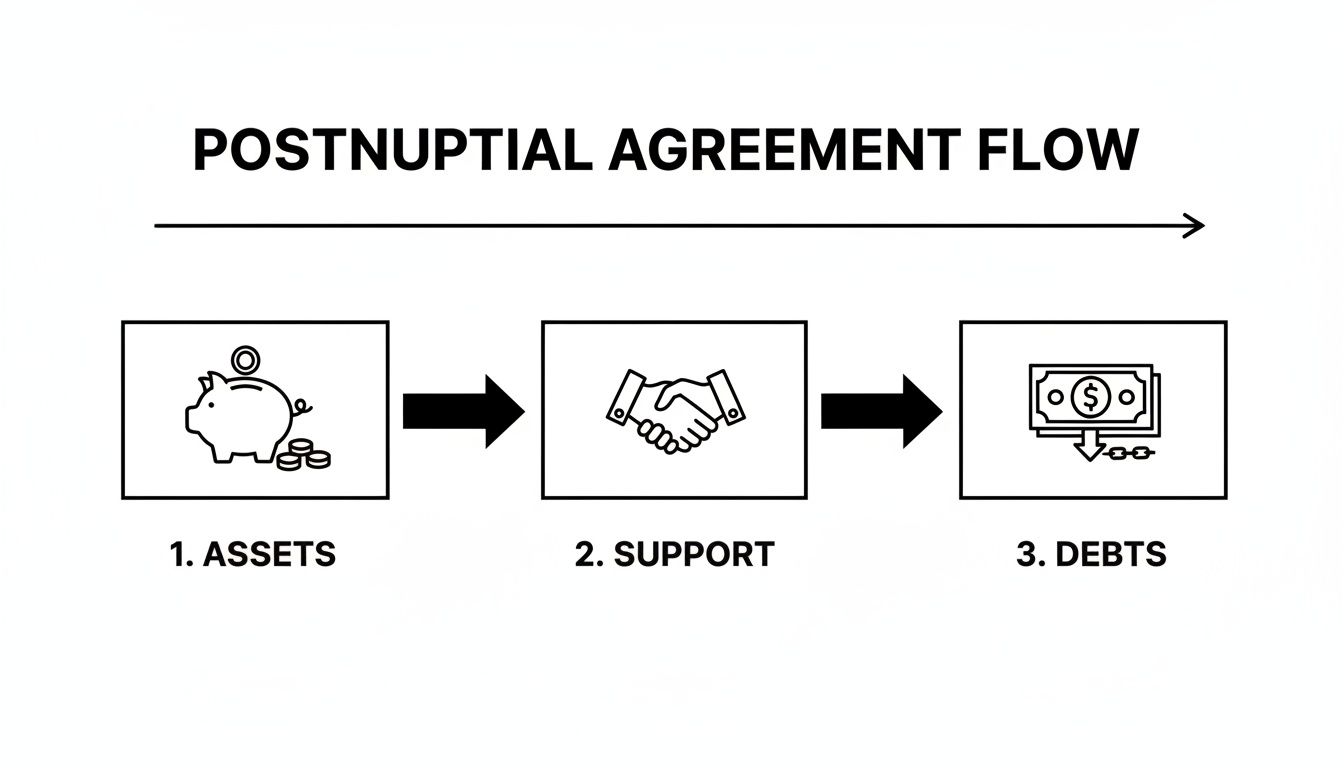
By methodically working through each of these financial categories, the agreement creates a clear and predictable structure for your marital finances.
Step 3: Drafting And Negotiation
Once all the financial cards are on the table, the drafting and negotiation phase kicks off. Usually, one spouse's attorney will prepare an initial draft based on the goals discussed. That draft is then sent over to the other spouse's attorney for their review.
This is where the real collaborative work begins. The attorneys will go back and forth, negotiating terms and making revisions until the document accurately reflects a mutual understanding. Sometimes this is very straightforward; other times, it requires more detailed discussion, especially if your assets or goals are complex. Many couples find that a structured, low-conflict approach, much like what's outlined in our guide on divorce mediation in Florida, helps keep the talks productive and amicable.
The most crucial element of this process is that each spouse is represented by their own independent attorney. This isn't about creating an adversarial environment; it's about ensuring the final agreement is fair, balanced, and protects both parties' rights fully.
Step 4: Final Review And Signing
After all the terms have been ironed out and agreed upon, the final version of the postnuptial agreement is prepared. You and your spouse will get the opportunity to review the document thoroughly with your respective attorneys. This is the last chance to make sure you understand every single clause and are completely comfortable with the agreement as a whole.
The final step is the formal signing. The agreement must be signed by both of you in the presence of a notary public. This formality is what turns the document into a legally binding contract. By following this structured process, you can create a postnuptial agreement that provides lasting financial clarity and real peace of mind. We guide our clients, including those in the LGBTQ+ community, through each of these steps with care and precision in Pasco, Pinellas, and Hillsborough Counties.
Common Mistakes That Can Invalidate Your Agreement
Knowing what not to do is just as important as knowing what to do when you're putting together a postnuptial agreement in Florida. One small misstep can unravel the whole thing, leaving a document you thought was ironclad completely worthless in the eyes of a judge. Certain mistakes are immediate red flags for the court and will torpedo the very protections you were trying to create.
Think of your postnup like building a house. If you use a faulty foundation or skip a critical support beam, the entire structure is compromised. The same goes for your agreement. Avoiding these common pitfalls is the only way to ensure it holds up when it matters most.
The Danger of Hiding Assets
One of the fastest ways to get a postnup thrown out is by playing games with your finances. Florida law is unforgiving on this point: both spouses must provide a full and honest financial disclosure. Hiding a brokerage account, conveniently undervaluing your business, or "forgetting" about a big loan isn't a minor oversight—it's grounds for invalidation and can even be considered fraud.
Imagine one spouse discloses everything they own but intentionally leaves out a profitable rental property. If the couple divorces years later and that hidden asset surfaces, a judge will almost certainly void the entire agreement. The logic is simple: the deal was based on bad information, making it fundamentally unfair from the very beginning.
Your postnuptial agreement is built on a foundation of total transparency. Full and fair financial disclosure isn’t just a good idea; it's a non-negotiable requirement for the contract to be valid.
Relying on Generic Online Templates
It might seem like a smart way to save a few bucks, but downloading a generic, one-size-fits-all template from the internet is a massive gamble. These cookie-cutter forms are rarely tailored to the specifics of Florida law, let alone the unique financial picture of your marriage. They're often vague, outdated, or missing clauses that are essential for your situation.
It’s like trying to navigate the complex backroads of Hillsborough County with a map of the entire United States—you're going to get lost. A template might fail to properly define what counts as separate property or use ambiguous language that leads to a costly court battle just to figure out what it means. For couples in our local area—Pasco, Pinellas, and Hillsborough Counties—a custom-drafted agreement is the only way to be sure your specific assets and goals are properly protected.
Pressure and Coercion
An agreement is only legitimate if both people sign it freely, without being backed into a corner. If one spouse feels pressured, threatened, or manipulated into signing, the agreement can be thrown out due to duress or coercion. This is something Florida courts take very seriously and will scrutinize with a fine-toothed comb.
For example, if one spouse says, "Sign this agreement right now or I'm filing for divorce and cutting you off financially," that's textbook coercion. To prevent any doubt about whether the signing was voluntary, both spouses must have plenty of time to review the document. Crucially, each person needs to have their own independent lawyer. This shows the court that both parties fully understood their rights and made a willing, informed decision.
Including Unenforceable Terms
Finally, you can't put just anything you want into a postnup. The agreement is void if it includes terms that violate Florida law or public policy. The most common error we see here involves trying to pre-determine issues related to children.
A postnup cannot legally decide:
- Child Support: Child support is calculated based on state guidelines and the child's best interests at the time of the divorce, not based on an agreement made years earlier.
- Child Custody or Timesharing: A parenting plan cannot be locked into a postnup. A court will always make this decision based on what is best for the child when the time comes.
Including these kinds of clauses won't just get those specific points tossed out; it can cast a shadow of doubt over the entire agreement. We guide couples, including LGBTQ+ families, to craft agreements that are not only effective for their goals but are also built to stand up in court. We serve clients in Pasco, Pinellas, and Hillsborough Counties.
Understanding The Cost And Timeline Involved
When you're thinking about a postnuptial agreement, two of the first questions are always: "How much is this going to cost?" and "How long will it take?" It’s best to see this not as an expense, but as a strategic investment in your financial future. Frankly, it's a tiny fraction of what a messy, contested divorce could cost down the road.
The final price tag for a postnuptial agreement in Florida really depends on your situation. The complexity of your finances and how much back-and-forth is needed will drive the cost. A couple with straightforward assets will naturally spend less than a high-net-worth couple with complicated business interests or investments.
Breaking Down The Investment
The cost is directly tied to the attorney hours needed to get it right. Many firms use flat-fee structures to give you cost certainty. Drafting a postnuptial agreement in Florida carries an average cost that shows protecting your assets is more accessible than you might think. For more details on this, you can check out some general postnuptial agreement cost data. This figure makes it clear that you can create a solid financial plan without breaking the bank.
Mapping Out A Realistic Timeline
Just like the cost, the timeline for finishing a postnup can range from a few weeks to several months. The process really moves at the speed of the spouses and their legal teams.
Several factors will speed up or slow down the process:
- Financial Disclosure: How quickly can both of you pull together all the necessary financial statements, property deeds, and account information? This is often the biggest holdup.
- Negotiation: Is there a lot of disagreement on the terms? The more negotiation needed between the attorneys, the longer it will take.
- Complexity: Intricate financial portfolios with multiple businesses or trusts just take more time to address carefully and correctly.
For couples here in Pasco, Pinellas, and Hillsborough Counties, setting realistic expectations from the outset helps everything go much more smoothly. While it does take a commitment of time and money, the peace of mind you get from having a clear plan is invaluable. To put this investment into perspective, you can read our article on the cost of divorce.
Common Questions We Hear About Florida Postnups
When you're considering a big step like a postnuptial agreement, it's natural to have questions. This isn't just paperwork; it’s about your marriage and your future. Let’s tackle some of the most common concerns we hear from couples in the Tampa Bay area, including Pasco, Pinellas, and Hillsborough Counties.
Does Signing a Postnup Mean We Think Our Marriage Will Fail?
Absolutely not. In fact, it’s quite the opposite. Think of a postnup like you would a will or an estate plan—it’s a smart financial planning tool for responsible adults. It’s about having a mature, open conversation about money to get on the same page and reduce future conflicts before they even start.
For many couples, especially those with their own businesses, blended families, or complex assets, a postnup clears the air. By creating a solid financial roadmap together, you can actually strengthen your partnership and focus on what matters: your relationship, not lingering anxieties about money.
What's the Real Difference Between a Prenup and a Postnup?
The only difference is timing. A prenup is signed before you get married. A postnup is signed after you’ve already said "I do." But that timing makes a huge legal difference.
Once you’re married, you owe each other a legal and fiduciary duty—a high standard of trust and good faith. Because of this, Florida courts look at postnups with a magnifying glass. They will scrutinize the agreement to make sure there was full financial disclosure and that the terms are fundamentally fair to both sides. This higher bar is exactly why getting guidance from an experienced family law attorney is non-negotiable.
Can We Change or Get Rid of the Agreement Down the Road?
Yes, you can. A postnuptial agreement in Florida isn't set in stone. It’s a living document that you can amend or even completely revoke, as long as both of you agree to the changes. Life happens, and what makes sense today might not make sense in five or ten years.
Any changes need to be in writing and signed with the same formality as the original agreement to hold up in court. Big life events—like starting a business, receiving a significant inheritance, or having a child—are often great reasons to revisit your postnup and make sure it still reflects your shared goals.
If We Agree on Everything, Do We Really Need Separate Lawyers?
Yes. It's not just recommended; it's the standard of practice for a reason. Having independent attorneys is one of the key things a judge looks for to confirm that the agreement was signed voluntarily, without any pressure or undue influence.
Separate counsel ensures both of you fully understand your rights, what you might be giving up, and the long-term consequences of the agreement. Taking this step massively strengthens the postnup against any future claims that it was unfair or one-sided. It’s about protecting the integrity of the document and, ultimately, protecting both of you.
Are you ready to create a clear financial roadmap for your marriage? The experienced team at Foley Family Law provides compassionate, knowledgeable guidance to couples throughout Pasco, Pinellas, and Hillsborough Counties. We are here to help all families, including LGBTQ+ individuals, craft a postnuptial agreement that protects your future and provides peace of mind. Schedule your consultation today by visiting us at https://wfoleylaw.com.


