

Many people hear the term "postnuptial agreement" and immediately think the marriage is in trouble. That’s a common misconception. Think of it less as planning for failure and more like creating a clear financial roadmap for your life together—one that provides security and predictability, no matter what the future holds.
Understanding Florida Post Nuptial Agreements
A postnuptial agreement is a legally binding contract a married couple signs to define how their assets, debts, and potential spousal support will be handled if they ever divorce. While it might not sound romantic, it's an incredibly practical tool that many strong couples use to solidify their financial partnership.
Going through the process forces you and your spouse to have open, honest conversations about money. It gets everything on the table, setting clear expectations and heading off potential conflicts before they ever start.

The reality is, life happens. And in Florida, where the divorce rate is a significant factor, having a plan isn't pessimistic—it's just smart. This trend is a big reason why more couples are looking for ways to protect their financial well-being after they’re already married. You can see more about these trends in recent Florida divorce data.
Why Consider A Postnup After Marriage
Couples here in Pasco, Pinellas, and Hillsborough Counties often come to us after a major life event has shifted their financial landscape. When things change, putting a formal agreement in place is simply a wise decision.
So, what kind of events trigger this conversation?
- Starting a New Business: One spouse launching a business is a huge step. A postnup can shield that company from being divided in a divorce, protecting all the sweat and capital invested.
- Receiving an Inheritance: If you or your spouse receives a significant inheritance, a postnup can make sure those assets stay separate, just as the giver likely intended.
- Changes in Career or Income: A big promotion, a new career path, or one spouse deciding to stay home with the kids can all be good reasons to update your financial ground rules.
- Addressing Financial Infidelity: Sometimes, an agreement is needed to rebuild trust. After one partner has been financially irresponsible, a postnup can set clear boundaries and get you both back on the same page.
A postnuptial agreement isn't about a lack of trust. It’s about building a foundation of clarity and mutual respect for your financial lives together. It gives you both certainty and control, letting you focus on your relationship with a shared understanding of your financial future.
At our firm, we handle all family and divorce matters, including for the LGBTQ community, without discrimination. Understanding your legal options is the first step toward achieving financial peace of mind, no matter what your family looks like.
Prenups vs. Postnups: What’s the Difference?
At first glance, prenuptial and postnuptial agreements look like two sides of the same coin. Both are legal contracts designed to map out how a couple's finances will be handled if a marriage ends. But under Florida law, the timing—when you sign the document—creates a massive difference in how courts treat them.
The bright line is your legal status at the moment of signing. A prenuptial agreement is signed before the wedding. At that point, you and your partner are still two separate individuals. You don't yet owe each other a special, heightened legal duty.
A postnuptial agreement, however, is signed after you're legally married. The moment you say "I do," you enter a confidential relationship that carries a fiduciary duty. This is a powerful legal obligation to act in your spouse's best financial interests with total good faith and loyalty.
This single distinction—the presence of that fiduciary duty—changes absolutely everything. It’s the reason Florida courts put postnuptial agreements under a much stronger microscope.
The Impact of Fiduciary Duty
Think of it this way. Negotiating a prenup is like two entrepreneurs drafting a partnership agreement before they launch their startup. Both are looking out for their own interests before officially tying their futures together.
Negotiating a postnup is more like those same partners trying to rewrite the ownership structure after the company is already a thriving success. Because they now share a legal duty to the business and each other, the law demands far more transparency and fairness in their dealings.
Since married spouses already owe each other this high standard of care, a court in Pasco, Pinellas, or Hillsborough County will look much more closely for any signs of unfairness in a postnup.
Florida law essentially starts with a yellow flag for postnuptial agreements. It presumes the agreement might have been created under pressure or with incomplete information. The burden is therefore much higher to prove it was signed voluntarily, without coercion, and with a crystal-clear understanding of each spouse’s finances.
A judge needs absolute certainty that one spouse didn't leverage their position in the marriage to take advantage of the other.
To help clarify these distinctions, here is a quick side-by-side comparison.
Prenuptial vs. Postnuptial Agreements At A Glance
Prenuptial Agreement
- Timing: Signed before marriage.
- Legal Relationship: Parties are fiancés; no fiduciary duty exists yet.
- Court Scrutiny: Standard scrutiny. The agreement must be fair and voluntary.
- Financial Disclosure: Full and fair disclosure is required.
- Presumption: Presumed valid if executed properly.
- Enforceability: Generally easier to enforce if legal requirements are met.
Postnuptial Agreement
- Timing: Signed after marriage.
- Legal Relationship: Parties are spouses; a fiduciary duty is legally established.
- Court Scrutiny: Heightened scrutiny. Courts look very closely for coercion or unfairness.
- Financial Disclosure: Rigorous disclosure is critical. Any hint of hidden assets is a major red flag.
- Presumption: Presumed potentially problematic; the burden of proof for validity is higher.
- Enforceability: More vulnerable to being challenged and set aside if not impeccably drafted.
As you can see, while the goals might be similar, the legal landscape is entirely different once you are married.
Key Differences in Legal Scrutiny
This heightened legal standard for post nuptial agreements in Florida isn’t just theoretical—it has very real consequences. While both agreements demand fairness, the expectations are simply more intense for postnups.
Here’s where the rubber meets the road:
- Financial Disclosure: A prenup requires solid financial disclosure. A postnup demands ironclad, exhaustive transparency. Even a whiff of hidden or undervalued assets is more likely to invalidate a postnup because it’s a direct breach of the existing fiduciary duty.
- Voluntariness and Coercion: A court will meticulously dissect the circumstances surrounding a postnup's signing. Was one spouse pressuring the other? Was the agreement presented as an ultimatum—"sign this, or the marriage is over"? These questions carry far more weight once a couple is already married.
- Fairness of the Terms: Florida courts are much more inclined to toss out a postnup if its terms are grossly one-sided. The law recognizes the trust and vulnerability baked into a marriage, so the agreement must be equitable and reasonable when signed.
Put simply, the law respects the unique dynamic of a marriage. A postnup must honor that dynamic by being impeccably fair and transparent. That’s precisely why having independent legal counsel for each spouse isn't just a good idea—it's a critical shield that helps create an agreement strong enough to stand up in court.
Creating an Enforceable Postnuptial Agreement
For a postnuptial agreement to hold up in a Florida court, it has to meet some pretty strict requirements. This isn't just about signing a piece of paper; it's a careful legal process designed to make sure everything is fair and transparent between spouses. The agreement absolutely must be a written contract, signed voluntarily by both people, and built on a foundation of complete honesty.
Think of it like building a house. You can't have a strong, stable structure if the foundation is weak. When it comes to postnuptial agreements in Florida, that foundation is built with specific legal "bricks." If any are missing, the whole agreement could crumble if it's ever challenged.
The visual below shows exactly where a postnup fits into a couple's timeline, underscoring its unique role after the wedding.
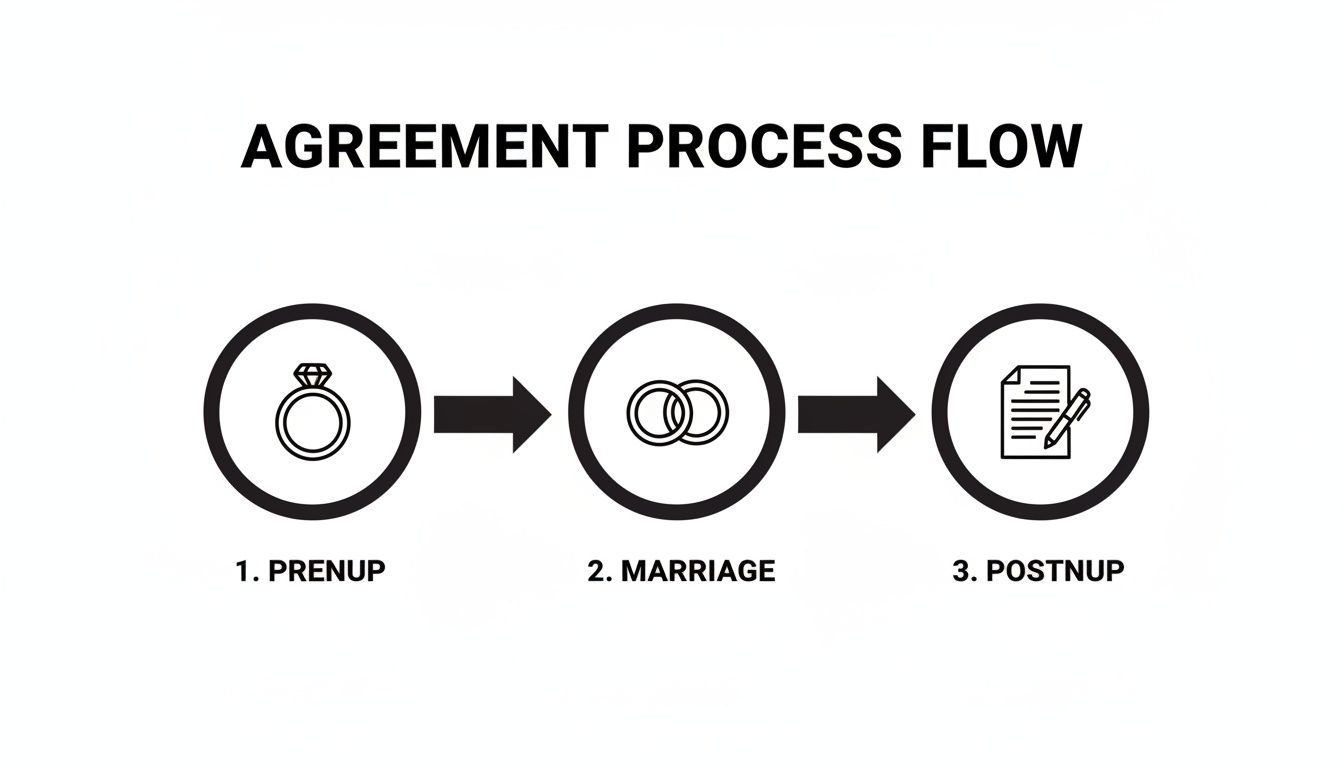
This sequence makes it clear: a prenup looks ahead before the marriage is official, while a postnup redefines the financial rules after the marriage has already begun.
The Pillars of a Valid Agreement
To be considered valid by a Florida court, a postnuptial agreement has to check several boxes. These aren't just suggestions—they are mandatory conditions that give the document its legal teeth. Miss even one, and the agreement could be worthless when you need it most.
A valid agreement must:
- Be a Written Contract: Verbal promises about who gets what simply won’t cut it. The agreement must be a formal, written document.
- Be Signed by Both Spouses: Both parties have to sign on the dotted line, showing they’ve read, understood, and agreed to everything inside.
- Be Executed Voluntarily: This is huge. The agreement has to be entered into freely, with no fraud, duress, or coercion from either side. One spouse can't bully or threaten the other into signing.
The core principle here is consent. A judge in Hillsborough, Pinellas, or Pasco County will need to see that both spouses made a conscious, informed, and unforced decision. Any hint of manipulation can be fatal to the agreement's enforceability.
The Critical Role of Financial Disclosure
This might be the single most important piece of the puzzle: full and honest financial disclosure. Because spouses have what's called a fiduciary duty to each other, they are legally required to be completely upfront about their financial situation.
That means no hidden bank accounts, no downplaying your income, and no conveniently forgetting about debts. Each spouse has to lay all their cards on the table, providing a complete and accurate financial picture. This includes:
- Bank accounts and investments
- Real estate properties
- Business interests and their values
- Retirement accounts and pensions
- All outstanding debts and liabilities
Failing to be transparent is one of the quickest ways for a court to throw out a postnup. Hiding an asset is a direct violation of the trust and legal duty that marriage is built upon.
The Necessity of Independent Legal Counsel
While it's not a hard-and-fast legal rule in every single case, having separate and independent attorneys is the gold standard for creating an enforceable postnup. It’s your best defense against future claims that someone was pressured or didn't understand what they were signing.
Imagine two captains trying to navigate a ship through a tricky channel. Each one needs their own navigator to chart a course that protects their specific interests. It’s the same concept here. Each spouse needs their own attorney to advocate for them and make sure the final agreement is fair, balanced, and legally solid.
When both sides have their own lawyer, it proves they had access to professional legal advice and fully understood the rights they might be giving up. As you think about this, it helps to know how to choose a divorce attorney with experience in marital agreements, as the skill set is very similar. Making sure your postnup is sound also requires a solid understanding of legal jurisdiction.
What a Florida Postnup Can and Cannot Cover
Think of a postnuptial agreement as the financial rulebook you and your spouse write for your marriage. It gives you incredible control over your financial future, letting you customize a plan that fits your life instead of defaulting to Florida's one-size-fits-all rules if a divorce ever happens.
This is empowering, no question. But it’s not a free-for-all. Florida law sets clear boundaries. For families in Hillsborough, Pinellas, and Pasco Counties, understanding what you can include—and what’s strictly off-limits—is the first step toward building a postnup that actually delivers security and peace of mind.
Provisions You Can Include in Your Postnup
At its core, a post nuptial agreement in Florida is a tool for managing financial matters. It’s your chance to have those frank conversations about money and lock in the decisions you make with a binding contract. This proactive step can sidestep a world of conflict down the road.
Here are the key areas a postnup can effectively handle:
- Defining Marital vs. Separate Property: You can draw a clear line between what’s shared (marital property) and what belongs to just one spouse (separate property). This is perfect for protecting a family business, an inheritance received after the wedding, or pre-marital assets that have shot up in value.
- Waiving or Defining Alimony: The two of you can decide to waive spousal support (alimony) completely or create your own terms. You can spell out the amount, how long it would be paid, and under what conditions, which brings much-needed predictability for both sides.
- Dividing Retirement Accounts and Pensions: Your agreement can detail exactly how retirement funds, 401(k)s, or pensions will be divided. Getting this sorted out now avoids a major headache later.
- Protecting Against Debt: A postnup can make it clear that you won't be on the hook for your spouse's debts, whether they brought them into the marriage or racked them up during it.
- Management of Finances: You can even outline the ground rules for day-to-day money matters, like who pays the bills, how much goes into savings, and what your investment strategy looks like during the marriage.
These provisions give you a powerful way to shape your financial life together. A huge piece of this puzzle is knowing how Florida divides assets in a divorce. You can get a clearer picture by reading our guide on the differences between equitable distribution and community property.
The Absolute Line a Postnup Cannot Cross
While you get a lot of say over your finances, Florida law draws a hard, non-negotiable line when it comes to kids. A postnuptial agreement cannot dictate anything related to child custody or child support. Full stop. This isn't just a rule; it's a matter of public policy designed to protect children.
The court's guiding star is always the "best interests of the child" at the moment a decision is being made—not what parents agreed to in a contract years ago. Life changes, and a child’s needs must be judged based on their current reality.
Because of this, any clause in a postnup that tries to do the following will be thrown out by a judge:
- Predetermine Child Custody or Timesharing: You can't legally lock in a parenting plan or visitation schedule in a postnup.
- Waive or Set Child Support Amounts: Florida’s child support guidelines are the law. You can't agree to a lower amount or get rid of the obligation completely.
- Limit a Child’s Rights: Any provision that weakens a child's right to financial support from both parents is automatically void.
This distinction is critical: postnups are for spouses. The courts handle matters involving children, always prioritizing what’s best for them. With Florida's significant divorce rate, these agreements are essential for preventing financial chaos. But to be valid, they have to be drafted correctly and respect these legal boundaries. You can find more statewide divorce statistics to understand the landscape better.
How We Guide You Through the Postnup Process
Deciding to create a postnuptial agreement is a big step, and honestly, the process can feel a little daunting. Our whole approach is designed to make it clear, collaborative, and supportive from the moment you walk through our door. We lay out a structured path so you and your spouse can make informed decisions about your financial future with confidence, not confusion.

The entire journey is built on open communication and finding practical solutions that minimize stress. We serve clients across Pasco, Pinellas, and Hillsborough Counties, offering steadfast support to all families—including LGBTQ+ couples—to ensure everyone feels heard and respected at every stage.
Your Initial Consultation and Goal Setting
It all starts with a comprehensive initial consultation. This isn't just a quick phone call; it's a deep dive into your unique situation, your financial landscape, and what you're hoping to achieve with a postnup. We take the time to really listen and understand what brought you to this decision.
During this first meeting, we will:
- Discuss Your Objectives: Are you trying to protect a new business venture? An inheritance that just came through? Or maybe you just want to clarify financial roles within the marriage to get on the same page.
- Explain the Legal Framework: We’ll give you a straightforward overview of the legal requirements for post nuptial agreements in Florida, so you understand what makes these contracts stick.
- Outline a Plan of Action: You’ll leave this meeting with a clear picture of the next steps, a realistic timeline, and the information we’ll need from you to move forward.
This foundational step ensures we're aligned with your vision from day one, allowing us to build a strategy that fits your family's specific needs.
Financial Disclosure and Transparent Exchange
The bedrock of any valid Florida postnup is a full and fair exchange of financial information. This part isn’t optional—it’s absolutely critical for creating an agreement that will hold up under legal scrutiny. Our job is to facilitate this process to keep it organized and thorough.
Each of you will need to provide detailed documentation of your complete financial picture. This means everything: assets, income, debts, and liabilities. We manage this exchange efficiently, ensuring both you and your spouse have all the cards on the table to negotiate fairly.
A postnuptial agreement built on incomplete or hidden financial information is like a house built on sand—it simply will not stand. Absolute transparency is the key to creating a lasting and enforceable contract.
Drafting, Negotiation, and Finalization
Once the financial disclosures are complete, we move into drafting and negotiation. We’ll prepare an initial version of the agreement that reflects the goals we discussed in our consultation. This document becomes the starting point for discussions with your spouse and their independent attorney.
Our focus here is on finding common ground and crafting solutions that work for both of you. We work diligently to protect your interests while keeping the conversation constructive, which helps dial down the potential for conflict. After all the revisions are made and both sides are in full agreement, we will oversee the final signing, making sure every legal formality is handled correctly.
Why a Postnup is a Smart Financial Tool for Your Marriage
There’s a common myth that signing a postnuptial agreement means a marriage is on the rocks. In my experience, the opposite is usually true. A postnup is a pragmatic financial tool that can actually strengthen a relationship by forcing those tough, honest conversations about money—a topic that often creates unspoken tension.
This isn’t about planning for failure; it’s about building a secure future together. By sitting down and creating a clear, mutually agreed-upon financial roadmap, you and your spouse are tackling potential issues head-on. That clarity removes a ton of uncertainty, letting you focus on your relationship from a solid, shared foundation.
The Core Benefits of a Postnup
A well-drafted postnuptial agreement brings some major advantages that go way beyond just dividing assets if things go south. For the couples I work with in Pasco, Pinellas, and Hillsborough Counties, these benefits translate directly into peace of mind.
What does it really do for you?
- Protecting Specific Assets: A postnup can clearly state that a new business you start, a recent inheritance, or other major assets are your separate property, shielding them completely.
- Ensuring Financial Predictability: It eliminates the guesswork. You both know exactly how assets and debts would be managed, preventing nasty surprises down the road.
- Reducing Future Conflict: By making decisions about sensitive financial matters now, while you're a team, you dramatically lower the odds of a bitter and expensive legal fight if a divorce ever happens.
A postnuptial agreement serves as a powerful financial tool for marriage, complementing a broader approach to financial management. For a wider understanding of personal and marital financial strategies, consider consulting general financial planning resources.
At the end of the day, a post nuptial agreement in Florida is an act of foresight. It sets clear rules and expectations, helping you and your spouse operate as a unified financial team. This is especially critical when dealing with complex assets. In my practice, I frequently see how these agreements bring stability to situations involving retirement funds. If that’s a concern, our guide on dividing retirement accounts in divorce offers some valuable context. We serve all families, including those in the LGBTQ community, ensuring their agreements are handled with the respect and expertise they deserve.
Frequently Asked Questions About Florida Postnups
Thinking through the what-ifs of a postnuptial agreement always brings up good questions. Here are some of the most common ones we hear from our clients across Pasco, Pinellas, and Hillsborough Counties, with straightforward answers to help you see the path forward.
Can a Postnuptial Agreement Be Changed or Revoked in Florida?
Yes, absolutely. A postnup isn’t set in stone for eternity. You and your spouse can mutually decide to change it or even scrap it altogether.
But—and this is a big but—you have to follow the same rules you did when you first signed it. Any modification or revocation must be in writing, and both of you must sign it with the proper legal formalities. It’s not something you can just agree to over dinner. We always recommend that each spouse have their own attorney review any proposed changes to make sure everyone’s rights are still protected.
Is a Postnuptial Agreement Still Valid if We Move Out of Florida?
That's a fantastic and critical question for anyone who might relocate. Generally, a valid Florida postnup will be honored by other states, but it’s not a 100% guarantee. The new state’s laws are what ultimately control.
If you move, one of your first calls should be to a family law attorney in your new home state. They can review your Florida agreement and tell you if it holds up under local law or if you need to make adjustments. It's a simple step that ensures the financial security you planned for actually travels with you.
What Happens if My Spouse Is Not Honest About Their Finances?
In Florida, honesty isn’t just the best policy when creating a postnup—it’s the only policy. Spouses owe each other a duty of complete financial transparency. Hiding assets or downplaying their value can completely invalidate the agreement.
A judge has the power to throw out an entire postnuptial agreement if they find that one spouse intentionally hid assets, lied about debts, or misrepresented their financial situation. An agreement built on a foundation of dishonesty simply won't stand up in court.
This isn't just a technicality; it's a fundamental protection. The whole point of the agreement is to plan based on the real financial picture, and Florida law takes that very seriously.
How Much Does a Postnuptial Agreement Cost in the Tampa Bay Area?
The cost really depends on how complex your financial situation is. A postnup for a couple with a house, two cars, and a few retirement accounts will cost less than one for a couple with multiple businesses, investment properties, and family trusts.
The price tag reflects the attorney’s time spent consulting with you, drafting the document, negotiating terms with your spouse’s lawyer, and finalizing everything. While it’s an upfront investment, it’s almost always a fraction of the cost—both financially and emotionally—of a drawn-out, contentious divorce. We're dedicated to providing transparent and supportive legal services to all families, including those in the LGBTQ community, so you feel secure and fully informed.
At Foley Family Law, we know that creating a postnuptial agreement is a major decision. Our job is to give you the clear, compassionate, and expert guidance you need to protect your future. If you’re in Hillsborough, Pinellas, or Pasco County and want to explore your options, contact us to schedule a consultation. https://wfoleylaw.com


