

A final judgment can feel like the end of the legal process. Then real life starts moving again. A parent gets transferred to another shift, a child begins struggling in school, support that once felt manageable no longer fits the household budget, or one parent wants a different time-sharing routine because the current one isn't working.
That's where post divorce modification comes in. In Florida, some parts of a divorce case can be updated when life changes enough to justify it. Others can't. Knowing that difference early saves time, money, and frustration.
In the Tampa Bay area, these cases often turn on practical facts, not dramatic stories. Judges in Hillsborough, Pinellas, and Pasco Counties want to see what changed, when it changed, whether the change is likely to continue, and how the requested modification solves the problem. That applies across families of all kinds, including married and unmarried parents, same-sex couples, and LGBTQ+ clients who need support, parenting, or related family-law relief handled without bias.
Some post-divorce disputes also spill into work, privacy, and reputation concerns. If an ex is making accusations online or targeting your professional standing, a practical guide on protecting your executive reputation can help you think through the non-court side of the problem while your legal strategy takes shape.
Your Life After Divorce Has Changed Now What
The first question isn't whether you're upset with the current order. It's whether the order still matches reality.
A divorce judgment is built on a snapshot of life at one point in time. Income, housing, medical needs, work schedules, school issues, and co-parenting dynamics rarely stay frozen. A parenting plan that made sense two years ago may now create weekly conflict. A support amount that was reasonable when both households were stable may become unworkable after a layoff, retirement, or a serious health issue.
Start With The Change, Not The Conclusion
Many people begin by saying, “I need custody changed,” or “I need support reduced.” That's understandable, but it skips the part the court cares about most. The stronger starting point is this:
- What exactly changed
- When it changed
- Whether it was expected
- How that change affects the child, the finances, or daily functioning
- What new order would realistically fix the issue
That approach keeps the case grounded. It also helps separate a real modification issue from a temporary disagreement.
Practical rule: If you can't explain the change in a short timeline with documents to back it up, you probably aren't ready to file yet.
The Tampa Bay Reality
In Pasco, Pinellas, and Hillsborough Counties, modification cases often rise or fall on preparation. People lose momentum when they wait too long, rely on verbal agreements, or assume the judge will “just understand” what's happening at home.
A better approach is to treat the situation like a problem that needs proof. Save messages. Keep calendars. Preserve school notices. Gather income documents. If the issue involves a first responder schedule, overtime volatility, rotating shifts, or mandatory call-outs, document those patterns clearly. If the issue affects an LGBTQ+ family, present it the same way any good case should be presented in Florida. Through evidence, consistency, and a child-focused or fact-focused request.
When You Can Modify A Divorce Decree In Florida
Florida courts don't treat modification as a do-over. The standard is narrower than that. In general, courts allow changes to ongoing obligations, such as child support, custody, parenting time, and sometimes alimony, when a party proves a material or substantial change in circumstances. By contrast, once property division is final, it's typically not modifiable, as explained in court guidance on modification of divorce judgments.

What Usually Can Be Modified
In Florida practice, the issues that most often qualify for review are the ones tied to ongoing life circumstances.
- Child support changes: Income rises or falls in a meaningful way, a parent loses a job, work hours change, or a child's expenses shift.
- Parenting plan updates: A child's needs change, one parent wants to relocate, the schedule no longer fits school or work, or conflict makes the existing plan unworkable.
- Alimony in some cases: This depends heavily on the wording of the final judgment or agreement and on the nature of the change.
If your issue is mainly about parenting, this overview of child custody modification in Florida is a useful place to compare your facts against the kinds of disputes courts typically review.
What Usually Cannot Be Modified
At this point, many people head down the wrong road.
Once property division is final in a divorce decree, it is typically not modifiable.
That means you usually can't come back later and ask the court to re-divide assets or debts because the deal now feels unfair, one asset changed in value, or you regret the original settlement. A modification case is generally about ongoing obligations, not about reopening the full judgment.
The Difference Between A Real Case And A Weak One
A viable modification request usually has three traits:
- The change is meaningful. Minor inconvenience isn't enough.
- The change wasn't just a brief bump in the road. Temporary disruptions are harder to build into a lasting order.
- The requested relief fits the problem. Asking for a complete overhaul when a narrower fix would do often weakens credibility.
A common example is the parent who says the other parent is difficult. Difficulty alone doesn't always justify modification. But if the conflict now affects school attendance, exchanges, medical decisions, or the child's stability, the analysis changes.
Another example is retirement. Retirement doesn't automatically justify a modification. Courts usually want context. Was it planned? Was it reasonable? What happened to income and expenses afterward? The same practical analysis applies to cohabitation, health decline, and work-schedule changes.
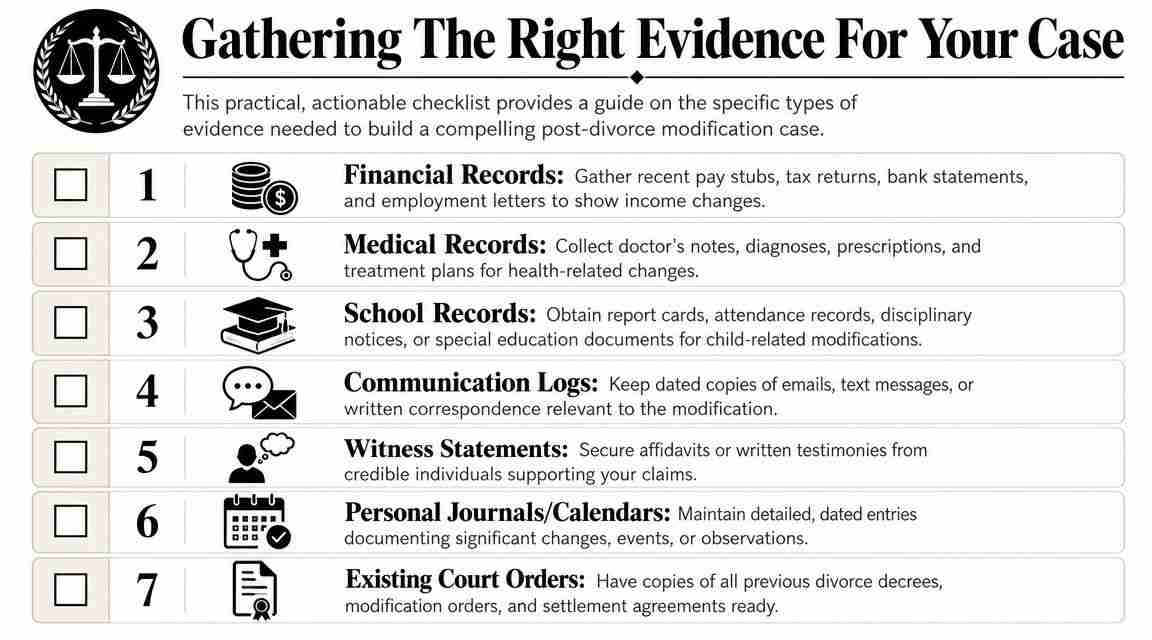
Gathering The Right Evidence For Your Case
A strong modification case is built like a file, not like an argument. Neutral legal guidance describes effective post-judgment modification practice as record-driven motion practice, with a formal filing supported by current evidence such as income records, medical documentation, school records, relocation proof, and the original decree, and notes that courts generally decide custody and support changes after that evidentiary showing, with many matters resolved in mediation first, as outlined in this discussion of post-judgment modifications.
Financial Cases Need Paper Trails
If you're asking to change support, start with current financial records and the older records that show what has changed. Judges don't want estimates if actual records exist.
Useful documents often include:
- Recent income proof: pay stubs, profit-and-loss materials if self-employed, offer letters, termination notices, disability paperwork, or retirement documents
- Tax records: useful for comparing past and current earnings
- Bank and account statements: sometimes needed to show actual cash flow
- Health insurance and medical-cost records: if benefits or out-of-pocket costs changed
When income is complicated, especially with commissions, business ownership, cash-heavy work, or multiple entities, the financial picture can take more work to present. In those cases, reading about uncovering hidden assets in divorce can help you understand why forensic review sometimes matters even after the divorce is over. Relatedly, forensic accounting may become relevant where reported income and real income don't appear to match.
Parenting Cases Need Specific Examples
When the requested change involves children, broad complaints rarely move a case forward. Specific facts do.
Focus on evidence such as:
- School records: attendance issues, report cards, behavior reports, special services paperwork
- Medical or counseling records: if the child's needs changed
- Calendars and exchange logs: missed overnights, repeated lateness, canceled visits
- Messages between parents: especially if they show inability to cooperate, repeated refusals, or agreed deviations from the plan
- Third-party observations: teachers, caregivers, coaches, or others with direct knowledge may matter depending on the issue
Bring evidence that shows patterns, not isolated bad days.
Organize The File Before Emotions Take Over
Clients often make one of two mistakes. They either bring a giant stack of unsorted papers, or they bring almost nothing because they assume testimony will be enough.
A better method is to build a dated timeline and match each event to a document. For example:
- January: child began missing school, attach attendance notice
- March: parent's schedule changed, attach employer communication
- April: doctor recommended treatment, attach note or billing record
- May: time-sharing exchanges repeatedly failed, attach message thread
That structure makes the case easier to negotiate and easier to present if negotiation fails.
Navigating The Florida Modification Process
Once you know the issue is modifiable and you have evidence, the next question is process. Florida modification cases are usually straightforward in design, but they can still feel stressful because every step matters and delay can weaken your position.
For support changes, an important rule across jurisdictions is that courts can typically modify only future payments from the date the motion is filed, so waiting can limit available relief, as discussed in this explanation of post-divorce support modification timing.

How A Typical Case Moves
Most Florida post divorce modification cases follow a path like this:
- A supplemental petition is filed. This tells the court what changed and what new order you want.
- The other party is served or formally notified. Proper service matters.
- The other side responds. They may agree, deny, or file a competing request.
- Financial disclosure or other discovery may follow. This depends on the issues.
- Mediation is often scheduled. Many family cases resolve here.
- If needed, the case goes to a hearing or trial. The judge then decides based on the evidence.
- A new order is entered. That order controls going forward.
If your issue is support, this guide on how to modify child support gives a more focused look at one of the most common modification tracks.
What Clients Often Get Wrong
The biggest mistake is waiting for things to “settle down” before acting. That can be costly in support cases, and it also allows bad parenting patterns to become normal.
Another mistake is trying to modify an order through text messages alone. Parents often make informal adjustments for convenience. Sometimes that works for a while. But if the arrangement later falls apart, the court generally looks to the written order, not the unwritten habit.
What To Expect In Tampa Bay Courts
In Hillsborough, Pinellas, and Pasco Counties, local procedure, scheduling, and judicial preferences can differ in the details, but the core demands are the same. File the correct pleading. Ask for relief that fits the facts. Be prepared to produce records. Take mediation seriously. Show the court you are trying to solve a problem, not score points against your former spouse.
The parties who do best in modification cases usually look prepared, reasonable, and document-focused from the beginning.
Negotiation Mediation And Courtroom Strategy
Not every modification case belongs in a courtroom fight. In fact, many of the best outcomes happen because the parties narrow the dispute before a judge ever has to decide it.
Guidance on post-divorce conflict management increasingly recommends proactive tools such as mediation clauses and built-in review procedures to reduce escalation and treat modification as a routine risk-management tool, as described in this discussion of handling post-divorce modifications without conflict.

Negotiation Works Best When The Facts Are Clear
Direct negotiation, usually through counsel, works well when both sides agree on the basic facts but disagree on the adjustment. Examples include a schedule tweak for a first responder parent, a support revision after a documented pay change, or revised holiday logistics as children get older.
Negotiation tends to work when:
- The requested change is narrow
- Both parties have exchanged records
- No one is disputing reality itself
- Each side understands what a judge is likely to do
This is the stage where lawyers can often save clients money by focusing on practical terms instead of rhetorical fights. Foley Family Law handles modification-related negotiation, mediation, and litigation in family court matters across Tampa Bay, including disputes that later require a formal hearing.
Mediation Is Often The Turning Point
Mediation gives both sides a structured chance to settle with help from a neutral professional. It can be especially effective in parenting disputes because it allows more creative scheduling than a trial often does.
If you're heading into mediation, prepare in advance:
- Know your bottom line: Decide what must change and what you can trade.
- Bring updated records: Unsupported demands rarely move the discussion.
- Separate legal goals from emotional goals: Vindication is not a parenting plan.
- Think in implementation terms: pickup times, holiday rotations, communication methods, expense-sharing details
If you want a closer look at the process, divorce mediation in Florida explains how mediated family-law resolutions are typically structured.
When Litigation Is The Right Move
Sometimes settlement isn't realistic. Court may be necessary if one parent won't disclose finances, repeatedly violates the current order, manipulates access to the child, or refuses reasonable updates despite obvious changes in circumstances.
A hearing becomes necessary when one side won't deal honestly with facts that can be proven.
Litigation is slower, more formal, and usually more expensive than settlement. But it also gives you subpoena power, discovery tools, and a judge who can impose a binding result when cooperation breaks down.
Understanding Costs And Enforcing Your New Order
Clients usually ask two questions early. What will this cost, and what happens if the other side ignores the new order?
The cost depends on the path. A negotiated update is usually leaner than a contested evidentiary hearing. Expenses may include filing fees, service costs, mediation fees, document gathering, expert review in some financial cases, and attorney's fees. The more disagreement there is about facts, the more time and expense the case usually requires.
Where Costs Rise
Modification cases become more expensive when:
- Financial information is incomplete or disputed
- One side files emotionally broad claims instead of narrow, supportable requests
- Parenting disputes involve a long history of conflict
- A party ignores deadlines or court requirements
A focused strategy matters. Asking for too much can cost more than asking for the right thing.
Enforcement Still Matters After You Win
A modified order only helps if people follow it. If your former spouse ignores the updated support terms, refuses the revised time-sharing schedule, or blocks required exchanges of information, the next step may be enforcement through the family court.
Florida courts can address noncompliance through enforcement procedures, including contempt remedies where appropriate. If that becomes necessary, this guide on how to enforce a divorce decree explains the practical steps.
Research on divorce outcomes also helps explain why enforcement and later adjustments continue to arise. A longitudinal study of 20 outcome measures found that men were more vulnerable to short-term negative consequences after divorce, while those gender differences largely faded in the medium term as adaptation occurred, with medium-term consequences broadly similar for women and men across areas such as economic well-being, mental health, physical health, residential moves, repartnering, and social integration, according to this study on divorce outcomes over time. In practice, that matches what family courts see. Post-divorce life keeps changing, and orders sometimes need updating or enforcing as households adjust.
FAQs For Specific Modification Scenarios
Can A First Responder Modify A Parenting Plan Because Of Shift Work
Sometimes, yes. The key question usually isn't whether the job is demanding. It's whether the schedule has changed in a way that makes the current plan unrealistic or harmful to the child's routine. A firefighter, law-enforcement officer, paramedic, or dispatcher should bring duty schedules, change notices, overtime patterns, and a proposed replacement schedule that is workable and child-focused.
A weak request says, “My job is hard.” A stronger request says, “My rotating shift now conflicts with school pickup every week, and this revised plan preserves consistency.”
What If My Income Looks Different Because I Own A Business
That's common in higher-asset cases. The court may need a clearer picture than a simple paycheck provides. Business owners often have fluctuating revenue, retained earnings questions, reimbursement issues, or personal expenses paid through a company. If your former spouse is self-employed, underreporting income, or suddenly claiming a steep drop without clear records, the modification may require close document review.
Do LGBTQ+ Families Use The Same Modification Process
Yes. Florida modification principles apply to families without regard to sexual orientation or gender identity. If you need to modify support, a parenting plan, or another ongoing family-law order, the court still looks at the same core questions. What changed, how significant is it, and what outcome serves the child's interests or fits the proven financial change.
That matters in real life because some LGBTQ+ clients come in expecting extra resistance from the system. The legal standard is the legal standard. A well-prepared case should be presented clearly and respectfully, with the same attention to facts and documentation as any other family.
Can A Military Family Seek Modification After Orders Or Relocation
Often, yes. Military life creates recurring change. Permanent moves, deployment-related logistics, training schedules, and transitions back to civilian life can all affect parenting plans and support. The strongest requests usually include the orders, updated calendars, and a practical long-distance or revised local schedule rather than a vague request for flexibility.
What If My Child Wants To Live Primarily With The Other Parent
A child's preference can matter, but it usually isn't the whole case by itself. Florida courts generally look at the full picture. They want context, stability, and evidence about how a change would affect schooling, health, routine, and parent-child relationships. If this issue is surfacing, gather facts before making abrupt informal changes that conflict with the current order.
If your current divorce order no longer fits your life in Pasco, Pinellas, or Hillsborough County, Foley Family Law can help you evaluate whether a Florida post divorce modification makes sense, what evidence you'll need, and whether your matter is better resolved through negotiation, mediation, or court.


