

TL;DR:
- Paternity in Florida is established either by voluntary acknowledgment or through court or administrative orders, creating enforceable parental rights. Unmarried parents can sign Form DH-432 at birth or later, while contested cases require court filings, genetic testing, or administrative procedures. Establishing paternity grants parental responsibility, time-sharing rights, child support, and access to benefits and inheritance.
In Florida, paternity is established either by signing a Voluntary Acknowledgment of Paternity (Form DH-432) or by a court or administrative order. Once established, it creates enforceable legal rights and obligations for both parents and the child. Under Florida Statutes Chapter 742, any woman who is pregnant or has a child, any man who has reason to believe he is the father, or the child may bring proceedings in circuit court to determine paternity. The Florida Department of Revenue Child Support Program also offers an administrative route that requires no court filing at all.
Here is what legal paternity immediately creates:
- Parental responsibility: The right and obligation to participate in major decisions about the child’s health, education, and welfare.
- Time-sharing: The ability to request a court-ordered parenting plan and visitation schedule under Chapter 61.
- Child support: A legal basis for either parent to seek a support order calculated under Florida’s child support guidelines.
- Benefits and inheritance: Access to Social Security, veterans’ benefits, health insurance, and inheritance rights for the child.
- Birth certificate update: The father’s name can be added to the birth certificate through the Florida Bureau of Vital Statistics.
Your immediate next step depends on your situation. If you are at the hospital when the child is born and both parents agree, sign Form DH-432 before leaving. If the birth has already occurred, you can sign the form later, contact the Florida Department of Revenue Child Support Program for free administrative assistance, or file a Petition to Determine Paternity (Form 12.983(a)) in circuit court.

How do you establish paternity in Florida?
Florida offers three legally valid pathways, each with different costs, timelines, and consequences.
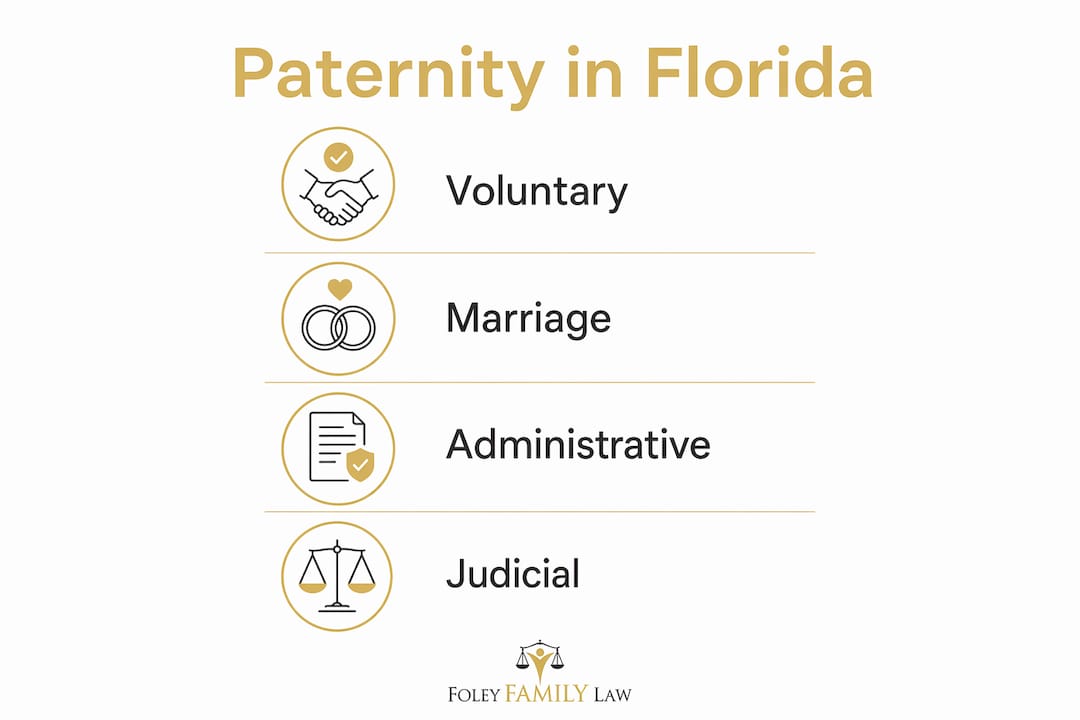
1. Voluntary Acknowledgment of Paternity (Form DH-432)
This is the fastest and most common route for unmarried parents who agree on the father’s identity. Both parents sign Form DH-432 in the presence of two witnesses or a notary. The form is available at the hospital at birth, at any Florida Department of Health office, or through the Bureau of Vital Statistics. Once filed, it has the same legal effect as a court judgment of paternity and places the father’s name on the birth certificate.
Either parent has a limited time period to rescind the acknowledgment, provided no court hearing has occurred. After 60 days, undoing it requires proving fraud, duress, or a material mistake of fact in court — a high bar.
2. Adding the father’s name after the parents marry
If the parents later marry after the child’s birth, they can file Form DH-743A (Affidavit of Paternity) along with a copy of the marriage certificate with the Bureau of Vital Statistics. This route is straightforward and does not require a court order.
3. Administrative paternity through the Florida Department of Revenue
The Florida Child Support Program can establish paternity without court by ordering genetic testing. If the test confirms biological parentage, the program issues an Administrative Order of Paternity and notifies the Bureau of Vital Statistics to update the birth certificate. This option is free and does not require an attorney, making it practical when the primary goal is establishing support.
Key differences from the judicial route:
- No filing fees or court appearances required.
- The process is driven by the Department of Revenue, not the parents.
- It does not automatically create a parenting plan or time-sharing order.
4. Filing a civil action in circuit court (Form 12.983(a))
When parents disagree, or when parenting arrangements need to be resolved at the same time, filing a Petition to Determine Paternity in circuit court is the appropriate path. Under Florida Statutes Section 742.011, the mother, a man who believes he is the father, the child, or the state may file this petition. The petition is served on the other party, who then has the opportunity to answer. If paternity is denied, either party may file Form 12.983(e) — Motion for Scientific Paternity Testing — to request court-ordered genetic testing. A failure to appear after proper service can result in a default ruling.
The judicial route takes longer and costs more than the DOR administrative process, but it resolves paternity, parenting plans, time-sharing, and child support in a single proceeding. That efficiency matters when the relationship between the parents is contentious.
What rights and obligations does paternity create?
Establishing paternity is the legal gateway to enforceable parental rights. Without it, a father’s access to the child is purely voluntary and unenforceable, regardless of what informal agreements exist.
- Parental responsibility: Courts default to shared parental responsibility, meaning both parents participate in major decisions about education, healthcare, and religion. Sole parental responsibility is awarded only when shared responsibility would be detrimental to the child.
- Time-sharing: Once paternity is established, either parent can request a parenting plan and time-sharing schedule under Chapter 61. Judges decide based on the child’s best interests and may appoint a guardian ad litem or request a parenting plan recommendation in contested cases. Learn more about securing time-sharing rights as a father in Florida.
- Child support: Either parent may seek a support order. The amount is calculated using Florida’s child support guidelines under Section 61.30, which consider both parents’ incomes, the time-sharing split, and the child’s healthcare and childcare costs. Retroactive support can be ordered back to the date the parents stopped living together, limited to a period before the petition was filed.
- Benefits and records: The child gains access to the father’s Social Security benefits, veterans’ benefits, health insurance, and medical history. Inheritance rights attach automatically under Florida law.
- Enforcement: Child support orders are enforced through the Department of Revenue or through contempt proceedings in circuit court. Parenting plan violations can be addressed by filing a motion for enforcement or contempt.
How does the presumption of paternity work when the mother was married?
When a child is born during a marriage, Florida law presumes the husband is the legal father. This presumption of legitimacy is one of the strongest in Florida family law, and it exists to protect the child’s welfare and the stability of the family unit.
Overcoming it is genuinely difficult. As the Florida Supreme Court addressed in Simmonds v. Perkins, rebutting the presumption requires clear and convincing evidence, and the burden placed on a biological father can approach the standard required to terminate parental rights. Courts have allowed rebuttal when a biological father has demonstrated a manifest, substantial, and continuing concern for the child’s welfare — and when doing so serves the child’s best interests. Courts have declined to allow it when the child has an established relationship with the presumed father and disrupting that relationship would harm the child.
Practically, this means that if you are a biological father and the mother was married to someone else at the time of birth, you face a complex, high-stakes legal situation. The court may appoint a guardian ad litem to represent the child’s interests independently. These cases almost always benefit from experienced legal representation, because the evidentiary and procedural demands are substantial.
How do you contest or disestablish paternity in Florida?
Contesting paternity follows a different path depending on how paternity was originally established and how much time has passed.
- Rescind the Acknowledgment of Paternity within 60 days. If you signed Form DH-432 and fewer than 60 days have passed with no court hearing, either parent may file a written rescission with the Bureau of Vital Statistics. This is the cleanest and least expensive option.
- File a paternity action in circuit court. If the 60-day window has closed, you must file a petition and prove fraud, duress, or a material mistake of fact. The court will consider the child’s best interests alongside the legal challenge.
- File a Motion for Scientific Paternity Testing (Form 12.983(e)). If a paternity case is already pending in court, either party can request genetic testing. The court allocates testing costs to one or both parties and sets a hearing date to review results.
- Petition for disestablishment of paternity. Under Chapter 742, a man who has been adjudicated the father may petition to disestablish paternity if new genetic evidence shows he is not the biological father. The court weighs the child’s best interests, the existing parent-child relationship, and the financial consequences.
The financial stakes are real. If paternity is disestablished, existing child support obligations may be terminated prospectively, but courts have discretion over retroactive support already paid. Custody and time-sharing arrangements must also be restructured.
Pro Tip: Never rely on an informal agreement with the other parent to remove a name from a birth certificate. Only a court order or a timely rescission of Form DH-432 accomplishes that legally. Informal arrangements have no legal force and can leave you exposed to future support claims.
For a detailed look at the eligibility requirements and process, Foley Family Law’s guide on disestablishment of paternity covers the specific steps under Florida law.
Where do you file paternity forms and what does the process look like?
The filing location depends on which pathway you choose. Here is a breakdown of each route and the forms involved.

At-birth hospital route: Form DH-432 is completed at the hospital and forwarded to the Florida Bureau of Vital Statistics. The birth certificate is updated, and legal paternity is recorded immediately. No court involvement is needed.
Administrative route (Department of Revenue): Contact the Florida Child Support Program to open a case. The program schedules genetic testing, and if results confirm paternity, an Administrative Order of Paternity is issued. The Bureau of Vital Statistics is notified automatically.
Judicial route (circuit court): File Form 12.983(a) in the circuit court of the county where the child resides. Attach a proposed Parenting Plan (Form 12.995(a), (b), or ©) if parenting arrangements are at issue, and a Child Support Guidelines Worksheet (Form 12.902(e)) if support is requested. The clerk issues a notice to all parties upon filing.
| Form | Purpose | Where to file or obtain |
|---|---|---|
| DH-432 | Voluntary Acknowledgment of Paternity | Hospital at birth; Florida Dept. of Health offices; Bureau of Vital Statistics |
| DH-743A | Affidavit of Paternity (post-marriage) | Bureau of Vital Statistics |
| Form 12.983(a) | Petition to Determine Paternity and for Related Relief | Circuit court in the child’s county of residence |
| Form 12.983(e) | Motion for Scientific Paternity Testing | Filed in the pending circuit court case |
| Form 12.902(e) | Child Support Guidelines Worksheet | Filed with Form 12.983(a) in circuit court |
Sample timelines:
- Hospital AOP: paternity recorded within days of birth.
- DOR administrative order: follows the genetic testing schedule, typically several weeks to a few months after the case is opened.
- Circuit court action: varies widely based on whether paternity is contested, ranging from a few months for an uncontested matter to a year or more in a fully litigated case.
What are the key deadlines for establishing or challenging paternity?
Timing can determine whether you keep or lose your rights entirely.
The 60-day rescission window for Form DH-432 is the most urgent deadline most parents face. Once that window closes without a rescission, the acknowledgment carries the legal weight of a court judgment. Undoing it after 60 days requires a formal court proceeding and proof of fraud, duress, or material mistake of fact — not simply a change of mind.
For unmarried biological fathers, the Putative Father Registry is a separate and critical deadline. Under Florida Statutes Section 742.021, a notarized claim of paternity must be filed with the registry before an adoption or termination of parental rights petition is filed. Filing after that point does not preserve your right to notice or consent. If there is any possibility that the mother may place the child for adoption, register immediately.
Other urgency triggers worth knowing:
- A pending divorce where the child’s paternity is disputed requires prompt action to protect both the biological father’s rights and the child’s interests.
- If the other parent is relocating out of state with the child, a court order establishing paternity and time-sharing becomes urgent.
- When child support is being pursued against you, establishing or contesting paternity before a default order is entered protects your legal position.
Courts have some equitable discretion, but statutory windows create real, practical limits. Waiting rarely helps and often forecloses options.
What should an unmarried father do right now?
If you believe you are a child’s father and paternity has not been legally established, here is a prioritized checklist.
- At the hospital: Ask about Form DH-432. If both parents agree, sign it before leaving. Confirm it is witnessed or notarized correctly and that it will be forwarded to the Bureau of Vital Statistics.
- If the birth has already occurred: Contact the Florida Department of Health to obtain Form DH-432, or reach out to the Florida Department of Revenue Child Support Program to open an administrative paternity case at no cost.
- If the other parent disputes paternity or you need a parenting plan: File Form 12.983(a) in the circuit court of the county where the child lives. You can request genetic testing through Form 12.983(e) at the same time.
- If adoption is a risk: File a notarized claim of paternity with the Florida Putative Father Registry immediately. Do not wait until after a petition is filed — at that point, the right to notice is gone.
- Gather documentation: Collect any evidence of your involvement — photos, communications, records of financial support, medical appointments attended, and school contacts. This evidence supports a later petition for time-sharing or parental responsibility.
- Consult a family law attorney if the situation involves a married mother, a contested paternity claim, a pending adoption, or any dispute about parenting arrangements.
What not to do:
- Do not take the child without a court order, even if you believe you are the biological father. Florida law does not recognize informal custody arrangements.
- Do not sign Form DH-432 or any legal document without understanding what it means. Signing creates permanent legal obligations, including child support.
- Do not delay registering with the Putative Father Registry if adoption is a possibility.
Pro Tip: Keep contemporaneous records of your involvement with the child from the earliest possible date — dated photos, text messages referencing the child, receipts for supplies or medical costs. Courts weigh demonstrated involvement heavily when deciding parenting plans, and a documented history is far more persuasive than testimony alone.
When should you hire a Florida family law attorney?
The Department of Revenue’s administrative process is free and works well when the only goal is establishing paternity and obtaining a support order. For anything more complex, private legal counsel makes a measurable difference.
An experienced Florida family law attorney can handle:
- Filing and serving a Petition to Determine Paternity (Form 12.983(a)) correctly the first time.
- Opposing or defending a paternity contest, including preparing for genetic testing motions.
- Representing you at hearings and negotiating parenting plans and time-sharing schedules.
- Challenging the presumption of legitimacy when the mother was married, which requires a specific evidentiary strategy and familiarity with the Simmonds v. Perkins standard.
- Advising on retroactive child support exposure before you sign anything.
- Managing appeals or modifications of existing paternity, support, or custody orders.
- Representing you in high-conflict matters where credibility, documentation, and courtroom advocacy are decisive.
The DOR route does not produce a parenting plan or time-sharing order. If you want enforceable rights to see your child, you need a court order, and getting that order right requires legal strategy, not just paperwork. For fathers seeking custody rights in Florida, the difference between a well-negotiated parenting plan and a poorly drafted one can affect years of the child’s life.
Local representation matters too. Attorneys familiar with Hillsborough, Pinellas, and Pasco county court practices, local judges’ preferences, and the procedural norms of those circuits can navigate your case more efficiently than someone working from a general template.
Key Takeaways
Establishing paternity in Florida is the legal foundation for every enforceable parental right, from time-sharing to child support to inheritance.
| Point | Details |
|---|---|
| Two main pathways | Sign Form DH-432 at birth (or later) for an agreed acknowledgment, or file Form 12.983(a) in circuit court for a contested or comprehensive order. |
| 60-day rescission window | Either parent may rescind Form DH-432 within 60 days of signing; after that, only fraud, duress, or material mistake of fact justifies reversal. |
| Putative Father Registry | Unmarried biological fathers must file a notarized claim before any adoption or termination petition is filed to preserve notice and consent rights. |
| Marriage presumption is a high bar | When the mother was married at birth, courts require clear and convincing evidence to replace the husband’s legal status as father. |
| Foley Family Law | Foley Family Law handles paternity petitions, parenting plans, and contested paternity matters in Hillsborough, Pinellas, and Pasco counties. |
A practitioner’s note on Florida paternity cases
Paternity cases in Florida move quickly once a petition is filed or a DOR case is opened, but the decisions made in the first few weeks often shape the outcome for years. The most common mistake we see is waiting. Parents who delay signing an Acknowledgment of Paternity, delay registering with the Putative Father Registry, or delay filing a petition often find that their options have narrowed considerably by the time they seek help.
The second most common mistake is treating Form DH-432 as a formality. It is not. Signing that form creates the same legal obligations as a court judgment, including child support, and reversing it after 60 days is genuinely difficult. If there is any doubt about paternity, or any concern about the terms of a future parenting arrangement, get legal advice before signing.
Paternity matters involving a married mother, a pending adoption, or a disputed parenting plan are not situations to navigate alone. The legal standards are demanding, the procedural requirements are strict, and the stakes for the child are high. Local counsel who knows the courts in Hillsborough, Pinellas, and Pasco counties can make a real difference in how these cases resolve.
Foley Family Law handles paternity cases in the Tampa Bay area
Paternity cases are rarely just about a form or a DNA test. They involve real decisions about a child’s future, and the legal steps you take now determine what rights you can enforce later. Foley Family Law focuses exclusively on family law, including paternity petitions, parenting plan negotiations, child support orders, and contested paternity matters in Hillsborough, Pinellas, and Pasco counties.

The firm’s approach is direct: understand your situation, explain your options clearly, and build a strategy that protects your rights and your child’s best interests. Whether you need help establishing paternity for the first time or are facing a contested claim, the team at Foley Family Law is prepared to represent you. Initial consultations are available for a fee. To schedule one, contact the firm and bring any documents related to the child’s birth, any existing court orders, and records of your involvement with the child. That preparation makes the first meeting more productive and gets your case moving faster.
Useful sources and official forms
Start with the source that matches your situation: Form DH-432 if you are at or near the time of birth, the Florida Department of Revenue if you want an administrative path, or Form 12.983(a) if you need a court order. For contested cases, consult a licensed Florida family law attorney before filing anything.
| Source | Purpose | Official URL |
|---|---|---|
| Florida Statutes Chapter 742 | Full text of Florida’s paternity determination law | flsenate.gov/Laws/Statutes/2025/Chapter742 |
| Florida Dept. of Revenue — Establish Paternity | Administrative paternity process, genetic testing, support orders | floridarevenue.com/childsupport/Pages/paternity.aspx |
| Form DH-432 (Acknowledgment of Paternity) | Voluntary acknowledgment form and instructions | floridahealth.gov — DH-432 PDF |
| Form 12.983(a) — Petition to Determine Paternity | Court petition for paternity, parenting plan, and support | flcourts-media.flcourts.gov — Form 12.983(a) |
| Child Welfare Information Gateway — Florida | Putative Father Registry guidance and unmarried parent rights | childwelfare.gov — Rights of Unmarried Parents in Florida |
FAQ
What rights does a father have to his child in Florida?
Once paternity is established, a father has the right to seek parental responsibility, a court-ordered time-sharing schedule, and access to the child’s medical and educational records under Florida Statutes Chapter 742. Without established paternity, those rights are not legally enforceable.
How long does a father have to establish paternity in Florida?
Florida does not impose a hard statute of limitations on filing a paternity action, but timing matters practically. The 60-day rescission window for Form DH-432 is firm, and the right to notice in adoption proceedings depends on filing with the Putative Father Registry before a termination petition is filed.
Can a father take his child without the mother’s consent in Florida?
No. Without a court order establishing paternity and a parenting plan, an unmarried father has no legal right to take the child over the mother’s objection, even if he is the biological father. A court order is required before time-sharing becomes enforceable.
What happens if a baby is born while the mother is married to someone else?
Florida law presumes the husband is the legal father. A biological father who wants to establish his parental rights must overcome that presumption with clear and convincing evidence, as the Florida Supreme Court addressed in Simmonds v. Perkins. These cases are complex and almost always require experienced legal representation.
What is the difference between acknowledgment and adjudication of paternity?
An acknowledgment of paternity (Form DH-432) is a voluntary, signed agreement by both parents that has the same legal effect as a court judgment. An adjudication of paternity is a formal court ruling, typically issued after a contested hearing or genetic testing through the judicial process under Chapter 742.
This article is general legal information, not legal advice for your specific situation. Florida law changes, and the facts of your case matter. Consult a licensed Florida family law attorney or contact the Florida Department of Revenue Child Support Program to confirm how current rules apply to you.


