

When you’re going through a divorce with children, one of the most critical pieces of the puzzle is the parenting plan. In Florida, this isn’t just a good idea—it’s a required legal document. It’s the detailed roadmap that will guide how you and your ex-spouse raise your children from two separate homes.
This plan goes way beyond a simple calendar. It sets out responsibilities, who gets to make what decisions, and how you’ll communicate, all to create a stable, consistent world for your kids.
What Is A Florida Parenting Plan And Why Does It Matter?
Think of a parenting plan as the constitution for your new co-parenting relationship. While the marriage is ending, your job as parents isn’t. This document provides a clear, predictable structure that’s designed to head off future arguments and keep everyone focused on what’s best for your child. Florida law is clear: every couple with minor children must have one of these filed and approved by a judge to finalize their divorce.
This framework isn't just a suggestion; it's a court order with real teeth. A well-thought-out parenting plan brings a sense of order to a chaotic time, giving both you and your children a much-needed sense of security. It becomes the rulebook you both turn to when disagreements pop up, helping you resolve them before they escalate.
The Foundation of Successful Co-Parenting
A strong parenting plan is the absolute bedrock of a healthy co-parenting dynamic. The process of creating one forces you to think through the real, day-to-day logistics of raising a child from two different households. By tackling potential friction points head-on, you build a system that can handle the challenges that will inevitably come up down the road.
For families here in Pasco, Pinellas, and Hillsborough Counties, a solid plan is non-negotiable for a few key reasons:
- It creates stability: Kids thrive on routine. A clear plan for the time-sharing schedule, holidays, and daily life helps them feel safe and secure.
- It reduces conflict: When the rules and expectations are written down in black and white, there’s much less room for misunderstanding and fighting.
- It ensures consistency: The plan gets both parents on the same page about the big stuff—healthcare, school, and general well-being.
- It is legally enforceable: If one parent doesn't hold up their end of the bargain, the other has legal options to enforce the plan.
It’s a common myth that parents who get along don't need a detailed plan. The truth is, even the most cooperative co-parents benefit from a formal agreement. It protects everyone’s rights and provides a clear framework if you hit a rough patch in the future.
A Plan for Every Family
At our firm, we know that no two families are alike. We are committed to serving every member of our community in Pasco, Pinellas, and Hillsborough Counties, and we do not discriminate. We proudly handle gay divorce, gay custody issues, and all LGBTQ+ family and divorce matters.
Your family’s unique situation must be at the heart of your parenting plan. Whether you're first responders with unpredictable schedules, military personnel facing deployment, or part of the LGBTQ+ community, your plan has to work for you. You can learn more about Florida's time-sharing statute in our comprehensive guide. A customized plan isn't a luxury; it's a necessity for building a successful co-parenting future.
The Core Elements Of An Effective Parenting Plan
Every solid parenting plan is built on a few key pillars required by Florida law. It's best to think of these elements not as a list of restrictive rules, but as a roadmap to help you and your co-parent navigate the future with clarity. Getting these details right from the start is absolutely critical for preventing future arguments and court dates.
At its core, a parenting plan is all about creating consistency and stability for your children. This infographic breaks down the three main pillars that give the document its structure.
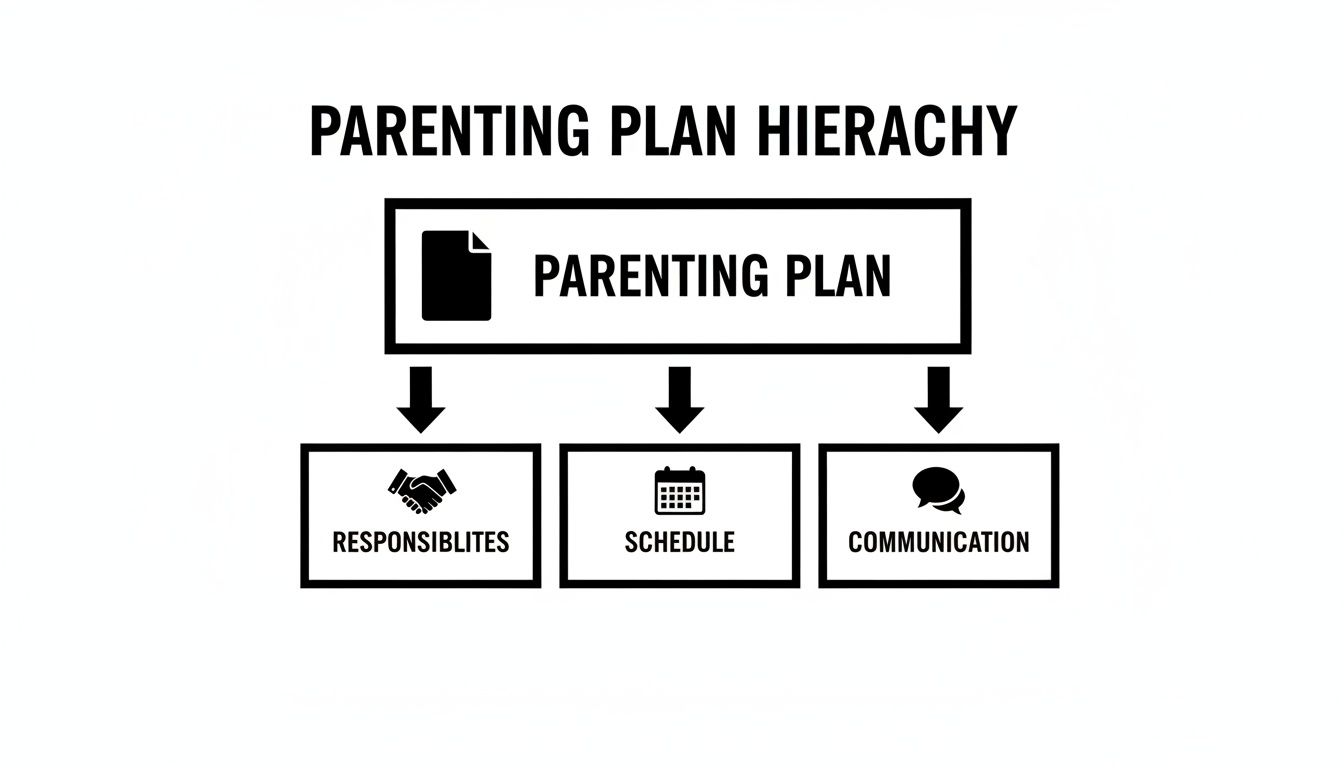
As you can see, a successful plan depends on clearly defined responsibilities, a predictable schedule, and agreed-upon ways to communicate. Let's break down what Florida law says you must include.
To make sure nothing is missed, Florida law is very specific about the issues that every parenting plan has to address. Think of it as a checklist to ensure all the essential bases are covered for your children's well-being. The key required elements include:
- Time-Sharing Schedule: This is a detailed, day-by-day calendar outlining where the children will sleep each night of the year. It must cover the regular school year, holidays, summer break, school vacations, and birthdays to avoid any confusion.
- Parental Responsibility: This section defines who makes major decisions for the children regarding their education, healthcare, and general welfare. The plan outlines whether decisions will be made jointly (shared responsibility) or by one parent (sole responsibility) and includes a process for resolving disagreements.
- Communication Methods: The plan must specify how the parents will communicate with each other and how each parent will communicate with the children when they are apart. This often includes approved methods like a co-parenting app or email, expected response times, and the frequency of calls with the children.
- Childcare Provisions: This addresses how before- and after-school care or daycare will be handled and paid for, including how providers are selected and transportation arrangements.
- Relocation Clause: Florida law has a strict legal process a parent must follow if they wish to move more than 50 miles away. The plan acknowledges these legal requirements and the process for seeking consent or court approval.
Covering each of these legally required elements in detail is the only way to create a plan that is both enforceable by the court and practical for your family's daily life.
The Time-Sharing Schedule
The first thing most people think of is the Time-Sharing Schedule. This is the practical, day-to-day calendar that clearly states where your children will be and when. It has to be specific enough to detail where the children will sleep on every single night of the year, leaving absolutely no room for confusion.
While a 50/50 split is a common goal, it can look very different from one family to the next. Some parents thrive on a week-on, week-off schedule. Others might prefer something like a 2-2-5-5 rotation to make sure neither parent goes too long without seeing the kids. The best schedule really depends on your children's ages, where their school is, and your own work commitments.
Decision-Making Authority
Next, the plan has to spell out Decision-Making Authority. This part determines how you and your co-parent will make the big choices in your child’s life. It’s all about who has the final say—or, more often, how you’ll work together to reach an agreement on the important stuff.
In Florida, the law starts with the assumption that shared parental responsibility is what's best for the child. This means both parents keep their full rights and responsibilities and are required to talk with each other to make joint decisions.
Key areas covered here usually include:
- Education: Choosing between public or private school, arranging for tutoring, or addressing special educational needs.
- Healthcare: Decisions on non-emergency medical, dental, and mental health care, like picking doctors or approving treatments.
- Religion: Any agreements on religious upbringing and instruction, if that's a factor for your family.
- Extracurricular Activities: Deciding which sports, clubs, or lessons the child will join.
It's important to know that while shared responsibility is the norm, a Florida court can award sole parental responsibility to one parent. This only happens if the court finds that a shared approach would actually be harmful to the child—a very high legal bar that isn't met easily.
Communication Protocols
Finally, every effective parenting plan must lay out clear Communication Protocols. This is one of the most overlooked sections, but it's often the most critical for keeping the peace. It sets the ground rules for how you'll interact with each other about your children.
These rules are designed to keep communication focused, respectful, and business-like. Your plan should name the approved methods for communication—like a co-parenting app or email—and set a reasonable timeframe for responses. For many people, this is a learned skill, and our firm offers practical co-parenting tips from a divorce lawyer to help make that transition smoother.
This section should also detail how and when each parent can communicate with the kids when they are with the other parent. For instance, you might agree to a specific time for a nightly phone or video call. By clearly defining these three core elements—time-sharing, decision-making, and communication—your parenting plan becomes a powerful tool for building a stable future.
Crafting A Clear Schedule For Holidays And Vacations
The regular weekly schedule often feels like the biggest hurdle, but believe it or not, arguments over holidays, school breaks, and summer vacation can create the most lasting bitterness. A well-defined schedule for these special times is your best defense against future conflict. By mapping out the entire year in your parenting plan in a divorce, you eliminate the gray areas that so often lead to fights.

Think of this part of the plan as a pre-agreed truce for the most emotionally charged days of the year. When Thanksgiving rolls around, you won’t have to get into a last-minute negotiation over who gets the kids; you’ll just check the plan. This predictability gives your children a much-needed sense of stability and allows both parents to make their own plans with confidence.
Dividing Major Holidays and School Breaks
For families in Pasco, Pinellas, and Hillsborough Counties, the key to a successful holiday schedule is fairness and absolute clarity. Most parents find that alternating major holidays annually is the most straightforward approach. This way, each parent gets to experience the holiday traditions with the children every other year.
Common holidays to address in your plan include:
- Thanksgiving: Often assigned to one parent in even-numbered years and the other in odd-numbered years. Simple.
- Winter Break: This is usually split right down the middle. For instance, one parent might get the first half of the break in even years, while the other gets the second half, which includes Christmas Day. The schedule then flips in odd years.
- Spring Break: This can be alternated annually, with one parent having the children for the entire break each year.
- Summer Vacation: This long break needs more detail. Plans often divide the summer into two-week blocks that parents can pick in advance, or they might simply split the entire break in half.
For parents trying to juggle these moving parts, it can be helpful to explore a complete guide to co-parenting calendars to find a system that keeps everyone on the same page. These tools are invaluable for putting the schedule you create into practice.
Addressing Birthdays and Other Important Dates
Beyond the big federal and school holidays, your plan should also cover personal dates that are important to your family. This level of detail shows respect for your family's history and minimizes the chances of fighting over what should be a happy occasion.
A precisely drafted holiday schedule does more than just divide time; it provides peace of mind. Knowing the plan far in advance allows both parents and children to look forward to special occasions without the anxiety of a last-minute conflict.
Consider how your plan will handle these moments:
- Children’s Birthdays: Some parents agree to share the day. Others alternate the birthday each year. Another popular option is for the parent who doesn't have the child on their actual birthday to celebrate with them the weekend before or after.
- Parents’ Birthdays: The plan can specify that the children will spend time with each parent on their respective birthdays, even if it's just for a celebratory dinner.
- Mother’s Day and Father’s Day: It is standard practice in Florida for the children to be with the appropriate parent for the entirety of these days.
The December holidays can get particularly complicated, but with careful planning, they don't have to be a source of stress. You can find more specific strategies in our guide on how to handle the December holidays while co-parenting.
By thinking through these details with an experienced attorney, you create a predictable and peaceful holiday structure that serves your family for years to come. We proudly serve all families in Pasco, Pinellas, and Hillsborough Counties, including LGBTQ+ parents, ensuring your unique traditions and needs are reflected in your plan.
Dealing with the Big Two: Relocation and Child Support
Beyond the day-to-day schedule, your parenting plan has to wrestle with some of the heaviest legal and financial issues you’ll face. Two topics, in particular, demand serious, forward-thinking attention: what happens if one parent wants to move away, and how your time-sharing schedule directly impacts child support.
Tackling these high-stakes issues proactively in your plan isn't just a good idea—it's your best defense against future court battles. It gives you both a clear, legally binding roadmap for handling major life changes and financial duties, protecting both your rights and your child’s stability.
Florida's Strict Relocation Laws
Life doesn’t stand still. A great job offer, a new relationship, or the need to be closer to family might make a move seem necessary down the road. But in Florida, you can't just pack up and go with your child. The law is very clear, and it’s designed to protect every parent-child relationship.
Under Florida law, a "relocation" isn't just any move. It's defined as moving 50 miles or more from your current home for at least 60 consecutive days. If you want to make a move like that, you must either get the other parent's written permission or get a court order allowing it. Trying to move without following these rules can land you in serious legal trouble.
Your parenting plan is the perfect place to acknowledge these rules and even spell out the steps you both agree to take if a move is ever on the table. A little foresight now can prevent a full-blown crisis later.
A smart relocation clause does more than just repeat the law. It creates a custom process for your family. You can detail how much notice is required, how travel costs for time-sharing will be split, or even what methods you'll use to discuss a potential move. It brings predictability to what could otherwise be a chaotic situation.
The Unbreakable Link Between Time-Sharing and Child Support
This one catches a lot of parents by surprise. In Florida, your time-sharing schedule and your finances are directly connected. The child support calculation isn't just based on who makes more money; it's fundamentally tied to the number of overnights each parent has with the children all year.
The state’s child support guidelines use a specific formula. It takes both parents' net incomes and the exact number of overnights into account. The more overnights you have, the greater your presumed share of day-to-day child expenses, which in turn adjusts the amount of child support you either pay or receive.
This means every single decision about the calendar—from the weekly handoffs to who gets the kids for Thanksgiving—has a real-world financial impact. Understanding this connection is absolutely critical for making informed decisions when you're negotiating the plan. We provide detailed guidance on this, and you can learn more about the state's formula in our article on Florida's child support calculation.
This financial reality highlights just how important it is to have a clear, stable, and well-thought-out parenting plan. For extra support in navigating co-parenting challenges and improving communication after a divorce, resources like virtual family therapy can be incredibly helpful.
Divorce profoundly impacts a family's stability, and research shows significant long-term effects on children are often tied to these shifts in income and environment. It disrupts family life for nearly a third of American children. In 2022's 673,989 U.S. divorces, roughly 880,000 child support cases were created alongside custody arrangements, showing just how critical a well-structured parenting plan is to softening that impact.
We have years of experience helping clients across Pasco, Pinellas, and Hillsborough Counties navigate these tough negotiations. Whether you're dealing with a high-asset divorce or military-specific challenges, we're here to help you craft a parenting plan that protects your kids and your financial future.
How To Finalize And File Your Parenting Plan
An agreement on paper is a great start, but it's not the finish line. To give your parenting plan real teeth, it needs to become a legally binding court order. After you've hammered out the schedules, decision-making, and all the other crucial details, the next step is to finalize the document and get it filed correctly with the court. This is the move that makes your agreement an enforceable part of your divorce.
There are a few different roads you can take to get to a final agreement, and the best one depends entirely on your family's situation and how well you and your co-parent are communicating. How you get there is just as important as the document itself.
Pathways To Reaching An Agreement
For many parents, the best-case scenario is direct negotiation. This is where you and your co-parent—usually with your lawyers in the room—sit down and work out the details face-to-face. It keeps you in the driver's seat and is almost always the most affordable route.
If talks hit a wall, the next logical step is mediation. In fact, courts in Pasco, Pinellas, and Hillsborough Counties will often require you to try mediation before a judge will even hear your case. In this confidential setting, a neutral third-party mediator helps you find common ground and build an agreement you can both live with.
When all else fails, the final option is litigation. This means you're taking your case to a judge, who will listen to both sides and make the final calls on your parenting plan based on what they believe is in the child's best interests. While it's a necessary tool in high-conflict situations, litigation takes the power out of your hands and gives it entirely to the court.
Drafting And Filing The Final Document
Once an agreement is reached—whether through negotiation, mediation, or a judge's ruling—it's time to draft the formal legal document. The plan must be written in crystal-clear language that leaves no room for interpretation and meets all of Florida's legal requirements. Every single detail, from holiday drop-off times to how you'll communicate about doctor's appointments, needs to be spelled out to prevent headaches down the road.
After the document is drafted and signed by both of you, it has to be filed with the Clerk of Court in the county handling your divorce. The judge assigned to your case will review it to make sure it’s complete, complies with Florida law, and truly serves your children's best interests.
Once the judge approves the plan, they will sign an order making it a legally binding part of your final divorce decree. This is the moment your agreement officially transforms from a piece of paper into an enforceable court order that both parents are legally obligated to follow.
You can't overstate the importance of a detailed, well-thought-out plan. National family law data shows that a staggering 90% of divorced mothers end up with primary custody. To secure a fair and balanced outcome, it's critical to create meticulous schedules for every aspect of your child's life. This avoids drawn-out court fights that can easily cost $15,000-$20,000 on average. You can learn more about these family law statistics.
Navigating this final stage demands a sharp eye for legal procedure and detail. Getting guidance from an experienced family law attorney ensures your plan is properly structured to protect your parental rights. A strong legal advocate is crucial, and knowing how to choose the right divorce lawyer is the first step toward securing a fair and workable plan for your family. We handle all family and divorce law matters in Pasco, Pinellas, and Hillsborough Counties, including gay divorce and LGBTQ+ custody issues, with the respect and diligence they deserve.
Common Questions About Florida Parenting Plans
When you're trying to figure out a parenting plan in a divorce, a lot of questions pop up. It’s a dense legal document, and it’s completely normal to wonder how it will actually play out in real life, especially years down the road. We've compiled some of the most frequent questions we get from clients across Pasco, Pinellas, and Hillsborough Counties to give you some clear, practical answers.
Our goal is to pull back the curtain on the legal process so you can move forward with confidence. Getting a handle on these key points will empower you to build a plan that truly serves your family for the long haul.
Can We Change The Parenting Plan After The Divorce Is Final?
Yes, you can, but it’s not as simple as just deciding to do things differently. Because the parenting plan is an official court order, any permanent change has to go through a formal legal process called a modification. Life is unpredictable, and the law gets that a plan that worked for a 5-year-old might not make sense for a 15-year-old.
To get a modification, you have to prove to the court that there has been a substantial, material, and unforeseen change in circumstances since the last order was entered. This is a high bar, and it's there for a good reason: to provide stability for your kids and keep parents from running back to court over every little disagreement.
What kind of change is significant enough? It could be things like:
- A parent's major job change that makes the current schedule unworkable.
- The evolving needs of a child as they enter their teenage years.
- One parent wanting to relocate more than 50 miles away.
- A serious change in a parent’s health that affects their ability to care for the child.
What Happens If My Ex Does Not Follow The Plan?
A court-approved parenting plan isn't a list of suggestions—it's a legally binding order. If the other parent is ignoring the terms of your agreement, you have legal recourse. This is precisely why having a detailed, official plan is so important in the first place.
When a parent violates the plan, it's called being in contempt of court or non-compliance. Often, the first step is to send a written message, pointing out the specific part of the plan that isn't being followed. If that doesn't resolve the issue, you can file a Motion for Enforcement or a Motion for Contempt with the court.
A judge takes violations of a parenting plan very seriously. The court can order various remedies to correct the situation, such as awarding make-up time-sharing to the parent who was denied their time, ordering the non-compliant parent to pay your attorney's fees and costs, or even modifying the parenting plan if the violations are severe and ongoing.
It's critical to document every single instance of non-compliance. Keep a log of dates, times, and what happened. This record will be your most powerful evidence if you need to take the matter to court.
Do We Need A Plan If We Agree On Everything?
Absolutely. This is a crucial point that even the friendliest co-parents can miss. Even if you and your spouse are on the same page about every single detail, Florida law requires you to file a formal, written parenting plan with the court in any divorce involving minor children.
A verbal agreement, no matter how solid it feels today, offers zero legal protection down the road. People's lives change. A new partner can enter the picture, a job can be lost, or a simple disagreement can escalate, turning that handshake deal into a major conflict.
Think of your parenting plan as your family’s safety net. It takes all your mutual understandings and turns them into a legally binding document. This protects both parents and, most importantly, provides a clear, enforceable roadmap if a dispute ever arises. It ensures your children’s stability rests on the rule of law, not just on goodwill. At our firm, we handle all family and divorce issues, including for LGBTQ+ clients, ensuring every family gets the legal protection they deserve.
Crafting a parenting plan in a divorce that anticipates future challenges and protects your rights requires skill and experience. If you are in Pasco, Pinellas, or Hillsborough County, the team at our law firm is here to guide you through every step. Contact us today to schedule a consultation and build a plan that secures your family's future. https://wfoleylaw.com


