

A military divorce isn’t just a standard divorce with a uniform. It's a completely different legal arena, governed by a unique mix of Florida state law and dense federal regulations. For service members and their spouses, this means navigating a minefield of challenges that civilian couples never encounter, from figuring out where you can even file to dividing highly specialized benefits.
Getting a handle on this specific terrain is the absolute first step toward a fair outcome.
The Unique Terrain Of A Florida Military Divorce
Ending a marriage is tough enough. But when one or both spouses serve in the armed forces, the process gets tangled in a web of federal laws and military rules that most family lawyers never have to deal with. These rules can dramatically change everything, from where the divorce papers are filed to how your assets are split.
The constant pressures of military life—PCS moves, long deployments, and the sheer stress of service—can wear a marriage down. It's a hard reality, but military marriages often dissolve at a higher rate than civilian ones. In fact, recent data shows the military divorce rate is around 3.09%, and roughly 30% of active-duty marriages end within the first five years. The numbers speak for themselves.
Civilian vs Military Divorce Key Differences
To help you quickly grasp the specific challenges ahead, here are the unique factors that set a military divorce apart from a typical civilian case in Florida.
Jurisdiction
- Civilian Divorce: Based on state residency (e.g., where you live).
- Military Divorce: Complicated. Can be based on the service member's legal residence, where they are stationed, or the spouse's residence.
Serving Papers
- Civilian Divorce: Straightforward process via a process server or sheriff.
- Military Divorce: Complex, especially if the service member is deployed overseas. Specific rules and international treaties may apply.
Court Timelines
- Civilian Divorce: Follows standard court deadlines and schedules.
- Military Divorce: Can be paused or delayed under the Servicemembers Civil Relief Act (SCRA) if military duties prevent participation.
Asset Division
- Civilian Divorce: Governed exclusively by state property laws (e.g., equitable distribution in Florida).
- Military Divorce: State law still applies, but federal law like the USFSPA governs how military retirement is divided. This creates a two-layer system.
Retirement
- Civilian Divorce: Division of 401(k)s and pensions is handled by a standard court order.
- Military Divorce: Military retirement division is much more complex, involving the 10/10 Rule, specific court order language, and direct payments from DFAS.
Child Custody
- Civilian Divorce: Parenting plans are based on state "best interest of the child" standards.
- Military Divorce: Must also account for deployment, PCS moves, and long-distance co-parenting, often requiring highly detailed, flexible parenting plans.
Benefits
- Civilian Divorce: Health insurance is typically handled through COBRA after divorce.
- Military Divorce: Former spouses may be eligible for continued health care (TRICARE) and other base privileges if they meet the 20/20/20 Rule.
Understanding these distinctions from the start is crucial for families in Pasco, Pinellas, and Hillsborough Counties. It can save you from making costly mistakes and prevent frustrating delays down the road.
Core Concepts You Must Understand
If you only take away a few things, make sure it's these:
- Jurisdiction and Residency: You can't just file anywhere. Figuring out the right state to file for divorce is a major first hurdle, especially if a service member is stationed out of state or deployed. Florida has very specific residency rules that have to be met.
- Servicemembers Civil Relief Act (SCRA): This is a big one. It's a federal law that gives active-duty members legal protections, including the power to put court proceedings on hold if their military duties make it impossible for them to show up and defend themselves.
- Dividing the Military Pension: For many military families, the retirement plan is the biggest asset they have. How it gets divided is controlled by a federal law called the Uniformed Services Former Spouses’ Protection Act (USFSPA), which works alongside Florida's equitable distribution laws.
A military divorce isn't just a family law case. It's a family law case that has to be threaded through a maze of federal regulations. Trying to ignore these unique rules isn't an option—it's a recipe for disaster that can permanently harm your financial future and parental rights.
Our firm is committed to providing expert legal guidance to all military families in Pasco, Pinellas, and Hillsborough Counties, including LGBTQ+ service members and their spouses. We handle all family and divorce issues without discrimination. We get the culture, we know the challenges, and we speak the language of the laws that will define your case. While the path ahead might seem complicated, having a clear roadmap is the first step toward protecting what you’ve earned and securing a stable future.
To get organized, you can check out our guide on the essential military divorce checklist.
Establishing Where To File And How To Serve Papers
The very first step in a military divorce can feel like trying to find the starting line in the middle of a maze. Two crucial questions have to be answered correctly right from the beginning: where can you legally file for divorce, and how do you properly notify your spouse?
Getting these initial steps wrong can lead to costly delays or, even worse, cause your case to be dismissed entirely, forcing you to start from scratch.
Finding The Right Court For Your Military Divorce
For any divorce, the court must have jurisdiction—that’s just the legal term for its authority to hear and decide a case. In a typical civilian divorce, this is usually straightforward; you file where you live. But when a service member is involved, frequent moves and deployments can seriously muddy the waters.
Florida law has specific residency rules to determine if its courts have jurisdiction. As a general rule, at least one spouse must have lived in Florida for the six months immediately before filing the divorce petition. But military life creates unique situations that Florida courts have learned to recognize.
For instance, a service member stationed at MacDill Air Force Base in Hillsborough County clearly meets the residency requirement. But what if the service member is stationed in another state or deployed overseas?
- Home State of Record: A service member who maintains Florida as their legal residence or "home of record" can often file for divorce in Florida, even if they are physically living somewhere else.
- Stationed in Florida: A service member who is stationed in Florida by military orders can also establish jurisdiction here, even if they haven't been in Pinellas or Pasco counties for a full six months.
- Civilian Spouse's Residence: If the non-military spouse has lived in Florida for the required six months, they can file for divorce here, no matter where the service member is currently stationed.
Choosing the correct jurisdiction isn't just a formality; it's the foundation of your entire case. Filing in the wrong state means the court has no power to grant your divorce, divide property, or make custody decisions.
We regularly help clients across Pasco, Pinellas, and Hillsborough Counties lock down the proper jurisdiction for their military divorce, ensuring a solid start to the process. Our firm is proud to serve all military families, including LGBTQ+ service members and their spouses, with the respect and expertise they deserve. We handle all LGBTQ issues, family and divorce issues, and do not discriminate.
The Rules For Serving Divorce Papers
Once you've filed in the correct court, the next step is service of process. This is the formal legal procedure of delivering the divorce paperwork to your spouse, which officially notifies them that a lawsuit has begun. In a civilian case, this is often handled by a sheriff's deputy or a private process server.
But serving an active-duty service member comes with its own set of rules. You can't just walk onto a military base and hand papers to someone.
If the service member is cooperative, they can simply sign a waiver acknowledging they've received the papers. This simplifies the process immensely. If they aren't cooperative, things get more complex, especially if they are deployed. Specific base protocols and, in some cases, international agreements must be followed.
Understanding these precise requirements is vital to moving your military divorce forward without a hitch. You can learn more about Florida residency requirements for divorce in our article on the topic.
Understanding The Servicemembers Civil Relief Act
When it comes to military divorce, one of the most significant—and most misunderstood—federal laws is the Servicemembers Civil Relief Act, or SCRA. There's a common myth that it’s a "get out of divorce free" card for service members. The reality is far more practical: think of it as a legal "pause button."
The entire point of the SCRA is to protect active-duty service members from being put at an unfair disadvantage in civil court when their military duties literally prevent them from showing up. It makes sure a divorce case can’t steamroll ahead to a default judgment just because a soldier, sailor, airman, or marine is deployed and can't respond.
How The SCRA "Pause Button" Works
The SCRA is a legal shield, not a sword. It doesn't make the divorce petition disappear. What it does is grant a temporary delay—legally called a stay of proceedings—to give the service member a fair shot at participating in their own case.
But here’s the critical part: the service member's military duty must materially affect their ability to appear in court. A service member deployed to a combat zone is the textbook example; they clearly can't hire a lawyer or respond to court filings from halfway across the world. On the other hand, a service member stationed right here at MacDill Air Force Base in Hillsborough County probably wouldn't get a stay just for being on active duty. The connection between duty and unavailability has to be real.
The SCRA acknowledges the unique sacrifices of military service by ensuring that court deadlines do not conflict with the demands of duty. It levels the playing field, allowing the legal process to wait until the service member can adequately represent their own interests.
This protection isn't automatic, either. The service member has to formally ask the court for it, usually by providing a letter from their commanding officer that explains why their duties are getting in the way. This keeps the law from being misused and ensures it protects those who genuinely can't participate.
The Duration Of An SCRA Stay
So, if a court hits the "pause button," how long does it last? Under Florida law, the initial stay is for at least 90 days. If the service member’s duties still prevent them from participating after that, they can request an extension.
The court has the final say on granting more delays, but as long as military service continues to materially affect the member's ability to appear, extensions are possible. For both the service member and the civilian spouse, this can inject a lot of uncertainty into the timeline. Our firm helps clients across Pasco, Pinellas, and Hillsborough Counties manage these potential delays with clear strategy and realistic expectations. We are also committed to serving all members of the community, including those in gay or transgender relationships facing these unique challenges.
The immense pressures of military life contribute to higher divorce rates. You can discover more insights about divorce rates in the military on oneop.org. For a deployed member, that stay can give them the time they need to respond to a filing and avoid a default judgment.
What This Means For The Civilian Spouse
If you're the non-military spouse, an SCRA stay can be incredibly frustrating. It feels like your life is on hold and the case is going nowhere. The key is to remember that the delay is temporary. The divorce will move forward.
This waiting period doesn't have to be wasted time. A civilian spouse can work with their attorney to get organized for the next phase. That means gathering financial documents, clarifying goals for property division, and drafting a proposed parenting plan. Being proactive during a stay means you can hit the ground running once the case resumes.
Ultimately, the SCRA is about ensuring fairness for those serving our country. It can change the timeline of a military divorce, but it doesn’t change the final outcome. Both parties will eventually have their day in court. Learn more about our approach as a Tampa military divorce attorney to see how we manage these complexities for our clients.
Dividing Military Retirement And Other Benefits
For many military couples, the pension isn't just another line item on a spreadsheet—it's often the single most valuable asset they’ve built together. Figuring out how to divide military retirement and other benefits is usually the most complex financial piece of the divorce puzzle. It’s a unique area where federal and Florida state laws have to work in tandem.
The entire conversation starts with a federal law: the Uniformed Services Former Spouses’ Protection Act (USFSPA). Now, this law doesn't automatically grant an ex-spouse a slice of the pension. What it does do is give Florida courts the green light to treat a service member’s disposable retired pay as marital property. This means it can be divided just like any other asset you both acquired during the marriage.
Demystifying The USFSPA And The 10/10 Rule
Think of the USFSPA as the federal government essentially telling a Florida judge, "Go ahead, you have the authority to divide this military pension according to your state’s laws." And in Florida, our guiding principle is equitable distribution, which means marital assets are split fairly—and that often translates to an equal split.
This brings us to one of the most persistent and damaging myths in military divorce: the 10/10 Rule. Countless people wrongly believe that if a couple wasn’t married for at least 10 years that overlapped with 10 years of creditable military service, the former spouse gets nothing. That is completely false.
The 10/10 Rule has absolutely nothing to do with a spouse's right to a share of the pension. It's simply a payment mechanism. It dictates who cuts the check—not whether a check is owed in the first place.
Here’s how it actually works:
- If the 10/10 Rule is met: The Defense Finance and Accounting Service (DFAS) can make direct payments of the former spouse's court-ordered share right to them. It's convenient and ensures the payments are made on time.
- If the 10/10 Rule is not met: The Florida court can still award the former spouse a share of the pension. The only difference is that DFAS won't be involved in the payment process. Instead, the retired service member is personally responsible for sending those payments to their ex-spouse every month.
Either way, the spouse's entitlement to a portion of the pension is decided by a Florida judge, not by a DFAS administrator. A lawyer who knows the military divorce landscape in Pasco, Pinellas, and Hillsborough Counties will fight to protect your rights, regardless of how long your marriage lasted. For a broader look at how different retirement assets are handled, you can also read our guide on dividing retirement accounts in divorce.
A Breakdown of Key Military Benefits in a Divorce
To get a clearer picture, here is a breakdown of the most common military benefits that come up in a divorce and, most importantly, whether they're on the table for division under Florida law.
Disposable Retired Pay
- What It Is: The portion of a service member's gross retired pay that remains after specific deductions (like VA disability waiver).
- Is It Divisible In A Florida Divorce? Yes. The USFSPA allows Florida courts to treat the marital portion of this pay as property subject to equitable distribution.
Thrift Savings Plan (TSP)
- What It Is: The military's version of a 401(k), a defined contribution retirement savings plan.
- Is It Divisible In A Florida Divorce? Yes. The portion of the TSP account that was contributed and grown during the marriage is considered a marital asset and can be divided.
Survivor Benefit Plan (SBP)
- What It Is: An annuity that provides a continuous lifetime income to a designated beneficiary upon the retiree's death. It's essentially an insurance policy on the pension.
- Is It Divisible In A Florida Divorce? Not directly as property, but a court can order the service member to elect "former spouse" coverage to protect the ex-spouse's share of the pension income.
VA Disability Compensation
- What It Is: A non-taxable monetary benefit paid to veterans with disabilities that are a result of a disease or injury incurred or aggravated during active military service.
- Is It Divisible In A Florida Divorce? No. Federal law preempts state courts from dividing VA disability pay. However, it can be considered as income when calculating child support or alimony.
Understanding these distinctions is critical. An experienced attorney can ensure that divisible assets are valued correctly and that non-divisible assets are properly accounted for when negotiating the overall financial settlement.
Protecting Your Future With The Survivor Benefit Plan
Another absolutely critical piece of the financial puzzle is the Survivor Benefit Plan (SBP). The easiest way to think of the SBP is as a life insurance policy that protects the military pension. When a retired service member passes away, their pension payments stop cold. For a former spouse relying on that monthly income, it would vanish overnight.
By electing "former spouse coverage" under the SBP, a portion of the pension continues to be paid to the ex-spouse for the rest of their life. This provides a crucial financial safety net. In a Florida military divorce, a judge can order the service member to make this election and keep it in place. For many former spouses, securing this protection is a non-negotiable part of the settlement.
The infographic below shows how the Servicemembers Civil Relief Act (SCRA) offers important protections during the divorce process itself, like postponing court dates and preventing default judgments when a service member's duties interfere.
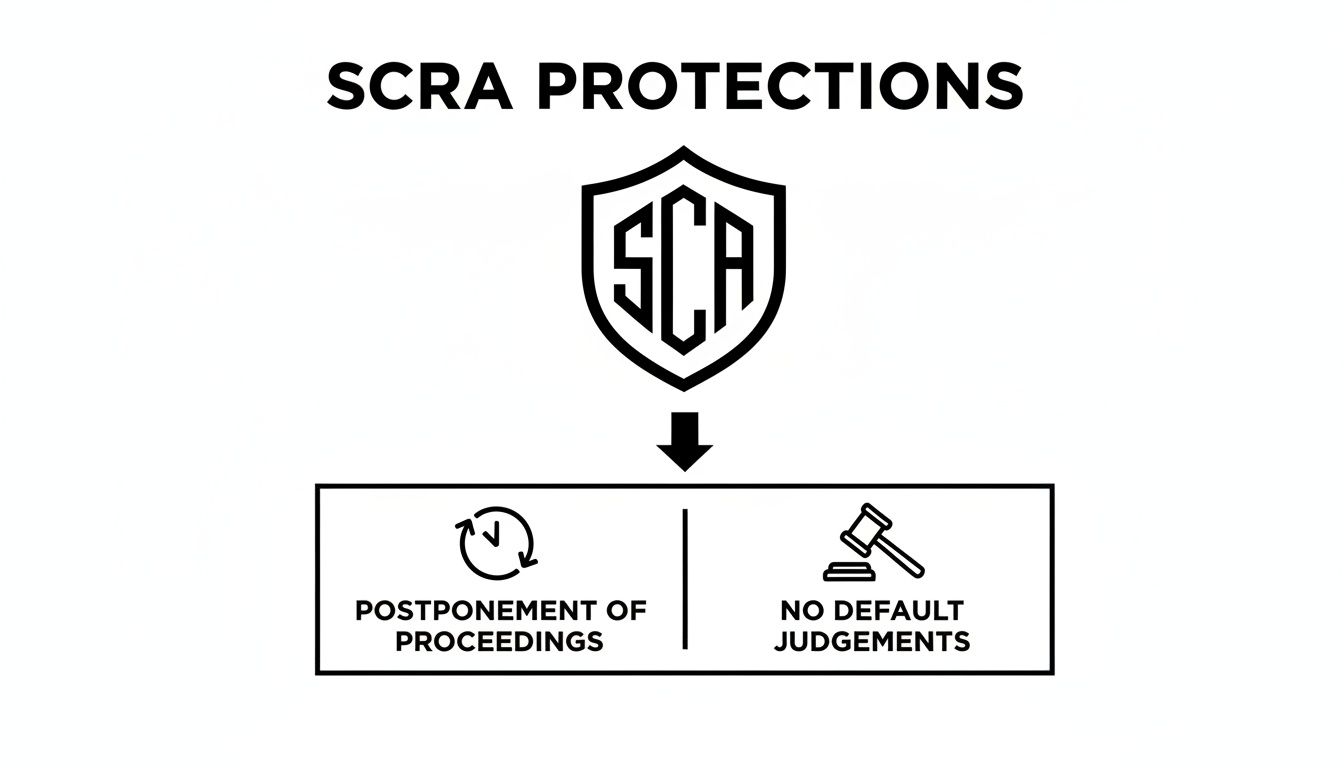
This protection is a shield, giving service members a legal pause so they can fairly address their case without the risk of an automatic negative outcome just because they are deployed or on active duty.
Crafting A Parenting Plan For Military Life

Child custody and support are almost always the most emotional and difficult parts of any divorce. When military service is involved, these issues get even more complicated. The realities of life in the armed forces—deployments, intensive training, and Permanent Change of Station (PCS) moves—demand a parenting plan that’s far more flexible and forward-thinking than a standard civilian agreement.
For families here in Pasco, Pinellas, and Hillsborough Counties, the goal is always the same: create a stable, loving environment for the kids. But how do you achieve that when one parent’s career is defined by unpredictability? The answer lies in a uniquely crafted plan grounded in Florida law.
Building A Deployment-Ready Parenting Plan
A typical parenting plan, which Florida calls a “timesharing schedule,” might lay out a simple week-on, week-off rotation. That neat schedule completely falls apart the second a service member gets deployment orders. A military parenting plan has to anticipate this.
Think of it as building a "backup plan" before you ever need it. The idea is to tackle all the "what-ifs" upfront, so there's a clear, agreed-upon process when that deployment notice inevitably arrives.
A truly effective military parenting plan must have specific provisions for:
- Temporary Custody During Deployment: The plan needs to name who the children will live with while the service member is gone. Florida law is unique here; it allows a deploying parent to delegate their timesharing rights to a close family member, like a grandparent or stepparent, who already has a strong relationship with the child.
- Detailed Communication Protocols: It’s not enough to just say "you can call." The plan should specify how and when the deployed parent can connect with the kids. This means scheduling video calls, phone calls, and access to messaging apps, all while being realistic about time zones and potential operational security (OPSEC) blackouts.
- Handling Relocation (PCS Moves): This is a huge one. The plan absolutely must address future PCS moves. It should outline the exact process for giving notice and negotiating a new timesharing schedule, making sure it follows Florida's very strict relocation laws.
A well-drafted military parenting plan is a roadmap for co-parenting through uncertainty. By setting clear rules for communication and temporary changes before a crisis hits, you shield your children from the stress of last-minute fights and emergency court hearings.
Calculating Child Support With Military Income
Child support is another area that trips people up. In Florida, we use a specific formula to calculate support based on both parents' net incomes and how many overnights the kids spend with each parent. For service members, "income" is a lot more than just base pay.
Florida courts look at the service member's total compensation. This includes non-taxable allowances that can significantly increase their actual take-home pay. A correct calculation has to include:
- Basic Allowance for Housing (BAH): Money provided for off-base housing.
- Basic Allowance for Subsistence (BAS): Money provided for food.
If these allowances are left out, the child support calculation will be unfairly low, and the children won't get the financial support they are entitled to. It's critical to work with an attorney who knows exactly how to document a service member’s complete income for the court. Our firm is committed to this level of detail for all families, including those in the LGBTQ+ community, to ensure a fair and just outcome.
A thoughtfully built parenting plan is the foundation of a healthy co-parenting relationship after a military divorce. To get a better sense of what these agreements cover, you can look over a helpful child custody agreement template that breaks down the essential parts. While military life adds extra layers, the core of a strong plan is always about what's best for the kids.
Why a Specialist Is Absolutely Critical for Your Military Divorce
Trying to navigate a military divorce without a specialist is a lot like trying to cross an ocean with a map of a local lake—you’re going to find yourself completely unprepared for the unique storms ahead. A general practice attorney, even a good one, is typically well-versed in standard Florida divorce law. But they often lack the deep, practical knowledge of the federal regulations that can and will control almost every aspect of your case.
This isn't just a minor detail. It’s the kind of thing that can mean the difference between a secure future and a genuinely disastrous financial outcome.
The way Florida law interacts with federal statutes like the Servicemembers Civil Relief Act (SCRA) and the Uniformed Services Former Spouses’ Protection Act (USFSPA) is incredibly complex. One wrong move in dividing military retirement benefits, for instance, could cost you tens or even hundreds of thousands of dollars over your lifetime. An attorney who doesn't live and breathe this specific area of law might not even know the right questions to ask, let alone how to fight for the answers you need.
It’s About More Than Just Knowing the Law
At our firm, we don't just know the statutes; we understand the military culture that has shaped your life. We speak the language of deployments, PCS moves, and the unique pressures that military families right here in Pasco, Pinellas, and Hillsborough Counties face every day.
This firsthand understanding allows us to build legal strategies that are not only legally solid but also practical for your real-world situation. We are also deeply committed to providing this specialized representation to all families, including those in the LGBTQ+ community, ensuring everyone receives the expert and respectful guidance they deserve.
Relying on a general practitioner for a military divorce is a huge risk. The legal nuances are too great, and frankly, the stakes are just too high. You need an advocate who has successfully navigated this specific, challenging legal terrain many times before.
Your Next Chapter Starts on Solid Ground
You’ve either served your country or stood by someone who has. Now, you deserve a legal team that can fiercely protect your rights and help you secure a fair start to your next chapter.
Don't leave your future to chance. If you are facing a military divorce in the Tampa Bay area, it’s time to talk with a team that is fully equipped to handle every single complexity your case will present. Your financial stability and your parental rights truly depend on it.
When you’re facing a military divorce, a million questions can race through your mind. The answers often seem buried under layers of legal jargon and dense military regulations. To cut through the noise, we've put together some straightforward answers to the questions we hear most often from service members and spouses in the Tampa Bay area.
Can I File For Divorce In Florida If My Spouse Is Stationed Elsewhere?
Yes, you most likely can. The key is establishing that Florida has jurisdiction over your case, which usually comes down to residency.
As long as the non-military spouse has lived in Florida for at least six months before filing the divorce petition, the court can typically hear the case. It’s that simple.
Another way is if the service member's official legal residence, or "home of record," is Florida. If that's the case, they can file for divorce here no matter where in the world they're currently stationed.
Does The SCRA Prevent My Spouse From Getting Divorced?
No, it doesn't. The Servicemembers Civil Relief Act (SCRA) is a crucial protection, but it doesn't stop a divorce from happening. Think of it more like a temporary "pause button."
A judge can grant a stay—a delay in the legal proceedings—if a service member's military duties physically prevent them from participating in their own defense. The divorce will still move forward eventually. The SCRA just ensures the process is fair and prevents a default judgment against someone who is deployed or otherwise can't respond.
Is My Spouse Entitled To Half Of My Military Pension?
This is where federal law and state law intersect. Under a federal law called the Uniformed Services Former Spouses’ Protection Act (USFSPA), Florida courts are allowed to treat military pensions as marital property.
This means the portion of the pension that was earned during the marriage can be divided just like any other asset. Florida law, not a blanket federal rule, dictates how it’s split. The goal is "equitable distribution"—what's fair—which often, but not always, means an equal division of that marital portion.
What Is The 10/10 Rule And Does It Affect My Pension Share?
The 10/10 Rule is one of the most misunderstood concepts in military divorce. Let’s be clear: it has nothing to do with whether a former spouse is entitled to a share of the pension. That's decided by the Florida court.
The rule is purely an administrative shortcut for payment.
If the marriage lasted at least 10 years, and those years overlapped with 10 years of the member's creditable military service, then the Defense Finance and Accounting Service (DFAS) can pay the former spouse's share directly to them.
If your marriage doesn't meet the 10/10 threshold, the court can still award a share of the pension. The only difference is that the retired service member is responsible for making those payments to their ex-spouse directly, instead of DFAS handling it.
At our firm, we handle all family and divorce issues with the nuance they deserve, including for gay and transgender service members. We don't discriminate, and we provide expert guidance for every family.
Navigating a military divorce means you need an attorney who is fluent in both Florida family law and the complex federal rules that will shape your future. At Foley Family Law, we have the experience to protect what you've earned and help you secure a stable new beginning. Start planning your next chapter with us.


