

Yes, Florida is a no-fault divorce state. This is a game-changer for many couples because it means you don't have to prove your spouse did anything wrong to end the marriage.
Simply put, the only thing you need to legally state is that the marriage is "irretrievably broken"—that there’s no realistic hope of repair. For couples in Pasco, Pinellas, and Hillsborough Counties, this modern approach removes a major hurdle right at the start of the process.
Understanding Florida's No-Fault Divorce System
When people ask, "is Florida a no-fault divorce state," they’re usually trying to figure out if they need to point fingers to get things started. The answer is a clear no. Florida’s system does away with the old, painful requirement of proving fault, like adultery or abandonment, just to get the divorce granted.
This was a deliberate change designed to lower the temperature from the very beginning. It allows everyone—including all members of the LGBTQ+ community—to skip the public blame game and focus on the real issues: dividing assets, creating a parenting plan, and moving forward. Our firm handles all LGBTQ+ family and divorce issues, and we do not discriminate.
The Two Core Requirements: No-Fault and Residency
While you don't have to assign blame, a couple of basic legal requirements still need to be met before you can file your petition. It’s pretty straightforward.
Here’s what the court needs to see:
- Irretrievably Broken: One or both spouses must state under oath that the marriage is beyond repair and cannot be saved.
- Residency: At least one of you must have lived in Florida for the six months right before you file the paperwork. You can learn more about how Florida's residency requirements might affect your case.
That's it. Your spouse doesn't even have to agree that the marriage is over for the divorce to proceed. If one person is done, they can file.
Florida actually led the way on this, becoming one of the first states to adopt a "pure" no-fault system. This change radically simplified the process of legally ending a marriage, making it less of a courtroom battle and more of a practical separation.
The Only Two Grounds For Divorce In Florida
Since Florida is a no-fault divorce state, you don't need to prove that your spouse did something wrong to end the marriage. The process is much more direct. However, you still have to state a legally valid reason—what lawyers call "grounds"—on your official paperwork.
Luckily, Florida law keeps it simple. There are only two options.
The Marriage is "Irretrievably Broken"
This is the reason cited in nearly every divorce case in Florida. It's legal-speak for a simple, human reality: the marriage is over, and there's no reasonable chance of fixing it. If one of you believes this to be true, the court will almost always accept it at face value.
You don’t need to air dirty laundry or point fingers. This no-fault ground prevents a courtroom drama, allowing you and your spouse to focus on the practical issues—like property, finances, and parenting—instead of getting bogged down in who’s to blame.
A marriage is considered irretrievably broken when there is no hope for reconciliation. This is a personal declaration, not something you need to prove with evidence of fault like in the old days.
Mental Incapacity of a Spouse
The second, and far less common, ground for divorce is the mental incapacity of one spouse. This isn't a simple claim; it requires a formal legal judgment declaring the spouse mentally incapacitated for a significant period before filing for divorce.
Because of the high legal and medical hurdles involved, this option is rarely used.
For almost every couple in Pasco, Pinellas, and Hillsborough Counties, declaring the marriage "irretrievably broken" is the standard path. This straightforward approach is a major distinction when you're weighing your options and considering an annulment vs. a divorce.
How No-Fault Impacts Property Division And Alimony
One of the most common—and costly—misconceptions about no-fault divorce is that a spouse’s bad behavior becomes legally irrelevant. That’s just not true. While you don’t have to prove fault to end the marriage, misconduct can absolutely influence the financial outcome of your divorce.
The court's primary goal isn't to punish a cheating or reckless spouse. Instead, the focus is on achieving a fair financial split. This is where the principle of equitable distribution comes into play, guiding how all your marital property is divided.
Understanding Equitable Distribution
Equitable distribution means that assets and debts acquired during the marriage are divided fairly. Notice the word is "fairly," not "equally." A 50/50 split is the starting point, but a judge can adjust those percentages based on specific factors—including one spouse’s financial misconduct.
Let's say one spouse secretly drained a joint savings account to pay for expensive gifts or trips related to an affair. This is a classic example of dissipation of marital assets. A judge in Pinellas, Pasco, or Hillsborough County can correct this injustice by awarding the other spouse a larger share of the remaining assets to make them whole.
This ensures one person's poor choices don't unfairly penalize the other financially. The system is designed for fairness, not revenge.
Equitable distribution is the court’s tool for achieving a just financial outcome. It allows a judge to look beyond a simple 50/50 division and consider the entire financial picture of the marriage, including any waste or misconduct.
How Misconduct Affects Alimony Awards
Misconduct can also tip the scales in alimony decisions. While the main drivers for spousal support are one spouse's need and the other's ability to pay, Florida law explicitly allows the court to consider adultery when making its decision.
The key is that the misconduct must have a financial connection. For instance:
- Wasting Marital Funds: If your spouse spent thousands on a romantic partner outside the marriage, those funds are no longer available to the family. A judge can factor that waste into the alimony calculation.
- Impacting the Marital Lifestyle: The court looks at the standard of living you both established. If misconduct drained resources that would have otherwise supported that lifestyle, it becomes directly relevant.
The court’s job is to ensure the final alimony award is fair and just. Getting a handle on the nuances of alimony in Florida is crucial for protecting your financial future. Because our team works exclusively in Pasco, Pinellas, and Hillsborough Counties, we know exactly how local judges tend to view these situations.
Protecting Your Children In A No-Fault System
When kids are part of the equation, the idea of "no-fault" gets thrown right out the window. While Florida doesn’t care why your marriage is ending, it cares deeply about how you behave as a parent.
Your fitness and conduct become the absolute focus when it’s time to decide on timesharing and parental responsibility. The court has one unwavering mission: to protect the "best interests of the child." This is the legal standard that guides every single decision. So, while the reason for the divorce itself might be no-fault, a parent’s actions are definitely not ignored.
How Parental Behavior Influences Decisions
Judges in Pasco, Pinellas, and Hillsborough Counties don't just guess what's best for a child; they are legally required to evaluate a long list of specific factors. This is where a parent's character and actions take center stage.
Certain behaviors are immediate red flags for the court and will be examined closely. These include:
- Domestic Violence: A history of abuse is one of the most serious factors and will dramatically impact timesharing arrangements.
- Substance Abuse: If a parent is struggling with alcohol or drug dependency, it directly questions their ability to provide a safe and stable home for a child.
- Moral Fitness: This is a broader category, but it essentially allows a judge to look at any behavior that shows a parent is unable—or unwilling—to put their child's needs first.
The courts focus intensely on creating predictable, stable parenting arrangements that serve the child, regardless of why the marriage failed. Our firm is committed to protecting the parental rights of everyone, including same-sex and transgender parents, to ensure their child's safety and well-being remain the primary goal. We handle gay divorce, gay custody issues, and gay or transgender name changes. We help our clients work through the details of creating a durable parenting plan in a divorce, which is the foundational document that outlines every aspect of your child’s care moving forward.
Navigating The Divorce Process In The Tampa Bay Area
Knowing the law is one thing, but actually navigating the local court system is a whole different ballgame. Let's walk through a practical roadmap for starting the divorce process right here in the Tampa Bay area, specifically within the court systems of Pasco, Pinellas, and Hillsborough Counties.
Before a single piece of paper can be filed, you have to meet Florida's residency requirement. It’s pretty straightforward: one of you must have lived in the state for at least six months before filing the petition. Once you've cleared that hurdle, the process officially kicks off by filing a Petition for Dissolution of Marriage. This is the document that gets everything started.
After it's filed, the petition has to be formally delivered to your spouse in a step known as "service." From that point on, your path forward really depends on one key question: is your divorce contested or uncontested?
Contested Vs Uncontested Divorce
An uncontested divorce is the simplest and most direct path. This is what happens when you and your spouse are on the same page about all the big issues—how to divide property, whether alimony is needed, and how you’ll share time with your children. For these more straightforward splits, specialized paralegal divorce services can sometimes provide a cost-effective way to get the paperwork done right.
A contested divorce, on the other hand, means you don’t agree on one or more of these critical issues. Those disagreements will have to be worked out through negotiation, mediation, or, if all else fails, litigation in front of a judge. This is where having an attorney who truly understands the specific procedures and even the tendencies of local judges becomes absolutely invaluable.
When children are involved in a contested case, the court's main focus is figuring out what is in their best interest. This infographic gives a simplified look at how a judge might approach that evaluation.
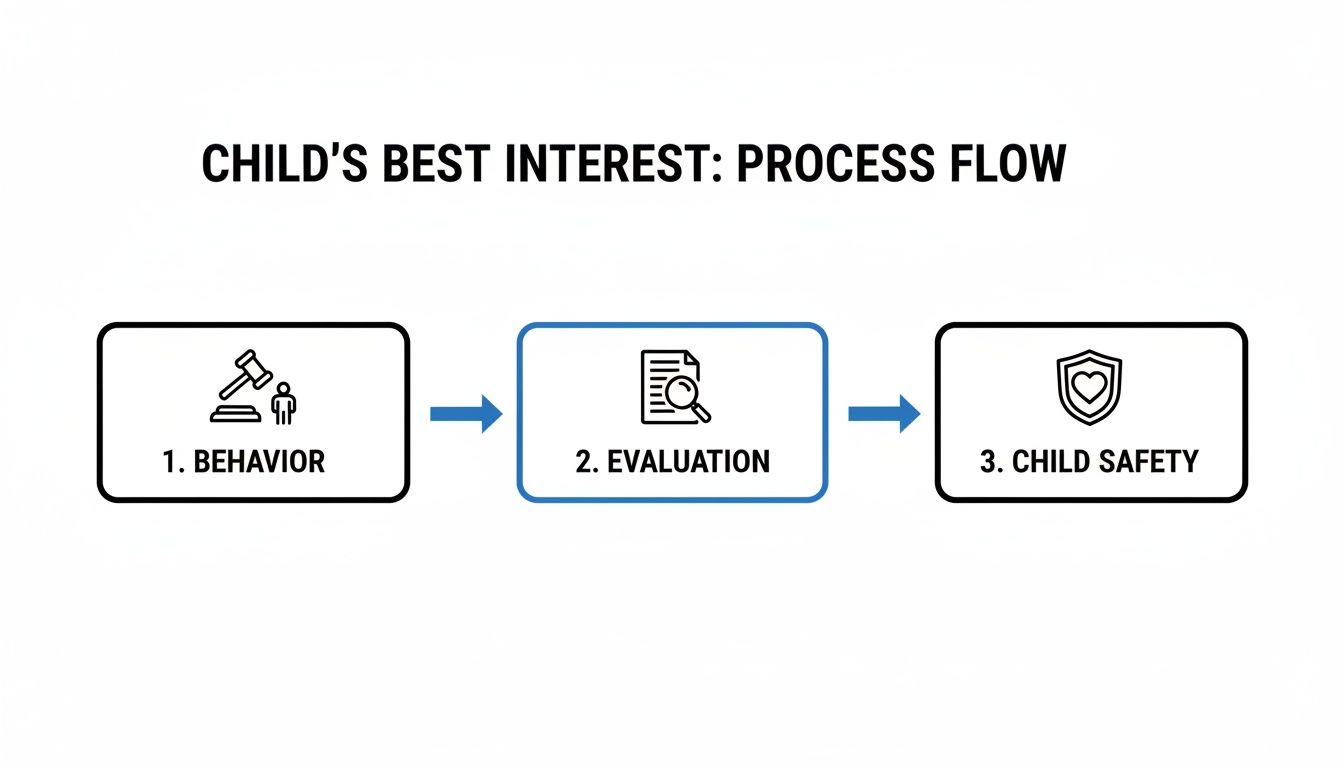
As the visual shows, a judge's assessment of parental behavior is a central part of making sure a child's safety and well-being are protected.
Just understanding these first few steps can take a huge weight off your shoulders. Knowing what to expect and making informed choices from the very beginning lays the groundwork for a much more manageable process. To get started on the right foot, take a look at our guide on how to choose the right divorce lawyer to find the best possible advocate for your unique situation.
Frequently Asked Questions About Florida's No-Fault Divorce
We've walked through the basics, but divorce is rarely basic. It's personal, and you probably have questions about how these laws apply to your life. Here are some of the most common questions we hear from clients in our office.
Does My Spouse Have To Agree To The Divorce?
No. Because Florida is a no-fault state, only one person has to state that the marriage is irretrievably broken.
Your spouse can’t legally stop you from getting a divorce. They can, however, make the process more difficult by contesting things like how assets are divided or what the parenting plan will look like.
How Long Does A No-Fault Divorce Take?
This varies wildly from case to case. If you and your spouse agree on every single issue—what we call an uncontested divorce—it can be finalized in just a few weeks in Pasco, Pinellas, or Hillsborough Counties.
But if there are disagreements and it becomes a contested divorce, the timeline can stretch out for many months, and sometimes over a year, before everything is resolved.
Can I Get More Alimony If My Spouse Cheated?
Not for the act of cheating alone. Florida law doesn't punish a spouse for infidelity by awarding more alimony.
However, if your spouse spent marital money on their affair—think expensive gifts, vacations, or paying for an apartment—a judge will take notice. This is called a dissipation of marital assets, and a court can adjust the property division or alimony award to make you financially whole again.
People often find answers to complex legal questions online, and that’s usually thanks to effective strategies for family law SEO.
Do I Need A Lawyer For A No-Fault Divorce?
While "no-fault" makes the reason for the divorce simple, it does nothing to simplify the process of untangling your financial lives or protecting your children's futures.
Things like dividing retirement accounts, valuing a business, or creating a stable parenting plan are almost never straightforward. Having an experienced attorney on your side is the only way to ensure your rights are protected and you walk away with a truly fair outcome.
Understanding how Florida's no-fault system works is the first step toward getting a fair resolution. The experienced team at Foley Family Law is here to guide you through every stage, protecting your rights and your future. Contact us for a consultation to discuss your case in Pasco, Pinellas, or Hillsborough County. https://wfoleylaw.com


