

Let's cut right to the chase: Florida is an equitable distribution state, not a community property state. This is, without a doubt, the single most important detail in how your property and debts will be handled in a divorce. Getting this one concept straight is the foundation for protecting your financial future.
Understanding Florida's Approach To Dividing Property
When people ask, "Is Florida a community property state?" they're usually thinking of a clean, simple 50/50 split. And that's exactly how it works in some states, where community property rules dictate that almost everything acquired during the marriage gets divided right down the middle.
But Florida law is different. Our system is built on the principle of fairness, and fair doesn't always mean a perfect 50/50 split.
Here, we follow what’s known as equitable distribution. Think of it this way: instead of a judge automatically cutting a pie exactly in half, they look at the entire marriage—the whole picture—to decide what a fair, or equitable, division looks like for both people involved. The court starts with the idea of an equal split, but it has the power to shift that balance based on specific, legally defined factors. This gives the court the flexibility it needs to address the unique circumstances of every single family.
Equitable distribution is designed to achieve a fair outcome by considering each spouse's contributions, financial standing, and future needs, rather than just applying a rigid mathematical formula.
What This Means For Your Divorce
This isn't just legal jargon; it has a direct and powerful impact on your financial life after the divorce is final. Under Florida’s equitable distribution model, a judge has the discretion to award one spouse a larger share of the marital assets if the situation warrants it. This is precisely why having an experienced legal guide in your corner is so critical.
The entire process boils down to a careful three-step analysis:
- Identification: First, we figure out what property is "marital" and what is "separate."
- Valuation: Next, we assign a current, fair market value to all the marital assets and debts.
- Distribution: Finally, the marital estate is divided in a way that is fair and just.
Successfully navigating these steps requires a deep, practical understanding of how Florida law is actually applied in the local courts. Our firm is dedicated exclusively to family law in Pasco, Pinellas, and Hillsborough Counties, giving us the focused experience needed to protect your rights—regardless of gender or sexual orientation. We handle all LGBTQ+ family and divorce matters with the same commitment and professionalism.
Understanding Equitable Distribution vs. Community Property
To really get why Florida's approach to dividing assets in a divorce matters so much, it helps to see it side-by-side with the "community property" model.
Think of a community property state as dissolving a business partnership with a rigid, one-size-fits-all rule. Every single asset acquired during the marriage is simply split exactly 50/50. It doesn't matter who earned the money, who saved it, or who ran the household. The rule is the rule.
Florida's equitable distribution system is a world apart. It’s less like a blunt liquidation and more like a thoughtful, detailed buyout process. A judge doesn't just punch numbers into a calculator and divide by two. Instead, they look at the entire story of the marriage to figure out what's genuinely fair.
What Makes A Division "Fair" Or "Equitable"?
In Florida, the court’s starting point is that marital assets and debts should be split equally. But—and this is a big but—the law gives judges the power to move away from that 50/50 starting line based on a number of specific factors. This is where a judge's discretion, and the skill of your attorney, become critical.
A judge can justify an unequal division of property based on things like:
- Contributions to the Marriage: This isn't just about who brought home the bigger paycheck. It also weighs the immense value of a spouse's work as a homemaker, raising children, or supporting the other's career.
- Economic Circumstances: The court looks at the financial reality each person will be walking into after the divorce is final.
- Duration of the Marriage: A brief, two-year marriage might be handled very differently than a 25-year partnership where a couple built their entire life together.
- Career and Education Support: Did one spouse put their own ambitions on hold to help the other finish a medical degree or get a business off the ground? That contribution has value.
- Wasteful Spending: If one spouse intentionally blew through marital savings on gambling or an affair right before filing for divorce, the court can adjust the division to make things right.
This side-by-side comparison shows the core difference: a rigid, automatic split versus Florida's flexible, fairness-focused approach.
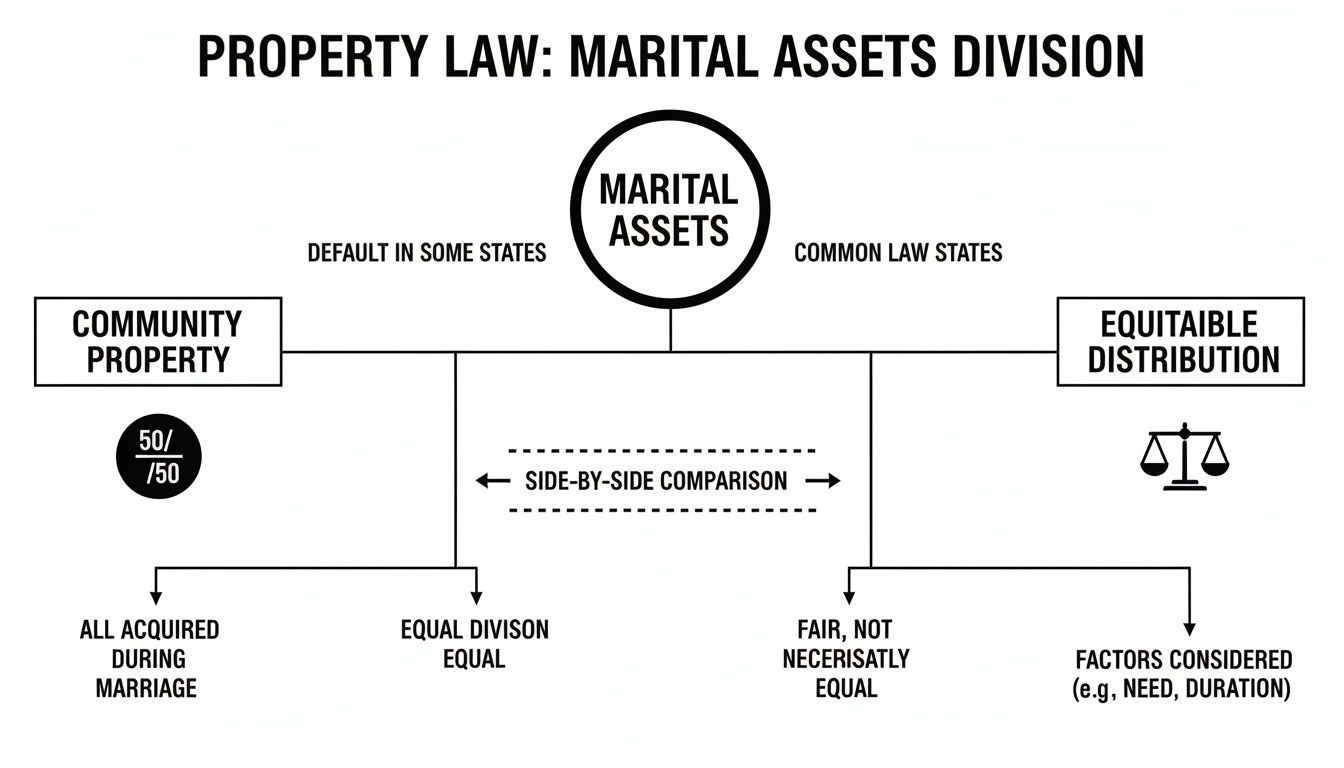
As the infographic shows, community property is a simple, clean break down the middle. Equitable distribution, on the other hand, is more like balancing a set of scales, with a judge carefully weighing all the factors to reach a just result.
Why This Distinction Is Crucial
This discretionary power means the outcome of your property division is never guaranteed. The arguments you make, the evidence you present, and the story you tell can dramatically shift the final numbers. For anyone facing divorce, including members of the LGBTQ+ community, grasping these nuances is absolutely vital.
Because judges in Pasco, Pinellas, and Hillsborough Counties can weigh these factors differently from case to case, having skilled legal representation isn't just a good idea—it's essential. An experienced attorney knows how to build a compelling narrative that shows the court precisely why a certain division of assets is the most equitable outcome for your specific situation.
You can learn more from a Tampa equitable distribution attorney to understand how these principles apply to the facts of your life. This personalized, factor-based approach is truly the cornerstone of Florida’s family law system.
Defining Marital Property In A Florida Divorce
To figure out how equitable distribution actually works, we first have to answer one key question: what’s on the table for division? The court’s authority only extends to what’s considered marital property. This is a broad category that covers almost every asset acquired and debt taken on by either you or your spouse from the day you got married until the day one of you files for divorce.
This isn’t just about the obvious things like a joint bank account or the family home. Marital property often includes assets you might not expect. For instance, the increase in value of a 401(k) or pension plan during the marriage is a marital asset, even if the account is only in one spouse's name. The same goes for businesses started after the wedding, investment portfolios that grew over the years, and even that credit card debt you both racked up.
What Is Separate Property?
On the flip side, Florida law recognizes separate property, sometimes called non-marital property. These are assets that belong solely to one spouse and, as a general rule, aren't subject to division. Identifying and protecting these assets is a critical step in securing your financial future.
Typically, separate property includes things like:
- Assets you owned by yourself before you got married.
- An inheritance left specifically to you, not to you as a couple.
- A gift you received from someone else, like a parent.
- Any income earned from these separate assets, as long as it wasn’t mixed in with marital funds or used for joint expenses.
The core idea is pretty simple: what was yours before the marriage or was given only to you during it should stay yours after. But keeping it "separate" isn't always so straightforward.
Preserving The Distinction
Protecting your separate property requires a lot of diligence. We help clients across Pasco, Pinellas, and Hillsborough Counties understand this crucial distinction, which really is the foundation of any property division case. Getting these definitions wrong can lead to very costly mistakes.
For example, when dealing with real estate, understanding the nuances of ownership documents is everything. If there are questions about how a property is titled and whether it was treated like a marital asset, every detail matters. Tools like an AI real estate title document reviewer can help meticulously comb through these records to clarify the ownership history.
Ultimately, the burden of proof falls on the spouse who is claiming an asset is separate. You have to be able to clearly trace its origins and show that it was never intended to become part of the marital pot. We work with individuals, including those in the LGBTQ+ community, to make sure their non-marital assets are correctly identified and protected throughout the entire divorce process.
How Separate Assets Can Become Marital Property

During a marriage, the line between "yours" and "ours" can get surprisingly blurry. An asset you owned long before your wedding—or a family inheritance you received—can lose its protected status as separate property. This often happens through actions you might not even realize are legally significant, making it one of the trickiest areas of Florida divorce law.
A common scenario we see plays out like this: You receive a $50,000 inheritance, which is legally your separate property. Instead of keeping it in its own, new bank account, you deposit those funds into the joint checking account you and your spouse use for everything from mortgage payments to groceries.
That single action is called commingling. By mixing your separate funds with marital money so thoroughly that they become impossible to tell apart, you have likely transformed that inheritance into a marital asset. Now, it's on the table for equitable distribution.
Understanding Commingling
Commingling is what happens when separate and marital assets get mixed together to the point that their original identity is lost. The source of the funds starts to matter less than how those funds were treated during the marriage. Meticulously tracing the flow of money is often a critical task in divorce cases across Pasco, Pinellas, and Hillsborough Counties.
By treating your separate property as a shared resource, you demonstrate an intent to make it part of the marital estate. Florida courts will often see this action as a "gift" to the marriage.
This principle isn't just for cash. Using separate funds to pay down the mortgage on the marital home or to renovate the kitchen can also convert those funds into marital equity in the house.
The Concept Of Transmutation
Another way separate property gets reclassified is through transmutation. This happens when an asset's legal identity is changed from separate to marital, usually by retitling it in both spouses' names. For example, if you owned a rental property before the marriage and later add your spouse's name to the deed, you have almost certainly transmuted that property into a marital asset.
There are two primary ways an asset loses its separate status:
- Commingling: Mixing separate money with marital money in a joint account.
- Transmutation: Changing the title of a separate asset to include your spouse.
These concepts highlight why proactive planning is so important. For anyone entering a marriage with significant separate assets, it's wise to explore when you should get a prenup. A prenuptial agreement can provide clarity and protection, clearly defining what remains separate no matter what happens down the road. Our firm works with all individuals, including members of the LGBTQ+ community, to protect their financial interests.
Navigating Complex Assets In Your Divorce

These days, a divorce rarely involves just splitting a house and a checking account. When significant wealth is on the table, the process of identifying, valuing, and dividing assets requires a much deeper level of financial and legal expertise. High-stakes assets demand a forensic level of attention and a seasoned understanding of Florida’s equitable distribution laws.
This is especially true for assets that change in value over the years, like retirement accounts. A common point of confusion is how a 401(k) or pension gets divided, particularly if it was started before the wedding. Florida law is clear on this: only the marital portion of that account—the value that built up from the date of marriage to the date the divorce was filed—is on the table for division. Pinpointing this exact amount requires a careful financial analysis to make sure the outcome is fair.
Valuing Business Interests
The complexity jumps to another level when one or both spouses own a business. If the business was started or grew substantially during the marriage, it's considered a marital asset. Just looking at the company's bank statements won't even scratch the surface of determining what it's truly worth.
Properly valuing a business almost always means bringing in outside experts. These forensic accountants and valuation specialists perform a detailed analysis to establish the business's real fair market value. This is a non-negotiable first step before any division can even be discussed. For business owners in Pasco, Pinellas, and Hillsborough Counties, this process is fundamental to protecting their life's work. To get a better handle on this, you can read our guide on how to protect your company during a divorce, which dives deeper into this topic.
The Role Of Marital Agreements
Think of prenuptial and postnuptial agreements as private contracts that can override Florida's default property division rules. These legal documents give a couple the power to decide, ahead of time, exactly how their assets will be split if they ever divorce.
A well-drafted marital agreement provides a predetermined roadmap for asset division, offering predictability and control in what can otherwise be an uncertain process.
It’s also important to remember that Florida courts may need to consider the character of property that was acquired while living in a community property state. So, if you moved to Florida from another state, how your assets are treated could be more complex.
Our firm is committed to providing this level of detailed, strategic guidance to every client. That includes skillfully managing the unique financial considerations that can arise in any divorce, ensuring every individual's rights are protected from start to finish. We handle all LGBTQ+ family and divorce matters with care and expertise in Pasco, Pinellas, and Hillsborough Counties.
Actionable Steps To Protect Your Financial Future
As you head into a potential divorce, the absolute best thing you can do is get organized and proactive. Thinking clearly now can save you a world of stress later, setting you up for a much more stable future. This isn't a time for guesswork; it's the time for a real, actionable game plan.
Your first move should be to gather every piece of financial paperwork you can find. This means creating a complete inventory of your marital life—bank statements, tax returns, pay stubs, retirement account summaries, and loan documents.
Be completely transparent. Hiding assets or making strange financial moves right now is a terrible idea. It can destroy your credibility in court and lead to serious penalties. It's also important to understand concepts like a potential breach of fiduciary duty, which can be vital for protecting your assets during this sensitive time.
Secure Professional Legal Counsel Early
The single most important step you can take? Talk to an experienced family law attorney as soon as you can.
An attorney can build a strategy designed specifically to protect your rights under Florida's equitable distribution laws. They can also walk you through options you might not have considered, like a postnuptial agreement, which can help define how assets are divided even after you're married. You can learn more about how a postnuptial agreement in Florida works and if it’s a good fit for your situation.
While Florida is an equitable distribution state by default, a specific type of trust can allow couples to opt into community property treatment for assets they place within it, though this is generally used for specific planning purposes.
Ultimately, getting professional guidance is about making sure you understand all your options. At Foley Family Law, we provide this level of dedicated counsel to everyone we work with, including members of the LGBTQ+ community across Pasco, Pinellas, and Hillsborough Counties. Our goal is to help you make informed decisions that lead to a secure future.
Frequently Asked Questions About Florida Property Division
Navigating a divorce brings up a whirlwind of questions, and getting clear, straightforward answers is the first step toward peace of mind. To help, we've tackled some of the most common concerns we hear about property division under Florida law.
Does Equitable Distribution Always Mean A 50/50 Split?
Not necessarily. The key word here is "equitable," which means fair, not always equal.
While Florida law starts with a 50/50 split as the baseline, a judge has the power to order an unequal division. This can happen for a number of reasons, like if one spouse recklessly wasted marital funds, if one person has unique economic needs, or if one spouse made significant sacrifices that boosted the other’s career.
What Happens To Our Family Home In The Divorce?
For most couples, the family home is their most significant marital asset, and figuring out what to do with it is a major hurdle. There are a few common paths:
- One spouse can buy out the other's equity in the home.
- The house can be sold, with both spouses splitting the proceeds.
- One spouse (often the one with primary custody of the kids) may be granted exclusive use of the home for a set period.
The right solution really depends on your family's specific finances and needs.
Is My Spouse Entitled To My Inheritance?
Generally, an inheritance is considered your separate, non-marital property. But—and this is a big "but"—that protection isn't foolproof.
If you "commingle" those funds by, for example, depositing them into a joint bank account or using them to pay down the mortgage on the marital home, you risk transforming it into marital property. Once that happens, it's on the table for division.
The surest way to protect an inheritance is to keep it in a separate account under your name only and avoid using it for joint marital expenses. This maintains its identity as your non-marital asset.
How Is Our Debt Divided In A Florida Divorce?
Just like assets, debts that pile up during the marriage are divided equitably. This includes everything from mortgages and car loans to credit card balances, even if the debt is only in one spouse’s name.
A court will look at who incurred the debt and what it was for when deciding how to fairly divide the responsibility. For a deeper look into the financial aspects of ending a marriage, you might find it helpful to understand how much does divorce cost in Florida.
Our firm is experienced in handling these complex questions for clients in Pasco, Pinellas, and Hillsborough Counties, including all LGBTQ+ divorce and family law issues.
Navigating the specifics of equitable distribution requires skill and experience. The legal team at Foley Family Law is dedicated to protecting your financial future and achieving a fair outcome. Contact us for a consultation to discuss your case. Learn more at https://wfoleylaw.com.


