

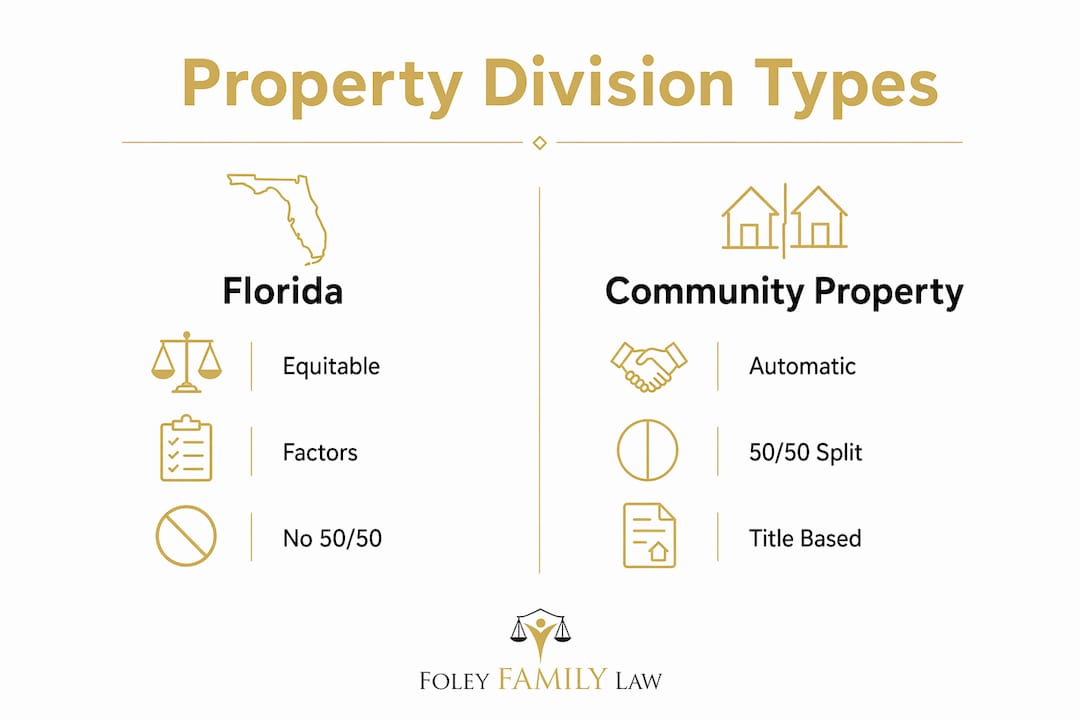
Florida is not a 50/50 community property state. Under Florida Statutes § 61.075, courts divide marital property through equitable distribution, a system that starts with a presumption of equal division but allows judges to adjust that split based on the specific facts of your case. Fairness, not arithmetic, drives the outcome.
Here is what that means in practice:
- Courts begin with the assumption that a 50/50 split is appropriate.
- Either spouse can present evidence to justify a different division.
- The burden of proof falls on the spouse seeking an unequal share.
- Equitable distribution applies to both assets and debts acquired during the marriage.
- Florida is not a “mother state” or “father state” for property purposes. Those informal labels relate to child custody, not property division.
What counts as marital property in Florida?
Before any division happens, a court must classify every asset and debt as either marital or non-marital. Florida Statutes § 61.075 draws a clear line between the two categories.
Marital property generally includes:
- Income earned by either spouse during the marriage
- Real estate, vehicles, and personal property purchased during the marriage, regardless of whose name is on the title
- Retirement account contributions made while married, including 401(k) and pension growth
- Debts incurred during the marriage, even if only one spouse signed for them
- Appreciation on non-marital assets when the other spouse contributed to that growth
Non-marital (separate) property typically includes:
- Assets owned before the marriage
- Inheritances and gifts received by one spouse, even during the marriage
- Property specifically excluded by a valid prenuptial or postnuptial agreement
The tricky situations arise when separate property becomes commingled with marital funds. A pre-marriage savings account that both spouses deposit into throughout the marriage can lose its separate character entirely. Courts look at the paper trail carefully, and the Florida Bar’s equitable distribution analysis confirms that setting aside non-marital property is the required first step before any distribution begins. Debt assignment follows the same logic. If a divorce decree assigns a joint credit card to one spouse, that does not automatically release the other from the creditor’s reach unless an indemnification clause is built into the settlement agreement.
Pro Tip: Document the source of any asset you believe is separate property before filing. Bank statements, gift letters, and inheritance records can make the difference between keeping an asset and splitting it.
How does Florida’s system differ from community property states?
The distinction matters more than most people realize, especially for anyone who moved to Florida from California, Texas, or another community property state.

| Feature | Florida (equitable distribution) | Community property states |
|---|---|---|
| Division standard | Fair, not necessarily equal | Automatic 50/50 split |
| Court discretion | High | Limited |
| Ownership rule | Based on title | Both spouses own 50% of all marital assets |
| Creditor protection | Tenancy by entirety available | No comparable protection |
| Outcome predictability | Less predictable | More predictable |
Florida follows common law property rules, meaning ownership tracks the title, not the date of acquisition. Nine states use community property rules: Arizona, California, Idaho, Louisiana, Nevada, New Mexico, Texas, Washington, and Wisconsin. In those states, each spouse holds an undivided 50% interest in every marital asset from the moment it is acquired.
Florida offers something those states cannot. Married couples here can hold property as tenants by the entirety, a joint ownership form that shields the asset from a creditor holding a judgment against only one spouse. No community property state offers a comparable protection. If you moved to Florida from a community property state, assets you brought with you generally retain their community property character for estate planning purposes, but anything acquired after the move falls under Florida’s equitable distribution rules.
What factors do Florida courts weigh when dividing property?
A judge does not simply split everything down the middle and move on. Florida Statutes § 61.075(1) lists the factors courts must consider when deciding whether an unequal distribution is justified:
- Duration of the marriage: Longer marriages tend to produce more equal divisions.
- Economic circumstances of each spouse: A spouse with significantly fewer earning prospects may receive a larger share.
- Contributions to the marriage: This includes non-monetary contributions like homemaking, child-rearing, and supporting the other spouse’s career.
- Career interruptions: If one spouse left the workforce or reduced hours to care for children, courts account for that sacrifice.
- Intentional waste or depletion: A spouse who dissipated marital assets through gambling, reckless spending, or hidden transfers before the divorce may receive a smaller share.
- Desirability of retaining a business interest: Courts try to avoid forcing a sale when one spouse runs a closely held business.
- Desirability of retaining the marital home: Particularly when minor children are involved, a court may award the home to the primary caregiver.
- Any other factor necessary to do equity: This catch-all gives judges flexibility to address unusual circumstances.
Valuation timing also shapes the outcome. Courts choose asset valuation dates they consider “just and equitable,” often the date of separation or the date the petition was filed. When an asset has appreciated passively since filing, courts generally use the final hearing date. When appreciation reflects one spouse’s post-separation work, the filing date is typically used instead.
Common misconceptions about Florida property division
Several persistent myths cause real confusion for people going through a divorce in Florida.
Myth 1: Florida guarantees a 50/50 split. The presumption of equal division is procedural, not absolute. Courts weigh evidence before deciding on any departure from parity. Distributions close to equal split are common in Florida divorces, with approximately 70% of cases resulting in property divisions between 45% and 55% to each spouse, but the remaining cases can look very different.

Myth 2: The spouse whose name is on the title keeps the asset. Florida courts look past the title when classifying marital property. A house titled solely in one spouse’s name is still marital property if it was purchased during the marriage with marital funds during divorce.
Myth 3: Adultery affects property division. Florida is a no-fault divorce state, so marital misconduct generally does not influence property division. The exception is when a spouse spent marital funds on an affair partner, which courts may treat as waste or dissipation.
Myth 4: A prenuptial agreement can be ignored. Valid prenuptial and postnuptial agreements are enforceable in Florida and can override the default equitable distribution rules entirely. Courts will honor them unless there is evidence of fraud, duress, or failure to disclose assets.
Myth 5: Property division and child custody follow the same rules. They do not. Questions about whether Florida favors mothers or fathers relate to time-sharing arrangements, which are governed by the best interests of the child standard, completely separate from property division law.
What Foley Family Law wants you to know about property division
Equitable distribution cases are rarely straightforward. The statutory factors give courts wide discretion, and the outcome often turns on details that seem minor at first, such as when an asset was valued, whether a contribution was documented, or how a debt was titled. Individuals from community property states often arrive expecting an automatic 50/50 result, but Florida’s system is built around fairness to the specific circumstances of each marriage. Getting the classification and valuation right from the start is where cases are won or lost.
Foley Family Law focuses exclusively on family law in Hillsborough, Pinellas, and Pasco counties, handling everything from straightforward uncontested divorces to high-asset contested cases where business interests, retirement accounts, and real estate require careful valuation. The firm’s approach centers on transparent communication and cost-effective strategy, so clients understand what they are fighting for and why. If your situation involves commingled assets, a business interest, or a spouse who may have dissipated marital funds, the details of how Florida law applies to your specific facts can shift the outcome considerably. Personalized legal advice is not a luxury in those cases. It is the practical path forward.

Ready to understand how equitable distribution applies to your situation? Foley Family Law offers consultations for individuals in Hillsborough, Pinellas, and Pasco counties. Learn more about what a family law attorney does and how the right representation can protect your financial future.
Key Takeaways
Florida courts start with a presumption of equal division but apply statutory factors under Florida Statutes § 61.075 to reach a fair outcome, meaning the final split often differs from a strict 50/50.
| Point | Details |
|---|---|
| Not a community property state | Florida uses equitable distribution, not an automatic 50/50 split. |
| Presumption of equality | Courts start at 50/50 but adjust based on statutory factors and evidence. |
| Near-equal outcomes are common | Many Florida divorces result in a distribution fairly close to equal, with about 70% of cases ending in splits between 45% and 55% to each spouse, though the exact split varies. |
| Title does not determine ownership | Marital assets are subject to division regardless of whose name is on the title. |
| Agreements override defaults | Valid prenuptial and postnuptial agreements can change how property is divided. |
FAQ
Is my wife entitled to half my house if it’s in my name in Florida?
Not automatically. If the house was purchased during the marriage with marital funds, it is marital property subject to equitable distribution regardless of whose name is on the title. A court will weigh the statutory factors under Florida Statutes § 61.075 before deciding each spouse’s share.
Is it hard to get a 50/50 child custody arrangement in Florida?
Florida courts apply the best interests of the child standard to time-sharing, not equitable distribution rules. Equal time-sharing is possible and courts favor arrangements that allow both parents to be involved, but the outcome depends on each family’s specific circumstances.
What assets are untouchable during a divorce in Florida?
Non-marital assets, including property owned before the marriage, inheritances, and gifts received by one spouse, are generally set aside before distribution begins. Assets protected by a valid prenuptial agreement are also excluded, provided the agreement meets Florida’s legal requirements.
Who pays for the divorce if adultery is involved in Florida?
Florida is a no-fault divorce state, so adultery does not determine who pays legal fees or how property is divided. However, if a spouse spent marital funds on an affair, a court may treat that spending as dissipation of marital assets and adjust the distribution accordingly. You can learn more about how alimony is determined separately from property division.


