

Being served divorce papers is an emotionally charged and legally significant moment. It’s jarring. The first thing to understand about how to respond to a divorce petition is that the clock starts ticking immediately—you have a strict 20-day deadline under Florida law to file a formal, written Answer with the court.
This initial response isn’t just a formality. It's your first real opportunity to protect your rights regarding your children, your home, and your financial future. Acting promptly and strategically is everything. Our firm handles all family and divorce issues in Pasco, Pinellas, and Hillsborough Counties, and we do not discriminate. We proudly handle gay divorce, gay custody issues, and other LGBTQ matters.
What To Do After Being Served Divorce Papers
The moment a process server hands you that stack of legal documents can feel disorienting. Buried in that stack is the "Petition for Dissolution of Marriage." This isn't just a notice; it's a formal lawsuit your spouse filed asking a Florida judge to legally end your marriage.
That petition lays out exactly what your spouse wants, from parenting arrangements to who gets the house. Your first instinct might be to ignore it or react with anger, but the most important thing you can do is stay calm and take deliberate action.

The exact date and time you were "served" are incredibly important because they start that legal clock. In Florida, you have exactly 20 calendar days to file a formal response. Missing this deadline can have devastating consequences. You could face a "default" judgment, where the court grants your spouse everything they asked for without ever hearing your side of the story.
To help you stay on track during these critical first few days, here’s a quick guide to what you should—and shouldn't—do.
Your First Moves After Receiving a Divorce Petition
Here are some things you should do immediately:
- Read Everything Carefully: Review every page you were served. Note the case number and the date of service.
- Secure Financial Documents: Start gathering pay stubs, bank statements, tax returns, and loan documents.
- Remain Calm & Professional: Keep communication with your spouse civil, especially if children are involved.
- Contact a Family Law Attorney: Get professional advice on your specific situation and strategic options right away.
Here are some mistakes to avoid:
- Ignoring the Deadline: Don't put the papers aside. The 20-day clock is real and non-negotiable.
- Moving Assets or Money: Avoid large purchases, transferring funds, or changing beneficiaries. A court order may already prohibit this.
- Reacting Emotionally: Don't text, call, or post on social media in anger. Anything you say or write can be used against you.
- Relying on "Friendly" Advice: Well-meaning friends or family don't know the law. Get guidance from an experienced divorce lawyer.
Taking these initial steps sets the stage for a much smoother process and helps protect your rights from the very beginning.
Understanding Your Immediate Response Options
Your response is much more than just a procedural step; it’s the legal foundation for your entire case. It’s where you formally agree or disagree with each statement in your spouse’s petition and tell the court what you want the outcome to be.
In Florida, you have two primary options for your official response:
- Filing an Answer: This is a document that responds, point-by-point, to each numbered paragraph in your spouse's petition. For each allegation, you will state whether you "admit" it, "deny" it, or are "without knowledge" of its truth.
- Filing an Answer and Counterpetition: This is often the more strategic choice. Not only do you answer your spouse's claims, but you also file your own petition (the Counterpetition). This allows you to proactively tell the court what you are asking for regarding parental responsibility, timesharing, equitable distribution of assets, alimony, and child support.
This first filing truly sets the tone for negotiations and any potential litigation. It is your chance to formally protect your interests from day one. For families in Pasco, Pinellas, and Hillsborough Counties, understanding the local court's nuances for these initial filings is essential. Our firm is experienced in handling cases for all families, including LGBTQ couples who may face unique issues related to parenting and asset division, and we do not discriminate.
A common misconception is that filing a formal response will make the divorce more contentious. In reality, it does the opposite. A timely, well-drafted response prevents a default, preserves your legal rights, and creates a level playing field for fair negotiations.
The First Practical Steps To Take
Before you even begin drafting a response, there are a few immediate actions you should take to protect yourself.
First, carefully read every single document you were served. Note any immediate deadlines, locate the case number, and identify the court where the petition was filed. You can get a better sense of the local process by reading about what to do when you are served divorce papers in Hillsborough County, Florida, as the procedures are similar across the Tampa Bay area.
Next, start gathering essential financial documents. This means recent pay stubs, bank and credit card statements, tax returns, and any information on assets and debts. Florida law requires mandatory financial disclosure from both parties, so getting a head start on this will save you a ton of time and stress later on.
It’s also crucial to avoid making any large purchases, moving assets out of accounts, or changing insurance beneficiaries. A standing court order often prevents these actions once a divorce is filed.
Finally, and most importantly, consult with an experienced family law attorney to discuss your specific situation and map out a clear plan of action.
That Critical 20-Day Response Deadline
Once you've been served with divorce papers in Florida, the clock starts ticking. Immediately. The single most important rule to understand right now is the 20-day deadline to file your formal response. This isn’t a friendly suggestion; it’s a hard legal timeline that can seriously shape the outcome of your case.
This 20-day window begins the day after you are officially served with the paperwork. It includes weekends and holidays, so there’s absolutely no time to waste. If you were served on a Friday, your countdown starts on Saturday.
How to Calculate the Deadline
Figuring out the 20 days is straightforward, but it demands your immediate attention. You count 20 consecutive calendar days, starting from the day after you received the petition.
A common mistake is assuming this means 20 business days. It doesn't. Waiting until the last minute is a risky gamble that leaves no room for unexpected delays or for your attorney to prepare a thoughtful, strategic response.
For anyone in Pasco, Pinellas, or Hillsborough Counties, knowing how to respond within this timeframe is non-negotiable.
The High Stakes of Missing the Deadline
Failing to respond within the 20-day window is one of the most damaging mistakes you can make. If that deadline passes without a response from you, your spouse’s attorney can file what’s called a Motion for Default.
A "default" is a legal term meaning you’ve forfeited your right to participate in the divorce proceedings. The court can then move forward with the case without ever hearing your side of the story.
This means a judge could grant your spouse everything they asked for in their original petition. Imagine a final judgment being entered that dictates:
- An unfair split of your marital home, savings, and retirement accounts.
- A parenting plan and timesharing schedule you had zero input in creating.
- An order for you to pay alimony or child support based only on your spouse's claims.
These aren't just theoretical scenarios; they are the real-world consequences of inaction. Once a default judgment is entered, it can be incredibly difficult—and sometimes impossible—to undo.
Why Acting Quickly is Your Best Defense
Taking prompt action is your number one defense against a default. By filing a timely Answer, you ensure your voice is heard. You preserve your right to be involved in every stage of the divorce, from financial discovery and mediation to the final hearings. It puts you in a position to negotiate from a place of strength, not desperation. Our firm is committed to helping all families, including those in the LGBTQ community, navigate these crucial first steps to secure a fair process.
Ultimately, meeting the 20-day deadline is about protecting your future. It ensures the final divorce decree is based on a fair evaluation of both of your circumstances, not just a one-sided demand. For residents across the Tampa Bay area, including Pasco, Pinellas, and Hillsborough Counties, the most reliable way to avoid these damaging—and entirely preventable—missteps is to seek legal counsel immediately.
Drafting Your Formal Response Document
Now that you're aware of the 20-day clock, it’s time to focus on the legal documents that will define your position. In Florida, your response is built on two core documents: the "Answer" and, in most cases, a "Counterpetition for Dissolution of Marriage." Think of these as the foundation for your entire case—they are your first real opportunity to tell the court your side of the story.
The first piece of the puzzle is the Answer. This is your direct reply to the Petition your spouse filed. You'll need to go through their petition methodically, paragraph by paragraph, and respond to every single statement.
For each numbered paragraph in their petition, you have three choices:
- Admit: You agree the statement is true.
- Deny: You believe the statement is false.
- Without Knowledge: You don't have enough information to either confirm or deny it.
This step is your chance to correct the record. If your spouse has made claims about your finances, property, or the reasons for the separation that aren't accurate, the Answer is where you officially dispute them. Be warned: failing to deny something that's incorrect could lead the court to accept it as a fact.
This timeline visualizes that strict 20-day deadline you're up against.
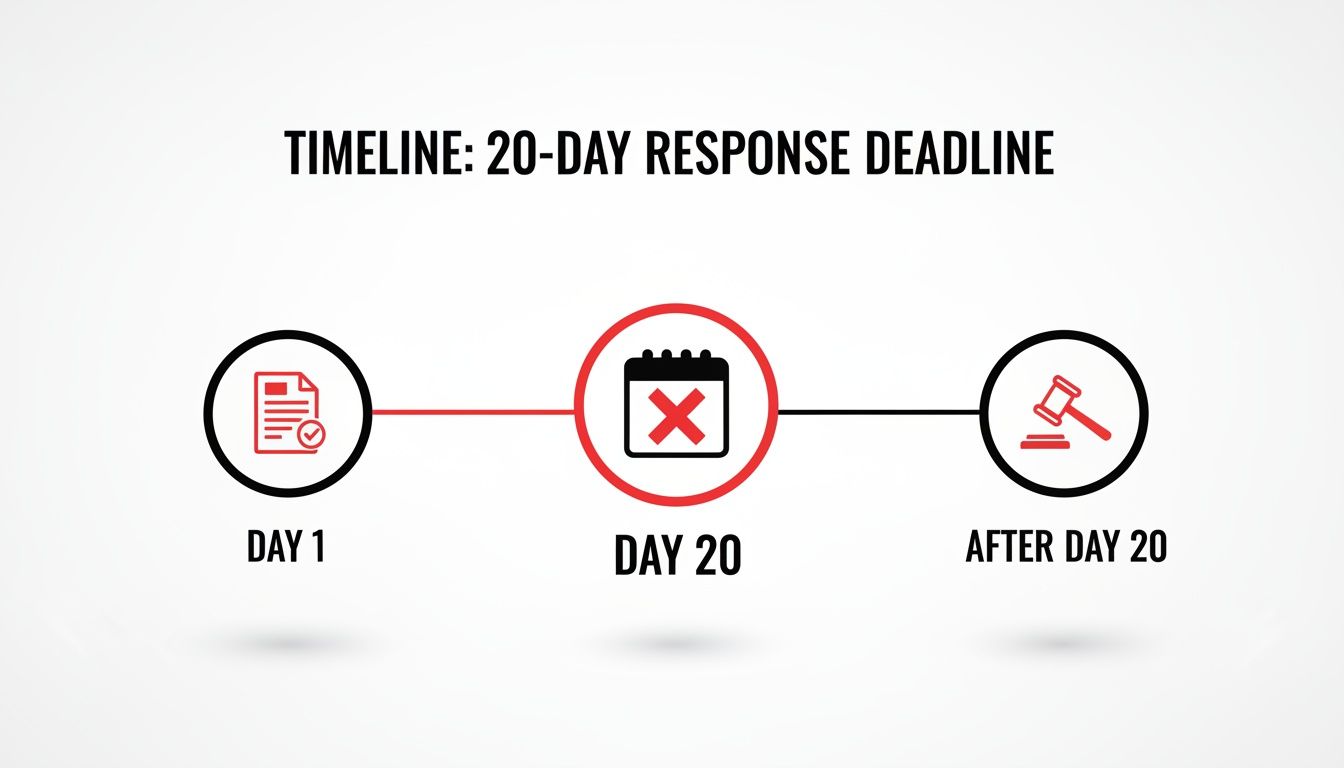
As you can see, the clock starts ticking the moment you're served. Waiting too long can result in a default judgment against you, which is a situation you absolutely want to avoid.
Going on the Offensive With a Counterpetition
While the Answer is reactive—it's you responding to their claims—the Counterpetition for Dissolution of Marriage is proactive. Frankly, it's the more powerful of the two documents. It’s where you stop defending and start telling the court what you want.
Instead of just disagreeing with their proposed parenting plan, you file your own. Instead of just denying their request for alimony, you can explain why it’s not appropriate or even make your own claim for support if your situation calls for it. The Counterpetition shifts you from being a passive respondent to an active participant who is also steering the direction of the case.
This is the document where you officially ask the court for specific outcomes on all the big issues.
Key Issues to Address in Your Counterpetition
Your Counterpetition needs to be clear about your desired results. This isn't the place for vague wishes. You'll need to spell out your position on:
- Parental Responsibility and Timesharing: Propose a specific schedule you believe is in your children's best interests.
- Child Support: Address how support should be calculated based on Florida's official guidelines.
- Equitable Distribution: State that all marital assets and debts must be divided fairly.
- Alimony (Spousal Support): Make your own request for alimony or explain why your spouse's request should be denied.
- Attorney's Fees and Costs: You can ask the court to have your spouse contribute to or pay for your legal fees, particularly if there’s a big income gap between you.
Taking this comprehensive approach is critical for all families, including LGBTQ couples, to make sure every unique aspect of your family structure and finances is considered right from the start.
Filing a Counterpetition gives you an independent claim for divorce. This means that if your spouse ever decided to dismiss their original petition, your case would still move forward, protecting your ability to finalize the divorce on your terms.
The Mandatory Financial Affidavit
Along with your Answer and Counterpetition, Florida law demands you file a Financial Affidavit. This is a sworn statement that lays out your entire financial world—income, expenses, assets, and debts. There are different versions of the form depending on your annual income, and getting the details right is non-negotiable.
This affidavit is the bedrock for every financial decision in your divorce, from child support and alimony to how property is divided. Pulling together all the necessary information can take a lot of time, which is just one more reason why it’s so critical to get started the moment you've been served.
Drafting these documents properly is a complex legal task that truly sets the stage for your entire divorce. For anyone in Pasco, Pinellas, and Hillsborough Counties, the process can feel overwhelming. Figuring out how to choose the right divorce lawyer is the most important first step you can take to ensure your response is drafted strategically to protect your rights and help you reach your goals.
Protecting Your Rights On Key Divorce Issues
Getting served with a divorce petition is a pivotal moment. Your response isn't just a legal formality—it's the first strategic move you'll make to protect your future. This is your chance to officially tell the court your side of the story on everything that matters: your children, your finances, and your property. A well-crafted Answer and Counterpetition sets the tone from day one.
When kids are involved, your response needs to be crystal clear about what you want for parental responsibility and timesharing. Florida law is all about the "best interests of the child," and your filing needs to show you're on the same page. Don't just say you want "custody." Instead, your Counterpetition should lay out a specific, workable timesharing schedule that fits your family's real life. Taking this proactive step shows you're serious and gives the judge a concrete plan to work with.
Every family is unique, and our firm is committed to representing all of them. We handle gay divorce and custody matters with the specific experience and sensitivity they demand, making sure the dynamics of LGBTQ+ families are properly reflected in every legal document. Your response is the place to firmly establish your parental rights and start building a stable future for your children.
Asserting Your Financial Claims
Beyond the kids, your response has to tackle the money. This means addressing spousal support (alimony) and the division of everything you've accumulated together. If you need alimony to get back on your feet—or if your spouse is asking for it and you think it's unjustified—your Counterpetition needs to state your position without ambiguity.
Florida is an "equitable distribution" state. This means all marital assets and debts have to be divided fairly, which doesn't automatically mean 50/50. Everything acquired during the marriage is on the table: the house, cars, bank accounts, retirement funds, and even credit card debt.
Your response should formally ask the court to identify and equitably divide all marital property. This simple step protects you from a spouse trying to hide assets or improperly claim something as their separate, non-marital property.
Creating a Strong Parenting Plan
The single best way to protect your relationship with your children is to propose a detailed parenting plan right in your Counterpetition. This document is much more than just a calendar.
A solid parenting plan should cover:
- Daily Timesharing: A clear schedule for school nights, weekends, and holidays.
- Decision-Making Authority: Who has the final say on major decisions about school, healthcare, and religion? It can be shared or given to one parent.
- Communication: How will you and your co-parent communicate about the kids? A dedicated app or email can keep things business-like.
- Travel and Relocation: Clear rules for taking the children out-of-state or on international trips.
Putting this level of detail in your initial filing establishes a professional, child-focused tone. To get a better sense of what Florida courts are looking for, you can learn more about crafting a parenting plan in a divorce.
A proactive, detailed response doesn't make a divorce more hostile. It sets a clear, reasonable foundation that often becomes the starting point for productive settlement talks, saving you unnecessary conflict and legal fees.
As you protect your legal rights, don't forget your online presence. Taking the time for understanding and protecting your digital footprint is just smart. It helps safeguard personal information that could otherwise be twisted or scrutinized during the divorce process. For our clients across Pasco, Pinellas, and Hillsborough Counties, a strong initial response drafted by an experienced attorney is a powerful tool that shapes negotiations and sets the stage for a fair resolution.
Filing Your Response and Preparing for What's Next
Once your Answer and Counterpetition are drafted, the next steps are procedural but absolutely critical. Simply having the documents isn't enough; you must formally file them with the court and make sure your spouse or their attorney gets a copy. This process officially puts you on the legal record and gets your case moving.
In Florida, most legal documents are filed electronically through the Florida Courts E-Filing Portal. This system shoots your documents directly to the Clerk of Court in the right county—whether that's Pasco, Pinellas, or Hillsborough. Once the Clerk stamps your filing as "accepted," it becomes part of the official case file.

After filing with the court, you must "serve" a copy of your response on your spouse. If they have a lawyer, you'll serve the documents on the attorney instead. Thankfully, this is usually done electronically through the same E-Filing Portal, which sends a notification directly to the other side. It’s a much simpler process than the formal, in-person service required for the initial petition.
What Happens After You File
By filing a response, you've officially made the divorce "contested." Now, that doesn't automatically mean you're destined for a nasty courtroom battle. It just means both parties are now actively involved in the case. This is the starting gun for the next phase of the legal process, which is often focused on gathering information and trying to find a resolution.
Realizing that your response is the true start of the legal journey helps you prepare mentally and strategically. You’ve successfully protected your rights from a default, and now you can focus on building your case and working toward a fair outcome.
Here’s a look at what typically comes next:
- Financial Discovery: This is the formal process where you and your spouse exchange detailed financial information. It goes way beyond the initial Financial Affidavit and often involves requests for documents, written questions (interrogatories), and even depositions.
- Mandatory Mediation: Before a judge will hear your case at trial, Florida requires most contested divorces to go through mediation. A neutral, third-party mediator sits down with you and your spouse to help you negotiate a settlement on all the outstanding issues.
- Hearings for Temporary Relief: If there are urgent issues that just can't wait for the final divorce decree—like who stays in the house, temporary child support, or a timesharing schedule—either party can ask the court for a hearing to get temporary orders put in place.
The Importance of a Clear Roadmap
This next phase can feel overwhelming, but it’s a structured, predictable process. Once your case is active, the court may schedule a Case Management Conference. This is essentially a check-in hearing where both sides meet with the judge to talk about the status of the case, set deadlines, and create a schedule for moving things forward. You can learn more about what happens at a Case Management Conference to be better prepared for this important meeting.
Our firm is committed to making sure every client, including members of the LGBTQ+ community, understands this roadmap. We handle gay divorce and custody issues with the diligence required to protect your rights at every stage. We equip our clients in Pasco, Pinellas, and Hillsborough Counties with the knowledge and support needed to face each step with confidence, from the initial filing to the final resolution.
Questions We Hear All The Time About Responding to a Divorce Petition
Even with a clear plan, getting served with divorce papers brings up a ton of "what if" questions. Here are some of the most common ones we hear from clients across Pasco, Pinellas, and Hillsborough Counties, along with some straight answers.
Do I Have to Agree With Everything in the Petition My Spouse Filed?
Absolutely not. In fact, you almost certainly shouldn't. Your formal "Answer" is your chance to go through your spouse's petition, paragraph by paragraph, and set the record straight.
For each statement, you can "admit" it if it's true, "deny" it if it's false, or state you are "without knowledge" if you can't be sure. It is incredibly important to deny anything that's inaccurate. If you don't, the court can treat it as an admitted fact. This is your first and best opportunity to correct the narrative on finances, property, or why the marriage broke down.
What If I Can’t Afford a Lawyer to Help Me Respond?
This is a very real and common worry. Many people think they have to go it alone if they can't write a large check upfront, but that's often not the case in Florida.
You can ask the court to order your spouse to pay for or contribute to your attorney's fees. This is especially common when there's a big gap in income or one person has always controlled the family's finances. This request has to be made correctly in your own court filings, like in a Counterpetition. Don't let the fear of cost stop you from at least getting a consultation to see what your options are. The financial damage from not having a lawyer often dwarfs the initial cost.
It's a huge mistake to assume you're on your own for legal fees. Florida law is designed to level the playing field, allowing for fee awards to make sure both people have fair access to legal help.
If I File a Formal Response, Does That Mean We Can't Settle?
Not at all. Actually, it's the opposite. Filing a proper response is a critical step toward reaching a settlement.
Filing an Answer and Counterpetition doesn't lock you into a courtroom battle. What it does is protect your legal rights and, most importantly, prevent a default judgment from being entered against you. The vast majority of divorces in Florida settle out of court, either through direct negotiation or mediation. Filing a strong, clear response just establishes your position and creates the foundation for negotiating a fair agreement. It shows you're taking this seriously and are ready to resolve the issues.
What Happens If My Spouse and I Already Agree on Everything?
Even if you think you're on the same page about every single issue, you should still file a formal response. Think of it as an insurance policy.
Verbal agreements can—and often do—fall apart. A so-called "uncontested dissolution" still requires a specific set of legal documents to be filed to make it official and final. Your response can be part of a larger package of settlement paperwork that locks in your agreements. By skipping the response, you leave yourself completely vulnerable if your spouse changes their mind or a new disagreement pops up. Filing a response is your safety net.
We are committed to helping all families, including LGBTQ couples navigating gay divorce, custody, or transgender name change issues. Our firm proudly serves clients in Pasco, Pinellas, and Hillsborough Counties without discrimination, providing the dedicated support needed to secure a stable future.
If you've been served with a divorce petition in Hillsborough, Pinellas, or Pasco County, you don't have to figure this out alone. Contact Foley Family Law today for a consultation. We'll help you create a clear plan of action that protects your rights and your future. Visit us at https://wfoleylaw.com to get started.


