

To have a chance at proving parental alienation, you have to do more than just feel it’s happening. You need to build a case brick by brick, documenting a clear pattern of manipulative behaviors designed to poison your child’s relationship with you. This means collecting hard evidence—things like texts, emails, and testimony from others who have seen it happen.
Understanding Parental Alienation in Florida

Parental alienation is a uniquely painful experience, a world away from typical co-parenting squabbles. It’s a deliberate and sustained campaign by one parent to intentionally wreck a child’s bond with the other. In Florida, the entire family court system is built around one thing: the child’s best interests. That interest almost always includes a healthy, loving relationship with both parents. When one parent’s actions actively sabotage this, the court has the power—and the duty—to step in. We handle these complex cases for families in Pasco, Pinellas and Hillsborough Counties.
The real challenge, though, is shifting from the emotional anguish of the situation to the cold, hard task of gathering proof. You won’t find a Florida law with the words “parental alienation” in the title. Instead, the court looks at the behaviors that make up alienation when it decides on timesharing and parental responsibility. Judges need to see clear evidence that one parent is trying to sever the child’s connection to the other.
What Does the Court Look For
To make your case successfully, you can’t just show up with a few frustrating anecdotes. A judge needs to see a clear, documented history of the other parent’s actions. An isolated incident or a general feeling of being pushed away won’t be enough. The court is looking for a consistent, manipulative campaign, and that’s where your meticulous record-keeping becomes your most powerful weapon.
You have to show how this conduct is harming your child. This isn’t just about your hurt feelings; it’s about proving the real emotional and psychological damage being done to a child caught in the middle. The goal is to demonstrate to the court that the alienating parent’s behavior is fundamentally detrimental to the child’s well-being and flies in the face of what shared parental responsibility is all about.
In our experience working with families across Pasco, Pinellas and Hillsborough Counties, the parents who succeed are the ones who shift their mindset. They move from being a victim of the behavior to becoming a diligent investigator of it.
Your Legal Path Forward
Navigating these treacherous emotional and legal waters demands a smart, strategic approach. It’s about building a case that is not only compelling but is also built on a foundation of admissible evidence. It doesn’t matter if you’re part of a traditional or LGBTQ+ family—the legal standards for protecting your relationship with your child are the same.
We’re committed to helping all families facing this nightmare, as we do not discriminate and handle all LGBTQ family and divorce issues. Proving parental alienation can feel like an impossible, uphill battle, but it can be done. With the right guidance and an unwavering commitment to documenting the truth, you can protect your bond with your child. To start, it’s critical to understand your basic rights within the custody framework; you can get a better sense of where you stand by reading about the truth about equal custody in Florida.
Identifying The Key Signs Of Alienation To Build Your Case
To prove parental alienation, Florida courts need more than just a gut feeling that something is wrong. They require a clear, consistent pattern of destructive behavior from the other parent.
Isolated arguments happen. But a deliberate campaign to poison your relationship with your child is something else entirely. Building a convincing case means stepping back from the emotional pain and learning to spot the specific, observable actions that a judge will recognize as evidence.
Think of yourself as a detective. Each incident you document is a piece of the puzzle. One piece might not mean much on its own, but when you put them all together, they reveal an undeniable picture of what’s really happening.
The Campaign Against You
Parental alienation isn’t usually a single, dramatic event. It’s often a slow burn—a methodical process of chipping away at your child’s love and trust for you. In our work with families across Pasco, Pinellas and Hillsborough Counties, we see the same heartbreaking tactics over and over again. They’re not random; they are part of a targeted effort to erase you.
These behaviors can be sneaky or completely out in the open, but the goal is always the same. Here are the most common signs you need to be watching for:
- Badmouthing And Criticism: The other parent constantly feeds your child a stream of derogatory or completely false statements about you, painting you as unloving, unsafe, or just plain incompetent.
- Interfering With Communication: Your scheduled phone or video calls are always “missed.” You’ll hear excuses like the child is “busy,” “sleeping,” or just “doesn’t want to talk,” creating a wall between you.
- Sharing Inappropriate Information: Your child is being told adult details about the divorce or court case, usually twisted to make you look like the bad guy.
- Creating Loyalty Conflicts: The child is made to feel guilty for having a good time with you or is pressured to “choose” a side. You might hear secondhand that they were told, “Mommy will be so sad if you go with your dad this weekend.”
- Undermining Your Authority: The alienating parent encourages the child to break your rules or disrespect you, effectively stripping you of your parental authority.
- Erasing Your Presence: Photos of you disappear. Your name becomes a forbidden topic in their home. The other parent might even invent stories to rewrite your positive history with the child.
Recognizing these behaviors is one thing; documenting them effectively for court is another. Here’s a practical breakdown of how to turn these observations into solid evidence.
Common Alienating Behaviors and What to Document
Interfering with Communication
- Example Scenario: Your ex repeatedly fails to have your child ready for scheduled calls, claiming they are “asleep” or “at a friend’s house.”
- How to Document It: Keep a detailed log of every missed call (date, time, reason given). Save screenshots of texts or emails where you attempt to arrange the call and the excuses provided.
Badmouthing You to the Child
- Example Scenario: Your child comes home and repeats a negative comment, such as, “Dad said you don’t have enough money to buy me nice things.”
- How to Document It: Note the exact phrase, date, and time your child said it. While hearsay, a consistent pattern of these statements can be powerful. If a third party (like a teacher or therapist) overhears it, try to get their statement.
Sharing Inappropriate Details
- Example Scenario: The other parent discusses the legal case with your child, blaming you for “dragging this through court.”
- How to Document It: Document what your child says. If they mention specific legal terms they shouldn’t know, note it. This can be powerful evidence to present to a Guardian ad Litem or custody evaluator.
Undermining Authority
- Example Scenario: You find out your ex told your child they don’t have to follow your “silly” rule about screen time.
- How to Document It: Write down the date and what your child told you. If you have texts or emails where the other parent admits to this, save them immediately. This shows a direct attempt to weaken your parental role.
The key is to be consistent and detailed in your record-keeping for every single incident.
The Impact On Your Child
It’s absolutely critical to understand that this behavior doesn’t just damage your relationship—it inflicts deep psychological wounds on your child.
When a child is relentlessly pressured to reject a parent they love, it creates a storm of internal conflict, anxiety, and guilt. To cope, they often resort to parroting negative things about you that they don’t truly believe, just to appease the alienating parent and keep the peace.
The more alienation a child is exposed to, the more severe their rejection of a parent and their resulting psychological distress.
This is exactly why your meticulous documentation is so important. Every blocked call, every overheard insult, and every broken promise adds another piece of proof. The pattern you build is what will ultimately convince a judge that they need to step in to protect your child’s well-being.
As you start documenting, don’t forget that social media can be a double-edged sword. It can be used as a weapon against you, but it can also be a goldmine of evidence for your case. It’s vital you know how to manage your own online footprint during this time. For more on this, check out our guide on navigating social media and divorce. Protecting yourself online is a non-negotiable part of building a solid parental alienation case.
Gathering and Organizing Evidence for Your Case
Once you start seeing the signs of alienation, your focus has to shift to one critical mission: documenting everything. Proving parental alienation in a Florida court isn’t about what you feel is happening; it’s about what you can prove with concrete evidence. This is your practical guide to gathering compelling, admissible evidence that tells the undeniable story of what’s really going on.
Success in these cases, whether you’re in Pinellas, Hillsborough, or Pasco County, comes down to your ability to present a detailed, chronological record. It’s not enough to just tell the judge the other parent is difficult. You have to show them the pattern of behavior with specific examples, dates, and times.
Creating Your Evidence Journal
Your single most powerful tool is a dedicated journal or log. Think of this less as a diary for your feelings and more as a factual, objective record of every single incident. For each entry, you need to capture the essentials:
- Date and Time: Be precise. When did this happen?
- What Happened: Stick to the facts. Describe the incident without emotional language.
- Direct Quotes: This is huge. Write down exactly what was said and by whom, especially if your child repeats something the other parent told them.
- Witnesses: Was anyone else there? Note who saw or heard what happened.
A detailed log like this transforms vague complaints into a powerful timeline. It’s what your attorney will use to build a clear, undeniable pattern of harmful behavior for the court.
This simple flowchart breaks down the process: first, you journal the details of each incident; second, you preserve the digital proof; and finally, you organize everything into a coherent file for your legal team.
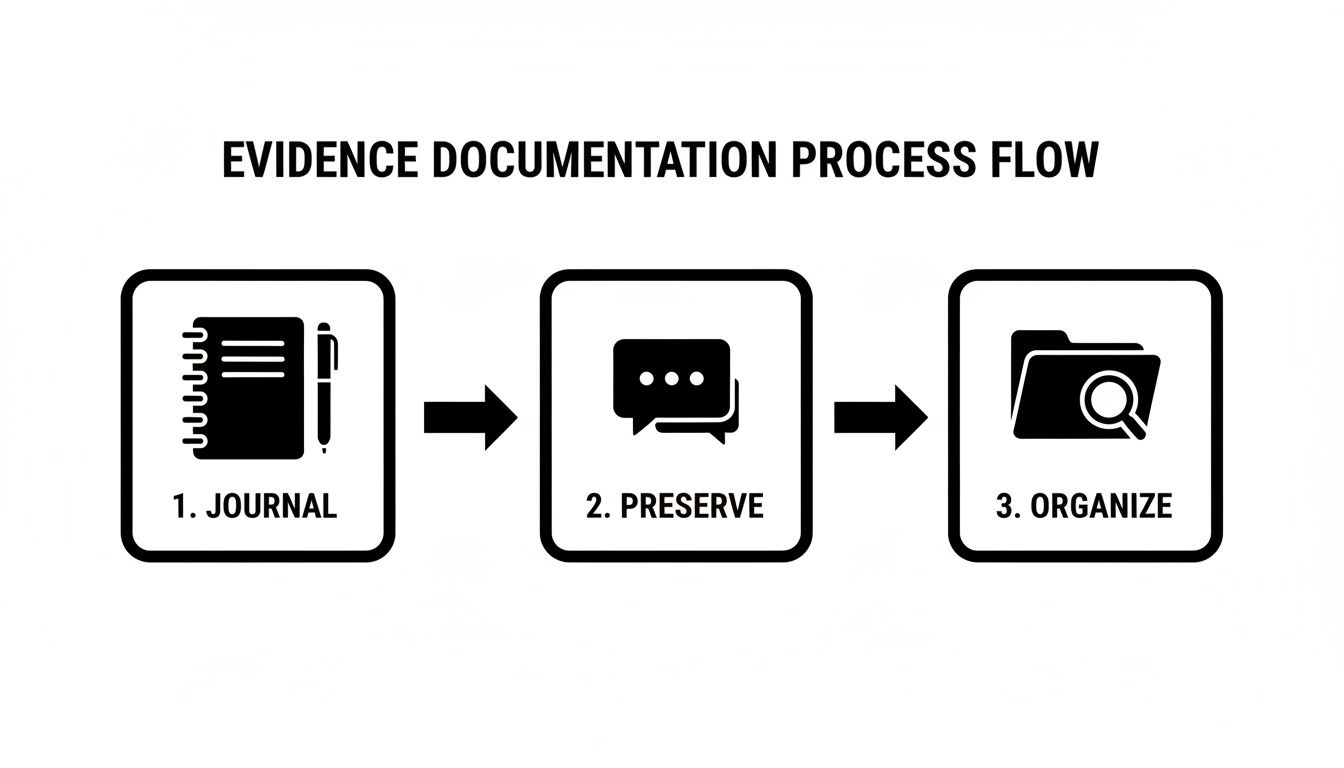
Following these three steps is the best way to make sure your evidence is collected, structured, and ready to be presented clearly and persuasively to a judge.
Preserving Digital Communications
So much of the evidence in parental alienation cases now lives on our phones and computers. Text messages, emails, social media posts—these can all provide direct, undeniable proof of the other parent’s attempts to interfere with your relationship with your child.
But just taking a screenshot often isn’t enough for court. You need to know how to properly preserve this digital evidence. This could mean using software to download entire text message threads or making sure email headers remain intact. These technical steps are what make the evidence authentic and admissible.
A quick word of caution on recordings: Florida has very strict laws about this. Before you even think about hitting record, it is essential to read up on the legalities of recording your spouse. Making a mistake here can have serious legal consequences.
The Power of Third Party Accounts
Your own records are vital, but objective observations from neutral third parties can give your case a massive boost. These are people who aren’t emotionally involved and can offer unbiased accounts of what they’ve seen and heard.
Think about getting statements or testimony from:
- Teachers or school counselors who have noticed changes in your child’s behavior or heard them say concerning things.
- Coaches or extracurricular leaders who can confirm missed practices or games that consistently fall on the other parent’s time.
- Therapists or pediatricians who have professional insights into your child’s emotional state.
These accounts from third parties provide independent proof of your claims, making your case that much stronger. The key is keeping all of this information—your journal, preserved communications, and witness statements—in an organized binder or digital folder. For anyone involved in a legal case, understanding What Is Documentary Evidence is fundamental to building a solid claim.
The court looks for patterns, not single incidents. Judges rely on concrete, dated behaviors and third-party observations to evaluate these claims. Documenting every missed visit, every manipulative text, and every teacher’s note helps build the quantifiable timeline the court needs to see.
This disciplined approach is your best strategy. It requires patience and diligence, but it is the single most effective way to present a clear, powerful, and persuasive case in the Tampa Bay area and protect your relationship with your child. We represent clients from all walks of life, including the LGBTQ+ community, and the principles of solid evidence collection apply to every single case.
Using Expert Witnesses To Strengthen Your Claim
Sometimes, your detailed journal and carefully organized evidence just aren’t enough. They can’t fully capture the slow, corrosive damage of parental alienation, especially when the other parent is a master manipulator who seems perfectly reasonable on the surface.
This is exactly when you need to bring in the experts. In Florida, we rely on professionals trained to see past the façade, dig into the family dynamics, and give the court an objective, expert opinion. Think of them as the court’s neutral eyes and ears, cutting through the endless “he said, she said” that plagues these custody fights.
Their involvement can be the difference-maker, validating your experiences and giving a judge in Hillsborough, Pinellas, or Pasco County the impartial evidence they need to see the truth. We make this a priority for all our clients, including those in the LGBTQ+ community, to ensure every family gets a fair shot.
The Role Of The Guardian ad Litem
A Guardian ad Litem (GAL) is appointed by the court for one reason: to represent the child’s best interests. A GAL doesn’t work for you or your ex; their only client is your child. Their job is to conduct a deep-dive investigation into the child’s world and recommend a timesharing and parental responsibility plan to the judge.
This isn’t a quick chat. A GAL’s investigation is thorough. They will:
- Interview both you and the other parent, always separately.
- Talk with your child in a neutral setting, using age-appropriate language.
- Visit both of your homes to get a feel for the environment.
- Speak with “collateral” witnesses—people like teachers, therapists, coaches, and other family members who know your child.
- Review all the important documents, including your evidence journal, communication logs, and school records.
When you meet with the GAL, the goal is to be honest, organized, and focused on your child’s well-being—not on tearing down your ex. Let your documented evidence do the talking. Present it calmly and clearly.
Understanding Forensic Psychological Evaluations
When parental alienation is a central issue, the court might order a forensic psychological evaluation of the family. This isn’t therapy. It’s a formal assessment conducted by a licensed psychologist who specializes in family law cases. The entire point is to give the court a detailed, clinical picture of the family’s psychological health.
The process is intense. It usually involves multiple interviews with each parent and the child, psychological testing, and a complete review of every document in the case file. The evaluator is hunting for patterns of behavior that line up with alienation, assessing each parent’s ability to support the child’s relationship with the other, and analyzing the child’s emotional state.
The final report is often a bombshell piece of evidence. It provides a clinical opinion on the family dynamics that a judge can rely on.
An expert’s report can be the turning point in a case. It transforms your personal observations into a professional assessment that carries significant weight with the judge, making it much harder for the other parent to dismiss your claims.
The Function Of A Parenting Coordinator
A Parenting Coordinator (PC) is another key player. A PC is a neutral third party—often a mental health professional or an attorney—brought in to help high-conflict parents manage day-to-day disagreements without running back to court every five minutes.
While their main job is to improve co-parenting, a PC can become an incredibly valuable witness in an alienation case. They have a front-row seat to every interaction. They see firsthand if one parent is constantly blocking communication, undermining the other’s authority, or refusing to follow the parenting plan. Their testimony gives the court a real-time account of the alienating behaviors as they actually happen.
Knowing who these professionals are and what they do is a critical part of building your strongest case. Their reports and testimony provide the objective validation you need to prove what’s been happening. To see how these experts fit into the overall legal strategy, you can get a broader look at our overview of Florida child custody matters.
Taking Decisive Legal Action in Florida Courts

With your meticulously organized evidence in hand, it’s time to shift from documenting the problem to demanding a solution. This is the point where we translate your collection of painful incidents into decisive action within the Florida court system.
Your attorney’s role is to formally present your case, compelling the court to intervene. We’re no longer just observing—we’re moving to fix it, especially in the courts serving Pasco, Pinellas, and Hillsborough Counties.
Filing the Right Motions in Court
That powerful evidence you’ve gathered becomes the backbone of the legal motions we file. These aren’t just forms; they are formal requests asking a judge to make a specific ruling based on the facts you’ve presented.
In parental alienation cases, two of the most common tools in our legal arsenal are a Motion to Enforce Timesharing and a Supplemental Petition to Modify the Parenting Plan.
If the other parent is actively and consistently violating the current court-ordered schedule—essentially stealing your time with your child—a Motion to Enforce is the direct approach. It asks the judge to force them to comply with the existing plan.
But what if the alienation is so severe that the current plan is no longer safe or healthy for your child? In that case, we may need to file a Supplemental Petition to Modify the Parenting Plan. This is a significant step requesting a fundamental change to custody or timesharing. You can learn more about the process from our experienced Tampa custody modification lawyers.
Potential Court-Ordered Outcomes
When a Florida judge is presented with a clear, evidence-backed case of parental alienation, they have a range of options to protect the child’s well-being. The court’s primary goal is always to repair the damaged parent-child relationship and put a stop to the harmful behavior.
Possible remedies a judge might order include:
- Reunification Therapy: This is a specialized, therapeutic process designed to safely and methodically rebuild the bond between you and your child.
- Appointment of a Parenting Coordinator: A neutral third party can be brought in to help manage high-conflict co-parenting, resolve day-to-day disputes, and ensure everyone follows the court’s orders.
- A Change in Custody: In the most extreme cases, where the alienating behavior is so damaging, a judge may determine that changing the primary residential parent is the only way to truly protect the child.
A judge’s order can feel like the end of a long, exhausting battle. In reality, it’s often the beginning of the healing process. The court’s intervention provides the structure and authority needed to start reversing the psychological damage inflicted on your child.
Preparing for Your Day in Court
Heading to a court hearing can feel incredibly intimidating, but solid preparation is your best defense. Your attorney will guide you on how to present yourself, your testimony, and your evidence effectively. This hearing is your opportunity to tell your side of the story, powerfully supported by the detailed logs, witness statements, and expert reports you’ve worked so hard to gather.
Understanding effective strategies for trial preparation is a critical step in making sure your case is presented as clearly and persuasively as possible.
Our firm is committed to supporting every client, including those in the LGBTQ+ community, through this entire process with strength and compassion. We’ll make sure you understand each step—from filing the initial motion to arguing your case before the judge—providing the robust representation you need to seek a just outcome for you and your child.
Got Questions About Proving Parental Alienation? We’ve Got Answers.
When you’re facing a parental alienation claim, the legal process can feel overwhelming, and it’s natural to have a lot of questions. Clients often come to us feeling lost and unsure of what to expect. This section cuts through the noise to give you direct, clear answers to the questions we hear most often from parents in your shoes. Our goal is to tackle your immediate concerns and help you see the path forward.
How Long Does It Take to Prove Parental Alienation in a Florida Court?
There’s no magic number here. The timeline for a parental alienation case in Florida really hinges on the specifics of your situation and, most importantly, the strength of your evidence.
A case with well-organized records, damning text messages, and solid testimony from third parties is going to move a lot faster than one built on he-said-she-said arguments. The legal gears have to turn—filing motions, discovery, expert evaluations, and court hearings all take time. On top of that, the court dockets in Pasco, Pinellas, and Hillsborough Counties have their own schedules. It’s not unusual for these cases to take several months, and sometimes over a year, to resolve.
The key takeaway? Start meticulously gathering your evidence the moment you suspect alienation is happening. Don’t wait.
Do Florida Courts Recognize Parental Alienation Syndrome?
This is a big one, and the answer is nuanced. While the clinical label “Parental Alienation Syndrome” is still debated in psychological circles, Florida courts absolutely recognize the destructive behaviors involved. That’s what matters.
The court’s focus isn’t on diagnosing a syndrome; it’s on stopping a pattern of conduct by one parent that intentionally poisons a child’s relationship with the other.
Your lawyer will focus on presenting concrete proof of these toxic actions—blocking calls, bad-mouthing you to the kids, interfering with your time—and showing the judge how it harms your child. The strategy is to prove the damaging behavior, not get bogged down in a debate over a psychological label.
In Florida family law, actions speak louder than labels. The court is far more concerned with a documented pattern of alienating conduct than with a specific clinical diagnosis.
Can Text Messages and Emails Be Used as Evidence?
Yes. 100% yes. In this day and age, digital communications like texts, emails, and social media DMs are often the smoking gun in a parental alienation case. They can provide undeniable proof of the other parent’s attempts to undermine you or manipulate your child.
But you have to preserve this evidence correctly. Taking screenshots is a good start, but it’s often not enough for court. You need to learn how to download the data in its original format to prove it’s authentic. Your attorney can walk you through the proper methods to make sure your digital evidence is locked down and admissible in a Florida court.
What Should I Do if My Child Refuses to See Me?
This is easily one of the most heartbreaking parts of parental alienation. The first, most critical thing to do is not to give up or get angry with your child. Keep showing up. Make every single scheduled attempt to see your child as laid out in your parenting plan.
From there, you need to become a master record-keeper.
- Document every refusal. Note the date, time, and exactly what was said by your child or the other parent.
- Communicate calmly and in writing. Send an email or a message through a co-parenting app to the other parent about the refusal. This creates a clear, undeniable paper trail.
Whatever you do, don’t blame your child. They are caught in an impossible situation. Continue to tell them you love them, no matter what. Then, you must contact your family law attorney immediately to discuss filing a Motion for Contempt or Enforcement. Under Florida law, the other parent has a legal duty to make sure your court-ordered timesharing happens.
At Foley Family Law, we get the immense emotional toll these situations take. We’re here to provide compassionate, strategic legal guidance for all families, including those in the LGBTQ+ community, navigating these challenges. If your relationship with your child is under threat, contact us to build a plan of action.


