

Protecting your assets before marriage is one of the smartest financial moves you can make. It’s not about planning for failure; it’s about starting your new life together with clarity, transparency, and a solid financial foundation. By creating a clear plan—often with a prenuptial agreement—you define which assets are separate and how you’ll handle finances as a couple, ensuring both of you are secure from day one. At our firm, we serve clients across Pasco, Pinellas, and Hillsborough Counties, guiding them through this important process.
Why Planning Before Marriage Is A Smart Financial Move

Getting married is a huge emotional milestone, but it's also a significant financial partnership. Talking about how to protect assets before you walk down the aisle isn't a sign of distrust. Frankly, it’s a mature and responsible way to build a strong, open marriage. We've seen time and again how open communication about money prevents future conflicts and actually strengthens a couple's bond.
This kind of proactive planning is a good idea for every couple, no matter how much or how little you have. But it becomes absolutely critical if you're coming into the marriage with:
- A business you’ve poured your life into
- Real estate properties titled solely in your name
- An expected inheritance or significant family gifts
- Children from a previous relationship
Tackling these issues early on is an act of collaboration, not conflict. It's about creating a shared understanding of your financial landscape before you legally merge your lives.
Shifting Perspectives On Asset Protection
Let’s be honest: prenuptial agreements used to have a bad rap. They were seen as something only for the super-rich or for people who were already expecting to get divorced. That perception has completely changed.
Today, more and more couples see these agreements for what they are: practical tools for financial planning. In fact, a recent survey found that by 2022, 15% of married or engaged couples had a prenup. That’s a huge jump from just 5% in 1995. The trend is even stronger among younger generations, with some studies showing up to 47% of millennials and Gen Z opting for a prenup. It signals a major cultural shift toward financial transparency in relationships.
Here in Florida, an equitable distribution state, pre-marital planning is especially helpful. It draws a clear line between what’s considered “non-marital” property (what you bring into the marriage) and “marital” property (what you build together).
At our firm, we proudly serve clients across Pasco, Pinellas, and Hillsborough Counties. We truly believe that pre-marital planning is a powerful way to start a marriage with confidence. We handle all LGBTQ family and divorce issues and do not discriminate. Protecting your future is a universal need, and we are here to provide the guidance you deserve.
The Prenuptial Agreement: Your Financial Blueprint For Marriage

When clients ask how to protect assets before marriage, the conversation almost always starts with a prenuptial agreement, or "prenup." Under Florida law, this is the single most direct and effective way to secure your financial future.
A prenup is simply a formal, written contract two people sign before marrying. It lays out your financial rights and responsibilities during the marriage and, crucially, what happens if the marriage ends. It’s your chance to create a financial blueprint for your partnership.
Without one, you're letting the state decide. Florida's family laws will dictate how your life is divided in a divorce. A well-drafted prenup replaces those default rules with your own, agreed upon when you’re both on the same team.
What Can A Florida Prenup Control?
The real strength of a prenup is its flexibility. It lets you customize the financial terms of your marriage to fit your unique situation. We see this all the time with our clients across Pasco, Pinellas, and Hillsborough Counties—they use prenups to get on the same page and start their marriage with clarity and peace of mind.
A solid Florida prenup can legally define:
- Separate vs. Marital Property: You can explicitly list assets you each bring into the marriage and state that they—and any appreciation in their value—will always remain separate property.
- Business Interests: If you own a business, a prenup is essential. It can ensure the company remains your separate property, shielding it from being divided or sold off in a divorce.
- Future Inheritances and Gifts: The agreement can make it clear that any future inheritances or significant gifts from family belong only to the spouse who receives them.
- Alimony (Spousal Support): You have the power to set the terms for alimony. You can decide if it will be paid, for how long, how much, or even waive the right to it completely.
- Debt Responsibility: A prenup can clarify that each partner is solely responsible for the debts they brought into the marriage, preventing you from inheriting your spouse's pre-marital financial baggage.
This level of control empowers you and your partner to build a financial framework that feels fair and secure to both of you from day one.
What A Prenup Cannot Control
While prenups are powerful, they have clear limits under Florida law. It’s critical to understand what you can’t include, because trying to overreach can put the entire agreement at risk of being invalidated by a judge.
Most importantly, a prenup cannot determine child custody or child support. Those decisions are always made by a court based on the child's best interests at the time of the divorce, not based on a contract signed years earlier. Any language attempting to pre-determine these rights is unenforceable.
A prenuptial agreement is a proactive financial instrument, not a tool for controlling personal matters. Its focus remains squarely on assets, debts, and spousal support, ensuring financial matters are handled with foresight and fairness.
Making Your Prenup Enforceable In Florida
For a prenup to hold up in a Florida court, it must meet several strict legal standards. Just downloading a template and signing it is a recipe for disaster; a court will likely throw it out.
The core pillars of an enforceable Florida prenup include:
- It Must Be in Writing: A verbal agreement is worthless.
- It Must Be Signed Voluntarily: Both parties have to sign without being under duress, coercion, or fraud. Handing your partner a prenup the week of the wedding is a classic example of duress.
- Full and Fair Financial Disclosure: This is the big one. It's non-negotiable. Both of you must provide a complete and honest accounting of all assets, debts, and income. Hiding assets is the fastest way to get a prenup invalidated.
While it isn't a strict legal requirement, the single best way to ensure your agreement is enforceable is for each partner to have their own independent lawyer. It proves that both parties fully understood the document they were signing and weren't pressured into it. As we handle family law for a diverse clientele, including gay and transgender individuals in the LGBTQ+ community, we know these protections are vital for every person entering a marriage.
If you want to go deeper, you can learn more about what a prenup protects in our detailed guide. An attorney ensures the language is precise, all legal formalities are met, and your rights are thoroughly protected. This step is a critical investment in your future financial security.
More Than A Prenup: Other Ways To Protect Your Assets Before Marriage
A strong prenuptial agreement is the cornerstone of any plan to protect your assets before marriage. But it shouldn't be the only tool in your toolbox.
Truly effective asset protection involves layering practical, everyday financial habits and smart legal structures that work hand-in-hand with your prenup. For anyone heading into a marriage in Florida—whether you're in Hillsborough, Pasco, or Pinellas County—understanding these strategies is key to safeguarding the assets you've worked so hard to build.
Using Trusts For Ironclad Protection
A trust is one of the most powerful instruments for shielding your property. Think of it as a legal lockbox. You place assets into the trust, and a "trustee" manages them for a "beneficiary."
When you create and fund an irrevocable trust before you get married, the assets transferred into it are no longer legally considered your personal property. They belong to the trust. This creates a firewall, preventing assets like a family business, generational wealth, or a significant investment portfolio from being classified as marital property and divided in a divorce.
A trust is an especially smart move for:
- Protecting a future inheritance.
- Keeping a family business in the family.
- Securing assets for children from a previous relationship.
This isn't a DIY project. Setting up a trust requires careful planning with an experienced attorney to ensure it's structured correctly under Florida law and serves your long-term goals.
Comparing Asset Protection Methods
It’s helpful to see how these tools stack up. Each one has a specific job to do, and using them in combination provides the strongest defense for your pre-marital property.
- Prenuptial Agreement: This is best for anyone with significant assets, a business, or an income disparity. Its main purpose is to legally define separate vs. marital property and set terms for alimony and asset division. In Florida, it must be executed voluntarily with full financial disclosure to be enforceable.
- Irrevocable Trust: This is ideal for protecting inheritances, family businesses, or assets for children from a prior marriage. The primary purpose is to remove assets from your personal ownership by placing them under the control of a trustee. To be most effective, a trust must be created and funded before marriage to shield assets from marital claims.
- Proper Property Titling: This is crucial for real estate, vehicles, and high-value physical assets owned before the marriage. Maintaining assets as "sole ownership" helps prevent them from being presumed a gift to the marriage. A key consideration in Florida is that adding a spouse's name to a deed is often presumed to be a gift, converting separate property into marital property.
- Separate Bank Accounts: This method is best for cash, investments, and income from separate property. The goal is to prevent the commingling of pre-marital funds with marital funds. Florida courts require a clear paper trail to trace separate funds, and commingling makes this nearly impossible.
As you can see, these strategies aren't mutually exclusive. A prenup can work alongside a trust and disciplined financial habits to create a comprehensive protection plan.
Property Titling: Where The Devil Is In The Details
How your property is titled might seem like a small detail on a piece of paper, but in a Florida divorce, it has massive consequences. You have to get this right before you walk down the aisle.
Sole Ownership: When an asset—a house, a brokerage account—is titled only in your name, it is presumed to be your separate, non-marital property. It's the cleanest and simplest way to maintain clear ownership.
Joint Tenancy: Here's where people get into trouble. If you add your new spouse’s name to the deed of your pre-marital home, Florida law generally presumes you intended to make a gift to the marriage. That single action can instantly turn your separate property into marital property, open for division in a divorce. If you're even thinking about this, you need to understand the full implications first. We break down the risks in our article on adding a spouse to a deed.
The simple act of retitling a pre-marital asset can completely undo your best-laid plans. Always get legal advice before changing the name on any significant property title.
Maintain Separate Bank Accounts
One of the most common and damaging mistakes we see is commingling funds. It’s what happens when you mix separate, pre-marital money with marital money.
For example, you inherit $50,000 and deposit it into the joint checking account you share with your spouse. That money is now commingled, making it nearly impossible to trace and prove it was your separate property down the road.
The solution is simple but requires discipline:
- Keep your pre-marital accounts separate. Do not add your spouse’s name to them after you get married.
- Open a new joint account strictly for shared marital expenses like the mortgage, groceries, and household bills.
- Pay for expenses related to your separate property (like repairs on a rental property you owned before the marriage) only from your separate accounts.
This creates a clean "paper trail" that shows your clear intent to keep your pre-marital assets separate. It’s a non-negotiable step in protecting your finances.
Create A Clear Paper Trail
When it comes to asset protection, documentation is your best friend. In a divorce, the burden of proof is on you to show an asset is separate, and you can't do that without good records.
Beyond formal legal documents, a crucial step is taking an inventory to protect your assets before the wedding. This creates a baseline snapshot of your financial life.
Create a detailed list of all your major assets and debts, including their value at the time of the marriage. This should include:
- Bank, brokerage, and retirement account statements
- Appraisals for real estate
- Valuations for any businesses you own
- A list of valuable personal items, like jewelry, art, or collectibles
Keep these records organized and in a safe place. They are the concrete evidence you'll need to prove what you brought into the marriage, making it much easier to defend their separate status if it ever becomes necessary. At our firm, we ensure all our clients, including those in the LGBTQ+ community, have access to these proactive strategies for a secure future. We handle all family law matters and believe everyone deserves sound legal counsel.
Common Mistakes That Undermine Asset Protection
You've spent time and energy putting together an asset protection plan, but it’s surprisingly easy to undermine your own work with a few common missteps. We’ve seen these exact mistakes play out for clients across Pasco, Pinellas, and Hillsborough Counties, and they can be incredibly costly.
Think of it this way: your pre-marital assets are in a protected space. Each of these mistakes creates a crack, allowing marital funds and claims to seep in and jeopardize everything you've tried to secure.
The Trap Of Commingling Funds
This is, without a doubt, one of the most frequent and damaging errors we see. Commingling is simply mixing your separate, pre-marital assets with marital ones. Once those funds are blended, it becomes a nightmare for a Florida court to untangle them—and sometimes, it’s just impossible.
Here's a classic example: You get a $100,000 inheritance. To be helpful, you deposit it into the joint checking account you share with your spouse to pay down some bills. You've likely just turned that separate inheritance into marital property, making it fair game in a divorce.
The same goes for using your pre-marital savings for a down payment on a home you buy together and title in both names. That money is now commingled with a marital asset, and your claim to it as separate property is in serious jeopardy.
Pro Tip: Keep at least one bank account in your name only. Use it exclusively for pre-marital funds, inheritances, or income from separate properties. This creates the clean paper trail you’ll absolutely need to prove an asset’s separate status in a Florida divorce.
Not Disclosing Everything (A Fatal Flaw For Prenups)
When it comes to a prenuptial agreement, honesty isn’t just good practice—it's a legal mandate. In Florida, full and fair financial disclosure is the absolute foundation of an enforceable prenup. If you fail to disclose even one significant asset, debt, or income stream, you’re handing your spouse the legal grounds to have the entire agreement thrown out.
This isn't about being picky. It’s about total transparency. Both of you have to enter the agreement with a complete and accurate picture of the other's finances. Trying to hide a brokerage account or downplay the value of your business is a bet you will almost certainly lose.
This process has parallels to what our firm handles during the discovery for divorce, where full financial transparency is non-negotiable. It’s always the best path forward.
Bad Timing And Signing Under Pressure
Florida courts look very closely at whether a prenup was signed voluntarily. An agreement can be invalidated if one person signed it under duress or coercion.
The classic example of duress? Handing your fiancé a prenup a week before the wedding. The timing itself creates immense pressure, implying a "sign this or the wedding is off" ultimatum. A judge could easily decide your partner didn't have enough time to find their own lawyer and truly understand what they were signing, making the whole agreement unenforceable.
Pro Tip: Start talking about a prenup at least three to six months before the wedding date. This allows for calm negotiations, proper financial disclosure, and gives both of you plenty of time to get advice from your own attorneys without feeling cornered.
Other Critical Oversights To Watch For
Beyond those major pitfalls, a few other things can punch holes in your plan.
- Accidental Gifts: Be careful about gifting an interest in your separate property. For example, adding your spouse's name to the deed of a home you owned before the marriage is legally presumed to be a gift to the marriage. Just like that, you’ve converted a portion of your separate house into a marital asset.
- Forgetting to Update: A prenup isn’t always a "set it and forget it" document. Major life events—like having children, starting a company, or a huge change in your financial situation—are good reasons to review your agreement and see if it still makes sense.
Steering clear of these common mistakes is just as important as creating the plan in the first place. Our firm is committed to helping all individuals, including our LGBTQ+ clients, navigate these issues and build a secure financial future with confidence.
Your Pre-Marriage Asset Protection Timeline
Figuring out how to protect your assets before you get married can feel overwhelming. The key is to start early and follow a clear timeline. Procrastination is your biggest enemy here—a rushed prenup signed just days before the wedding can easily be challenged and thrown out by a Florida court.
When you give yourselves plenty of time, the whole thing becomes less of a tense negotiation and more of a collaborative planning session for your future. It allows for calm, honest discussions and careful legal work. This timeline breaks down the process, giving you a practical roadmap whether you're in Pasco, Pinellas, or Hillsborough County.
Getting the timing wrong can lead to huge mistakes. As you’ll see, things like mixing your separate and marital money, hiding assets, or feeling pressured to sign can completely undo all your hard work.
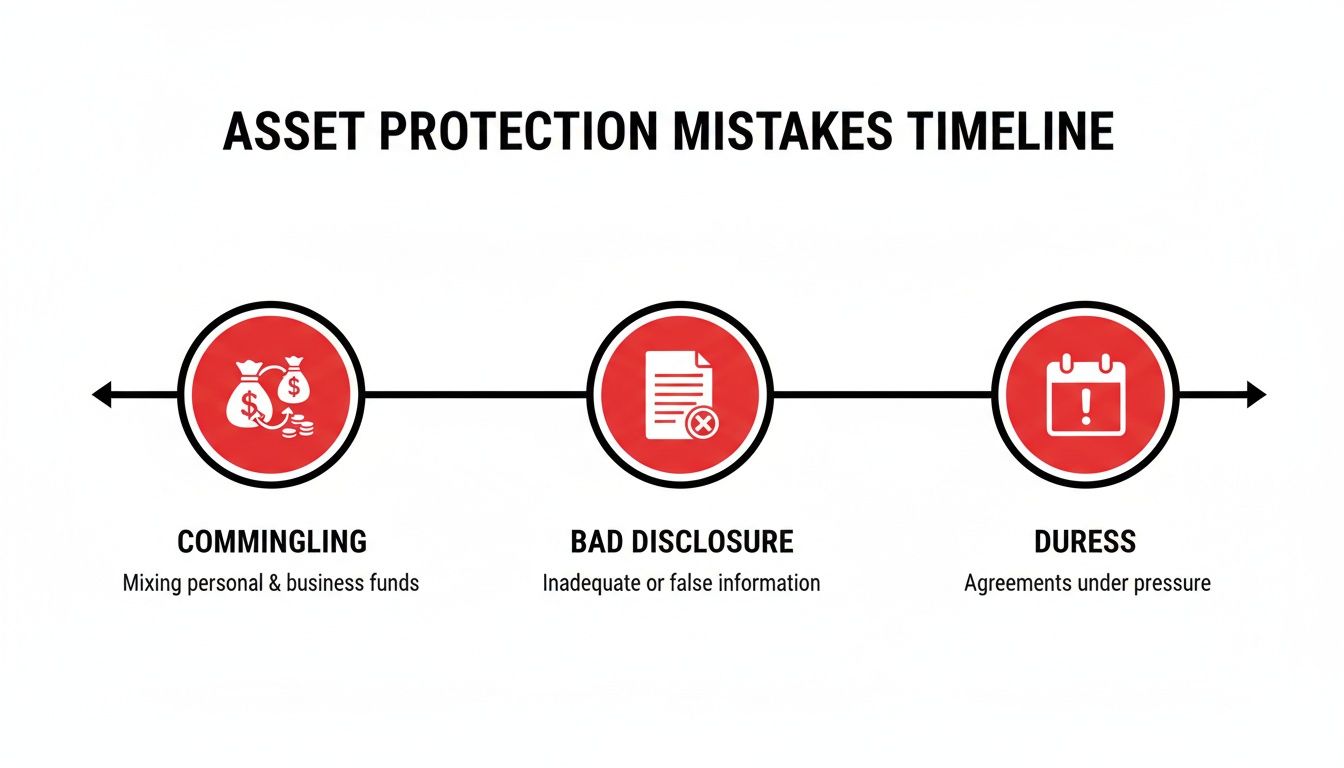
These errors almost always happen because of a rushed process and a lack of openness. That’s why starting early and being transparent from day one is so important.
6-12 Months Before The Wedding
This is the sweet spot. With the wedding still a good way off, these conversations feel proactive and strategic, not like a last-minute demand. There’s no pressure, just smart planning.
First things first: you both need to create a detailed financial inventory. This is a complete list of everything you own and everything you owe. Be thorough.
- Real estate (primary home, investment properties)
- Bank accounts, brokerage accounts, and other investments
- Retirement funds like 401(k)s, IRAs, and pensions
- Any ownership stake in a business
- High-value personal items like art, jewelry, or collectibles
- All debts—mortgages, student loans, car loans, credit card balances
This list is the foundation for everything that follows. Once you each have a clear picture of your own finances, it's time to sit down with your partner and talk.
4-6 Months Before The Wedding
Now that you've had the initial talk, it's time to bring in the professionals. Each of you needs to hire your own, separate family law attorney. I can't stress this enough—it's not a suggestion, it's a requirement for a prenup to be enforceable in Florida.
Your lawyer will review your financial inventory, talk through your goals, and explain your rights. We regularly provide these consultations to people all over the Tampa Bay area, including for our LGBTQ+ clients covering gay divorce, gay custody issues, and gay or transgender name changes, because we believe everyone should walk into a marriage with their eyes wide open.
This is also when you'll formally exchange your financial information, guided by your attorneys. For a prenup to be valid, full and fair disclosure isn't just a good idea, it's the law. No hiding the ball.
An experienced attorney does more than just draft a document. They act as your advocate and guide, ensuring the process adheres to all of Florida’s strict legal requirements and that your financial future is protected.
2-4 Months Before The Wedding
This is the drafting and negotiation phase. Your attorneys will communicate back and forth, shaping the agreement to reflect what you've both discussed. It’s normal for a prenup to go through several drafts as you fine-tune the details on separate property, what happens with the marital home, or whether alimony will be waived.
Be patient. It’s critical that you both have plenty of time to review each draft and discuss it with your respective lawyers without feeling rushed.
1-2 Months Before The Wedding
With a final version agreed upon, it's time to sign. This should be a deliberate, formal process. Your attorney will ensure it is signed and notarized correctly, with all the i's dotted and t's crossed.
By signing the agreement at least 30 days before the wedding, you effectively eliminate any future argument that one of you was pressured or signed under duress. Once signed, store the original in a safe place, like a safe deposit box, and make sure both you and your attorney have a copy. Getting this done well ahead of time lets you shift your focus back to the joy of what’s to come.
Frequently Asked Questions About Protecting Your Assets
When you're getting ready for marriage, figuring out how to protect your assets brings up a lot of questions. We hear these same concerns from clients all across Pasco, Pinellas, and Hillsborough Counties. Here are some clear, direct answers to help you make the right decisions for your future.
Do I Still Need A Prenup If My Assets Are In A Trust?
Yes, you absolutely should. Think of it this way: a well-drafted trust is like a vault protecting the specific assets you place inside it. A prenuptial agreement, on the other hand, is the complete financial rulebook for the marriage itself. They serve different, but equally critical, functions.
A trust does a great job of shielding its contents, but it can't address everything. A prenup covers crucial ground that a trust simply can't, like:
- Alimony (Spousal Support): A trust has no impact on a future claim for alimony. A prenup is the only legal tool that lets you and your partner decide on alimony terms—or waive it altogether—before you get married.
- Division of Future Marital Assets: A trust only protects what's in it. A prenup sets the ground rules for how all other assets you both acquire during the marriage will be handled if you divorce.
- Growth on Separate Property: Without an agreement, the appreciation in value of your separate property during the marriage can become a legal gray area. A prenup can state definitively that any growth remains your separate property.
The best strategy is to have them work in tandem. An experienced Florida family law attorney can make sure these two powerful documents are aligned, giving you comprehensive protection without creating legal conflicts down the road.
My Partner And I Agree On Everything. Can We Draft Our Own Prenup?
While it might seem like a smart way to save money, drafting your own prenup is a huge gamble that we strongly advise against. It’s a classic case of being penny-wise and pound-foolish, often resulting in an unenforceable agreement and much bigger legal bills later on.
Florida has very strict legal requirements for prenuptial agreements. A DIY document can be thrown out by a judge for countless reasons, including vague language, improper financial disclosures, or trying to include terms that aren't allowed under state law.
The surest way to ensure a prenuptial agreement holds up in court is for each partner to have their own independent attorney. This proves that both of you signed willingly, with a full understanding of your rights and what the agreement actually means.
How Does Florida Law Treat My Pre-Marriage Assets Without A Prenup?
In theory, Florida law says that assets you owned before the marriage are your “non-marital” property and aren’t subject to division in a divorce.
In practice, that protection is fragile and easily lost. The most common way this happens is through commingling—mixing your separate property with marital property. Once mixed, it can be reclassified by a court.
For example, if you deposit a large inheritance into a joint bank account or add your new spouse to the deed of a home you owned before the wedding, you've just commingled that asset. That simple act can convert what was once yours alone into marital property. A prenup is the only reliable way to prevent this, as it allows you to define what stays separate, no matter how it’s titled or used during the marriage.
Is It Too Late To Protect My Assets If The Wedding Is Soon?
It’s never too late to get legal advice, but time is a critical factor for a valid prenup. An agreement signed just days before the wedding is highly vulnerable to being challenged later on the grounds of duress or coercion.
A Florida court will want to see that both you and your partner had plenty of time to review the document, consult with your own lawyers, and understand the terms without feeling pressured. A "sign this or the wedding is off" ultimatum presented at the last minute is the classic example of duress, and it could make the entire agreement unenforceable.
If your wedding is fast approaching, contact a family law attorney immediately to go over your options. If a prenup is no longer practical due to the timeline, you might consider a postnuptial agreement, which is signed after the wedding. We are committed to helping everyone, including our LGBTQ+ clients, find the right solutions for their unique circumstances and handle all family law issues with the care they deserve.
Navigating the complexities of pre-marital asset protection requires experienced guidance. At our firm, we are dedicated to helping clients in Hillsborough, Pinellas, and Pasco Counties create clear, enforceable plans that provide peace of mind. If you are ready to secure your financial future, contact us to schedule a consultation and build a strategy that’s right for you. We handle all LGBTQ issues, family and divorce issues, and do not discriminate.


