

Facing a custody hearing in Florida can feel like staring up at a mountain. It’s overwhelming, but a calm, organized approach is your most powerful tool. The good news? Most custody cases in Pasco, Pinellas, and Hillsborough Counties are resolved long before a final, drawn-out trial. This makes your initial preparation for negotiation and mediation absolutely critical.
Starting Your Custody Hearing Preparation
When a custody hearing is on the horizon, the uncertainty is often the hardest part. It's completely natural for anyone, male or female, between the ages of 35 and 65, to feel anxious and fiercely protective of your relationship with your child. The key is to channel that powerful energy into productive, strategic preparation.
While the court system can feel intimidating, remember its primary goal: to establish a stable and supportive environment for your child. Your journey doesn’t start in the courtroom. It begins with quiet, methodical organization at home. This is where you build the bedrock of your case.
Our firm handles all family and divorce issues with respect and professionalism. We are experienced in assisting all families, including those in the LGBTQ community with gay divorce, gay custody issues, or name changes, and we do not discriminate. We proudly serve clients in Pasco, Pinellas, and Hillsborough Counties.
Understanding The "Best Interests Of The Child" Standard
From this moment on, every action you take should be viewed through a single, critical lens: Florida's "best interests of the child" standard. This isn't just a vague suggestion; it is the absolute cornerstone of every custody decision a judge makes under Florida law.
The judge’s focus is not on what seems "fair" to the parents. It's about what arrangement will best promote the child's well-being, stability, and healthy development.
To make this determination, judges are required to weigh a specific list of factors. These include, but are not limited to:
- Each parent's willingness to foster a close relationship between the child and the other parent.
- The ability to provide for the child's needs—food, shelter, medical care, and so on.
- The emotional bonds that exist between each parent and the child.
- The moral fitness of the parents, along with their mental and physical health.
Your job is to prove, with concrete evidence, how your proposed parenting arrangement best serves these interests. For example, instead of just saying you're a "good parent," you'll need to show it with school records, proof of consistent involvement in healthcare, and a history of being present in their daily routines.
Your Immediate Action Plan
An effective strategy starts with a clear, simple plan. Your first moves should be all about organization and documentation. This will become the foundation you build your entire case upon.
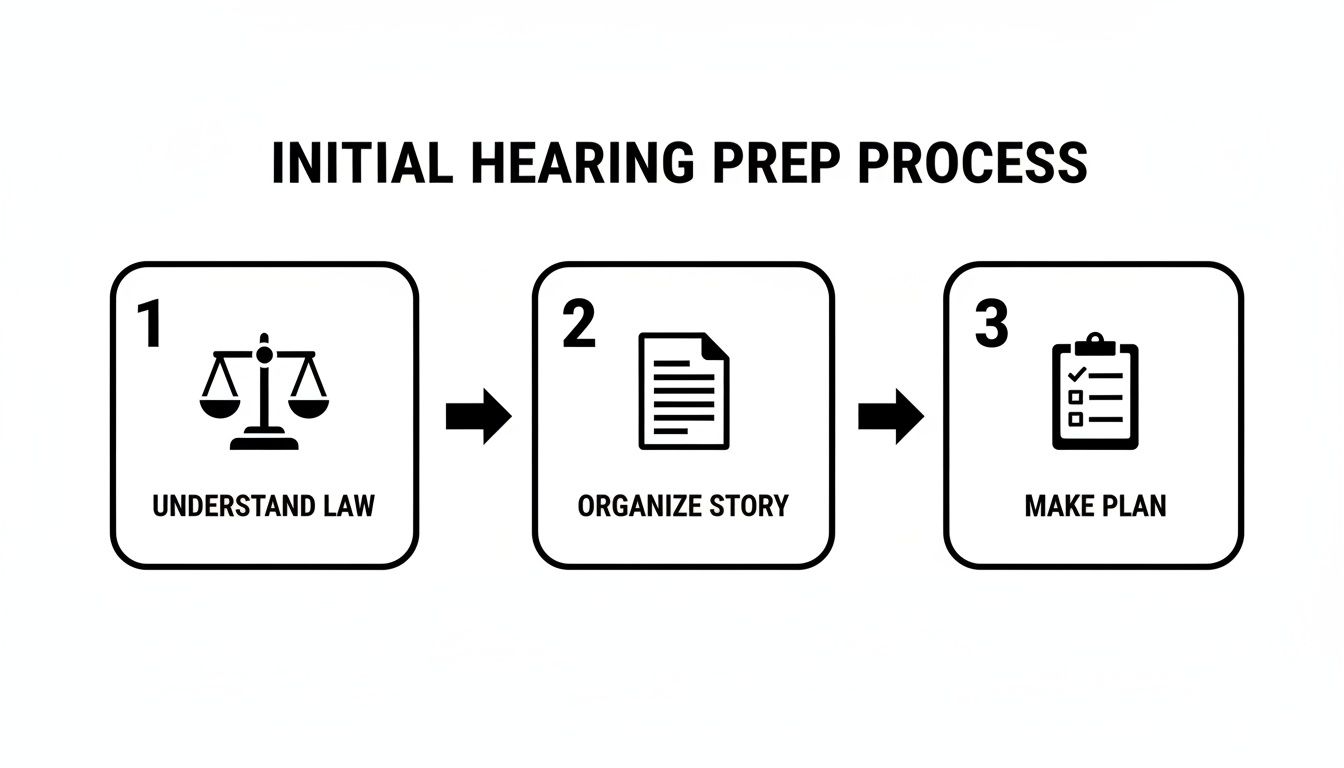
As you can see, a strong case is built on a logical progression. You start with the law, organize your facts, and then create a plan to present them.
The first practical step? Create a dedicated folder—physical or digital—for every single case-related document. This simple act of organization brings an immediate sense of control and ensures nothing critical gets lost in the shuffle.
The court relies heavily on tangible evidence. While your testimony matters, documents that prove your consistent, positive involvement in your child's life are often far more persuasive to a judge in Hillsborough, Pinellas, or Pasco County.
This early phase is also the time to think about the legal path ahead. Most cases are required to go through mediation before a judge will even consider a final trial. This makes your prep work vital not just for a potential hearing, but for a successful negotiation.
Of course, some situations are truly urgent and require immediate court intervention. You can learn more about how an emergency custody order in Florida works in our detailed guide.
By laying this solid groundwork now, you position yourself for a favorable outcome, whether it's reached through a settlement or a formal court ruling.
Building Your Case With Compelling Evidence
In a custody hearing, your words matter, but tangible proof is what truly persuades a judge. While your testimony is important, a judge in Hillsborough, Pinellas, or Pasco County will lean heavily on concrete evidence to decide what’s in your child's best interests. Your job is to build a powerful narrative of stability and care using organized, credible documentation.
This isn't just about printing a few angry text messages from the other parent. It’s a strategic process. You need to gather and organize information that paints a clear, verifiable picture of your role as a parent. This evidence becomes the backbone of your case, whether you end up negotiating a settlement or presenting your position in court.
What Documents And Evidence Should You Collect
First things first: create a dedicated file for your case. It can be a physical binder or a secure digital folder, but it must be meticulously organized. This isn't just for your lawyer or the court; it’s for you. Seeing everything laid out helps you spot the strengths and weaknesses in your own case long before you step into a courtroom.
Most people think custody battles are all courtroom drama, but that's rarely the case. A significant majority of custody cases are settled before ever reaching a full trial. This means your preparation is more about building a strong negotiating position than preparing for a showdown. In fact, prepared parents who propose a joint custody arrangement are more likely to have it granted.
So, where do you start? Begin by collecting records from the past year. Courts in Pinellas and Pasco Counties prioritize a child’s best interests, which is often measured by stability and continuity. Things like consistent attendance at doctor's appointments or being the parent who always handles school pickup matter.
Here's a checklist of the essentials you should start gathering right away:
- Communication Records: Save every text, email, and app message with the other parent. This log can be your best evidence to show you’re a cooperative co-parent—or, if necessary, to highlight the other parent's unwillingness to work together.
- School and Daycare Records: Get copies of everything. Report cards, attendance sheets, notes from teachers, and even disciplinary notices can demonstrate your hands-on involvement in your child’s education.
- Medical Records: Keep a complete file of all doctor and dentist visits, vaccination records, and any notes or recommendations from medical professionals. This is hard proof that you are attentive to your child's health.
- Financial Documents: Pull together your pay stubs, bank statements, and receipts for child-related expenses. Think clothes, school supplies, sports fees, and lunches. This establishes your financial contributions and your ability to provide for your child.
The Power Of A Personal Parenting Journal
Beyond the official documents, one of the most powerful tools you have is a simple journal. This isn't a place to vent your frustrations; think of it as a factual logbook of your parenting life.
A detailed journal is incredibly helpful during the legal process of discovery in litigation, which is the formal exchange of information between parties. Your personal log can help you accurately recall key dates and details when responding to requests from the other side.
Keep your journal entries objective and fact-based. Instead of writing, "I had a great day with my son," be specific: "Picked up my son from school at 3:15 PM. We worked on his science fair project for an hour, and then I took him to soccer practice at 6:00 PM."
This kind of detailed timeline creates an undeniable record of your consistent involvement. Months down the road, when you're asked to testify about a specific event, this journal will be your most reliable source for jogging your memory.
This level of detailed record-keeping is an essential part of discovery. You can learn more about how this fits into the bigger picture in our guide on the role of discovery for divorce and custody cases in Florida.
Choosing The Right Witnesses
Documents tell one part of the story, but credible witnesses provide the human element. A great witness is someone who has personally and recently seen you parent. Their third-party perspective can carry enormous weight with a judge.
But not all witnesses are created equal. While it's tempting to ask your mom or best friend, family members can sometimes be seen as biased. The most effective witnesses are often neutral, third-party individuals who can speak to your character and parenting skills without an emotional stake in the outcome.
Think about people like:
- Teachers or daycare staff
- Coaches or music instructors
- Neighbors who see you and your child playing outside every day
- A family counselor or therapist
When you approach someone to be a witness, be direct and clear. Don't just ask them to "say something nice." Give them specific examples to refresh their memory, like your consistent volunteering at school events or how you patiently handled a public tantrum at the park. This helps them provide specific, impactful testimony instead of vague, unhelpful praise. Our firm is experienced in helping all clients, including gay and transgender parents, select witnesses who can speak authentically and effectively to their unique parenting journey.
Craft A Detailed Florida Parenting Plan
This might just be the single most important document you’ll put together for your entire custody case. In Florida, a Parenting Plan isn't some optional worksheet; it's a mandatory, legally binding roadmap that will govern how you and the other parent raise your children post-separation. When a judge in Pasco, Pinellas, or Hillsborough County sees a thorough, well-reasoned plan, it tells them you’re a forward-thinking parent who is focused on what truly matters: your child’s best interests.
Think of the Parenting Plan as the constitution for your new co-parenting relationship. It’s designed to create predictability and give you a clear process for handling disagreements down the road—without running back to court every time. A vague or incomplete plan is just a recipe for future conflict. A detailed one, on the other hand, is the foundation for your child's stability.
What Must Be In Your Parenting Plan?
Florida law is very specific about what a Parenting Plan has to cover. While you can always add more detail (and you should), you absolutely must address two core concepts: time-sharing and parental responsibility.
It's easy to get these two confused, but they are distinct:
- Time-Sharing: This is the calendar. It's the schedule that dictates precisely when the child will be with each parent. This includes the regular school week, holidays, summer break, and other vacations.
- Parental Responsibility: This is all about decision-making. It outlines how the two of you will talk through and decide on the big-ticket items in your child’s life, like their education, healthcare, and religious upbringing.
A judge will go through your proposed plan with a fine-tooth comb to make sure it’s practical and truly built around your child’s needs. A plan that’s clear and easy to understand shows the court you’re committed to a stable, cooperative future.
Essential Components Of A Florida Parenting Plan
To meet Florida's standards, your Parenting Plan must detail how you'll handle several crucial aspects of your child's life. Here are the non-negotiable components you'll need to address:
- Parental Responsibility: Detail how you will share decision-making for education, healthcare, and other activities. Specify if one parent will have ultimate authority in certain areas.
- Time-Sharing Schedule: Provide a detailed, day-by-day schedule for the school year, holidays, and summer break that specifies exchange times and locations.
- Communication: Outline the methods and frequency of communication between parents (e.g., email, co-parenting app) and between each parent and the child (e.g., phone/video calls).
- Child's Healthcare: Explain how healthcare decisions will be made, which parent will carry insurance, and how uninsured medical costs will be paid.
- Child's Education: Designate the school district and describe how decisions about school choice or special needs will be handled.
- Relocation: Include a statement acknowledging Florida's strict relocation statute, which requires agreement or a court order to move more than 50 miles.
The strength of your plan lies in the specific, real-world details you provide for each of these categories.
Designing A Time-Sharing Schedule That Actually Works
Your time-sharing schedule needs to be more than a generic "week on, week off" arrangement. The best schedules are customized to the reality of your family’s life. The goal isn't just to divide time; it's to create a routine that feels consistent and predictable for your child.
For instance, a standard every-other-weekend schedule is a non-starter for a parent who is a firefighter or nurse working rotating 24-hour shifts. A much better proposal would be a schedule based on a four-week rotation that mirrors that parent's actual work calendar. For military families, the plan must contain clear provisions for handling time-sharing during deployments or out-of-state assignments.
A strong Parenting Plan anticipates future friction and solves it ahead of time. Don't just write, "parents will split Christmas." A judge wants to see specifics. A better entry reads: "The Mother shall have the children for the first half of Winter Break in even-numbered years, from the time school releases until 12:00 PM on Christmas Day."
This level of detail eliminates ambiguity, which in turn reduces the odds of future arguments. It proves to the court that you’ve thought through the practicalities of making co-parenting work. Our firm is proud to help all families, including LGBTQ+ parents, craft plans that honor their unique family structures.
Defining How You'll Make Decisions Together
Parental responsibility is the "how" of co-parenting. How will you make the big calls? In Florida, the law starts with the presumption that shared parental responsibility is what’s best for the child. This means both parents have a right to be involved, and you must confer with each other to reach an agreement on major issues.
However, you can propose that one parent has ultimate decision-making authority over a specific area, but you’ll need to prove why it’s in the child’s best interest. For example, if one parent is a dentist, it might make sense for them to have the final say on non-emergency dental care, provided they consult with the other parent first.
Your plan should clearly outline things like:
- How you'll communicate about major decisions (e.g., via a platform like OurFamilyWizard, email only).
- A reasonable timeframe for responding to the other parent (e.g., within 48 hours for non-emergencies).
- A dispute resolution process, like requiring mediation before either parent can file a motion with the court.
Showing a judge that you have a concrete plan for communicating and cooperating is a massive point in your favor. For a closer look at the exact language and clauses you can use, our guide to a Florida child custody agreement template offers more examples. Putting in the effort to create a detailed, child-focused Parenting Plan is a critical step in preparing for your custody hearing.
Navigating Courtroom Dynamics And Testimony
Knowing what to expect on the day of your custody hearing can take a huge weight off your shoulders and help you present your case clearly. Let's be honest, the formality of a courtroom in Pasco, Pinellas, or Hillsborough County can be nerve-wracking. But understanding the procedure and etiquette is a critical part of your preparation.
Your appearance and demeanor send a message to the judge before you even say a word. Treat it like a crucial job interview and dress professionally. Address the judge as "Your Honor," and always stand when you speak to them. These aren't just empty gestures; they show the court you respect the process and take this matter seriously.
Mastering Your Testimony
This is your chance to speak directly to the judge. The goal is to come across as clear, calm, and honest, even when the opposing attorney is asking tough questions. This is where all your hard preparation really pays off.
Answering questions effectively is a learned skill. Make sure you listen to the entire question before you even think about answering. If you're confused, it is perfectly fine to say, "I don't understand the question, can you please rephrase it?"
Most importantly, answer only the question you were asked. It's a classic mistake to volunteer extra information or get defensive and over-explain. Stick to the facts, be direct, and let your attorney do the work of guiding the narrative.
Key Takeaway: Your credibility is your most valuable asset in court. Exaggerating, guessing, or being dishonest—even about small things—can destroy the judge's trust in you. If you don't know the answer, the correct response is, "I don't know" or "I don't recall."
We believe in preparing our clients for the human element of the courtroom. We handle all family and divorce issues, including for gay and transgender individuals, and often use mock trial sessions to help them build the confidence they need for their day in court.
Avoiding Common Courtroom Pitfalls
One of the most damaging mistakes a parent can make is speaking negatively about the other parent. You may have completely valid frustrations, but the courtroom is not the place to vent. A judge wants to see that you are willing and able to co-parent for the sake of your child.
Try to avoid these common missteps:
- Badmouthing the Other Parent: Focus on your own parenting abilities and the positive relationship you have with your child. Let the evidence you’ve gathered speak for itself when it comes to any of the other parent’s shortcomings.
- Displaying Anger or Frustration: You have to maintain your composure, even if the other side says something that is untrue or deeply upsetting. Outbursts, eye-rolling, or muttering under your breath will only hurt your case.
- Arguing with Opposing Counsel: Remember, their job is to poke holes in your testimony. Stay respectful, and always direct your answers to the judge, not the other lawyer.
The goal is to present yourself as a stable, reasonable parent who is focused squarely on the child's well-being. That approach always resonates more positively with a judge than one driven by conflict. Sometimes, the court may appoint a neutral third party to investigate the family dynamics. For more on this, you can explore our explanation of what a Guardian ad Litem is and the role they play. This type of evaluation is common in custody matters but not in dependency cases, which are outside the scope of this article.
The Realities of Court Decisions
Preparing for your hearing also means understanding the realities of family court. The data on custody cases can be revealing and highlights how critical your initial preparation is. For instance, joint custody is often favored, a number that can increase when fathers actively request a shared parenting role. To support your case, you need to bring quantitative proof. Track the miles you drove for visitation, the money you spent on child-related expenses, or your role in ensuring consistent school attendance. Judges scrutinize every piece of evidence, so building your narrative with solid documentation and credible witnesses is absolutely vital.
The Role Of Mediation In Resolving Your Case
If you’re picturing your custody battle ending in a dramatic courtroom showdown, you might be surprised by the reality here in Florida. The truth is, the vast majority of custody disputes are actually settled outside of court. That’s why understanding mediation isn't just a side note—it's a core part of preparing for a custody hearing.
Across Pasco, Pinellas, and Hillsborough Counties, mediation is a mandatory step in nearly every contested family law case. Before a judge will even think about scheduling a final trial, they'll require you and the other parent to make a good-faith effort to resolve your issues with a certified neutral mediator. This isn't just a procedural hoop to jump through; it reflects the court's deep-seated preference for parents to craft their own solutions, which tend to be far more durable than anything a judge could order.
Understanding The Mediator's Role
First thing's first: the mediator doesn't work for you, and they don't work for the other parent. Their job isn't to pick a "winner" or give legal advice. Think of them as a neutral third party, professionally trained in conflict resolution. Their only goal is to facilitate a productive conversation and help you both find common ground.
The mediator guides the discussion, helps you brainstorm creative solutions you might not have considered, and keeps the focus where it belongs: on building a workable Parenting Plan for your child. They are a guide, helping you see past the conflict to focus on your child's needs. Critically, the process is completely confidential, allowing for open and honest negotiation without the fear that your words will be used against you later if you don't reach an agreement.
Preparing For Mediation With The Same Diligence As A Trial
Don't make the all-too-common mistake of treating mediation like an informal chat. You should prepare for this session with the same detail and organization you would for a final hearing. That means having all your documents, evidence, and your proposed Parenting Plan ready to go.
Being thoroughly prepared allows you to negotiate from a position of strength. When you can support your proposals with hard evidence—like school records, a communication log, or financial statements—your position instantly becomes more credible and harder to dismiss.
The most successful mediations happen when both parents show up ready to negotiate in good faith. This means being willing to genuinely listen to the other side's perspective and being open to compromise to find a solution that is truly in your child’s best interest.
We are committed to helping all our clients, including same-sex couples facing complex custody situations, achieve fair outcomes with minimal conflict. A successful mediation is often the fastest, least stressful, and most cost-effective path to a final resolution.
The High Success Rate Of Mediation
There’s a good reason Florida courts make this a required step. The numbers don't lie: mediation succeeds in a high percentage of family law disputes. This is precisely why having a solid legal strategy from the very beginning is so important.
If you can prepare for mediation like a pro, you dramatically increase your chances of reaching an agreement you can live with. The goal is to find a middle ground and craft a mutually acceptable Parenting Plan without the time, expense, and emotional toll of a trial.
For a deeper look into the specifics of the process, be sure to check out our complete guide on divorce mediation in Florida.
Common Questions About Florida Custody Hearings
Even with the best preparation, you’re bound to have questions about what a custody hearing actually feels like. Getting answers can demystify the process, and knowing what to expect builds confidence. Here are some of the most frequent questions we hear from clients across Pasco, Pinellas, and Hillsborough Counties, answered in plain English.
These insights come from years of experience with Florida law and the practical realities of our local courtrooms. We believe every parent deserves to walk into that hearing feeling prepared and empowered.
What Does 'Best Interests Of The Child' Really Mean In A Florida Court?
This is it. This is the single guiding principle a judge uses for every custody decision. It’s not about what seems "fair" to the parents, but about what will best promote the child’s stability, safety, and overall well-being.
Florida law gives judges a long list of factors they must consider. These include each parent's capacity to provide a consistent routine, the emotional bonds they share with the child, and—critically—each parent's willingness to encourage the child's relationship with the other parent. Every piece of evidence, every witness, and every argument you make must tie directly back to how your requests serve these best interests.
Will My Child Have To Testify In The Custody Hearing?
It's incredibly rare for a child to testify in open court during a Florida custody case. Judges are fiercely protective of children and avoid putting them in the middle or forcing them to feel like they have to "choose" a parent.
If a judge feels it's necessary to hear from a child, they will almost always conduct a private "in-camera interview." This happens in the judge's office (their chambers) with only a court reporter present—no parents, no lawyers. More often, the court appoints a neutral professional, like a Guardian ad Litem, to investigate the family's circumstances and report back on what's in the child's best interests. This is different from a dependency case, which is a separate type of legal proceeding.
Critical Tip: Never, under any circumstances, try to coach your child on what to say. Not to a judge, not to a Guardian ad Litem, not to anyone. It’s viewed as manipulation and will absolutely destroy your credibility and your case.
How Long Does A Custody Case Take In The Tampa Bay Area?
The timeline for a custody case can swing wildly. The single biggest factor is how much conflict exists between the parents.
- An uncontested case, where both parents agree on every detail of the Parenting Plan, can sometimes be wrapped up in just a few months.
- A contested case, however, can easily take a year or even longer. These cases may involve extensive discovery (exchanging documents and information), multiple temporary hearings, and ultimately a full trial.
The court's own busy schedule and the specific complexities of your case also play a major role. Honestly, being thoroughly prepared and making a genuine effort to negotiate during mediation are the two most powerful things you can do to shorten the timeline.
Is Mediation Required Before A Final Hearing?
Yes. In virtually every contested family law case in Florida—including here in Hillsborough, Pinellas, and Pasco counties—mediation is mandatory. Before you can have your day in court for a final trial, the judge requires you to make a good-faith attempt to resolve your disputes with a certified neutral mediator.
This isn't just a procedural hurdle. This policy reflects the state's firm belief that agreements made by parents themselves are far more successful and durable than solutions ordered by a judge. Statistically, they lead to much healthier long-term co-parenting relationships.
Navigating a custody hearing demands more than just showing up; it requires strategic preparation and guidance from someone who has been there before. If you're facing a custody battle in the Tampa Bay area, the team at Foley Family Law is here to advocate for your rights and your child’s future. Contact us today to schedule a consultation and build a clear plan of action.


