

To change a child support order in Florida, you have to prove there’s been a substantial, material, and unanticipated change in circumstances since the last order was signed. This isn't about a minor dip in overtime or a small, expected bonus. We're talking about a significant life event that completely changes the financial picture for your family.
Grounds For Modifying Child Support In Florida
Life happens. A child support order that made sense last year might be totally unrealistic today. Florida law gets this, which is why there's a process for parents to adjust their obligations when things genuinely change.
But let's be clear: the courts set a high bar. They don't want parents running back to court for every small financial shift. The change has to be significant and lasting—not just a temporary blip on the radar.
At Foley Family Law, we help families across Pasco, Pinellas, and Hillsborough Counties figure out if their situation meets this legal standard. We’re here to provide clarity and respect for all families. We handle all LGBTQ family and divorce issues and do not discriminate, including gay divorce, gay custody issues, and gay or transgender name changes, with the dignity they deserve.
What Is a Substantial Change in Circumstances?
"Substantial change" is the legal term that forms the bedrock of any modification case. It means a life event has occurred that seriously impacts a parent's ability to pay support or a child's financial needs. Crucially, this change usually needs to be involuntary and permanent.
For instance, quitting your job just to get out of paying child support won't fly. But getting laid off because your company downsized? That's a different story and would likely qualify.
Here are the most common scenarios we see that often meet the threshold:
- Significant Income Changes: This is the number one reason people seek a modification. It could be an involuntary job loss, a disability that prevents you from working, a major promotion, or a serious pay cut.
- Changes in Parenting Time: If the number of overnights your child spends with you changes significantly from what's written in the parenting plan, it directly affects the support calculation.
- Increased Needs of the Child: A new medical diagnosis that comes with expensive treatments, the need for specialized tutoring, or a big jump in health insurance premiums can all be grounds for a modification.
- Changes in Daycare or After-School Care Costs: When a child starts or stops needing daycare, or the costs go up or down dramatically, it can trigger a change in the support amount.
Real-World Examples in Tampa Bay
Think about a Hillsborough County first responder who gets promoted and sees a 25% salary increase. That promotion is almost certainly a substantial change, and it would warrant a request to increase the child support obligation.
Now, flip the script. Imagine a small business owner in Pasco County whose company takes an unexpected and prolonged nosedive. If their income plummets with no quick recovery in sight, they have strong grounds to ask the court for a downward modification.
The key is proving the change is both significant and lasting. Florida courts need to see a genuine shift in your financial reality, not just a temporary rough patch, before they’ll agree to alter an existing support order.
Proving Your Case From The Start
Understanding if you meet these grounds is the critical first step. Statistics show just how important this is. In 2023, while the U.S. child support program collected $29.6 billion, only 65% of the total support due was actually paid.
That gap often points to outdated orders that no longer reflect a parent's true ability to pay. For families here in Tampa Bay, a major event like a job loss or a child’s new medical needs is exactly what the court is looking for to prove a 'substantial change.' Unrealistic support orders can push paying parents into poverty, making it essential to get the amount right.
So, you've established that a "substantial, material, and unanticipated change in circumstances" has occurred. What now? Now, you have to formally ask the court for a change.
Filing a petition can feel intimidating, but understanding the sequence of events makes it a much more structured and predictable journey. Think of it as the practical roadmap for pursuing a modification in Florida, particularly in the courts we practice in most: Hillsborough, Pinellas, and Pasco Counties.
The whole process kicks off when you prepare and file a specific legal document with the court. From that moment on, financial transparency becomes the cornerstone of your entire case.
This flowchart breaks down the core stages—from identifying a change to proving it and finally filing with the court.
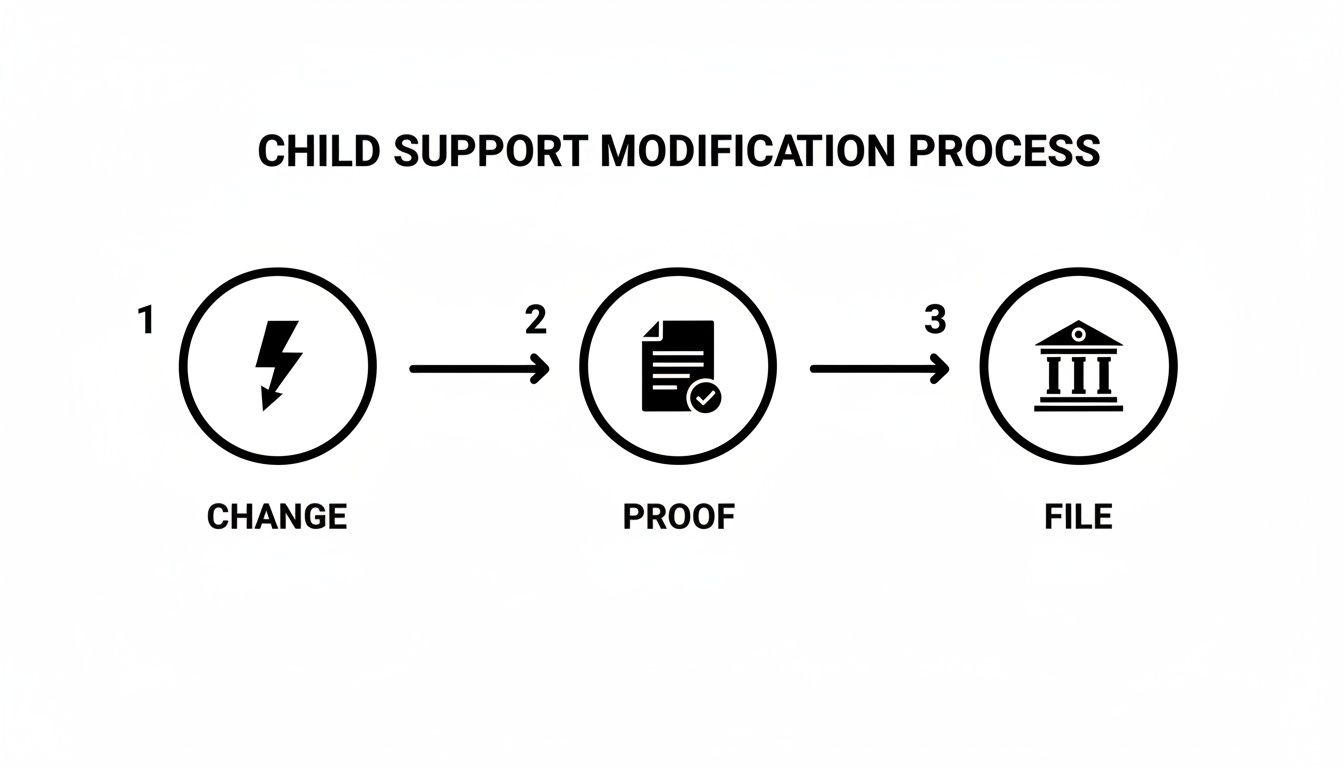
Each step builds on the last. You need to gather solid evidence that supports your claim of a significant life change before you officially start the legal proceedings.
Kicking Off the Legal Process
The first official move is to file a Supplemental Petition to Modify Child Support. This document is your formal notification to the court and the other parent that you're requesting an adjustment to the existing order. It lays out the specific circumstances that have changed and explains why the current support amount just doesn't work anymore.
This petition isn't just another form; it's the foundation of your legal argument. It has to be filed in the same court that issued your original child support order.
The Indispensable Financial Affidavit
Along with the petition, you absolutely must complete and file a Family Law Financial Affidavit. Honestly, this is probably the single most critical document in the entire modification process. It’s a sworn statement that details your complete financial picture, including:
- Income: This covers everything—base salary, wages, bonuses, commissions, and any self-employment earnings.
- Assets: You'll list all assets, from bank accounts and real estate to vehicles and investments.
- Debts: This includes your mortgage, car loans, credit card balances, and any other liabilities.
- Monthly Expenses: You need a detailed breakdown of your household budget, covering everything from housing and utilities to food and transportation.
Complete honesty on this form is non-negotiable. Any attempt to hide income or inflate expenses can completely destroy your credibility with the judge and might even lead to legal penalties.
This document gives the court the raw data it needs to run the child support guidelines calculation. Without it, your case grinds to a halt. Our firm, which serves clients across Pasco, Pinellas, and Hillsborough Counties, places immense emphasis on helping clients prepare this document with meticulous accuracy.
Serving the Petition and What Happens Next
After filing your petition and financial affidavit, you have to legally notify the other parent. This is called service of process, and it’s usually handled by a professional process server or a sheriff's deputy. This formal step ensures the other parent has officially received the documents and has an opportunity to respond.
Once they've been served, the other parent has a specific amount of time to file their own financial affidavit and a formal answer to your petition. This exchange of information is known as discovery. During this phase, both sides can request additional financial documents—think tax returns, pay stubs, and bank statements—to verify the information everyone has provided.
The economic need for these modifications is very real. You can learn more about the national trends and their economic impact in this comprehensive child support payments study. For the Tampa families we represent in Pasco, Pinellas, and Hillsborough Counties, especially military members or first responders, income fluctuations from relocations or pension changes make modifications essential. A petition must prove that 'material change,' which often hinges on solid financial proof like tax returns.
From here, the case will typically proceed to mediation, which is a mandatory step in many Florida family law cases. A neutral third-party mediator helps both parents try to hammer out an agreement without going to court. If you reach a deal, it can be submitted to the judge for approval. If not, the case gets set for a final hearing, where a judge will listen to both sides and make a final decision.
Gathering The Right Evidence For Your Case
A successful petition to modify child support hinges entirely on the quality of your evidence. You can't just walk into court and tell a judge your income dropped or your child's needs went up; you have to prove it with clear, credible documentation.
Think of each piece of evidence as a building block for your legal argument. The more solid blocks you have, the stronger your case will be.

This process is all about creating a compelling narrative backed by undeniable facts. For parents in Pasco, Pinellas, and Hillsborough Counties, presenting a well-organized file of proof is often the single biggest factor between getting a modification approved or denied. We're proud to serve all families, ensuring members of the LGBTQ+ community receive the same dedicated and knowledgeable representation.
Documenting a Change in Income
When your income changes in a major way, you need to paint a clear "before and after" picture for the court. This is the number one reason people seek a modification, so judges have seen every excuse in the book. They will scrutinize your financial proof very, very carefully.
Your goal is to show not just that your income changed, but why it changed. For example, if you were let go from your job, a formal termination letter is a critical piece of the puzzle. It shows the change was out of your control.
Key documents to start collecting include:
- Pay Stubs: Gather pay stubs from before the income change and every single one you've received since. This creates a direct, undeniable comparison.
- Termination Letter or Separation Notice: If you were laid off or fired, this official document proves the job loss was involuntary.
- New Employment Offer or Contract: If you found a new job but at a lower salary, the contract is definitive proof of your new earnings.
- Job Search Log: If you're currently unemployed, you must keep a detailed log of your efforts to find work. This means listing every application, interview, and email with potential employers.
- Profit and Loss Statements: For business owners, recent and past P&L statements are essential to show a downturn in revenue.
Proving Increased Needs for the Child
Sometimes, the modification isn't about a parent's income at all—it's about the child's evolving needs. As kids get older, their expenses can change dramatically, especially when new health or educational challenges pop up.
It’s not enough to just say that things are more expensive now. You have to provide concrete proof of these new, ongoing costs. Receipts, invoices, and official statements are your best friends here.
A judge needs to see a direct link between a new expense and a substantial, ongoing financial impact. A one-time cost is unlikely to justify a permanent change in child support, but a recurring new expense often will.
Examples of powerful proof for increased needs include:
- Medical Records and Bills: Documentation of a new diagnosis, along with the corresponding bills for therapy, medication, or specialist visits.
- School Invoices: Invoices for required tutoring, special educational programs, or private school tuition if it's been deemed necessary for the child.
- Health Insurance Statements: Paperwork showing a significant increase in the monthly premium for the child's health, dental, or vision coverage.
In some complex cases involving a child's special needs, the court might appoint a neutral third party to investigate what's truly in the child's best interests. You can learn more about this role in our guide on what is a Guardian ad Litem.
Demonstrating a Shift in Timesharing
Florida's child support calculation is directly tied to the number of overnights each parent has with the child. If the schedule you're actually following has shifted substantially from what's written in your parenting plan, that can be a solid basis for a modification.
Proving this kind of change requires meticulous record-keeping. You need to show a consistent, long-term pattern that’s different from what the court ordered. Simply relying on your memory won't cut it.
Effective evidence to show a timesharing change includes:
- Detailed Calendars: Mark every single overnight the child spends with each parent over a period of several months. Don't miss a single one.
- Communication Logs: Keep records of text messages or emails where you and the other parent discuss and confirm changes to the schedule.
- School or Daycare Records: These can sometimes show which parent is consistently handling drop-offs and pick-ups, which can help paint a picture of the actual day-to-day reality.
- Travel Itineraries: If one parent moved farther away and made the old schedule impossible, document this with proof of the new address and the distance.
How a Rising Cost of Living Can Justify a Modification
It’s no secret that the cost of everything, from groceries to gas, is through the roof. This isn't just a minor annoyance; it’s a real financial squeeze that directly affects your ability to care for your kids. In Florida, a sharp and sustained increase in your cost of living can absolutely be considered a substantial change in circumstances, opening the door to modifying your child support order.
The trick is to prove that these rising costs aren't just forcing you to tighten your budget a bit. You need to show it's a fundamental shift that makes the current child support amount either impossible to pay or simply not enough to cover your child's needs. This is an argument that resonates in the Tampa-area courts we practice in daily, from Pasco to Pinellas and Hillsborough Counties, where judges are seeing firsthand how these economic pressures are hitting local families.
From Inflation Headlines to a Legal Argument
To build a winning case, you have to connect the dots between broad economic trends like inflation and your own household budget. A judge won’t change an order just because they saw a news report about the economy. They need to see cold, hard proof of how it’s impacting your finances and your child's life.
This means you have to get specific. It’s not enough to just say, "Groceries are more expensive." You have to demonstrate how much more expensive they’ve become for your family, month after month.
This requires diligent documentation. You’ll need to gather tangible proof that paints a clear "before and after" picture of your essential living expenses.
- Housing Costs: Got a notice about a significant rent hike? Is your adjustable-rate mortgage payment suddenly much higher? That's your evidence.
- Utility Bills: Compile several months of your electric, water, and gas bills to show a consistent upward trend.
- Grocery Receipts: It might feel tedious, but tracking what you spend on groceries over time can create a powerful visual of how much more it costs just to feed your family.
- Child-Specific Expenses: Don't forget to show how the costs for your child’s clothes, school supplies, and extracurricular activities have gone up.
The New Financial Reality of Raising a Child
Parenting is a lot more expensive today than it was even a few years ago. Inflation has had a staggering effect on the costs of raising a child, and this massive spike is forcing courts to take inflation seriously as a legitimate reason for modifying support.
The child support program collects over $30 billion a year, yet only about 65% of what's owed is actually paid. This shortfall is a big reason why many custodial parents are forced to seek upward modifications just to keep up. And remember, it's not always the father who pays; mothers can also be ordered to pay support. For more on that, check out our article on whether women pay child support.
The goal is to prove that the original child support calculation, based on old economic data, no longer reflects the true cost of raising your child in today's economy.
This evidence helps an attorney build a compelling argument that the current support order is no longer fair or adequate. We help clients all over the Tampa Bay area, from military families to high-net-worth individuals, demonstrate these needs with precision. You can find more insights on how inflation is reshaping support calculations in this LPE Law article.
Common Reasons for Child Support Modification in Florida
Florida courts recognize a variety of life changes as valid grounds for modifying child support. It's crucial to understand what qualifies as a "substantial, material, and unanticipated change" before you file.
- Significant Change in Income: One parent experiences a major, involuntary increase or decrease in earnings (e.g., promotion, job loss). Required evidence includes pay stubs, termination letters, tax returns, and proof of job search efforts.
- Change in Timesharing: The number of overnights the child spends with each parent changes substantially from the original parenting plan. Required evidence includes the signed parenting plan, calendars, school records, and witness testimony.
- Increased Child-Related Costs: The child's needs have become more expensive due to health issues, educational needs, or rising extracurricular costs. Required evidence includes medical bills, insurance statements, school tuition invoices, and receipts for activities.
- Change in Daycare or Health Insurance: The cost or availability of childcare or health insurance for the child has changed significantly. Required evidence includes daycare contracts, insurance premium statements, and proof of payment.
- One Parent Becomes Disabled: A parent's ability to earn income is significantly impacted by a long-term disability. Required evidence includes a Social Security disability determination, medical records, and doctor's letters.
Having the right documentation is the key to a successful modification request. Without solid proof, it's just your word against your ex-spouse's.
When Is a Cost Increase Legally "Significant"?
Not every price hike at the grocery store is enough to get your child support changed. Under Florida law, the change in circumstances generally needs to be significant enough to alter the final calculation by at least 15% or $50 per month, whichever amount is greater.
Your job is to show that the combined effect of all these increased costs meets that legal threshold. This is where an experienced family law attorney is invaluable. We can take your financial documents, run the numbers through the official Florida Child Support Guidelines Worksheet, and tell you whether the changes are substantial enough to warrant filing a petition. That analysis is critical—it lets you know if you have a strong chance of success before you ever step foot in a courtroom in Pasco, Pinellas, or Hillsborough Counties.
Why You Need an Experienced Family Law Attorney
Sure, you can represent yourself when modifying child support in Florida. People do it. But the reality is that navigating the family court system alone is a minefield of procedural tripwires and complex legal standards. Hiring an experienced attorney isn't just about filling out forms correctly; it's about building a proactive legal strategy from day one to protect your rights.

At Foley Family Law, we live and breathe the local rules of Hillsborough, Pinellas, and Pasco counties. We’ve seen what works and what doesn't in front of these specific judges. Our firm is committed to providing sharp, effective representation for all families, including LGBTQ+ individuals facing unique custody and support challenges. The right lawyer prevents costly mistakes and gives you the best shot at a fair outcome for your child.
It's About Strategy, Not Just Paperwork
An attorney’s real value is in crafting a comprehensive strategy built around your specific circumstances. Our first step is always a deep dive into your situation to confirm your reasons for modification meet Florida's tough legal test: a "substantial, material, and unanticipated change."
We don't just take your story at face value; we anticipate the other side's arguments. For example, if you lost your job, we know the other parent might claim you're "voluntarily underemployed." We get ahead of that by immediately gathering extensive proof of your job search—applications, emails, interview logs. This kind of foresight can be the single factor that gets a modification approved instead of denied.
Getting the Financial Affidavit Right is Non-Negotiable
The Family Law Financial Affidavit is the absolute foundation of your case. The court and the other party will scrutinize every single line item. One mistake, one omission, one inconsistency can completely torpedo your credibility and sink your entire petition.
We work with you to make sure this critical document is perfect. We help you:
- Properly account for all income, including tricky self-employment revenue or irregular bonuses.
- Accurately list every asset and debt without error.
- Justify your monthly expenses so they appear reasonable and well-documented to the court.
Think of an attorney as your safeguard against accidental errors that the other side could twist to make you look dishonest.
Uncovering the Truth with Financial Discovery
What happens when the other parent is self-employed, owns a business, or has a complicated financial portfolio? Getting a true picture of their income can feel impossible. This is where an attorney's power to conduct formal discovery becomes a game-changer.
We can legally compel the other party to produce documents they'd rather keep hidden. We can issue subpoenas for bank records, demand business profit-and-loss statements, and even bring in a forensic accountant to trace hidden cash or assets. Trying to do this yourself is overwhelming and rarely effective. We have the legal tools to demand full financial transparency, which is the only way to get a fair child support calculation.
An experienced family law attorney not only provides legal guidance but also ensures efficient client communication, potentially leveraging modern tools like the best AI receptionist for law firms to manage inquiries and keep you informed.
Winning in Mediation and in the Courtroom
Whether you're sitting across from your ex in a mediation room or standing before a judge, a skilled attorney is your advocate and your voice. In mediation, we negotiate from a position of strength because we know the law and the facts of your case inside and out. Crucially, we know how judges in our local counties of Pasco, Pinellas, and Hillsborough are likely to rule, which helps us advise you on what's a fair settlement and what's not.
If mediation fails and you have to go to a hearing, we know exactly how to present evidence, cross-examine witnesses, and make persuasive legal arguments. We understand the rules of evidence and local court procedures that trip up so many people who represent themselves. This is a level of professional advocacy you simply can't replicate.
Choosing your legal partner is a major decision. For more on what to look for, check out our guide on how to choose the right divorce lawyer. Ultimately, hiring an attorney is an investment in your financial future and, more importantly, in securing a fair support order that truly serves your child's best interests.
Frequently Asked Questions About Modifying Child Support
Going through a child support modification brings up a lot of questions. We get it. Below are some clear, straightforward answers to the most common concerns we hear from parents in Florida looking to change their support order.
How Long Does It Take To Modify A Child Support Order In Florida?
The timeline for a modification can really swing one way or the other, and it all comes down to cooperation. If both parents are on the same page and agree to the new terms, an uncontested modification can be wrapped up in just a few weeks. It's relatively quick and painless.
But if it's a contested case, you need to prepare for a longer haul. A contested modification often involves financial discovery, mandatory mediation, and eventually, a final court hearing. This process can easily stretch out over several months. The court dockets in Pasco, Pinellas, and Hillsborough Counties, plus the complexity of your finances, will all play a part in how long it takes.
Can A Child Support Modification Be Retroactive?
Yes, but this is where a lot of people get tripped up. In Florida, a modification can only be made retroactive to the date the Supplemental Petition to Modify Child Support was officially filed and served on the other parent.
It does not go back to the date your job situation or income actually changed. This is a critical point. It’s why you have to file as soon as a substantial change happens. Waiting can cost you months of adjusted support, whether you're the one paying or the one receiving.
What If My Ex-Spouse Refuses To Provide Financial Documents?
Financial disclosure isn't a suggestion—it's a legal requirement in Florida. If the other parent is stonewalling and refuses to provide their Financial Affidavit or other key documents, your attorney can file a Motion to Compel. This asks the judge to formally order them to comply.
If they still refuse, the court can issue sanctions. These aren't slaps on the wrist; they can include ordering the uncooperative parent to pay your attorney's fees or even making financial rulings in your favor based only on the information you've provided. It's a legal duty they can't just ignore.
Does Remarriage Automatically Change My Child Support?
No, simply getting remarried doesn't automatically trigger a change to a child support order in Florida. Your new spouse's income isn't directly plugged into the calculation. You can play around with different income scenarios using our Florida child support calculator to get a feel for how parental income drives the final number.
That said, the financial impact of a new spouse is a nuanced issue. If their contributions to household expenses free up more of your personal income, a court might consider that when recalculating support. It’s a complex area that really requires a conversation with an experienced attorney who can analyze your specific situation.
Every family's circumstances are different, and getting the details right is essential for a fair outcome. If you're facing a major life change and need to understand your options, contact Foley Family Law for a strategic consultation. We serve clients throughout Pasco, Pinellas, and Hillsborough Counties, providing the clarity and advocacy you need. Visit us at https://wfoleylaw.com to get started.


