

For any dad looking to take on the primary role in his child’s life, the first thing to understand is that Florida law starts everyone on a level playing field. If you want to get full custody, you have to prove to the court that granting you sole parental responsibility is without a doubt in the best interest of the child.
This means showing you are the parent best prepared to provide a stable, safe, and nurturing home where your child can thrive.
Demystifying Fathers' Custody Rights In Florida
So many fathers walk into a custody battle feeling like the deck is stacked against them. This is a myth, usually born from outdated ideas about parenting roles. Florida law is completely gender-neutral.
Judges in Pasco, Pinellas, and Hillsborough Counties are legally required to base their decisions on a long list of factors that look at what each parent actually does, not their gender. The parent who has been the most consistent, stable, and hands-on caregiver is the one who starts with the strongest case.
This is a huge opportunity for dedicated dads. If you're the one scheduling doctor's appointments, showing up for parent-teacher conferences, checking homework, and providing the day-to-day routine, the court will take notice. The key is to stop thinking of it as "fighting for custody" and start thinking of it as "demonstrating your established role" as the primary parent.
What Does "Full Custody" Mean In Florida?
In the Florida legal system, the term you'll actually see is "sole parental responsibility." This is what most people mean when they say "full custody." It's an arrangement where one parent has the exclusive authority to make the big decisions about the child's life, without having to get the other parent's approval.
These major decisions are the pillars of a child's upbringing, including:
- Education: Choosing schools, tutors, or any special educational programs.
- Healthcare: Making all decisions about doctors, dentists, and mental health care.
- Religion: Deciding on the child's religious or spiritual upbringing.
It's critical to know that sole parental responsibility is separate from the timesharing schedule. Even if one parent has all the decision-making power, the other parent will almost always be granted some form of visitation or timesharing, unless contact would be dangerous for the child.
A court will only grant sole parental responsibility if shared decision-making would be detrimental to the child. This is a very high legal bar, typically reserved for situations where one parent is proven unfit because of serious issues like substance abuse, neglect, abandonment, or a history of domestic violence.
The Unmarried Father's First Hurdle
For fathers who weren't married to their child's mother when the child was born, there’s a crucial first step you cannot skip: legally establishing paternity. In Florida, an unmarried mother automatically has sole custody until a court order changes that.
Until you are legally recognized as the father, you have zero enforceable rights to custody or even timesharing. Before you can even make your case for custody, your legal fatherhood has to be official. You can learn more about how to establish paternity in our detailed guide.
Our firm is committed to making sure every parent, no matter their gender identity or sexual orientation, gets fair and skilled representation. We proudly handle custody issues for gay, lesbian, and transgender parents across the Tampa Bay area, because we know what truly matters is a parent's dedication to their child. We serve clients throughout Hillsborough, Pasco, and Pinellas Counties, providing the steady guidance needed for these sensitive family matters.
Building a Compelling Case for Full Custody
To convince a judge in Pasco, Pinellas, or Hillsborough County that you should have full custody, you need to show them, not just tell them. It's about building a case with undeniable proof that you are the more stable, consistent, and involved parent. This isn't about mudslinging; it's about showcasing your positive and primary role in every part of your child's life.
A Florida court is looking for a clear, established pattern of responsible parenting. Your job is to make that pattern so visible that a judge can't miss it. This takes an organized, strategic approach to documenting the central role you play every single day.
Documenting Your Parental Involvement
The single most powerful tool you have is a detailed record. Start today. Grab a simple notebook or open a digital document and begin a parenting journal. Your goal is to create a living timeline of your actions as a father.
This journal needs to track everything you do for and with your child. The entries don't need to be novels, but they must be consistent.
Be sure to include specifics like:
- Medical Appointments: Note the date, the doctor's name, the reason for the visit, and the outcome. Did you make the call to schedule it? Did you take your child?
- School and Daycare: Log every parent-teacher conference you attend and every email you send to teachers. Who helps with homework each night? Who chaperones the field trips? Write it down.
- Daily Routines: Document who wakes the child up, makes breakfast, packs lunch, handles bath time, and reads the bedtime story. These small daily acts add up to a powerful narrative.
- Extracurriculars: Keep a record of who drives to soccer practice, sits through piano lessons, or organizes playdates with friends.
Over time, this journal transforms a vague claim like "I'm an involved dad" into a mountain of factual evidence that screams commitment and stability.
Gathering all the necessary paperwork can feel overwhelming. To help you stay organized, we've put together a checklist of the most critical documents and records you'll need to support your case. A judge needs to see tangible proof, and this list is your roadmap to collecting it.
Essential Evidence Checklist for Florida Fathers
Evidence Category
Parenting Journal
Specific Examples
Daily logs of routines, appointments, homework help, meals, and activities.
Why It Matters to the Court
Demonstrates your consistent, hands-on involvement and primary caregiving role.
Evidence Category
School & Childcare Records
Specific Examples
Report cards, attendance records, communication with teachers, volunteer logs.
Why It Matters to the Court
Proves you are engaged in your child’s education and development.
Evidence Category
Medical Records
Specific Examples
Doctor/dentist visit summaries, vaccination records, notes on who scheduled/attended appointments.
Why It Matters to the Court
Shows you are responsible for managing your child’s health and well-being.
Evidence Category
Financial Documents
Specific Examples
Receipts for child-related expenses (clothing, food, school supplies), proof of payment for lessons.
Why It Matters to the Court
Establishes your role as a financial provider for the child's direct needs.
Evidence Category
Communication Records
Specific Examples
Organized texts, emails, and co-parenting app messages with the other parent.
Why It Matters to the Court
Can illustrate your reasonable co-parenting efforts versus the other parent's potential conflict or disengagement.
Evidence Category
Photos & Videos
Specific Examples
Dated pictures and videos of you and your child at school events, holidays, and daily activities.
Why It Matters to the Court
Provides visual, emotional context to your bond and shared experiences.
Evidence Category
Witness Information
Specific Examples
Contact details for teachers, coaches, neighbors, or family members who can attest to your parenting.
Why It Matters to the Court
Third-party validation strengthens your claims of being a fit and loving parent.
Systematically collecting these items isn't just busywork; it's the foundation of your entire case. Each document is a piece of the puzzle that, when assembled, presents a clear and compelling picture to the court.
Turning Communications Into Evidence
Those texts, emails, and messages in your co-parenting app? They're more than just chatter; they are a written record of your interactions. When you use them correctly, they can become some of the strongest evidence you have.
Save everything. Organize these communications to highlight two things: your consistent efforts to be reasonable and the other parent’s potential lack of cooperation or involvement. For instance, a string of texts where you're calmly trying to coordinate a holiday schedule while the other parent is unresponsive or combative tells a very clear story.
A judge will immediately see the contrast between a parent who genuinely tries to work together for the child's sake and one who creates conflict or dodges responsibility. Your documented attempts to communicate with respect can become one of your greatest assets.
When you bring all this together, you’re not just dumping a pile of papers on a judge's desk; you’re building a narrative. School records prove you’re invested in their education. Medical logs show you manage their health. Financial statements can confirm you’re the primary provider. This collection of evidence directly speaks to the “best interests of the child” factors that Florida law requires the court to consider. For a deeper dive into how different custody arrangements are defined, you can learn more about sole custody vs joint custody in our related article.
Your Role As A Committed Father
Dads seeking full custody sometimes feel like they're facing an uphill battle, but the landscape is changing. Recent Census data reveals that over 3 million children in the U.S. now live exclusively with their fathers. In fact, among the 13 million custodial parents nationwide, about 20% are dads shouldering the day-to-day responsibilities. This proves that courts are increasingly recognizing the vital, irreplaceable role a father plays.
As you build your case, it can be helpful to reflect on what it means to be a good father, maybe even drawing some inspiration from different perspectives like these quotes about good fathers. Our firm is proud to represent all dedicated parents, including those in the LGBTQ community. We handle gay custody issues and all family law matters with the respect and focused expertise they deserve, because we know that a parent’s love, stability, and commitment are what truly matter.
Navigating The Florida Family Court System
The family court process can feel like you're trying to learn a new language overnight, but understanding the basic roadmap is half the battle. When you know what to expect at each stage, you can reduce the stress of the unknown and prepare a much stronger case. From the first filing to the final hearing, every step has a purpose.
Our firm is committed to protecting the rights of all parents in Pasco, Pinellas, and Hillsborough Counties, including those in the LGBTQ community. We make sure every client gets the dedicated and knowledgeable representation they deserve.
The First Steps: Filing The Petition
Your journey into the court system officially kicks off when you file a Petition to Establish a Parenting Plan. This is the foundational legal document where you tell the court exactly what you’re asking for—in this case, sole parental responsibility and a proposed timesharing schedule that reflects that.
You'll also need to file a UCCJEA Affidavit. The name sounds complicated, but its job is simple: it informs the court where your child has lived for the last five years. This is how the court confirms that Florida has the proper jurisdiction to make decisions for your child.
Building a solid case to back up the claims in your petition is a systematic process. You can't just walk in and say you're the better parent; you have to prove it.
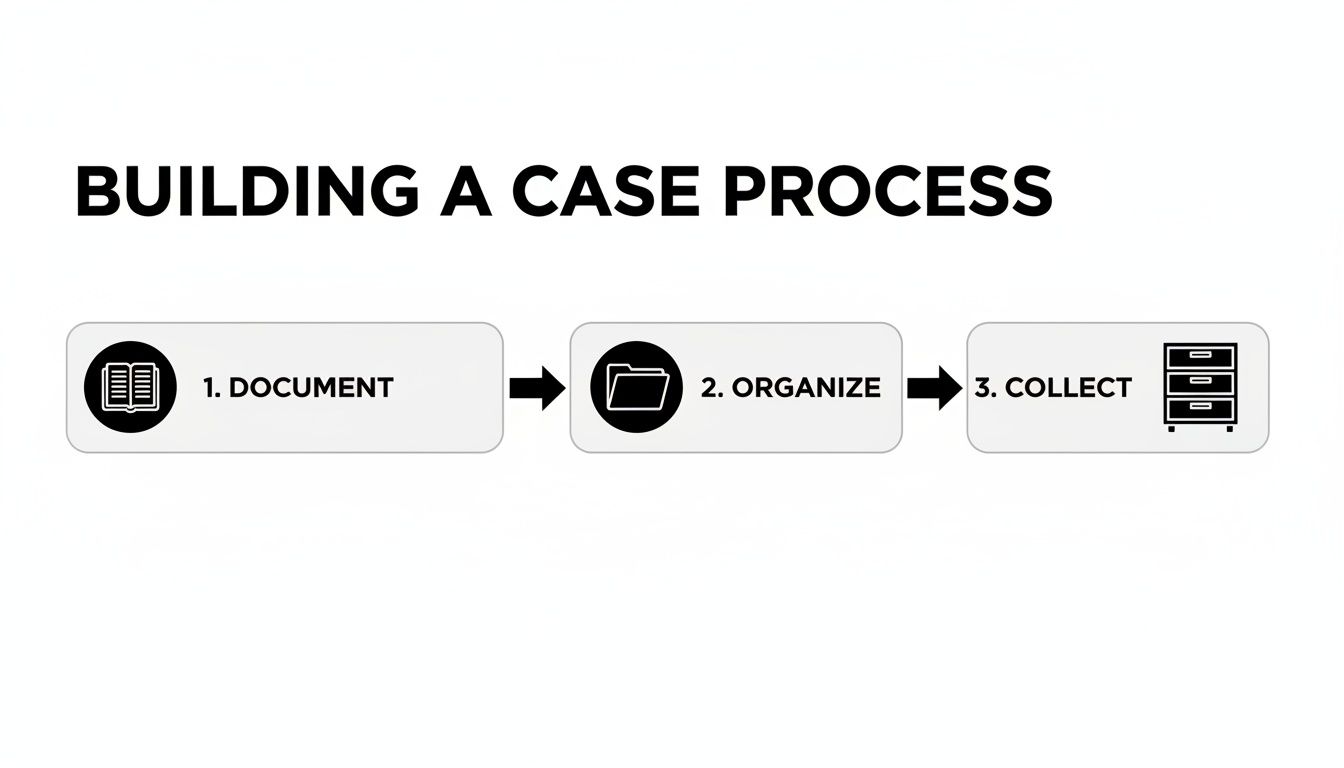
This really breaks it down. It starts with documenting your daily involvement, then moves to organizing all those records, and finally, collecting the official paperwork. Following this flow creates a powerful, evidence-based foundation for your case.
Key Stages Of A Custody Case
Once the petition is filed and officially served on the other parent, your case starts moving through a few predictable phases. Every case has its own unique twists and turns, but most follow a standard set of procedures designed to resolve issues as efficiently as possible.
One of the first big events is often a Temporary Hearing. A judge will make short-term decisions about where the child will live and what the visitation schedule will look like while the case is still pending. Don't underestimate this hearing—temporary orders can absolutely set the tone for the final outcome.
One of the most important stages in any Florida custody case is mandatory mediation. Before you ever see the inside of a courtroom for a trial, the court requires both parents to sit down with a neutral mediator and try to work things out. A surprising number of cases get resolved right here, saving everyone a tremendous amount of time, money, and emotional energy.
If you can't reach an agreement in mediation, your case will start moving toward a trial. This is when "discovery" happens—the formal process of exchanging evidence and information. It can involve depositions (sworn testimony outside of court), requests for documents, and other legal tools to get all the facts on the table. In really complex cases where the child’s best interests are heavily contested, the court might even appoint a neutral expert to investigate. You can learn more about what a Guardian ad Litem is and the critical role they play.
Presenting Yourself In Court
If your case does end up going to trial, how you present yourself in the courtroom is immensely important. Judges in Pasco, Pinellas, and Hillsborough Counties aren't just looking at the facts; they're sizing up your character and credibility.
Always stick to proper courtroom etiquette:
- Dress Professionally: Show the court you're taking this seriously. You don't need a tuxedo, but business casual is a safe bet.
- Speak Clearly and Respectfully: Address the judge as "Your Honor." Never, ever interrupt the judge or the other attorney. Let them finish their thought.
- Focus on Facts, Not Feelings: This is emotional, I get it. But your testimony needs to be based on factual evidence. Instead of saying, "She's a bad mom," you provide specific examples: "On October 5th, 12th, and 19th, she failed to take our son to his scheduled doctor's appointments."
Your goal is to be seen as the calm, reasonable, and stable parent. Let your organized evidence and respectful demeanor do the talking. It sends a powerful message that your only motivation is securing the best possible future for your child.
Challenging the Mother’s Fitness to Parent
When you have to raise concerns about the other parent's fitness, it's a path you have to walk carefully. This is not the time for mud-slinging or vague accusations. Florida courts, especially in Pasco, Pinellas, and Hillsborough counties, need to see objective, verifiable evidence that directly impacts your child’s safety and well-being. Your motivation has to be about protection, not punishment.
Every argument you make about serious issues like substance abuse, neglect, or mental instability must be framed around the child. The goal is never to punish the mother; it's to shield your child from potential harm. This measured, fact-based approach is absolutely critical for maintaining your credibility with the judge.
From Accusation to Evidence
Florida law sets a high bar for limiting a parent's rights. A judge simply won't act on your word alone. Instead of saying, "She has a drinking problem," you need to show the court how that alleged problem endangers your child.
This is where hard proof becomes your most powerful tool. The court gives significant weight to official records and observations from neutral third parties because they cut through the personal conflict.
Here’s what effective evidence looks like:
- Police Reports: Documents detailing domestic disturbances, calls for welfare checks, or any incident involving law enforcement can be incredibly compelling.
- Medical Records: These can show proof of missed appointments for the child or other records that might point to neglect.
- Third-Party Testimony: Statements from teachers, daycare providers, or family counselors who have witnessed concerning behavior or seen its impact on your child are invaluable.
When your co-parent exhibits manipulative or destructive behaviors, understanding the dynamics of navigating relationships with a narcissistic partner can give you crucial insight for your legal strategy and help protect your child's well-being.
The Role of a Guardian ad Litem
In really tough, high-conflict cases, the court might appoint a Guardian ad Litem (GAL). A GAL is a neutral third party—often a specially trained attorney or volunteer—whose only job is to investigate the entire situation and recommend what is truly in the child's best interests.
The findings of a Guardian ad Litem can be incredibly influential. The GAL will interview both of you, your child, teachers, and doctors, and will review all the relevant documents. A report that confirms your concerns about the mother’s fitness can dramatically strengthen your case for getting sole parental responsibility.
This professional assessment helps the court see beyond the "he said, she said" and get to the heart of what's really going on.
Maintaining Your Credibility
One of the biggest landmines you can step on when raising these concerns is being accused of parental alienation. If the court gets even a whiff that you're trying to damage the child’s relationship with their mother out of spite, it will torpedo your case. We've handled these sensitive situations countless times, and you can learn more about how to prove parental alienation in our detailed guide.
Your own conduct must be flawless. Stay calm, stick to the facts, and never bad-mouth the other parent in front of your children. This approach proves to the court that your focus is exactly where it should be: on your child’s welfare.
The legal landscape is shifting as courts increasingly recognize the vital role fathers play. We're seeing more dads win sole custody, and the statistics back this up. The number of single-father families has been on a steady rise, hitting around 1.6 million in the U.S. in 2023. This growth means over 3 million children are now living in father-only homes—a clear testament to dads successfully making their case in court. A key factor? Economic stability. With 74% of custodial fathers working full-time year-round, courts see them as a reliable source of provision. Our firm is proud to serve all families, including LGBTQ parents, ensuring every client gets the fair, skilled representation they deserve in Pasco, Pinellas, and Hillsborough Counties.
Critical Mistakes Fathers Must Avoid In A Custody Battle
Even a father with a rock-solid case can torpedo his own chances by making a few avoidable mistakes. The pressure cooker of a custody battle leads to bad decisions, but knowing the common pitfalls is the first step to sidestepping them entirely. Honestly, knowing what not to do is just as important as knowing what you should be doing.
Everything you do will be put under a microscope. Keeping your cool and acting strategically, especially when you're being provoked, shows the court that you are the stable, thoughtful parent a child needs. Our firm helps fathers in Pasco, Pinellas, and Hillsborough Counties protect their cases by focusing on smart, legally sound decisions from day one.
Moving Out Without A Plan
One of the most damaging things you can do early on is move out of the family home without a temporary custody order or a written agreement in hand. I get it—leaving a toxic situation can feel like the only option. But from a legal standpoint, it sends the wrong signal to the judge.
When you move out, you can accidentally create what’s called a status quo, where the child lives primarily with their mother. Judges are often hesitant to disrupt a child's established routine. By leaving, you may have just created a "new normal" that works completely against your goals.
From the court's perspective, it's simple: if you left the child in the mother’s primary care for weeks or months, you must have been okay with that arrangement. This makes it much harder to argue later that you should be the primary parent.
The Social Media Trap
In a custody fight, your social media accounts are no longer your private diary—they're potential evidence for the other side. Posting angry rants about your ex, photos from a boozy night out with friends, or even just complaining about the legal process can all be twisted and used against you.
Even a post that seems harmless can be stripped of context to paint you as irresponsible, unstable, or bitter. The smartest play here is to assume the judge and the opposing attorney will read every single thing you post online.
A good rule of thumb? Either stop posting altogether or limit your activity to strictly neutral, positive content. Never, ever discuss your case online, and tell your friends and family to do the same.
Speaking Negatively About The Other Parent
It is absolutely crucial that you never bad-mouth the other parent in front of your children. This behavior, sometimes called parental alienation, is a massive red flag for judges. Courts in Florida want to see that you are willing and able to support a healthy relationship between your child and their mother.
Even if your frustrations are completely valid, using your child as a sounding board hurts their emotional well-being and completely shreds your credibility in court. This includes things like:
- Making negative comments about the other parent's character, lifestyle, or choices.
- Discussing the details of the court case with your child.
- Blaming the other parent for the separation or financial struggles.
Instead, every communication you have should be child-focused and positive. Show the court you're the parent who can rise above the conflict for the sake of your kids.
Mishandling Communication And Court Orders
The way you communicate with the other parent is a direct reflection of your co-parenting skills. Firing back an angry text or ignoring messages about the children makes you look uncooperative and unreasonable.
Keep all communication—texts, emails, everything—factual, brief, and focused only on the kids. This creates a clean written record that shows you're the calm, responsible one.
Furthermore, failing to follow court orders to the letter is a catastrophic error. If a judge sets a temporary timesharing schedule, you follow it precisely. Deliberately violating an order can lead to serious consequences, including being held in contempt. For more on just how serious that is, you can read our guide on what contempt of court means.
Making the right moves is about avoiding the traps just as much as it is about building a strong case. Below is a quick comparison of common mistakes we see versus the strategic alternatives that will actually help you.
Mistake vs. Smart Strategy in Custody Cases
Common Mistake
Moving out of the home immediately.
Why It Hurts Your Case
Creates a "status quo" where the mother is the primary caregiver, which judges are hesitant to change.
Smarter Strategic Alternative
File for a temporary custody order or get a written agreement before leaving the home, establishing your role from the start.
Common Mistake
Posting frustrations on social media.
Why It Hurts Your Case
Provides the opposing side with evidence to paint you as angry, unstable, or an unfit parent.
Smarter Strategic Alternative
Go silent on social media or only post neutral, positive content. Never discuss the case online.
Common Mistake
Venting about the other parent to your kids.
Why It Hurts Your Case
Shows the judge you're engaging in parental alienation and not prioritizing your child's well-being.
Smarter Strategic Alternative
Keep all conversations with your child positive and child-focused. Use a therapist or trusted friend to vent your frustrations.
Common Mistake
Sending emotional or angry texts.
Why It Hurts Your Case
Creates a written record that makes you look impulsive and difficult to co-parent with.
Smarter Strategic Alternative
Communicate factually and briefly via text or a co-parenting app, focusing only on logistics related to the children.
Common Mistake
Ignoring or bending the rules of a court order.
Why It Hurts Your Case
Can result in contempt of court, fines, or even losing timesharing. It signals to the judge that you can't be trusted.
Smarter Strategic Alternative
Follow every detail of the court's orders precisely. Document your compliance and any violations by the other party.
These strategic shifts can make all the difference. They demonstrate to the court that you are a stable, responsible, and child-focused parent—exactly what a judge is looking for.
Our firm is committed to protecting the rights of all parents, and we proudly serve the LGBTQ community in Pasco, Pinellas, and Hillsborough Counties, handling gay custody issues and all family law matters with the focused expertise they deserve. We understand that a parent's love and stability are what truly matter.
Your Top Questions About Fathers' Custody Rights
When you're fighting for full custody, a million questions run through your mind. It's natural. I've sat down with countless fathers across Pasco, Pinellas, and Hillsborough Counties, and many of the same core concerns come up time and again. Let's tackle some of the biggest ones right now.
Will The Court Automatically Favor The Mother?
Absolutely not. This is probably the most persistent—and damaging—myth out there. Florida law is crystal clear: it's gender-neutral.
Judges are legally forbidden from making decisions based on a parent's gender. Their sole focus is the child's best interests. The parent who has consistently been the source of stability, nurturing, and day-to-day care is the one with the stronger case. Period.
Can I Get Full Custody If The Mother Isn't "Unfit"?
This is where it gets tough. The court's starting point is that children benefit from having both parents actively involved. To get sole parental responsibility (what most people mean by "full custody"), you can't just be the better parent; you have to prove that shared decision-making would actually be detrimental to your child.
That's a very high bar. We're typically talking about serious, documented issues like substance abuse, untreated mental illness, domestic violence, or abandonment. A simple disagreement over bedtimes or homework styles won't cut it.
How Much Will A Custody Battle Cost?
There’s no single answer, as the cost can swing wildly. A case that settles quickly in mediation is going to be thousands of dollars cheaper than a conflict-heavy battle that drags on to a full-blown trial.
What drives up the cost? Things like hiring multiple expert witnesses, endless back-and-forth discovery requests, and an unwillingness to compromise. The more organized you are with your evidence and the more reasonable you are in negotiations, the more you can keep expenses in check. We get the financial strain this puts on families and always focus on practical, cost-effective strategies.
What If My Child Is Old Enough To Choose?
In Florida, a child’s wishes are just one piece of the puzzle, and it is not the deciding factor. A judge will certainly give more weight to the preference of a mature, thoughtful teenager than to a seven-year-old.
But let’s be clear: there is no magic age where a child can legally "choose" which parent to live with. The judge listens, but the final call is based on all the evidence and what the court determines is in the child's overall best interest.
Do I Have Any Rights If We Weren't Married?
This is a critical point that trips up many fathers. If you were not married to your child's mother when they were born, you have zero enforceable custody or timesharing rights until you legally establish paternity.
Until a court order officially recognizes you as the legal father, the mother has sole custody by default. It doesn't matter if your name is on the birth certificate. Establishing paternity is the non-negotiable first step.
Our firm is proud to serve all families, including those in the LGBTQ community. We handle gay divorce, custody matters, and related family law issues with the specialized expertise they demand. We believe a parent’s love and commitment are what define a family, not gender identity or sexual orientation. We serve clients throughout Pasco, Pinellas, and Hillsborough Counties.
Navigating a custody case is complex and emotionally draining. You need skill, strategy, and a deep understanding of your rights. At Foley Family Law, we give fathers in Pasco, Pinellas, and Hillsborough Counties the dedicated, aggressive representation they need to protect their role in their child's life.
If you're ready to build a plan of action, contact us to schedule a consultation.


