

Getting a prenuptial agreement in Florida is a structured process. It involves open communication with your partner, hiring separate family law attorneys, fully disclosing all your finances, and negotiating the terms before signing the final document—well in advance of your wedding day. It’s about transforming a sensitive topic into a practical financial plan for your marriage.
A Prenup Is Smart Financial Planning For Florida Couples
Staring at a blank page can be intimidating. The idea of a prenuptial agreement can feel just as overwhelming. But what if you viewed it not as a forecast for failure, but as a blueprint for a strong financial partnership?
For couples in Pasco, Pinellas, and Hillsborough Counties—especially those between 35 and 65 with established assets, businesses, or children from previous relationships—a prenup is a powerful financial planning tool. It’s all about creating transparency and setting mutual expectations right from the start.
This guide demystifies the process, offering a clear roadmap to protect your future. Think of it like insurance for your assets or a well-crafted estate plan. It ensures both partners, including those in our diverse LGBTQ+ community, can enter a marriage with confidence and peace of mind. We handle all LGBTQ+ family and divorce issues and do not discriminate.
The Modern View On Prenuptial Agreements
Prenups used to be seen as something reserved for the rich and famous, but they're becoming much more common today. The perception has shifted in a big way. A 2023 YouGov poll, for instance, revealed that 42% of people now view them positively, compared to only 13% who see them negatively.
And it’s not just about opinions. Harris Poll data shows that 20% of married couples in the U.S. have a prenup, with overall support for them climbing to 50%. This trend highlights a growing understanding that these agreements aren't about expecting divorce; they're about smart, proactive financial management. For a broader look at the basics, this general prenup guide is a helpful resource.
The process is really about laying a secure foundation for your marriage, moving from initial planning to a place of confidence.
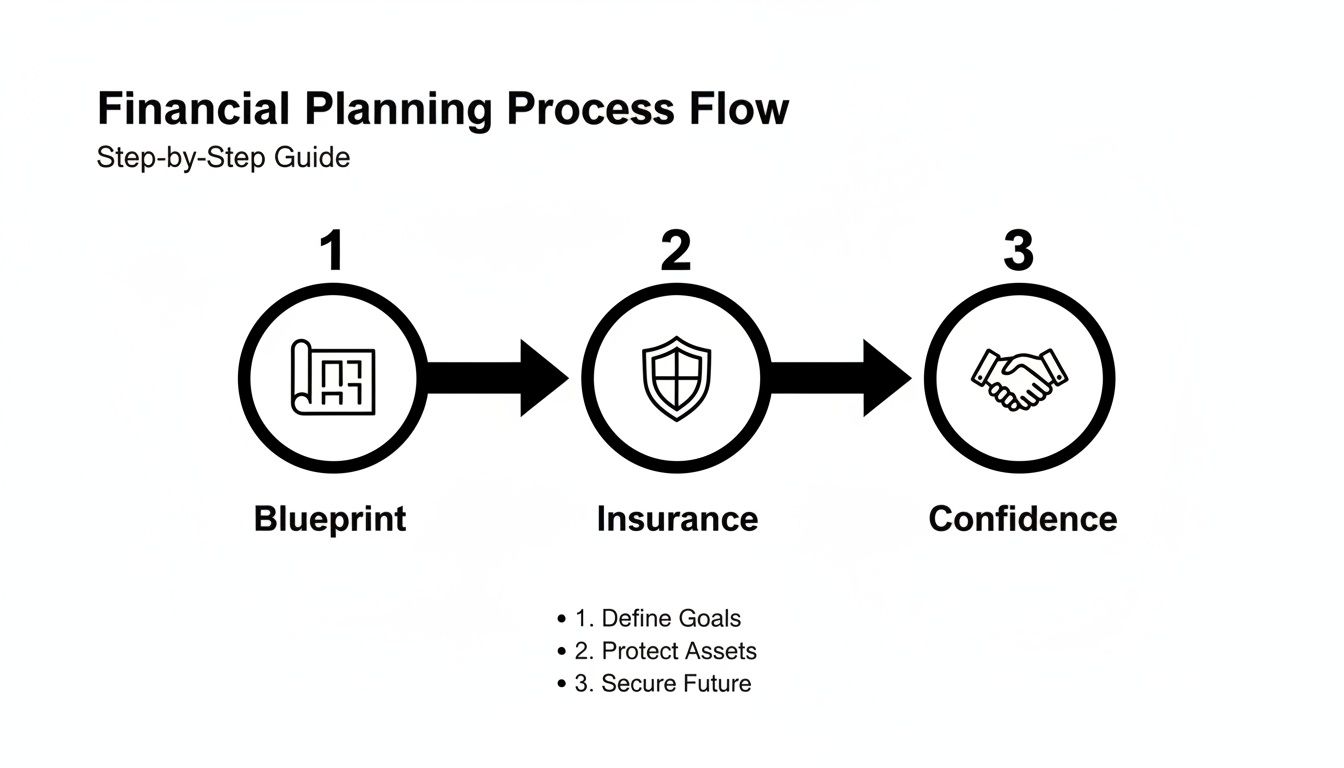
This shift in perspective is what turns a prenup from a dreaded conversation into a collaborative financial blueprint.
Why Tampa Bay Couples Are Choosing Prenups
In our local economic landscape here in Pasco, Pinellas, and Hillsborough Counties, a prenup offers some very specific advantages. By getting financial matters out in the open upfront, couples can head off future conflicts and protect what they’ve worked so hard to build.
To see if this applies to you, consider some of the common scenarios we see. Here are a few key situations where a prenup can be especially beneficial:
- One partner has significantly more assets or debt: A prenup clarifies that pre-marital assets remain separate and protects the other partner from pre-existing debt.
- You own a business: It protects the business from being divided or disrupted in a divorce, ensuring business continuity.
- You have children from a previous relationship: It ensures your children's inheritance from your separate property is protected and legally designated.
- One partner plans to be a stay-at-home parent: The agreement can define financial support (alimony) to ensure the non-working spouse is secure if the marriage ends.
- You anticipate a significant inheritance: It can specify that future inheritances remain separate property and are not subject to division.
By establishing these clear financial boundaries, you aren't planning for an ending. You're building a stronger, more transparent beginning. You can learn more about the specific reasons to get a prenup in our detailed guide.
Starting The Prenup Conversation With Your Partner
Let's be honest: bringing up a prenuptial agreement can feel like the single most awkward conversation you'll have with your partner. But it absolutely doesn't have to be a fight. The trick is to reframe it—this isn't about planning for a breakup; it's about smart, collaborative financial planning for your shared life.
Timing and tone are everything here. Pick a time when you're both calm, relaxed, and have some privacy. Don't spring it on them during a stressful week or in the middle of a disagreement. Learning some basic strategies to stop arguing and foster connection can go a long way in making this discussion productive and loving.
Framing The Talk For Mutual Benefit
Instead of leading with the cold, hard phrase, "We need a prenup," try a softer, team-oriented approach. You want this to feel like a "we" decision that protects both of you.
Here are a few ways to get the ball rolling that focus on clarity and mutual respect:
- "As we're getting ready to combine our lives, I think it would be a great idea for us to sit down and create a clear financial plan together. A prenup could be a really helpful tool to make sure we're on the same page and protect both of our futures."
- "You know, since we both have careers and some assets we're bringing into this marriage, I was reading that a prenup is a smart way to be clear about everything from the start. It feels like a responsible step to take."
- "I want our marriage to be built on complete openness and honesty. Going through the prenup process would let us put all our financial cards on the table now, so there are no surprises down the road."
This approach shifts the conversation from divorce to partnership. For a deeper dive, check out our article on how to ask for a prenup without starting a fight.
The Non-Negotiable Need For Separate Attorneys
Once you’ve both agreed to explore a prenup, the next step is non-negotiable: you each need to hire your own, independent family law attorney. This isn't just a strong recommendation; it’s the foundation of a legally enforceable agreement in Florida.
Having separate legal counsel is the single best way to ensure a prenup is considered fair and voluntary. It protects the agreement from being challenged later on the grounds that one party didn't fully understand what they were signing or was pressured into it.
Think of it this way: one lawyer simply cannot serve two masters. There's an inherent conflict of interest. Your attorney's job is to advocate for you—to explain what each clause means for your future, negotiate on your behalf, and make sure your rights are fully protected.
Finding The Right Family Law Attorney
Don't just hire any attorney. You need someone who lives and breathes family law and has deep experience drafting prenuptial agreements specifically in Florida. This is a specialized area of law that demands a nuanced understanding of how courts treat assets in a marriage and divorce.
For couples here in the Tampa Bay area, it’s incredibly valuable to work with a lawyer who knows the financial landscape of Pasco, Pinellas, and Hillsborough Counties.
Look for an attorney who:
- Practices Exclusively in Family Law: This isn't a side gig for them. They're up-to-date on every change in state law and recent court rulings.
- Has Verifiable Prenup Experience: Don't be shy. Ask them how many prenups they’ve drafted and negotiated.
- Communicates Clearly: You need an advisor who can break down complex legal jargon into plain English so you can make informed choices with confidence.
Your attorney is your advocate and your guide. They will work with your partner's lawyer to translate your shared intentions into a durable legal document that stands the test of time. This professional guidance is absolutely essential to getting a prenup done right.
The Critical Step of Full Financial Disclosure
A Florida prenuptial agreement stands or falls on one core principle: total transparency. This brings us to the most crucial, non-negotiable part of the process—full and fair financial disclosure.
This isn't just a casual chat about your finances. It's a formal, detailed inventory of every single asset, debt, and income source you both possess. This step is the absolute bedrock of your agreement's enforceability. Without it, you risk a judge throwing out the entire document years down the road, no matter how carefully you drafted the other terms. It’s the ultimate act of putting all your financial cards on the table.
What Does Full Disclosure Actually Involve?
Think of this as creating a complete financial snapshot of your life as it exists right before the marriage. It goes way beyond just listing your house and your car. In Florida, the law demands a comprehensive and honest accounting of everything you own and everything you owe.
This means rolling up your sleeves, gathering specific documents, and creating a detailed financial statement. To get started, you'll typically need to compile:
- Proof of Income: Recent pay stubs, W-2s, and at least three years of personal and business tax returns.
- Bank and Investment Records: Statements from all checking, savings, money market, brokerage, and mutual fund accounts.
- Retirement Accounts: Full statements for any 401(k)s, IRAs, pensions, or other retirement vehicles. For first responders in Pasco, Pinellas, and Hillsborough Counties, this includes detailed information about state or local pension plans.
- Real Estate Information: Deeds, recent appraisals or tax assessments, and mortgage statements for any property you own.
- Business Valuations: If you own a business, you'll need documentation establishing its value, like financial statements or a professional business valuation.
- Debt Statements: A clear list of all liabilities, including credit card balances, student loans, car loans, and personal loans.
- Other Valuables: Information on significant assets like vehicles, boats, jewelry, or art collections.
Gathering all of this takes time, which is just one reason why you can't rush the prenup process. It often surprises clients just how much work goes into preparing a prenuptial agreement, but this thoroughness is precisely what gives the final document its legal strength.
The Consequences of Hiding Assets
Let’s walk through a real-world scenario we often see in the Tampa Bay area. Imagine a partner owns a small but growing e-commerce business they started before the relationship. During the prenup process, they list their personal bank accounts but "forget" to disclose the business bank account or its true value, figuring it's not a big deal since it was a premarital venture.
Years later, the couple divorces. The other spouse's attorney discovers the undisclosed business, which has since become highly profitable. Because there was a material omission during the financial disclosure phase, a judge now has clear grounds to set aside the entire prenuptial agreement, potentially making that once-separate business a marital asset subject to division.
This is exactly why honesty is paramount. It doesn't matter if the omission was intentional or accidental—the legal result can be the same: the prenup you were counting on for protection is suddenly worthless.
For high-net-worth individuals, the stakes are even higher. Getting a prenup is becoming a practical necessity as U.S. divorce rates hover around 2.3 per 1,000 people, according to CDC reports. While about 10% of marriages currently involve prenups, that leaves many couples financially exposed if their marriage ends. You can read more about prenuptial statistics and trends to understand the shifting landscape.
This step requires diligence and a firm commitment to transparency from both partners. By working with experienced family law attorneys who serve clients in Pasco, Pinellas, and Hillsborough Counties, you can navigate this process confidently, ensuring your financial foundation is solid and your agreement is built to last.
Negotiating And Drafting Your Agreement Terms
Once the financial cards are on the table, it's time to get into the heart of the matter: negotiating the actual terms of your prenup and having your attorneys draft the legal document. Think of this not as a battle, but as a collaboration. The goal isn’t to “win” against your partner; it’s to build a clear, legally sound blueprint for your financial future that you both agree on.
This is where you decide, together, what stays separate, what becomes shared, and how you’ll handle assets and debts you acquire during the marriage. It’s about creating clarity now to prevent conflict later.
Demystifying Common Prenup Clauses
The language in a prenuptial agreement can look intimidating, but the concepts behind the legalese are usually pretty straightforward. Your attorney's job is to translate it all into plain English so you know exactly what you’re signing. This is especially crucial for our clients across Tampa Bay, where unique family structures, including those in the LGBTQ+ community, require a personalized approach.
To give you a better idea of what goes into a prenup, here is a quick breakdown of the most common clauses we work with:
- Separate Property: This is the foundation of most prenups. It clearly lists all assets and debts each of you brings into the marriage, locking them in as separate property that won't be divided in a divorce.
- Marital Property: Florida law already defines what's considered marital property (things acquired during the marriage). A prenup lets you either stick with that definition or create your own customized rules for what you'll consider shared.
- Management of Assets: This clause gets specific about how certain assets are handled during the marriage. For example, you can decide if the income from a separate rental property remains separate or gets treated as a shared marital asset.
- Spousal Support (Alimony): This is one of the most powerful and flexible parts of a prenup. You can agree to waive alimony entirely, set a specific amount or duration, cap it, or just leave it up to the court to decide later.
- Business Interests: Absolutely critical for entrepreneurs in Pasco, Pinellas, and Hillsborough Counties. This protects a business from being forcibly divided or tied up in litigation during a divorce, ensuring it can continue to operate smoothly.
- Inheritance & Gifts: Specifies that any inheritance or significant gifts received by one spouse during the marriage will remain their separate property.
- Debt Allocation: Clarifies who is responsible for pre-marital debts and any debts incurred during the marriage, preventing one spouse from being on the hook for the other's liabilities.
Ultimately, these clauses are just the building blocks. An experienced attorney will help you combine and customize them to fit your specific life circumstances and financial picture.
The Art Of Negotiation
The negotiation itself is really a series of conversations between your attorneys, who then relay proposals back to you for your feedback. It’s a give-and-take. Your lawyer is there to advocate for your best interests while working toward an agreement that’s fair and acceptable to both of you.
A key thing to remember is that a fair agreement is an enforceable one. Florida courts are far more likely to uphold a prenup that isn't completely one-sided or "unconscionable." The goal is protection, not punishment for either party.
This is where having a seasoned family law attorney really proves its worth. They’ve seen it all and can often suggest creative solutions or compromises you might not have thought of, keeping the process moving forward without unnecessary friction.
And this process is flexible. Sometimes, couples realize their financial goals aren't what they thought they were. That's okay. For couples already married who face a major life change—like starting a business or getting an inheritance—a similar document can be created after the wedding. In those cases, it’s helpful to understand the nuances of post-nuptial agreements in Florida, which follow a very similar drafting and negotiation process.
Tailoring The Agreement To Your Life
No two couples are the same, so no two prenups should ever be identical. A generic template you find online is a recipe for disaster; it simply can't provide the real protection you need. Your agreement has to be custom-built for your specific assets, your future goals, and your genuine concerns.
Just think about a few real-world scenarios:
- A partner with kids from a previous marriage might include specific language to safeguard their children’s inheritance rights.
- For same-sex couples who were partners long before they could legally marry, a prenup can be used to formally recognize and protect assets they acquired together during their pre-marital relationship. We handle all LGBTQ+ family law issues and do not discriminate.
- If one person plans to leave a career to raise a family, the prenup can build in financial protections to ensure they aren't left at a major disadvantage if the marriage were to end down the road.
The drafting stage is where your attorney translates all these negotiated points into precise legal language. You’ll get to review drafts, ask as many questions as you need, and suggest changes until the final version perfectly matches what you both agreed to. This meticulous, personalized approach is what makes a prenup a genuinely powerful tool for your future.
Executing The Prenup For Maximum Enforceability
After all the conversations, financial disclosures, and back-and-forth negotiations, you’ve finally reached the last step: signing the prenuptial agreement. This final stage is just as critical as all the work that came before it. Why? Because a perfectly drafted agreement is useless if it isn't executed correctly under Florida law.
Think of this as your final checklist for legal validity.

The core requirements are straightforward but incredibly strict. The agreement must be a physical written document—oral promises simply won't hold up in court. Both of you must also sign it voluntarily, completely free of any pressure, duress, or coercion. This is a huge reason why understanding if you need an attorney for a prenup is so important; having your own separate lawyer is the best possible evidence that your signature was voluntary and well-informed.
The Importance Of Proper Timing
One of the easiest ways for a prenup to be challenged down the road is to claim it was presented as a last-minute ultimatum. Just imagine being handed a complex legal document the week of your wedding, with all the stress and pressure that comes with it. A court might see that as coercive, raising serious questions about whether you truly had enough time to review it and sign freely.
To head off this potential problem, the best practice is to sign the final agreement well in advance of the wedding day. Ideally, you should aim for at least 30 days before the ceremony. This creates a crystal-clear record that both of you had ample time to consider the terms without feeling rushed by the impending wedding date.
For our clients here in Pasco, Pinellas, and Hillsborough Counties, we always emphasize starting the entire process months ahead of time. This allows for a calm, thoughtful execution of the final documents, free from any last-minute chaos.
Formalities Of Signing The Agreement
Florida law has specific procedural requirements for signing a prenuptial agreement, treating it with the same seriousness as a will. Following these steps isn’t optional—it’s absolutely essential for enforceability.
- Written Document: The agreement must be in writing.
- Signatures of Both Parties: Both you and your partner must sign the document.
- Two Subscribing Witnesses: Your signatures must be witnessed by two other people, who then also sign the agreement in your presence and in the presence of each other.
- Notarization: The document must be notarized. A notary public will verify your identities and witness your signatures before applying their official seal.
Think of these formalities as the legal armor for your agreement. Each signature, witness, and notary stamp adds another layer of protection, making it much harder for the document to be successfully challenged in the future.
Avoiding Stigmas And Focusing On The Benefits
Despite their rising popularity and clear value, prenups can still carry an unfortunate stigma. But the data shows just how important they are in a world where divorce is a real possibility.
While only 15% of married or engaged Americans actually have a prenup, over 50% support the idea of them. Here in Florida, which accounts for about 10.48% of all prenups in major U.S. markets, more and more couples are recognizing them as a practical financial tool. It’s true that nearly 30% of people skip them out of sheer optimism, thinking "we won't get divorced." But that mindset overlooks the incredible real-world benefits of starting a marriage with total financial clarity. You can find more insights on this trend from a recent Sky News report on the rise of prenuptial agreements.
By following these proper execution steps, you transform all your hard work and negotiated terms into a durable, enforceable legal document. This final action provides the lasting peace of mind you set out to achieve from the very beginning.
Answering Your Questions About Florida Prenups
Even after laying out the whole process, it's completely normal to have a few more questions rattling around. A prenup is a major financial and personal decision, and you should feel 100% confident before moving forward. Let’s tackle some of the most common questions we get from couples right here in the Tampa Bay area.
How Much Does a Prenup Cost in Florida?
This is usually the first thing couples ask, and the most honest answer is: it depends. The cost of a Florida prenuptial agreement is tied directly to how complex your finances are. If you and your partner have relatively straightforward assets, the cost might be a few thousand dollars for each of you.
But for high-net-worth individuals, business owners, or anyone with complicated investment portfolios and real estate holdings, the process is naturally more involved. The cost will reflect that extra work. I always tell clients to think of it not as an expense, but as an investment in clarity and your financial future. A well-crafted prenup costs a tiny fraction of what a messy, contested divorce could run you down the line. At our firm, we serve Pasco, Pinellas, and Hillsborough Counties and always provide clear, transparent pricing based on your specific situation.
Can We Change a Prenup After We Get Married?
Yes, absolutely. A prenuptial agreement isn't locked in stone forever. Life happens, things change, and your financial agreement can evolve right along with you. You can amend or even completely scrap a prenup after you're married, but there's one huge catch: both spouses have to agree to the change.
To make any changes, you'll need a new legal document, usually called a postnuptial agreement or an amendment. This document has to meet the same high legal standards as the original prenup:
- It has to be in writing.
- Both of you must sign it voluntarily.
- You'll need to go through another round of full and fair financial disclosure.
One person can't just decide to change the terms unilaterally. It has to be a mutual, formally documented decision every single time. This is what keeps the agreement fair and consensual throughout your marriage.
What Makes a Prenup Unenforceable in Florida?
A Florida judge can throw out a prenuptial agreement, but they don't do it lightly. There have to be very specific legal reasons for it. The whole point of working with an experienced attorney is to build a rock-solid agreement that steers clear of these common pitfalls.
Here are the most common reasons a prenup gets invalidated:
- Hiding the Ball on Finances: If one person hid assets or seriously lowballed their net worth, a court can toss the entire agreement. Transparency isn't just a suggestion; it's a requirement.
- Signing Under Duress: The agreement must be signed freely and voluntarily. If a judge believes someone was pressured, threatened, or backed into a corner—especially right before the wedding—the prenup can be voided. This is a classic "sign this or the wedding is off" scenario that judges look at very closely.
- Grossly Unfair Terms: This is a tough one to prove. It means the agreement was so ridiculously one-sided at the moment it was signed that it shocks the conscience. It can’t just be a bad deal; it has to be fundamentally unconscionable.
- Sloppy Paperwork: The document wasn't executed properly according to Florida's formal rules. Maybe it was missing signatures, wasn't witnessed correctly, or wasn't notarized.
The single best way to protect against these challenges is to make sure both you and your partner have your own, independent lawyers. It’s the clearest evidence that you both understood what you were signing, did so willingly, and had a chance to get professional advice. It makes the agreement incredibly difficult to challenge later.
Does Getting a Prenup Mean We Don’t Trust Each Other?
This is probably the biggest emotional hurdle, but the way people think about prenups is really changing. Talking about a prenup isn't a vote of no confidence in your relationship. It’s an act of radical transparency and smart planning.
Let’s be real: money is one of the top sources of conflict in any marriage. By having these conversations openly and honestly during the prenup process, you're getting ahead of potential arguments before they even start. You’re building a foundation on clarity, not assumptions.
Many Tampa Bay couples we work with find that the process actually makes them feel closer. It forces them to have critical conversations they might have otherwise put off, allowing them to walk into their marriage with a shared understanding of their financial partnership. It clears the air so you can focus on what really matters—building an amazing life together.
Navigating the path to a prenuptial agreement requires clear guidance and experienced legal support. At Foley Family Law, we are dedicated to helping couples in Hillsborough, Pinellas, and Pasco Counties create fair and enforceable agreements that provide lasting peace of mind. If you are ready to take the next step in protecting your future, contact us to schedule a consultation.


