
Before you can file for divorce in Florida, you have to meet the state's residency requirement. This means at least one spouse must have lived here for the six months leading up to the filing. Once you've established that, the process officially begins when you file a Petition for Dissolution of Marriage with your local circuit court, stating that the marriage is "irretrievably broken."
Your First Steps in the Florida Divorce Process
Deciding to end a marriage is a huge moment, and it’s normal to feel overwhelmed by the legal process. For most people, it feels like an intimidating maze. The best way to get your bearings and calm some of that anxiety is to understand the first few foundational steps. It doesn't matter if you're in Pasco, Pinellas, or Hillsborough County—every Florida divorce starts with the same ground rules.
First and foremost is residency. This is non-negotiable. Before a Florida court will even look at your case, one of you must have lived in the state for at least six months right before filing the petition. You’ll need to prove it, usually with a copy of your Florida driver's license or a voter registration card.
This flowchart gives you a bird's-eye view of how a divorce case typically unfolds from the very beginning.
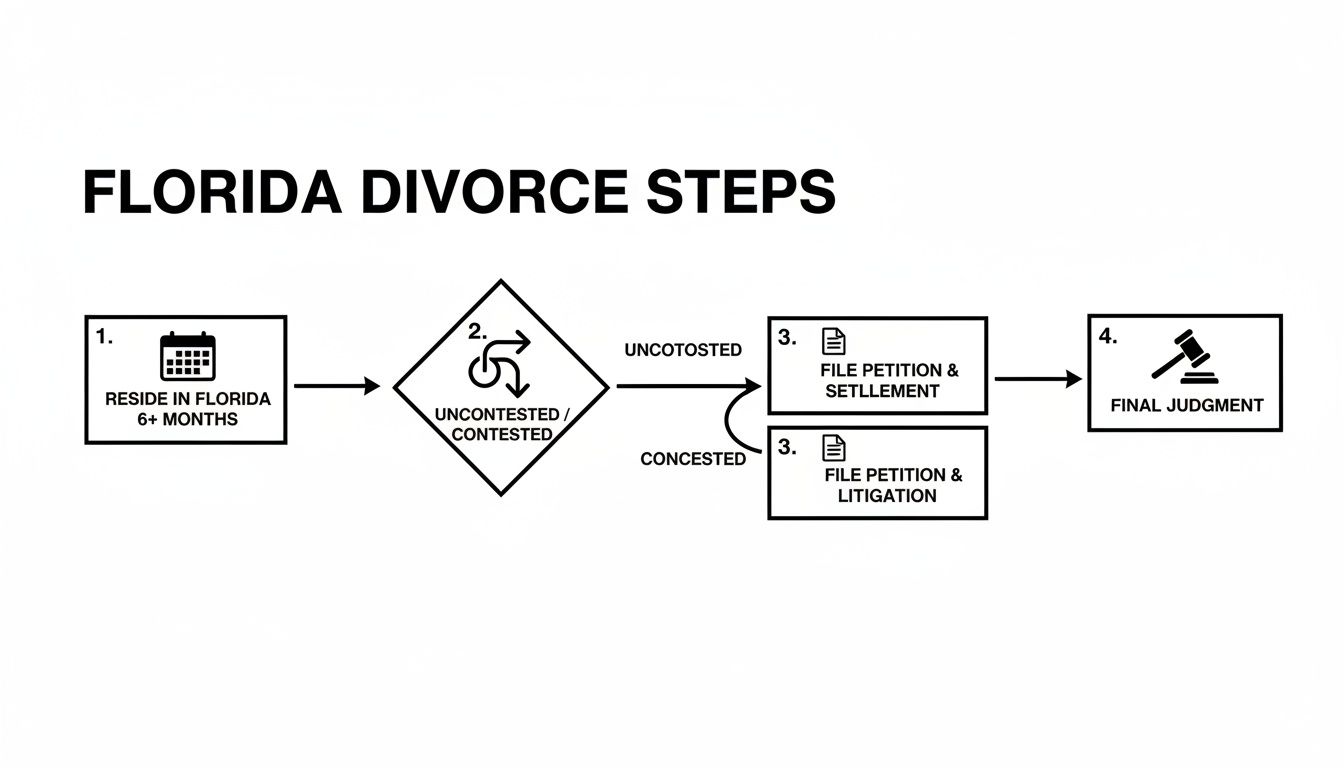
As you can see, once you clear the residency hurdle, your case will head down one of two tracks—uncontested or contested—which sets the stage for everything that follows.
Before we get into the details, here is a quick summary of the key concepts you'll need to know as you start the process.
Florida Divorce At a Glance: Key Requirements
- 6-Month Residency: You or your spouse must have lived in Florida continuously for 6 months before filing. This is the first box you must check.
- Petition for Dissolution of Marriage: This is the official document that kicks off your divorce case. It gets filed with the clerk of the circuit court.
- "Irretrievably Broken": The legal reason for divorce in Florida. You don't have to prove fault; you just need to state the marriage cannot be saved.
- Uncontested Divorce: The ideal path. You and your spouse agree on all issues (assets, debts, kids) and sign a Marital Settlement Agreement.
- Contested Divorce: You and your spouse disagree on one or more issues. This path involves negotiation, mediation, and possibly a trial.
Understanding these basics will give you a solid foundation as you move forward.
Florida Is a No-Fault State
Another core principle is that Florida is a "no-fault" state. This makes the initial filing much simpler. You don’t have to prove your spouse did anything wrong, like having an affair or abandoning the family, just to get a divorce.
All you have to do is state that the marriage is "irretrievably broken," which is just a legal way of saying there’s no chance of getting back together. This system is designed to lower the temperature from the very beginning, letting everyone focus on resolving the practical issues instead of slinging mud in court.
Uncontested vs. Contested Divorce
After you've met the residency requirement, your divorce will go one of two ways. The path it takes will have a massive impact on the time, expense, and emotional energy required.
Uncontested Divorce: This is the smoothest, quickest, and most affordable route. It’s possible when you and your spouse agree on everything—how to divide property and debts, whether there will be alimony, and, if you have children, the entire parenting plan and child support. All these agreements are put into a written Marital Settlement Agreement, which you then submit to the judge for approval.
Contested Divorce: This happens whenever you can’t agree on one or more of those key issues. Your case will then need to be resolved through negotiations between attorneys, mandatory mediation, or, as a last resort, a trial where a judge makes the final decisions. These cases are more complicated, take much longer, and are far more expensive.
A lot of people hear "contested divorce" and immediately picture a dramatic courtroom battle. The reality is that the vast majority of contested cases get settled during mediation, long before they ever see the inside of a courtroom for a trial.
We know that every family's situation is different. At our firm, we handle all family and divorce matters with the personalized attention and dedication they require in Pasco, Pinellas, and Hillsborough Counties. We are proud to serve all members of our community and do not discriminate; we handle all LGBTQ+ divorce, custody, and name change issues.
Preparing And Filing Your Divorce Petition
Once you've confirmed you meet Florida's residency requirement, the next step is where the legal process truly kicks off: preparing and filing the divorce petition. This can feel like you're staring up at a mountain of paperwork, but it’s much less intimidating when you break it down into manageable parts.
Think of it as gathering your ingredients before you start cooking. Proper preparation at this stage prevents frustrating delays and complications down the road.

The primary document you'll be working with is the Petition for Dissolution of Marriage. This form is your formal request to the court to end your marriage. It also outlines what you're asking for regarding property, debts, and, if you have children, their care. While there are a few different versions of the petition, they all serve this same core purpose.
Our firm is deeply familiar with the local procedures in Pasco, Pinellas, and Hillsborough Counties. We make sure our clients use the correct and most current forms for their specific situation, which is a detail that can easily trip people up.
Key Forms You Will Likely Need
Beyond the main petition, Florida law requires several other documents to give the court a complete picture of your life. Accuracy here is absolutely critical—mistakes or omissions can cause significant setbacks.
The most important supporting document is the Family Law Financial Affidavit. This form is a detailed snapshot of your complete financial situation, and you must disclose everything. We're talking about:
- Income: Pay stubs, bonuses, and any other money coming in.
- Expenses: Monthly bills, from your mortgage and car payment to your grocery costs.
- Assets: Bank accounts, retirement funds, real estate, vehicles, and valuable personal items.
- Debts: Mortgages, car loans, credit card balances, and student loans.
If you and your spouse have minor children together, you'll also need to file a Uniform Child Custody Jurisdiction and Enforcement Act (UCCJEA) Affidavit. This form simply tells the judge where your children have lived for the past five years. It helps establish that Florida is the right state to make decisions about their welfare.
Gathering and organizing all your financial documents is often the most time-consuming part of this stage. Start early. Begin collecting recent pay stubs, bank statements, tax returns, and credit card bills. Creating a dedicated folder for these papers can make the process much smoother.
Filing Your Documents With The Court
Once all your paperwork is accurately completed and signed, the next move is to file it with the Clerk of the Circuit Court. This has to be done in the county where either you or your spouse lives. For our clients, that means filing in the courthouses of Pasco, Pinellas, or Hillsborough County.
Filing initiates your case and officially puts it on the court's radar. You'll have to pay a filing fee, which is typically around $400, though this amount can vary slightly by county. If you can't afford the fee, you might be able to apply for a payment plan or a waiver from the court.
After the clerk accepts and stamps your documents, you will receive a case number. This number is the official identifier for your divorce and will be used on all future documents you file. The petition is now officially filed, and the clock starts on the next phase: serving your spouse.
While some people try to handle this paperwork on their own, figuring out the system without legal help can be a real challenge. You might find it helpful to read our guide on the realities of getting a divorce without a lawyer to better understand the complexities involved.
Our firm handles all types of family law matters, and we ensure every petition is filed correctly to protect our clients' rights from the very start.
Understanding How Divorce Papers Are Served
Once you file the divorce petition, the next step is a legal requirement called “service of process.” It sounds technical, but it’s a fundamental part of the system. Your spouse has to be officially notified that you’ve filed for divorce, giving them a fair chance to respond.
This isn’t just a courtesy; it’s a constitutional requirement. Without proper proof that your spouse received the paperwork, a judge can’t move your case forward.
Many clients worry about this part, picturing a dramatic scene from a movie. The reality is far more routine. The goal is simply to deliver the documents and create an official court record that they were received. That’s it. This formal step allows the case to proceed under Florida law.
Personal Service: The Standard Method
The most common and legally solid way to serve divorce papers is through personal service. This simply means a neutral, third-party professional physically hands the divorce petition and summons to your spouse.
In Florida, this job is handled by one of two people:
- A Sheriff's Deputy from the county where your spouse lives.
- A certified private process server.
For example, if you file your divorce in Hillsborough County but your spouse now lives in Clearwater, you would use the Pinellas County Sheriff's Department or a private server who works in that area. Private process servers often have more flexibility, allowing them to make attempts at different times of the day or even at a workplace if necessary.
After the documents are delivered, the server files a "Return of Service" with the court. This is the official proof of delivery, and it starts a critical clock.
Once served, your spouse has exactly 20 calendar days to file a formal, written answer with the Clerk of Court. If they miss this deadline, you may be able to ask the court for a default judgment, which can have serious consequences for their ability to participate in the case.
Other Ways to Handle Service
While personal service is the gold standard, it’s not always necessary or practical. The best method really depends on your situation, particularly how cooperative your spouse is. At our firm, we’ve navigated every possible service scenario for clients across Pasco, Pinellas, and Hillsborough Counties.
A few alternatives exist:
- Waiver of Service: If your divorce is amicable, this is the way to go. Your spouse can voluntarily accept the papers by signing a document called an "Answer and Waiver of Service." This avoids the cost and potential awkwardness of having a stranger show up at their home or job. It’s a simple, respectful way to start an uncontested case.
- Constructive Service: This is a last-resort option for when you genuinely cannot find your spouse. It involves publishing a legal notice in a local newspaper. The rules for this are incredibly strict. You first have to prove to the judge that you’ve made a "diligent search"—an exhaustive, documented effort to locate them.
Getting service right is non-negotiable. A mistake here can bring your entire case to a grinding halt, wasting both time and money. Our team helps clients choose the most effective way to handle service from day one, ensuring every legal box is checked. If you need more information about what happens after papers are delivered, we have a detailed guide on what to do after being served with divorce papers in Hillsborough County.
Untangling Your Finances: Property Division and Disclosures
For a lot of couples, the toughest part of a divorce isn't the emotional split—it’s the financial one. Trying to sort out years of shared bank accounts, assets, debts, and investments can feel completely overwhelming. In Florida, the entire process is guided by a legal concept called equitable distribution, and getting a handle on what that really means is your first step toward a fair outcome.
A lot of people hear "equitable" and automatically think it means a clean 50/50 split of everything. That's one of the biggest myths out there. "Equitable" actually means fair, which might not be a perfectly equal division at all. A judge in Pasco, Pinellas, or Hillsborough County will start with the idea of a 50/50 split, but they have the power to adjust it based on a long list of factors to get to a result that is truly just for both spouses.
Marital vs. Non-Marital Property: What's in the Pot?
The court’s primary job is to sort everything you own and owe into two buckets: marital and non-marital. This distinction is absolutely critical because, as a general rule, only your marital assets and debts will be divided.
Here’s a simple breakdown:
Marital Property: This is the vast majority of assets and debts that either of you acquired during the marriage. It doesn't matter whose name is on the car title or the bank account. A paycheck one spouse earned, a 401(k) that grew in value over the years, or a car you bought together are all typically considered marital property.
Non-Marital Property: This is stuff you owned before the marriage, or things you received during the marriage as a personal gift or inheritance meant just for you. For example, that classic car you owned before you ever said "I do" or an inheritance you received from your grandmother would almost certainly be considered your separate, non-marital property.
But be careful—these lines can get blurry. If you take that inheritance money and use it for a down payment on the marital home, those funds might become "commingled" and lose their separate status. This is one of many financial traps where things can get complicated fast. Our firm is proud to serve everyone in our community, including business owners, first responders, and LGBTQ+ couples, who often have unique financial situations that demand a careful, experienced eye.
To help clarify this crucial distinction, here are some common examples of what typically falls into each category in a Florida divorce.
Marital vs Non-Marital Property Examples
Understanding what property is typically subject to division in a Florida divorce.
Retirement Accounts (401k, IRA, Pension)
- Marital: The portion of value that accrued between the date of marriage and the date of filing for divorce.
- Non-Marital: The value of the account before the marriage, and any passive growth on that pre-marital portion.
Real Estate (Marital Home)
- Marital: Purchased during the marriage, regardless of whose name is on the deed.
- Non-Marital: Owned by one spouse before the marriage and the deed was never changed to include the other spouse's name.
Bank Accounts
- Marital: Wages earned by either spouse during the marriage are deposited into the account.
- Non-Marital: The account exclusively holds funds from a pre-marital source, inheritance, or gift, and no marital funds were ever added.
Inheritance or Gifts
- Marital: Inherited funds were deposited into a joint account or used to buy joint assets (like a family car).
- Non-Marital: The inheritance or gift was given to one spouse individually and was kept entirely separate from marital finances.
Business Interests
- Marital: A business was started or its value significantly increased during the marriage due to the efforts of either spouse.
- Non-Marital: The business was owned entirely before the marriage and its increase in value was purely passive (not from a spouse's efforts).
These examples provide a general guide, but the specific facts of your case will always determine the final classification of an asset or debt.
No Secrets Allowed: The Mandatory Financial Disclosure Process
You can't divide what you don't know about. That simple truth is why Florida law requires both spouses to provide complete and brutally honest financial disclosures. This isn't just a suggestion; it's a non-negotiable rule designed to ensure everyone is making decisions with all the cards on the table.
You will be required to fill out and exchange a detailed Financial Affidavit along with a mountain of supporting documents. The goal is total transparency. This mandatory exchange includes things like:
- Recent pay stubs and tax returns
- Bank and credit card statements
- Retirement and investment account statements
- Loan documents and mortgage statements
Gathering all this paperwork is a chore, there's no way around it. But it's absolutely essential for negotiating a fair settlement. To get a better sense of what this involves, you can learn more about the discovery process for a Florida divorce.
Full and frank financial disclosure is the bedrock of a fair divorce settlement. Hiding assets or "forgetting" to disclose information can bring serious penalties from the court. It could even cause your entire settlement agreement to be thrown out down the road.
As part of this process, many couples also face the major decision of selling the marital home during divorce. This is often the largest single asset a couple owns, and figuring out what to do with it is a cornerstone of the financial settlement. Whether one person buys out the other or you sell it and split the proceeds, the home's equity has to be accounted for in the equitable distribution.
Ultimately, the goal is to reach a fair resolution that lets both of you move on to your next chapter with financial stability. Whether you get there through negotiation, mediation, or a judge's decision, it all starts with a clear, complete, and honest picture of your financial life.
Crafting Parenting Plans And Calculating Child Support
When kids are part of a divorce, their well-being isn't just a priority—it's the entire focus of the legal process. For parents, the goal shifts from simply ending a marriage to building a stable, new future for their children.
Florida law has evolved to support this. We’ve moved away from outdated, combative terms like "custody" and "visitation." Instead, the focus is now on two key ideas: parental responsibility and time-sharing. This isn't just semantics; it's a fundamental shift that encourages parents to see themselves as a restructured family, not opponents in a legal battle. At our firm, we're dedicated to helping all families, including LGBTQ+ parents, create lasting solutions that protect their children's best interests across Pasco, Pinellas, and Hillsborough Counties.
The Foundation: A Florida Parenting Plan
Every single divorce in Florida that involves minor children requires a Parenting Plan. This document is far more than a simple calendar. It's a detailed, legally binding roadmap that dictates exactly how you will co-parent after the divorce is finalized. A judge must approve the plan, and their one and only standard is whether it serves the best interests of the child.
A well-drafted Parenting Plan is your best defense against future conflict. By anticipating potential disagreements and providing clear answers now, you can avoid countless arguments down the road.
At a minimum, the plan must detail how you’ll handle the big issues:
- Decision-Making Authority (Parental Responsibility): This outlines how major decisions about the kids will be made. The vast majority of cases involve shared parental responsibility, meaning parents must confer and agree on significant issues like healthcare, school choice, and religious upbringing.
- Time-Sharing Schedule: This is the nitty-gritty schedule of when the children will be with each parent. A good plan covers everything—regular school weeks, all major holidays, birthdays, and summer vacations—leaving as little room for misinterpretation as possible.
- Communication Rules: The plan needs to set clear ground rules. How will you and your co-parent communicate about the kids (e.g., email only, a co-parenting app)? How will each of you communicate with the children when they’re with the other parent?
Putting this document together is one of the most critical steps in your divorce. For a deeper dive, you can learn more about what goes into a comprehensive parenting plan in a divorce.
How Florida Calculates Child Support
With a time-sharing schedule in place, the next step is figuring out child support. In Florida, this isn't a number a judge just comes up with. It’s calculated using a very specific mathematical formula laid out in the Florida Child Support Guidelines. The entire point is to ensure the children receive the same level of financial support they would have if the family had stayed together.
Think of it like a legal calculator. You plug in a few key numbers, and it produces a presumptive child support amount.
The main inputs for the formula are:
- Each Parent's Net Income: This starts with your gross monthly income and then subtracts allowable deductions like taxes, health insurance premiums, and mandatory retirement contributions.
- The Number of Overnight Stays: Your time-sharing schedule directly impacts the calculation. The formula accounts for the exact number of overnights the children spend with each parent per year.
- Additional Child-Related Costs: The calculation also factors in who pays for the child's health and dental insurance and the costs for any necessary daycare or after-school care.
A huge misconception we see all the time is that 50/50 time-sharing means no one pays child support. That's almost always false. If one parent earns significantly more than the other, they will likely still have a child support obligation, though it will be less than if they had less time with the kids.
The formula gives you a starting number, but a judge can deviate from that amount by up to 5% (and sometimes more) if there's a compelling reason. Our firm has extensive experience ensuring these calculations are done right—accounting for every source of income and every allowable deduction to land on a fair and accurate support amount. We know that for our clients, from first responders to business owners, getting these financial details right is absolutely essential for their family’s future.
Finalizing Your Divorce and Planning Your Next Chapter
Getting to the end of a divorce is a huge milestone. It’s the official transition from a period of legal and emotional limbo to the beginning of your next chapter.
How you cross that finish line depends entirely on whether your case is uncontested or contested. The endgame looks different for each, but the goal is the same: to get a Final Judgment of Dissolution of Marriage from the court, which is the document that legally ends your marriage.
The Smooth Path: Finalizing an Uncontested Divorce
If you and your spouse have managed to agree on all the terms of your split, the path to finalization is much more straightforward. You'll put everything you’ve agreed upon into a formal, written document.

This comprehensive document is called a Marital Settlement Agreement. It covers the division of every asset and debt you share. If you have children, you’ll also have a signed Parenting Plan detailing timesharing.
Once these documents are filed, a judge reviews them to make sure they follow Florida law. The good news? In many uncontested cases, you won’t even have to show up for a final hearing. The judge can simply sign the Final Judgment based on your paperwork.
Reaching a Deal in a Contested Case
When you and your spouse just can’t see eye-to-eye on one or more issues, the journey to the final judgment has a few more stops. Florida courts strongly prefer that couples settle their own differences rather than leaving it up to a judge.
That’s why almost every contested divorce in Pasco, Pinellas, and Hillsborough counties is required to go through mediation.
Mediation is a confidential meeting where you, your spouse, and your respective attorneys sit down with a neutral third-party mediator. The mediator’s job isn't to make decisions for you. Instead, they facilitate a productive conversation and help guide you toward an agreement you can both live with.
The vast majority of contested divorce cases in Florida find a resolution during mediation. It's an incredibly effective tool that keeps you in control of the outcome, rather than handing critical life decisions over to a judge who doesn't know you or your family.
If you reach a settlement in mediation, your attorneys will draft a Marital Settlement Agreement reflecting those terms. From there, it gets submitted to the court, and your case proceeds to finalization just like an uncontested one.
The Final Hearing and Moving On
So, what happens if mediation doesn't resolve everything? Any remaining issues will have to be decided by a judge at a final hearing, which is basically a non-jury trial.
Both sides will present evidence, call witnesses to the stand, and make their legal arguments. After hearing all the testimony, the judge will make the final call and issue a Final Judgment that settles all outstanding matters.
Once that Final Judgment is signed, your divorce is legally complete. While it’s a moment of closure, it’s also the starting pistol for several important practical steps. You'll need to start officially untangling your financial lives.
Here are a few post-divorce tasks you’ll want to tackle:
- Update your will and any other estate planning documents. Don't forget to change the beneficiary designations on things like life insurance policies and retirement accounts.
- Change the titles on cars and the deeds for any real estate, as laid out in your settlement.
- Close any joint bank accounts or credit cards you agreed to shut down.
- If you're changing your name, that can often be included right in the Final Judgment.
At our firm, we're with our clients every step of the way, making sure they’re prepared for the end of the process and ready to start their next chapter with confidence. We handle all LGBTQ+ family and divorce issues, including name changes for transgender individuals, and are committed to serving every member of our Tampa Bay community in Pasco, Pinellas, and Hillsborough Counties.
Common Questions We Hear About Florida Divorce
Going through a divorce brings up a lot of uncertainty. It's natural to have questions. Here are some of the most common ones we get from our clients across Pasco, Pinellas, and Hillsborough Counties, with straightforward answers to help you see the path forward.
How Long Will My Divorce Actually Take?
This is the million-dollar question, and the answer almost always comes down to one thing: cooperation.
If you and your spouse are in complete agreement on every single issue—we call this an uncontested divorce—you could be done in just a few months. But the moment there's a disagreement, the timeline stretches. A contested divorce, where you can't agree on things like property division or parenting, can easily take six months to a year, and sometimes even longer depending on how complex your finances are and the level of conflict involved.
What If My Spouse Lives in Another State? Can I Still File in Florida?
Yes, absolutely. The key is your residency, not your spouse's. As long as you have personally lived in Florida for the six months immediately before you file the petition, you can start the divorce process here.
Just be aware that things can get a bit more complicated when it comes to the court's authority over property or children located outside of Florida. Resolving those issues might require some extra legal steps.
Do I Have to Go to Court to Get Divorced?
Not always. For a truly uncontested case where you've worked everything out, signed a Marital Settlement Agreement, and filed all the right forms, many judges will finalize the divorce just by signing the Final Judgment. No hearing required.
However, in a contested case, you can almost guarantee you'll be making a few trips. You'll definitely have to attend mediation, and if you still can't settle all your issues there, a final hearing or trial in front of the judge will be necessary.
Navigating a divorce requires clear guidance and an advocate who will fight for you. The team at our firm is here to protect your rights and help you move forward with confidence. We handle all family law matters, including complex LGBTQ+ divorce and custody issues, with the dedication your family deserves in Pasco, Pinellas, and Hillsborough Counties.
To discuss your case and create a plan of action, contact us today.


