

So, you're thinking about handling your Florida divorce without a lawyer. It's absolutely possible, but there's a huge catch: you and your spouse have to agree on everything. This is what the courts call a pro se divorce, and it hinges on complete cooperation for dividing property, settling debts, figuring out alimony, and deciding on all things related to the kids. It’s a path that can definitely save you money, but it requires a ton of personal effort and mutual respect.
Is A DIY Divorce The Right Path For You?

Choosing to represent yourself is a major decision. While it can feel empowering and certainly keep costs down, it's really only a good fit for couples who are on amicable terms. The absolute, non-negotiable requirement is a total agreement on every single aspect of your split. If there’s even one lingering disagreement, the process can get complicated and emotionally exhausting, fast.
The good news is that most couples are finding ways to end their marriages without a drawn-out courtroom battle. In fact, an incredible 95% of divorce cases now get settled through direct negotiation or mediation, not by a judge's ruling.
The Ideal Scenario For A Pro Se Divorce
An uncontested, do-it-yourself divorce works best when communication is still open and respectful. Both of you have to be ready to have honest conversations and share all your financial information without hiding anything.
This path is usually a great fit for couples who have:
- A relatively short-term marriage.
- Minimal shared assets and debts to untangle.
- No minor children, or are in complete agreement on a parenting plan.
- A genuine, mutual desire to part ways amicably and move on.
At Foley Family Law, we're an inclusive firm that proudly serves our entire community, including handling gay divorce, gay custody issues, and other LGBTQ family law matters across Pasco, Pinellas, and Hillsborough Counties.
A successful DIY divorce really boils down to one critical factor: absolute agreement. From who gets the sentimental coffee table to how the last credit card bill gets paid, every detail must be mutually decided before you file a single form.
Self-Assessment For A DIY Divorce
Before you commit to this route, you need to be brutally honest with yourself and your situation. Are you and your spouse truly on the same page?
Take a moment for a quick gut check. Answering "no" to any of the questions below is a pretty strong signal that you'll likely need at least some professional legal guidance to get through this.
Quick Assessment: Can I Handle My Own Divorce?
Use this checklist to quickly gauge whether an uncontested, pro se divorce is a practical option for you and your spouse.
- Do we agree on how to divide all property (real estate, cars, bank accounts, furniture, etc.)?
- Have we settled on how to handle all shared debts (mortgages, car loans, credit cards)?
- If we have minor children, do we have a detailed, agreed-upon parenting plan and timesharing schedule?
- Is alimony (spousal support) completely settled, with both of us agreeing on the terms (or that none is needed)?
- Do we trust each other to be fully transparent about our finances without needing formal discovery?
- Is there no history of domestic violence, intimidation, or a significant power imbalance in our relationship?
If you can confidently answer "yes" to all of those questions, a DIY divorce might be a very practical option for your family. If not, it's time to think about getting some help.
One of the biggest factors for most people is the expense involved. Understanding the potential expenses can help you decide on the right path forward. For a deeper look, check out our guide on how much a divorce costs.
Getting a Handle on Florida's Uncontested Divorce Rules
If you’re planning to handle your own divorce, the first step is to get familiar with the ground rules. Florida’s legal system has a few non-negotiable requirements you have to meet before a judge will even look at your case. Getting these right from the beginning will save you a world of frustration and keep you from getting your paperwork rejected.
Meeting the Residency Requirement
First things first, you can't file for divorce in Florida unless you or your spouse has actually lived here. The law is very specific: at least one of you must have been a resident of the state for six continuous months right before you file the petition.
You’ll have to prove this. A Florida driver's license or ID card is the easiest way, but you can also use a sworn statement from a friend or relative who can confirm you’ve been living here for the required time.
Why "No-Fault" Divorce Makes Things Easier
Thankfully, Florida is a "no-fault" divorce state. This is a huge advantage for anyone trying to go it alone. It means you don’t have to prove your spouse did anything wrong—like cheating or abandonment—to end the marriage.
All you have to do is state that the marriage is "irretrievably broken." That’s just the legal way of saying there’s no hope of getting back together. This no-fault system strips away the need for ugly, evidence-heavy fights over who’s to blame, letting you and your spouse concentrate on the practical details of separating your lives.
Finding and Using the Right Forms
One of the biggest mistakes people make when representing themselves is grabbing the wrong legal forms. Florida’s court system provides all the official forms you'll need for free on their website, but you have to be careful.
Forms get updated to reflect changes in the law. If you use an outdated version, the clerk will reject your filing, and you’ll have to start all over again. Always go directly to the source and make sure you’re downloading the most current packet that matches your situation—especially whether you have minor children or not.
Simplified vs. Regular Dissolution of Marriage
Florida gives you two main routes for an uncontested divorce. The one you choose will determine which forms you use and what the final hearing will look like.
Simplified Dissolution of Marriage: This is the express lane, but the rules are incredibly strict. You can only use it if you and your spouse have no minor children, the wife is not pregnant, you've already agreed on how to divide every single asset and debt, and neither of you wants alimony. A big catch is that you both must agree to show up for the final hearing.
Regular Dissolution of Marriage: This is the path most people on good terms will take. It’s for couples who agree on everything but don't meet the tight criteria for the simplified process. For instance, if you have children and need to file a Parenting Plan, this is your only uncontested option.
The real trade-off here is speed versus flexibility. The simplified process is fast but rigid. The regular uncontested route is built to handle more common life situations, like those involving kids or spousal support, as long as you have a complete agreement.
It's easy to get turned around trying to figure out which path is right for you. For a deeper look at how these two processes work, check out our guide on the real difference between contested and uncontested divorce for a smoother split. Nailing these fundamentals is the essential first step toward successfully managing your own divorce in Pasco, Pinellas, or Hillsborough County.
Negotiating Your Marital Settlement Agreement

Once you've confirmed an uncontested divorce is the right path, you get to the absolute heart of the matter: the Marital Settlement Agreement (MSA). This is the legally binding contract where you and your spouse will spell out every single decision you’ve made about your shared life. Think of it as the detailed blueprint for going your separate ways.
This document is much more than a formality. It’s the final word on who gets what and who pays for what. From the house and the 401(k) down to the last credit card bill, it all has to be covered in the MSA. Getting this agreement right is the single most critical part of successfully divorcing without a lawyer.
Tackling Equitable Distribution Of Assets
In Florida, the guiding principle for dividing property is "equitable distribution." This doesn't automatically mean a clean 50/50 split. Instead, the goal is fairness. While that often results in an equal division, the law allows for adjustments based on each spouse's unique circumstances.
Your first job is to create a complete, honest inventory of all your marital assets. This includes everything acquired or earned from the day you said "I do" until the day you file, regardless of whose name is on the title.
Common marital assets include:
- The marital home and any other real estate.
- Bank accounts (checking, savings, money market).
- Vehicles, boats, or RVs.
- Retirement funds like 401(k)s, IRAs, and pensions.
- Furniture, art, and other valuable personal property.
It is absolutely vital to be completely honest here. Hiding assets is illegal and can have severe consequences, potentially giving a judge grounds to void your entire agreement down the road. In our practice across Hillsborough, Pinellas, and Pasco Counties, we consistently stress that full financial disclosure is the bedrock of any valid MSA. As you start sorting through your belongings, you might find some helpful tips for assigning item ownership to keep things moving.
The key to a fair negotiation is transparency. Lay all your financial cards on the table. A successful DIY divorce is impossible if one person feels the other is hiding something, as this erodes the trust needed to reach an agreement.
Dividing Liabilities Fairly
Just as you share assets, you must also divide the debts you racked up during the marriage. Marital liabilities are treated much like assets and must be distributed equitably between both of you.
This list typically includes things like:
- Mortgages on real estate.
- Car loans.
- Credit card balances.
- Student loans taken out during the marriage.
- Personal or medical loans.
A common-sense approach is to assign a debt to the person who primarily incurred it or to the person who is getting the asset tied to it. For example, the person keeping the car also takes the car loan. The most important thing is that your plan is crystal clear and agreed upon by both of you.
Discussing Spousal Support
Spousal support, which Florida law calls alimony, is often one of the most sensitive topics in any divorce. It's not automatic. An award is based on one spouse's demonstrated need and the other spouse's ability to pay.
When you're trying to decide on alimony yourselves, try to think like a judge would. Florida courts look at several factors, including:
- The length of the marriage (short-term, moderate-term, or long-term).
- The standard of living you established together.
- The age and health of each spouse.
- The financial resources and earning capacity of each person.
- Each spouse's contributions to the marriage, like homemaking and childcare.
For our clients, who are often between the ages of 35 and 65, these discussions can be particularly complex, especially after a long-term marriage where one spouse may have put a career on hold. We support all families in these negotiations, including those in the LGBTQ community facing the same financial questions. The goal is to land on a number that feels reasonable and sustainable for both of your new, separate lives.
Some assets, like retirement accounts, can be especially tricky to divide correctly. For more detailed guidance, you may want to review our information on dividing retirement accounts in divorce to understand the specific rules and potential tax implications. A well-drafted MSA that addresses every financial detail is your best tool for a clean break and a stable future.
Nailing Down a Florida Parenting Plan That Actually Works
When you have kids, a divorce isn't just about two adults separating—it's about restructuring a family. Florida law takes this very seriously, which is why every divorce involving minor children requires a formal Parenting Plan. This isn't just a casual agreement; it's a detailed, legally binding roadmap that dictates exactly how you and your ex will co-parent moving forward. Getting this right is one of the most critical parts of handling your own divorce.
The entire plan must be built around one guiding principle: the "best interests of the child." This is the legal standard judges use for every decision about children. Your plan needs to be practical and create a stable, predictable environment that keeps conflict to a minimum. We've seen firsthand, especially in our work with LGBTQ+ families and complex custody matters, that a well-crafted plan is the foundation of a successful co-parenting relationship.
Defining Your Time-Sharing Schedule
First up is the nuts and bolts of the plan: the time-sharing schedule. Florida has moved away from outdated terms like "custody" and "visitation." Now, the focus is on a collaborative schedule that clearly outlines when the children will be with each parent.
You have to get incredibly specific here to shut down future arguments before they even start. Your schedule must detail:
- The regular school year: Will you do a week-on/week-off rotation? Maybe one parent takes the school week and the other gets the weekends? Whatever you decide, write it down.
- Holidays and vacations: Think about major holidays like Thanksgiving, Christmas, or Hanukkah. A common approach is to alternate these each year, so no one misses out forever.
- School breaks: Don't forget to spell out the plan for spring break, winter break, and the entire summer vacation.
A solid schedule gives your kids the routine and predictability they need to feel secure. If you want to dive deeper into different scheduling options, you can find more details on building a strong parenting plan in a divorce.
Establishing Parental Responsibility
Beyond just the calendar, your Parenting Plan must define parental responsibility. This is all about how you two will make the big decisions for your kids. The law in Florida defaults to shared parental responsibility, which means both of you keep your rights to have a say in your children's upbringing.
Your plan needs to spell out exactly how you'll tackle major decisions together. Think about:
- Healthcare: How will you choose doctors, dentists, or agree on non-emergency treatments?
- Education: Who gets the final say on school choices, tutors, or special programs?
- Extracurricular Activities: How do you decide on sports, music lessons, or other activities, and who pays for them?
You also need to set clear rules for how you'll communicate with each other to discuss and resolve these issues.
A strong Parenting Plan is a conflict-prevention tool. By hammering out the process for making decisions now, you save yourselves from bitter, high-stress arguments down the road.
Calculating Child Support
Finally, your Parenting Plan doesn't stand alone. It must be filed alongside a Child Support Guidelines Worksheet. In Florida, child support isn't a number you just agree on; it's a legal right that belongs to the child and is determined by a strict formula. The calculation hinges on things like both parents' net incomes, how many kids you have, and the number of overnights each parent has based on your time-sharing schedule.
To get to that number, you'll each have to complete and file a Financial Affidavit, which is a sworn statement of your income, assets, debts, and expenses. This financial transparency is mandatory. The court has to sign off on the child support amount to make sure it's fair and meets the state's guidelines for your children's needs.
There’s a common myth that a DIY divorce is only for the wealthy, but that’s just not true anymore. Legal processes have become more accessible, making an uncontested divorce a realistic option for many families in Pasco, Pinellas, and Hillsborough Counties. When you can cooperate and create a solid agreement, the cost is a fraction of what a messy, litigated divorce would be. This trend isn't just local; you can see how divorce is becoming more affordable globally in this analysis of global divorce trends on divorce.com. A well-planned DIY divorce is absolutely within reach for many families willing to do the work.
Filing Your Paperwork And Finalizing Your Divorce
You’ve done the hard work. The negotiations are over, and the agreements are drafted. Now, all that's left are the final administrative hurdles to make your divorce official. This last stage is all about precision and following the court’s procedures to the letter. Don't let your hard work get sidelined by a simple procedural mistake.
The first move is taking your completed and signed paperwork to the clerk of court. This includes the Petition for Dissolution of Marriage, your Marital Settlement Agreement, Parenting Plan, and Financial Affidavits. You'll file these in the county where you or your spouse lives, whether that’s in Pasco, Pinellas, or Hillsborough. Be ready to pay a filing fee—it’s a standard cost for kicking off any court case.
Properly Serving The Other Spouse
Even in the most amicable, cooperative divorce, Florida law has a non-negotiable step called "service of process." It's the formal way of proving to the court that the other party, known as the Respondent, has officially received the divorce papers. You can’t just hand the documents to your spouse yourself, no matter how well you get along.
In an uncontested case, you have a couple of straightforward options:
- Waiver of Service: This is the simplest route. The Respondent just signs a specific form acknowledging they received the petition and waives any need for more formal service.
- Using a Sheriff or Process Server: If for some reason your spouse won't sign a waiver, you'll need to have a deputy from the Sheriff's office or a certified private process server formally deliver the paperwork. This is the default method.
Getting service right is critical. A judge simply cannot move forward with your case until there's proof that the Respondent has been properly notified.
For parents, this is the point where all the pieces of your Parenting Plan—the timesharing schedule, who makes what decisions, and the financial support—all lock into place as a final, court-ordered agreement.
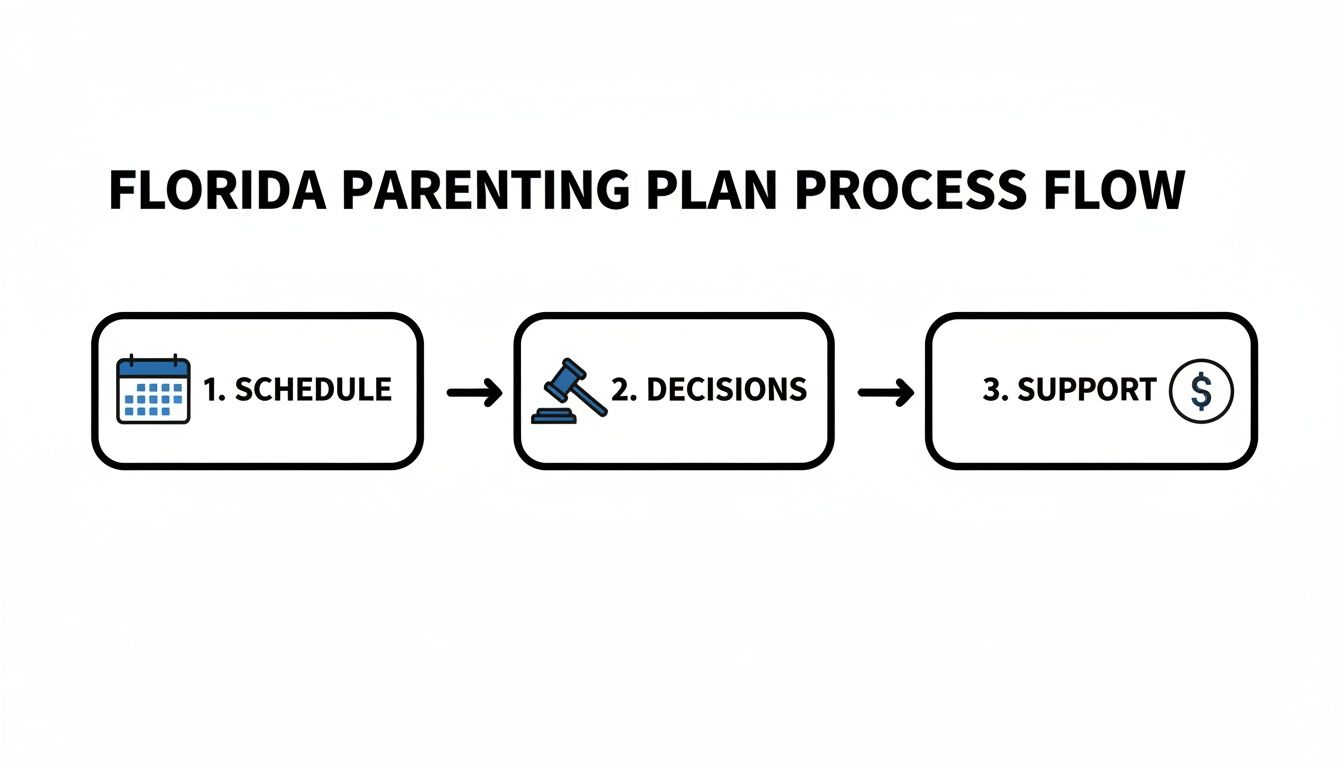
This process isn't just about checking boxes; it’s about creating a clear, legally enforceable roadmap for your children's lives that can prevent a world of conflict down the road.
The Final Hearing And Judgment
Once all your documents are filed and service is complete, you're in the home stretch. Depending on your specific circumstances and the judge assigned to your case, you might need to show up for a brief final hearing. If you filed for a Simplified Dissolution, both of you must attend.
For a Regular Uncontested Dissolution, sometimes the judge will finalize the divorce based on the paperwork alone, no hearing required. If a hearing is needed, it’s usually incredibly quick. The judge will ask a few simple questions to confirm you meet the residency requirement, that your marriage is irretrievably broken, and that you both signed the agreements freely and voluntarily.
The final hearing isn't a trial. In an uncontested case, it's just a formality. The judge's job is to confirm the basic facts and enter the Final Judgment of Dissolution of Marriage—the court order that officially ends your marriage.
Avoiding Common Procedural Mistakes
I see it all the time: people handling their own divorce get tripped up by small procedural errors that bring their case to a screeching halt. Staying organized and double-checking everything is the key to avoiding these common pitfalls.
A few frequent mistakes to watch out for:
- Using outdated forms: Court forms get updated. Always, always download the latest versions directly from the Florida Courts website before you start.
- Incomplete or missing documents: Make sure every required document, like the Financial Affidavit or Child Support Guidelines Worksheet, is filled out completely and filed with your petition.
- Incorrect filing location: You have to file in the proper county circuit court. Filing in the wrong county will get your case dismissed, and you'll have to start over.
These administrative steps can feel tedious, but getting them right is what makes for a smooth process. Our firm, which proudly serves all families, including the LGBTQ community, knows how frustrating these details can be. If you hit a procedural wall you just can't get over, it might be the perfect time to get a little bit of targeted help.
After the judge signs that final order, the next chapter begins. Securing your financial future is paramount. For a comprehensive guide on what to do next, check out resources on rebuilding finances after divorce to help you get started on solid ground.
When A DIY Divorce Is Not The Answer
The promise of a DIY divorce is hard to ignore—it seems faster, cheaper, and a lot less painful. And for some couples, it absolutely is the right path. But this approach is far from a one-size-fits-all solution.
Frankly, for many people, trying to handle a divorce without a lawyer can backfire spectacularly, leaving them exposed legally and in a financial hole for years to come. Knowing the red flags that signal you need professional help is the single most important thing you can do to protect yourself.
The whole idea of a DIY divorce is built on a foundation of trust, transparency, and a relatively even playing field. If any of those pieces are missing, the entire thing can come crashing down.
Red Flags In The Relationship
Some relationship dynamics make a fair DIY divorce next to impossible. The process demands that both people can negotiate calmly and honestly. When there's a serious power imbalance, one person is almost guaranteed to get taken advantage of.
You need to pump the brakes on a DIY divorce if your situation involves any of these issues:
- A history of domestic violence or intimidation. If you feel scared, pressured, or can't speak freely, you simply cannot negotiate a fair agreement on your own. Your safety comes first, and your legal rights are paramount.
- Substance abuse or significant mental health issues. If one spouse’s judgment is clouded by addiction or a serious mental illness, they might not be capable of making sound, long-term decisions or negotiating in good faith.
- A controlling or manipulative spouse. When one person has always controlled the money, isolated the other from friends and family, or made all the big decisions, a DIY negotiation will probably just be a continuation of that toxic pattern.
These situations create a severe power imbalance that the formal legal process is specifically designed to correct. An attorney serves as a critical buffer, making sure your voice is heard and your rights are protected from coercion or manipulation. At Foley Family Law, we're dedicated to creating a safe and supportive space for everyone, including clients in the LGBTQ community, ensuring every person can navigate their divorce with dignity.
Complex Financial Situations
Even for couples who are on great terms, some financial situations are just too tangled to handle without professional help. The risk of making a mistake that costs you dearly down the road is just too high. If you need to divide complicated assets, a DIY divorce is probably not your best bet.
Think of a complex financial portfolio like a delicate piece of machinery. You wouldn't try to fix a high-performance engine with a basic wrench. Similarly, dividing intricate assets requires specialized legal and financial knowledge to avoid serious, long-term consequences.
Here are a few financial scenarios that almost always need a lawyer:
- You own a family business. Putting a value on a business, figuring out how much of it is marital property, and dividing it without killing the company is an incredibly specialized task.
- One or both of you have significant retirement assets. Dividing things like military pensions, 401(k)s, or other retirement accounts requires a specific court order called a QDRO (Qualified Domestic Relations Order). If you mess this up, you could trigger massive tax penalties.
- You suspect there are hidden assets. If you think your spouse is hiding money, property, or income, you'll need a lawyer to conduct formal discovery—like issuing subpoenas—to uncover the truth. You can't do this on your own.
- High net worth or extensive real estate holdings. The more assets in the picture, the more complicated the tax implications and division strategies become.
When You Need A Different Kind Of Help
Realizing you can't go it alone doesn't automatically mean you're headed for a full-blown, wallet-draining court battle. The legal world has evolved, and there are flexible options that give you the support you need without the cost of traditional, full-scope representation. For many folks in Pasco, Pinellas, and Hillsborough Counties, these alternatives are the perfect middle ground.
Consider these options:
- Mediation: A neutral, third-party mediator helps you and your spouse talk through the issues and negotiate the terms of your agreement. The mediator doesn't represent either of you; their job is to facilitate a productive conversation so you can find common ground.
- Limited-Scope Representation: Sometimes called "unbundled services," this lets you hire an attorney for specific, clearly defined tasks. For instance, you could hire a lawyer just to draft your Marital Settlement Agreement, review documents you’ve already prepared, or coach you through the negotiation process.
These approaches give you access to critical legal expertise right where you need it most. It's a safety net that still leaves you in control of the process and the budget. If you're feeling stuck, knowing how to choose a divorce lawyer who offers these kinds of flexible services can make all the difference in reaching a fair and final resolution.
Answering Your Questions About DIY Divorce
Going it alone on your divorce is a big decision, and it’s totally normal to have a lot of questions pop up. We hear from people all the time in Pasco, Pinellas, and Hillsborough Counties who are trying to figure out if they can really handle their divorce without a lawyer.
Here are answers to some of the most common questions we get.
How Long Does An Uncontested Divorce Take In Florida?
For a truly uncontested divorce, you're generally looking at a timeline of one to three months from the day you file to the day the judge signs the final judgment. It's a surprisingly quick process when things go smoothly.
The biggest variables are your local court's docket—how busy the judges are—and how quickly and accurately you and your spouse get all the paperwork filled out and filed.
The single biggest factor in how fast your divorce moves is you. If you walk into the courthouse with every agreement finalized and every form filled out perfectly, you're already way ahead of the game and can avoid unnecessary delays.
Do I Have To Go To Court For An Uncontested Divorce?
Maybe. It really depends on the specific path you take.
If your situation is simple enough to qualify for Florida's Simplified Dissolution of Marriage, then yes, you and your spouse will almost certainly have to show up for a very brief final hearing together.
For a Regular Uncontested Dissolution—which is what most people use—it's possible the judge will waive the final hearing. This is never guaranteed. It depends entirely on the county, the judge assigned to your case, and their specific procedures, so it’s always smart to check the local court rules.
What If We Agree On Everything But Child Support?
This is a huge one, and it trips a lot of people up. If you and your spouse can't agree on a child support amount that lines up with the official Florida Child Support Guidelines, your divorce is legally 'contested' on that issue. End of story.
The court has the final say on child support because it’s seen as a fundamental right of the child, not a negotiating tool for parents. You can't just agree to waive it if the guidelines show that one parent should be paying.
A disagreement here is a bright red flag that you need to talk to a lawyer. You have to get this part right to protect your kids and make sure your final agreement is even legally valid. Our firm is proud to be inclusive and we regularly handle all LGBTQ family law matters, including complex gay custody and support issues, with the experience and sensitivity they demand.
Even the most straightforward DIY divorce can hit a snag. If you've run into a problem you can't solve or just want an experienced attorney to look over your paperwork before you file, Foley Family Law can help. We offer focused legal services designed to protect you and get your divorce finalized correctly. Reach out today for a consultation at https://wfoleylaw.com.


