

Figuring out child support in Florida isn't just pulling a number out of thin air. The state uses a specific formula called the Income Shares Model. The whole point is to make sure children get the same level of financial support they would have if their parents were still together. It all starts with digging into the financials to figure out each parent's net income, which then gets plugged into the state's guidelines.
Your First Steps In Florida Child Support

The path to a fair child support arrangement begins long before you step into a courtroom. It starts with preparation. Before any numbers get crunched, both parents have to lay their financial cards on the table, clearly and honestly. This isn't optional; it's a mandatory part of the legal process in Florida.
The court's primary goal is always to create an order that serves the child's best interests. To get there, it uses a standardized approach that takes most of the guesswork out of the equation. This methodical process ensures the calculations are consistent for families across Pasco, Pinellas, and Hillsborough Counties.
Gathering Your Essential Financial Documents
The first real, actionable step is to collect all your financial paperwork. Getting this right from the start is absolutely crucial because these documents are the foundation for the entire calculation. If information is missing or wrong, you're looking at delays or, worse, an inaccurate support amount.
You'll need to pull together a comprehensive file that includes things like:
- Proof of Income: Think recent pay stubs, W-2s, 1099s, and at least the last two years of your federal tax returns.
- Business Records: If you're self-employed, you'll need profit and loss statements and other key business financial records.
- Expense Verification: Get your receipts and statements for any child-related costs you pay directly, like health insurance premiums and any daycare or after-school care costs needed for you to work.
At our firm, we constantly stress that transparency is non-negotiable. Trying to hide income or inflate your expenses almost always backfires. It can completely destroy your credibility with the judge. It’s always, always better to be upfront and accurate from day one.
The Importance of Paternity
For parents who were never married, there’s a critical preliminary step: legally establishing paternity. A court can't order child support until it legally recognizes the child's father. This is a separate legal process from the support calculation, but it has to be done first. You can learn more about how to establish paternity and why it’s a necessary hurdle to clear before support can be determined.
Our firm is committed to helping all families with these foundational steps. We proudly handle divorce and custody matters for the LGBTQ community, making sure every parent's rights and responsibilities are clearly defined and protected under Florida law. We believe every family deserves a fair start.
Defining and Calculating Each Parent's Income
The entire child support calculation in Florida hinges on one thing: getting an accurate picture of each parent’s monthly income. This isn't just about looking at a base salary on a pay stub. To get it right, Florida law demands a full financial deep-dive to make sure the final support number is fair and reflects what each parent can truly contribute.
For the families we work with in Pasco, Pinellas, and Hillsborough Counties, we can't stress this enough: nailing down the income numbers from the very start is the key to a stable and equitable child support order.
Gross Income vs. Net Income: What’s the Difference?
First things first, we need to understand the two key terms here: gross income and net income.
Gross income is the big number—it's pretty much all the money you earn or receive from every possible source before a single thing is taken out. Think of it as your total compensation package, not just your paycheck.
Net income, on the other hand, is the number we actually plug into the child support formula. You get to this figure by taking the gross income and subtracting a very specific, limited list of legally allowed deductions.
What Florida Counts as Gross Income
When it comes to defining gross income, Florida courts cast a very wide net. The goal is to capture every potential source of funds that could be used to support a child. This prevents one parent from shouldering an unfair burden while the other has access to resources that weren't counted.
Common sources that get factored into gross income include:
- Wages, salaries, overtime pay, and tips
- Bonuses, commissions, and allowances
- Business income (if you're self-employed, a partner, or own a corporation)
- Disability or Social Security benefits
- Workers' compensation and unemployment benefits
- Pension, retirement, or annuity payments
- Spousal support (alimony) received from a previous marriage
- Interest, dividends, and any rental income
It doesn't stop there. Even things like reimbursed expenses or in-kind payments that lower your living costs—like a company car or a housing allowance—can be counted. If it’s a financial benefit to the parent, the court will probably want to include it.
From Gross to Net: The Allowable Deductions
Once we have a solid gross income figure for each parent, the next step is to calculate their net income. This is where we subtract certain expenses, but it’s absolutely critical to know that you can't just deduct all your monthly bills.
Florida law is extremely specific about what you can and can't subtract. Things like your car payment, mortgage, or grocery budget don't count. The only deductions allowed are for mandatory, non-discretionary financial obligations.
The biggest mistake we see parents make is confusing their personal budget with legally allowed deductions. The court isn't looking at your discretionary spending; it's focused on non-negotiable costs like taxes and other required payments that reduce the actual cash you have available each month.
The deductions allowed by Florida law are very specific. They are designed to account for mandatory payments that reduce your available income. These typically include:
- Federal, state, and local income taxes
- Social Security and Medicare taxes (FICA)
- Mandatory retirement contributions
- Mandatory union dues
- Health insurance premiums (for the parent & child)
- Court-ordered child support for other children
- Court-ordered spousal support (alimony)
As you can see, the list of deductions is much shorter than the list of income sources. This is by design to ensure the calculation is based on the maximum available income.
Figuring all this out can get complicated, fast. This is especially true in cases involving high assets or a self-employed parent where income isn't always straightforward. Knowing what financial information to ask for—and how to ask for it—is vital. To learn more about how financial information is formally exchanged in a Florida case, you can read our guide on discovery for divorce.
Applying The Florida Child Support Guidelines
Once you've nailed down each parent's net monthly income, it's time to plug those numbers into Florida's Child Support Guidelines. This is the core of the entire calculation. Think of the Guidelines as the state's official framework for turning two separate incomes into one shared financial responsibility for the children. Its purpose is to create a consistent and predictable starting point for every family.
The process is pretty straightforward at this stage. You’ll combine both parents' net incomes and then find that total on a schedule issued by the state, cross-referencing it with the number of children you have. This gives you the basic monthly obligation—the baseline amount Florida presumes is needed to cover the kids' essential needs each month. From there, we'll figure out how that responsibility gets divided.
Finding the Basic Obligation
The Florida Child Support Guidelines operate on specific financial inputs and formulas, almost like a profit margin calculation formula helps a business understand its true earnings. For parents here in Pasco, Pinellas, and Hillsborough Counties, getting this part right is the key to understanding what a fair outcome will look like.
Let’s walk through a common scenario to see how it works in practice.
Example Calculation
- Parent A's Net Monthly Income: $3,500
- Parent B's Net Monthly Income: $2,500
- Number of Children: Two
First, we combine their incomes: $3,500 + $2,500 = $6,000 in combined net monthly income.
Next, we consult the official Florida Child Support Guidelines schedule for a combined income of $6,000 and two children. According to the chart, the basic monthly obligation is $1,737. This is our starting figure before we factor in any other adjustments.
Calculating Each Parent's Percentage Share
With the basic obligation identified, the next job is to determine what percentage of that amount each parent is responsible for. This is how the system ensures the financial load is shared proportionally, based on each parent's ability to earn.
The math is simple: just divide each parent's individual net income by the combined net income.
- Parent A's Share: $3,500 / $6,000 = 58.3%
- Parent B's Share: $2,500 / $6,000 = 41.7%
So, Parent A is presumptively responsible for 58.3% of the $1,737 basic obligation, while Parent B is responsible for 41.7%. These percentages are the foundation for the final support payment, though they will be adjusted later for timesharing and other direct expenses like health insurance and daycare.
It's worth noting that Florida law has a built-in safeguard to prevent an order from creating true financial hardship. A court may adjust an obligation to avoid imposing an unreasonable financial burden on a parent.
Moving from raw financial data to a final net income figure is a critical first step. This flowchart breaks down that essential path from gross income to the final number used in the guidelines.
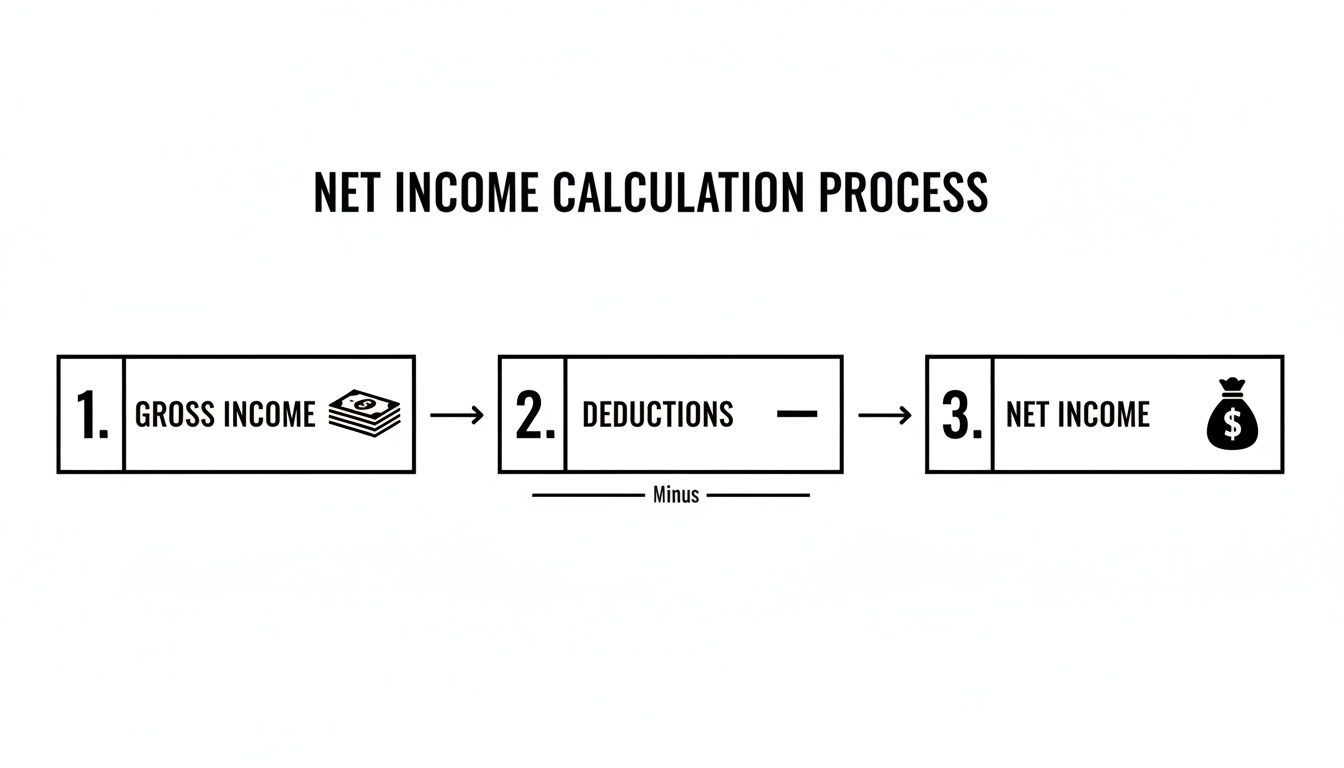
As you can see, it's a simple but vital calculation: start with all sources of gross income, subtract only the legally allowed deductions, and you'll arrive at the net income figure that drives the rest of the child support determination.
What if Your Income Is Off the Chart?
The Guidelines schedule provides exact dollar amounts for combined incomes up to a certain amount per month. But plenty of families fall outside that range. So what happens then?
- For High-Income Parents: When the combined monthly net income goes over the guidelines chart maximum, the law provides a specific percentage-based formula to calculate the additional support obligation on the excess amount.
- For Low-Income Parents: If a parent's income is below the chart's minimum, the court has the discretion to set an amount based on the unique circumstances of the case and what the parent can realistically afford to pay.
No matter the income level, the goal is a fair and legally correct calculation. If you want to run your own numbers to get a preliminary idea, our online Florida child support calculator can give you a helpful estimate.
How Timesharing And Expenses Adjust The Final Amount

That number you get from the Florida Child Support Guidelines chart? It’s not the final answer. Think of it as the starting point. The actual check one parent writes to the other is almost always different, thanks to two major factors: the timesharing schedule and who pays for big-ticket expenses like health insurance and daycare.
For parents in Pasco, Pinellas, and Hillsborough Counties, this is where the abstract numbers on a worksheet collide with the daily reality of co-parenting. It’s the part of the calculation that recognizes both parents contribute in ways that go far beyond a monthly payment.
The Impact Of Substantial Timesharing
Florida law gets one thing right: when a parent spends more time with their child, they’re also spending more money directly on that child. This common-sense idea is baked right into the formula through an adjustment for substantial timesharing.
This isn't just a small tweak; it fundamentally changes the math. To even qualify for this adjustment, a parent must have the child for at least 20% of the overnights in a year. That works out to 73 overnights.
Once you hit that 73-night threshold, the standard calculation is out the window. The court shifts to a more complex formula that accounts for the fact that you’re already covering a big chunk of the child’s daily costs—food, utilities, housing, you name it—out of your own pocket during your time.
The substantial timesharing adjustment is one of the most significant factors in the final child support calculation. Hitting that 20% mark can drastically reduce a parent's child support obligation because the formula presumes you are already spending more on the child directly during your time.
When parents have substantial timesharing, the guidelines use a different calculation method to account for duplicated costs. This adjustment recognizes that having two homes for a child is more expensive. For anyone navigating this, understanding the nuances of the Florida timesharing statute is essential for protecting your rights.
How The Formula Shifts With Timesharing
Let’s walk through a quick scenario to see how this plays out.
Say the basic child support obligation, pulled straight from the guidelines chart, is $1,000. If Parent B has the kids for fewer than 73 nights a year, they are probably going to pay an amount very close to their percentage share of that $1,000. Simple enough.
But what if Parent B has the children for 100 nights per year (around 27% of the time)? Now, the substantial timesharing formula kicks in. The base obligation is adjusted to cover the costs both parents incur (like maintaining a bedroom and supplies at each house). Then, each parent's share is calculated based on their percentage of overnights. The end result is almost always a lower child support payment for Parent B.
Factoring In Health Insurance And Childcare Costs
Beyond overnight schedules, the formula also adjusts for specific, major expenses that one parent typically pays directly. The big two are health insurance premiums and work-related childcare costs.
These aren't treated like deductions from your gross income. Instead, these amounts are added directly to the basic child support obligation, which ensures both parents contribute to these necessary expenses in proportion to their incomes.
Here’s the breakdown of how it works:
- Tally the Monthly Costs: First, you figure out the monthly cost for only the child’s portion of the health and dental insurance premium. Then, add the total monthly cost of any necessary daycare or after-school care.
- Add to the Basic Obligation: This total gets tacked onto the basic support amount. For example, if the base obligation is $1,000, health insurance is $200, and daycare is $500, the new total obligation balloons to $1,700.
- Credit the Paying Parent: Each parent’s percentage share is applied to this new, higher total. But here’s the key part: the parent who actually pays the insurance or childcare bill gets that full amount credited back to them in the final calculation.
This process makes sure that the parent covering these large, upfront costs isn't unfairly burdened. It properly splits these essential expenses between both parents, leading to a more equitable and accurate final child support order.
When Courts Can Deviate From The Guidelines
While the Florida Child Support Guidelines provide a predictable and consistent formula, they aren't set in stone. The final number spit out by the worksheet is considered "presumptively correct," but Florida law recognizes that no two families are exactly alike. Sometimes, sticking to that calculated amount would be flat-out unfair or simply wouldn't meet a child's unique needs.
In these specific situations, a judge has the discretion to deviate from the guideline amount. This isn't something done on a whim, though. A court can only order a support amount that is more than five percent above or below the guideline calculation if it provides a written finding, explaining exactly why the standard formula would be unjust or inappropriate for that particular family.
Justifiable Reasons For A Deviation
Judges in Pasco, Pinellas, and Hillsborough Counties need compelling evidence to justify going off-script. The reason has to be significant enough to show that the standard calculation doesn't serve the child's best interests. It’s all about making sure the final order truly reflects the family's reality.
Some of the most common grounds for a court to consider a deviation include:
- Extraordinary Expenses: This is a big one. These are costs that go far beyond typical day-to-day expenses but are necessary for the child's well-being.
- A Child's Age: Let's face it, the needs of a teenager are often far more expensive than those of a toddler. A court might consider this, especially when it involves significant costs for things like extracurricular activities or educational needs.
- Unique Family Dynamics: The court can look at the entire financial picture, including the standard of living during the marriage and the specific circumstances of each parent and child.
- Special Needs of the Child: This is a critical area where deviations are often essential to make sure a child gets the proper care and support they require.
A deviation from the guidelines is an exception, not the rule. The parent asking for the change has the burden of proving that a different amount is not only justified but necessary to achieve an equitable result for the child.
Spotlight On Special And Medical Needs
One of the clearest justifications for deviating from the guidelines involves a child with special needs. This could mean physical, emotional, or developmental challenges that require significant financial resources—the kind not factored into the basic calculation.
For instance, a child with a chronic illness might need:
- Costly medical treatments that aren't fully covered by insurance.
- Specialized therapeutic equipment like wheelchairs, hearing aids, or communication devices.
- Ongoing therapies such as physical, occupational, or speech therapy.
Similarly, a child with unique educational requirements, like needing to attend a specialized private school for a learning disability, could absolutely warrant an upward deviation. The court will look at whether these expenses are both reasonable and necessary for the child's development. If you're asking a judge to order a higher amount, presenting clear, documented proof of these costs is absolutely essential.
The Role Of A Written Agreement
Parents can also agree to a child support amount that differs from the guidelines. If both parties come to a mutual agreement and present it to the court as part of their settlement or parenting plan, a judge will often sign off on it. The key is that the agreement must be in the child's best interest and wasn't reached under pressure or duress.
Understanding when and how to argue for a deviation is complex, and it’s a critical part of ensuring the final support order is fair. If your family's circumstances have changed significantly since your order was put in place, it might be time to learn more about how to modify child support to better reflect your child's current needs.
Turning Your Calculation into a Court Order
So you've worked through the Florida Child Support Guidelines and have a final number. That's a huge step, but the process isn't quite finished. On its own, that number on your worksheet is just a calculation—it has no legal authority.
To make it a real, enforceable obligation, you have to get it formalized in a court order. This is the final and most important move in securing your child's financial support.
This final figure gets incorporated into a Marital Settlement Agreement if you and the other parent can reach a deal. If you can't agree, a judge will decide the amount and include it in a Final Judgment. Once you have the numbers locked in, you’ll need to understand the right way of filing court documents to make it all official. This is what transforms a simple worksheet into a legally binding duty.
What Happens When Life Changes? Modifying a Child Support Order
Life is anything but static, and financial situations can shift dramatically over time. An order that seems perfectly fair today might be completely out of balance a few years from now. Florida law gets this, which is why parents can ask a court to modify child support when circumstances change significantly.
But this isn't about small ups and downs in income. To get a modification, the change has to be substantial, permanent, and involuntary. That legal standard is there for a reason—it prevents a constant back-and-forth to court over minor life events.
Some of the most common reasons a modification gets approved include:
- A parent loses their job or takes a major pay cut through no fault of their own.
- One parent gets a significant promotion or a substantial, long-term raise.
- The timesharing schedule changes in a big way, with one parent now having the kids for a lot more or fewer overnights.
- A child’s needs change drastically, maybe due to a new medical condition requiring expensive, ongoing care.
A child support order is a living document, not something set in stone. As your family's needs evolve, the order should be able to evolve with them to ensure it remains fair and continues to serve the child's best interests.
Our firm is committed to helping all families, including LGBTQ+ parents, navigate these complex legal steps in Pasco, Pinellas, and Hillsborough Counties. Whether you are finalizing an initial order or preparing for a future modification, we provide the guidance needed to ensure the outcome is accurate, fair, and legally sound for everyone involved.
Common Questions About Florida Child Support
We get a lot of questions from clients in Pasco, Pinellas, and Hillsborough Counties about the specifics of child support. Here are some of the most common scenarios we see and how Florida law typically handles them.
What if a Parent Quits Their Job or Is Hiding Income?
This comes up more often than you'd think. If a parent is intentionally unemployed or taking a lower-paying job just to dodge their support obligation, a Florida court can step in and impute income.
What does that mean? A judge will calculate child support based on what that parent should be earning. They’ll look at things like their recent work history, their skills and qualifications, and the job opportunities available in the local area. It’s a way to ensure the kids don’t suffer because a parent is trying to game the system.
When we suspect a parent is hiding income—maybe they're getting paid in cash or not reporting all their earnings—we have legal tools to get to the truth. We can issue subpoenas for bank records or conduct depositions to uncover their actual financial picture and make sure the calculation is fair.
Will My New Spouse's Income Affect Child Support?
The short answer is no. In Florida, a new spouse's income is not directly included when calculating child support. The legal duty to provide for a child falls squarely on the child's parents, not a stepparent.
However, it can sometimes come into play indirectly. If a parent argues they can't afford the guideline support amount, a judge might look at their overall household financial situation. If their new spouse is contributing significantly to household bills (like the mortgage and utilities), it frees up more of that parent's own income, which the court can then consider available for child support.
While a new spouse’s salary isn’t on the worksheet, their financial impact on a parent's household budget can sometimes be part of the larger conversation in court.
How Long Does Child Support Last in Florida?
In most cases, the obligation to pay child support in Florida ends when a child turns 18 years old.
But there are a couple of key exceptions:
- If your child turns 18 but is still in high school and on track to graduate, support continues until they get their diploma, as long as that happens before they turn 19.
- For a child with a qualifying disability that began before they turned 18, support can be extended indefinitely to ensure their needs are met.
Is the Process Different for Unmarried Parents?
Not at all. The marital status of the parents has no bearing on how child support is calculated. The process is exactly the same for everyone in Florida.
Once paternity has been legally established (either through a signed acknowledgment or a court order), both parents have a legal responsibility to support their child. The court will use the same Income Shares Model and the official Florida Child Support Guidelines to figure out the final amount, whether the parents were ever married or not.
Understanding the nuances of child support is essential for protecting your child's future. If you are facing a child support issue in Pasco, Pinellas, or Hillsborough County, contact Foley Family Law for a consultation to discuss your specific situation. https://wfoleylaw.com


