

When you're facing a divorce in Florida, the thought of paying alimony can be a major source of stress. The best ways to avoid it are almost always proactive: a solid prenuptial or postnuptial agreement that waives spousal support, or a creative settlement where your spouse takes a larger piece of the marital assets in exchange for forgoing ongoing payments.
But if those cards aren't on the table, it's time to build a case. Your focus will need to shift to proving one of two things in court: your spouse either doesn't have a true financial need, or they have the clear ability to support themselves. Our firm is proud to serve clients in Pasco, Pinellas, and Hillsborough Counties, handling all family and divorce matters, including for the LGBTQ+ community, with a commitment to non-discrimination and equality.
Understanding Your Alimony Risk In Florida

So, will alimony be a factor in your divorce? That's the million-dollar question. The answer really depends on how a judge in Pasco, Pinellas, or Hillsborough County looks at the specific facts of your marriage. Getting a realistic grasp of your potential exposure is the first, and most critical, step in defending against a future alimony obligation.
Florida law has changed recently, and permanent alimony is off the table. However, several other types of alimony are still very much in play. Understanding what they are, what they're for, and how long they last is key to seeing the situation clearly.
The Core Factors in an Alimony Case
Before a judge even considers awarding alimony, two fundamental questions must be answered: Does one spouse have a real financial need? And does the other spouse have the ability to pay?
These two factors are the gatekeepers. If the answer to both is "yes," the court then dives deeper into the specifics of your marriage to figure out the right type and amount of support.
Here’s what they'll be looking at:
- The Length of Your Marriage: This is a big one. Florida law classifies marriages into different durational categories. How long you were married has a direct impact on how long alimony could last.
- Each Spouse's Financial Standing: This is a full financial deep-dive—income, assets, debts, and what each person is capable of earning.
- The Standard of Living: The court considers the lifestyle you both established during the marriage. Of course, everyone acknowledges that it’s nearly impossible to maintain that same standard across two separate households.
- Contributions to the Marriage: This isn't just about who earned the paycheck. Being a stay-at-home parent, supporting a spouse's education, or managing the household are all considered valuable, non-financial contributions.
This legal framework is applied consistently to all marriages, including those in the LGBTQ+ community. Our firm is committed to providing expert, non-discriminatory guidance on all family and divorce matters for clients in Pasco, Pinellas, and Hillsborough Counties.
Types of Alimony You Might Face
Recent legislative updates have simplified the types of spousal support available in Florida. Knowing them helps you pinpoint your potential vulnerabilities.
Here are the main forms of alimony you could encounter:
- Temporary Alimony: Paid only while the divorce case is ongoing.
- Bridge-the-Gap Alimony: Short-term help meant to cover specific, identifiable needs as a spouse transitions to being single.
- Rehabilitative Alimony: Support provided for a limited time to help a spouse get the education or skills needed to find a job.
- Durational Alimony: Payments for a set period of time, which cannot be longer than a certain percentage of the marriage's length.
It’s a common myth that if a spouse cheats, they can't get alimony. While marital misconduct can be a factor—especially if marital money was wasted on an affair—the court’s main focus will always circle back to financial need and the ability to pay.
By measuring your marriage against these legal factors, you can start to get a clear picture of your alimony risk. A skilled attorney can provide a detailed analysis based on your specific circumstances. This initial assessment is the bedrock of any strategy designed to minimize or avoid alimony entirely.
Proactive Financial Planning With Marital Agreements
Without a doubt, the most effective way to control, limit, or even completely sidestep alimony in Florida is to deal with it long before it becomes a fight in a divorce. Marital agreements—prenuptial and postnuptial agreements—are incredibly powerful legal tools. They allow you and your partner to decide your financial future on your own terms, instead of leaving it in the hands of a judge.
These agreements aren't about planning for failure. They're about creating certainty and a mutual understanding while you're still a team. By mapping out how assets, debts, and potential spousal support will be handled, you remove one of the biggest potential sources of conflict if the marriage ever ends. It's a proactive approach we regularly use for clients across Pasco, Pinellas, and Hillsborough Counties.
The Power of a Prenuptial Agreement
A prenuptial agreement is a contract you both sign before the marriage. It's especially valuable for anyone walking into a marriage with significant assets, a business, or children from a previous relationship.
Imagine a small business owner in Tampa getting ready to marry. A properly drafted prenup can lock down their business—including its future growth—as their separate property, shielding it from alimony claims down the road. This isn't about being unromantic; it's about providing the peace of mind to focus on the marriage without a lingering fear of financial ruin.
For a prenup to hold up in a Florida court, it has to meet some very strict requirements:
- It must be in writing and signed by both of you.
- There must be full and fair financial disclosure from both sides. No hiding the ball.
- The agreement has to be signed voluntarily, free of any fraud, duress, or coercion.
When to Consider a Postnuptial Agreement
What if you’re already married? You haven't missed your chance. A postnuptial agreement accomplishes the same goals as a prenup, just after the wedding. Couples often turn to these when there’s a major shift in their financial picture, like one spouse starting a business, getting a large inheritance, or leaving their career to raise children.
A postnup can recalibrate your financial expectations and build in security for both spouses moving forward. To get a better sense of how they work and whether one makes sense for you, take a look at our detailed guide on postnuptial agreements in Florida. These documents are held to the same high standards of validity as prenups, meaning transparency and voluntary consent are non-negotiable.
A common myth is that asking for a marital agreement shows a lack of trust. In my experience, it’s the opposite. It shows a real commitment to open communication about finances—a topic that causes immense stress in many marriages. It's about setting clear, respectful boundaries together.
Florida's recent alimony reforms have brought some much-needed predictability, but they don't give you the ironclad control that a private contract does. The new laws might create ways to reduce or end alimony based on things like retirement, but those are all reactive measures. The statutes set limits on how long alimony can last and require a huge change in circumstances to modify an award, whereas a marital agreement lets you write your own rules from day one.
Ultimately, both prenuptial and postnuptial agreements demand precision and careful drafting. If you're considering signing digitally, it’s also critical to be aware of state-specific electronic signature laws to ensure your agreement is fully compliant with Florida regulations. A little foresight here goes a long way in making sure your financial plan is secure, giving you a clear roadmap for the future, no matter what it holds.
Negotiating A Divorce Settlement Without Alimony
If you didn’t sign a prenup or postnup, the divorce negotiation table is your next—and best—chance to avoid or minimize long-term alimony. This is where creative, practical strategies come into play, helping you find a path to financial finality so you can move forward with a clean slate. The goal is to craft a settlement that both parties can live with, without ever having to see the inside of a courtroom.
For many people across Pasco, Pinellas, and Hillsborough Counties, a well-structured settlement is a far better outcome than the stress, cost, and uncertainty of a court battle. By understanding your options, you can guide the negotiation toward a result that sidesteps ongoing spousal support.
The Lump-Sum Buyout Strategy
One of the cleanest ways to resolve an alimony claim is the lump-sum buyout. Instead of being tied to years of monthly checks, you make a single, larger payment to your spouse when the divorce is finalized. That’s it. This one payment permanently settles any and all future claims for spousal support.
This approach offers real benefits for everyone involved. For the paying spouse, it delivers absolute certainty—no future obligations, no risk of a modification request down the line, and no lingering financial ties. For the receiving spouse, it provides immediate capital to buy a house, start a business, or simply begin their next chapter without relying on a former partner’s monthly payments.
Trading Assets for Financial Freedom
Another powerful tactic is to negotiate an unequal distribution of marital assets. In this scenario, the spouse who might otherwise get alimony agrees to take a larger slice of the marital property pie instead.
For example, your spouse might receive all the equity in the marital home, a bigger share of a retirement account, or ownership of an investment portfolio. This kind of trade-off is often very appealing, as it gives the receiving spouse a substantial, tangible asset they control completely. It effectively converts a potential stream of future income into a secure, upfront financial foundation.
This visual highlights how proactive agreements, whether made before or during the marriage, can be used to structure these kinds of financial outcomes.
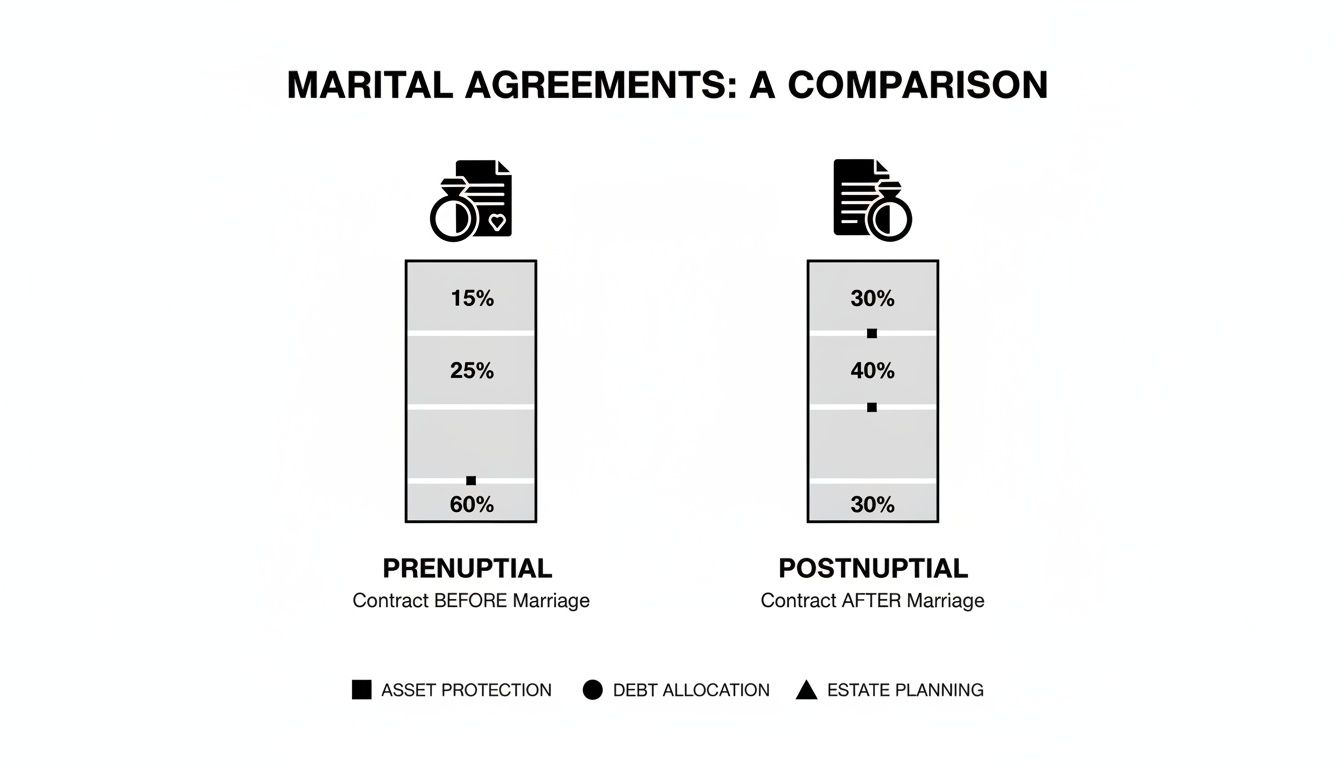
As you can see, both prenuptial and postnuptial agreements are foundational tools for dictating financial terms, including alimony waivers, long before a settlement negotiation even begins.
Using Florida's Alimony Laws as Leverage
Even when you're negotiating, Florida’s alimony laws provide a critical backdrop. Recent changes to the law have created clear, predictable limits on both the amount and duration of alimony, and you can use these limits as powerful leverage.
By calculating your potential "worst-case scenario" under the current law, you can present a buyout or asset-trade offer that is not only fair but also financially attractive compared to what a court might award.
Florida’s recent legal reforms significantly reined in durational alimony and established general guidelines and caps on the amount. These hard numbers allow you to model potential outcomes and craft a settlement offer that is compelling and firmly grounded in legal reality.
When you're working through settlement options, it's also critical to understand how major life changes like divorce impact your taxes. A lump-sum payment has very different tax implications than divided assets, and planning for this from the start is essential.
Successfully negotiating an alimony-free settlement often happens in mediation or through a collaborative divorce process, which is specifically designed to be less adversarial. You can learn more by reading about a https://wfoleylaw.com/collaborative-divorce-a-less-contentious-path-for-tampa-families/. By presenting a fair, well-reasoned offer, you can reach an agreement that provides a clean break and protects your financial future.
Building Your Case to Contest an Alimony Award

Sometimes, no matter how reasonable you are, a negotiated settlement just isn't in the cards. When that happens, you have to be ready to stand your ground and fight an alimony claim in court. This is a big shift in strategy—you’re moving from trying to find middle ground to methodically dismantling the legal basis for your spouse's alimony request.
The focus turns to building a strong, evidence-based case. It’s no longer about compromise; it's about arguing your position before a judge with hard facts and persuasive legal reasoning. For folks here in Pasco, Pinellas, and Hillsborough Counties, this is where having a seasoned legal team becomes non-negotiable. Our job is to tell a clear, compelling story that shows the court why alimony just isn't appropriate in your specific situation.
Proving Self-Sufficiency and Earning Capacity
One of the most effective ways to challenge an alimony claim is to prove your spouse is perfectly capable of supporting themselves. A judge needs to see more than just your opinion; they need to see cold, hard proof. This means taking a deep dive into your spouse's background to paint a realistic picture of their earning potential.
To do this right, you need to gather specific evidence demonstrating their ability to land a good job. This often includes:
- Educational Background: Diplomas, degrees, professional licenses, and any certifications or specialized training they’ve completed.
- Work History: A detailed resume that outlines past job titles, salaries, and key responsibilities.
- Transferable Skills: Identifying valuable skills they have—like project management, sales, or software proficiency—that are in demand, even if they've been out of the workforce for a while.
In many cases, the most powerful tool we have is a vocational expert. This is a professional we hire to evaluate your spouse's skills and the local job market. They can provide expert testimony on what jobs are available and the income your spouse could reasonably earn. That expert opinion can completely reframe the case, shifting the judge’s focus from your spouse’s claimed "need" to their actual ability to meet that need on their own.
Scrutinizing the Financial Affidavit
Every alimony case lives and dies by the Financial Affidavit. This is a sworn document where each spouse details their income, expenses, assets, and debts. Your spouse's affidavit is the entire foundation for their claim of need, which makes it ground zero for our analysis. Our job is to poke holes in it—to challenge their stated expenses and show that their "need" is either inflated or based on a lifestyle the marriage couldn't sustain.
When we review a financial affidavit, we're not just checking the math. We are cross-referencing every line item with bank statements, credit card bills, and other financial records to find discrepancies, exaggerated costs, or expenses that simply don't reflect the marital standard of living.
For instance, a spouse might claim sky-high monthly costs for things like vacations, designer clothes, or expensive hobbies. If we can show the court these expenses weren't part of the established marital lifestyle, it dramatically weakens their argument for needing a hefty support check. It’s a meticulous process, but it’s absolutely essential for exposing an overstated need.
The Impact of Marriage Duration and Misconduct
The length of your marriage is a huge factor in any alimony case. In Florida, there's a legal presumption against durational alimony for very short-term marriages. Leveraging this presumption is often a straightforward and highly effective defense.
What about bad behavior, like an affair? Florida is a no-fault divorce state, so adultery on its own won't automatically kill an alimony claim.
However, it becomes a big deal if you can prove that marital money was wasted or depleted because of the affair. If your spouse spent thousands on gifts, trips, or supporting a romantic partner, a judge can absolutely consider that "financial dissipation" when deciding on alimony or dividing assets. To make this argument stick, you need clear financial records—bank statements, credit card bills—that directly link the misconduct to a financial hit on the marriage.
Successfully contesting an alimony claim requires a sharp, evidence-driven strategy. If you're headed to court, understanding how to build these arguments is crucial. A skilled Florida alimony lawyer can help you assemble the strongest case possible to protect your financial future.
How Income and Lifestyle Drive Alimony Calculations
When a Florida court weighs an alimony claim, it boils down to the numbers. A judge’s decision is almost entirely shaped by the financial picture each person presents.
It’s not about hiding money or misleading the court. Far from it. The goal is to strategically and accurately frame your income and lifestyle by preparing a financial affidavit that is credible, defensible, and rooted in reality.
The court first needs to figure out each person's net income. This is simple enough for someone with a straightforward W-2 salary, but it gets complicated fast. Judges here in Pasco, Pinellas, and Hillsborough counties are well-versed in dissecting complex income sources, whether it's from irregular bonuses, sales commissions, or the profits of a privately-owned business.
The Risk of Imputed Income
One of the most important concepts to grasp is imputed income. If a judge suspects a spouse is voluntarily unemployed or underemployed simply to game the alimony system, they can assign an income to that person.
The court will calculate an income level they believe that spouse should be earning based on their education, work history, and the local job market. This is a powerful defense against someone quitting a high-paying job right before filing for divorce to create an artificial "need" for support. Proving your spouse has a realistic earning capacity—even if they aren't using it—is a potent tool in your legal arsenal.
Defining the Marital Standard of Living
The other cornerstone of any alimony case is the standard of living you both established during the marriage. The court will look at how you lived your life together: the home you had, the vacations you took, the cars you drove, and general spending patterns. The aim is to prevent the lower-earning spouse from suffering an unfair and drastic drop in their lifestyle after the divorce.
But Florida courts are also pragmatic. They know it's almost always more expensive to run two separate households than one.
A huge misconception is that the court will award enough alimony to perfectly duplicate the marital lifestyle for both people. In reality, the "standard of living" is a benchmark, not a blank check. The court has to balance this factor against the realistic financial capabilities of both individuals moving forward.
Your job is to present an accurate picture of the marital lifestyle, backed up by hard evidence like bank statements and credit card bills. This helps stop your spouse from painting an inflated picture of a life that was never sustainable or was financed by debt.
At the same time, you have to be ready to scrutinize every line item on your spouse’s financial affidavit to challenge any exaggerated claims of "need." For business owners, this financial scrutiny is even more intense. If that's your situation, you need to understand how to navigate the unique challenges of a divorce and your Tampa business to protect your company. This meticulous, evidence-based approach is absolutely vital for reaching a fair and just outcome.
Frequently Asked Questions About Alimony in Florida
When you're facing the possibility of paying spousal support, your mind is probably racing with very specific, urgent questions. Here, we'll give you direct, clear answers to some of the most common concerns we hear from our clients across Pasco, Pinellas, and Hillsborough Counties.
Our goal is to tackle these pressing issues head-on, reinforcing the strategies we've discussed and providing the clarity you need right now.
Can I Avoid Alimony If My Spouse Cheated?
While discovering infidelity is emotionally devastating, adultery on its own doesn't automatically bar a spouse from receiving alimony in Florida. The court's main focus will always be on one spouse's genuine financial need and the other's ability to pay.
That said, cheating can become a significant financial factor. If you can prove that your spouse wasted marital assets on their affair—spending thousands on gifts, lavish vacations, or otherwise supporting their affair partner—a judge has the power to adjust the property division or alimony award to make you whole for that financial loss.
What If My Spouse Refuses to Work?
This is a classic and incredibly frustrating scenario. If you believe your spouse is intentionally unemployed or underemployed just to create an artificial need for support, you're not powerless. You can ask the court to impute income to them.
This legal strategy involves having the court assign a theoretical income level your spouse should be earning based on their education, skills, work history, and the job market right here in our area. To make this argument stick, we often bring in a vocational expert. Their testimony about your spouse's earning potential can be incredibly powerful, and if the court agrees, the imputed income can dramatically slash or even eliminate a potential alimony obligation.
A huge mistake people make is thinking they're stuck if their spouse quits a job right before the divorce. The court looks at earning capacity, not just the current paycheck. This makes imputed income a vital tool for reaching a fair outcome.
Is A Lump-Sum Alimony Buyout A Good Idea?
For many people, a lump-sum buyout is a fantastic way to resolve an alimony claim for good. It offers a clean break and total financial finality, and that peace of mind is often priceless for everyone involved.
From the paying spouse's point of view, it gets rid of the stress of monthly payments and eliminates any risk that your ex will come back in a few years asking for a modification. For the receiving spouse, it provides a big chunk of immediate capital to buy a home, invest, or start a new chapter without ever having to rely on their former partner again. The trick is negotiating a fair number that accurately reflects the potential long-term value of the payments, creating a true win-win.
How Do Alimony Laws Apply To Same-Sex Marriages?
In Florida, the alimony laws are applied equally to all legally recognized marriages, period. Gender and sexual orientation are irrelevant to the legal analysis. At our firm, we handle all family and divorce matters for the LGBTQ+ community and are committed to ensuring everyone receives fair and equal treatment under the law.
Courts in Pasco, Pinellas, and Hillsborough will conduct the exact same analysis for a same-sex couple as they would for an opposite-sex couple. They will look at the length of the marriage, each person's financial need, their respective abilities to pay, and all the other legal factors to decide if alimony is appropriate.
Navigating the complexities of Florida alimony law demands skill, experience, and a strategy tailored to your unique situation. If you are facing a divorce and have concerns about alimony, the legal team at Foley Family Law is here to protect your rights and your financial future. Contact us today to schedule a consultation and create a plan of action. https://wfoleylaw.com


