

So, you've just received a final ruling from a family court judge in Pasco, Pinellas, or Hillsborough County. The emotional weight can be crushing, especially if the outcome wasn't what you hoped for. It's in this moment that the idea of an "appeal" often comes up.
Before you go any further, it’s critical to understand what an appeal really is—and what it isn’t.
An appeal is not a second chance to argue your case. You don’t get a do-over. You can't introduce new evidence or call new witnesses. Instead, an appeal is a highly technical legal challenge focused on one thing: convincing a higher court that the trial judge made a significant legal error that warped the final decision.
This is a world away from simply disagreeing with the outcome.
The Uphill Battle of Judicial Deference
Appellate courts operate on a principle of “judicial deference.” In plain English, this means they give a tremendous amount of respect to the trial judge’s decisions. The system is built on the idea that the judge who heard the testimony, saw the evidence, and looked the witnesses in the eye was in the best position to make the right call.
Because of this deference, the burden is completely on you—the appellant—to prove a clear mistake was made. It's a tough standard to meet and requires a deep, meticulous dive into the law and the trial record.
An appeal is not about what feels "fair" in an emotional sense; it's about proving a specific legal or procedural error occurred. The appellate court will not reweigh the evidence or second-guess the trial judge's decisions on who to believe.
To start this process, you must file a Notice of Appeal within 30 days of the final ruling. Missing this deadline is fatal to your case. From there, the appellate court only looks at the existing record—the transcripts and evidence from your original trial—to hunt for those specific mistakes in law or abuses of discretion.
Why The Odds Are Stacked Against You
Let's be blunt: appealing a family court decision is an uphill battle. The statistics are sobering. Nationally, fewer than 20% of civil appeals succeed. Family law appeals are often even more difficult because trial judges have so much discretion, particularly on issues like parenting plans and alimony.
For families here in the Tampa Bay area, those numbers highlight why you absolutely need an experienced appellate specialist in your corner. This isn't the time for a general practitioner. The complexities of appellate practice require specialized expertise from dedicated Family Law Firms.
This reality isn't meant to discourage you, but to set realistic expectations. Whether you're dealing with a complex divorce, a custody dispute, or even a name change, including for our LGBTQ clients, understanding the high bar for success is the first step. At Foley Family Law, we handle all family and divorce issues without discrimination.
At Foley Family Law, we're committed to giving you an honest, clear-eyed assessment of your case. We’ll help you understand the potential challenges and identify the specific legal errors that could form the basis of a successful appeal. As we often discuss, knowing how to choose a divorce attorney is critical, and that’s doubly true when it comes to the lawyer handling your appeal.
Before diving in, it's essential to grasp the core concepts that define the entire process. Here are the key considerations every potential appellant in Florida needs to understand.
Florida Appeals at a Glance: Key Considerations
- Strict 30-Day Deadline: Filing the Notice of Appeal is a non-negotiable deadline. If you miss it by even one day, you lose your right to appeal.
- "Abuse of Discretion": This is a key standard of review. You must prove the judge's decision was so unreasonable that no reasonable judge would have made it.
- "Harmless Error" Doctrine: Even if the judge made a mistake, the appellate court won't reverse if the error didn't affect the final outcome of the case.
- The Record on Appeal: This is your entire case. It's only what was said and filed in the trial court. If it's not in the record, it doesn't exist for the appeal.
- No New Evidence: You cannot introduce new facts, witnesses, or documents. The appeal is limited strictly to reviewing what already happened.
- Cost & Timeline: Appeals are expensive and slow. They can easily take a year or more, involving costs for transcripts, filing fees, and attorney's fees.
Understanding these points is the foundation of a strategic appellate plan. It's a specialized field where procedure is everything, and a single misstep can end your case.
The Critical First Steps To Initiate Your Appeal
When a Florida family court issues a final order that just feels wrong, your first instinct is to fight back. But in the world of appeals, you have to move fast and follow the rules precisely. The window to challenge a decision is shockingly short, and the very first steps you take will make or break your entire case.
It all starts with a single, non-negotiable deadline. You have exactly 30 days from the date the final order is "rendered" (filed by the clerk) to file a Notice of Appeal. This isn't a guideline; it's a hard stop. If you miss this deadline, even by one day, your right to appeal is gone forever.
Filing The Notice of Appeal
This first document is simple but powerful. It’s your official signal to the court system and the other side that you are challenging the trial judge's decision. You don't lay out your entire argument here—that comes much later. The Notice of Appeal's only job is to preserve your right to be heard by a higher court.
Here at Foley Family Law, we often see clients in Pasco, Pinellas, and Hillsborough Counties who are understandably upset by a ruling but wait too long to get advice. Procrastination is the single biggest enemy of a successful appeal. The moment you get that unfavorable order, the clock is ticking.
The path of an appeal is a steep climb, not a do-over. It's a review of what already happened, which is why getting it right from the start is so important.
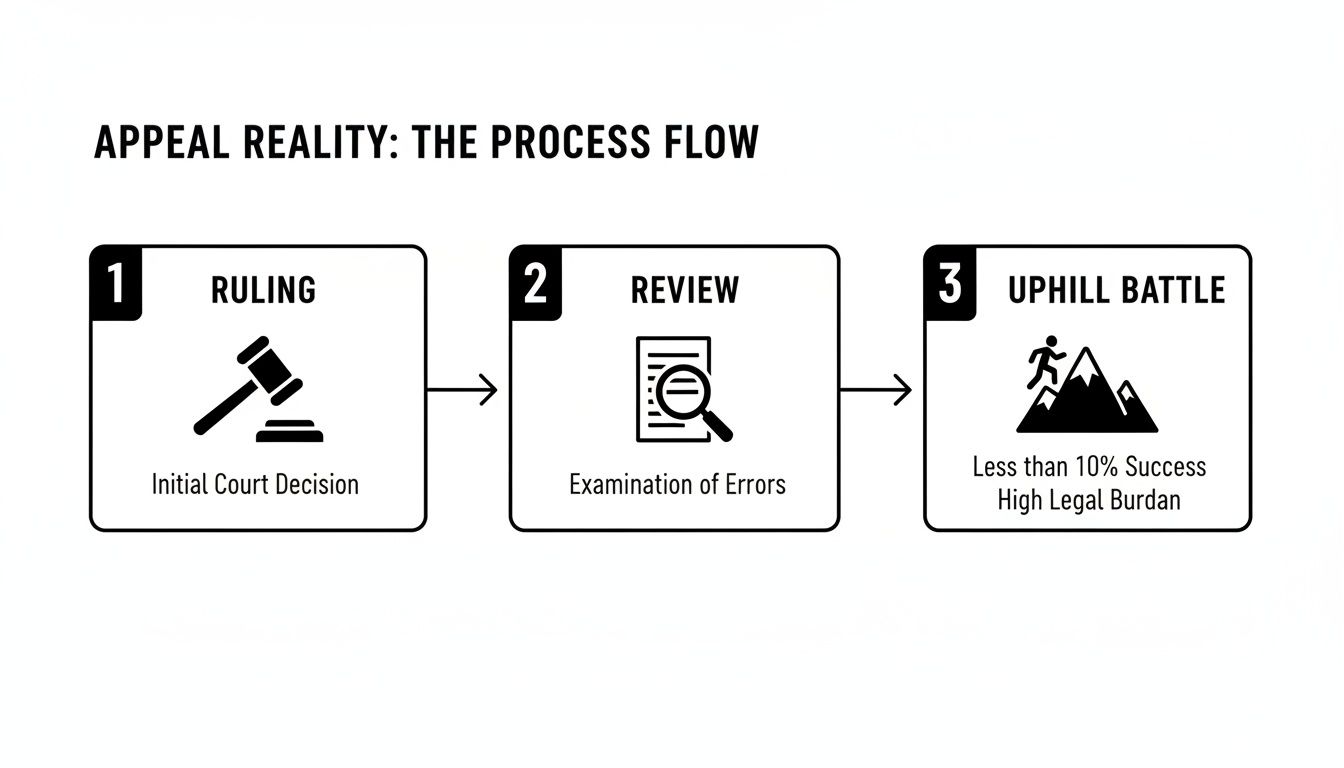
This process underscores that an appeal isn't a second chance to present your case, but a careful examination of the trial court record. Meticulous preparation is everything.
Assembling The Record And Transcripts
Once your Notice of Appeal is filed, the next job is to gather all the materials the appellate court will actually look at. This collection of documents is called the record on appeal. You have to remember, the appellate judges weren't in the courtroom. They can only base their decision on what was officially documented during your trial.
The record is built from two main things:
- The Court Record: This is every official document filed in your case—motions, pleadings, discovery responses, and the final judgment itself.
- The Transcripts: This is the word-for-word, written account of everything said in court by the judge, the attorneys, and the witnesses.
Think about a high-net-worth divorce in Hillsborough County where valuing a family business was the key issue. The appellate court can't hear new testimony about what the business is worth. It can only review the exact expert testimony and financial documents that were admitted into evidence during the trial. If a critical piece of evidence wasn't presented correctly then, it can't be added now. This is why the discovery for divorce process is so vital—it builds the foundation of evidence that can later be appealed.
The record is everything. In an appeal, if it wasn't said or filed in the trial court, it effectively never happened. Your entire argument will be built exclusively on the evidence contained within these documents.
Understanding The Initial Financial Commitments
Kicking off an appeal comes with immediate costs you need to be ready for. These are separate from your attorney's fees and are required just to get the process started.
You can generally expect two main upfront expenses:
- Filing Fees: The court charges a fee just to file the Notice of Appeal and get your case on the appellate docket.
- Transcript Costs: You have to pay a court reporter to turn the audio recordings of your trial into a written transcript. This is usually charged per page, and the cost can add up quickly if your trial lasted several days.
At Foley Family Law, we believe in being completely upfront about the costs. We work with a diverse range of clients, from first responders to members of the LGBTQ community, and we know financial clarity is non-negotiable. Having a frank discussion about these initial expenses ensures you can make a fully informed decision about whether an appeal is the right move for you and your family.
Building Your Case with a Persuasive Appellate Brief
Once the Notice of Appeal is filed and the record is officially assembled, the real work begins. This is where the legal battle is truly fought—not in a courtroom with witnesses, but through meticulously crafted legal arguments called appellate briefs. Your entire case hinges on the strength and clarity of these documents.
Think of the appellate process as a formal, written conversation between you, the other side, and a panel of judges. It’s a highly structured dialogue governed by strict rules. Each party gets a chance to state their case on paper, and it all starts with your Initial Brief.

The Three Key Briefs in a Florida Appeal
This back-and-forth on paper unfolds across three main documents. Each one serves a specific purpose in building the narrative for the appellate judges who will ultimately decide your fate.
- The Initial Brief: This is your opening salvo and, frankly, the most important document you will file. It’s where we lay out the facts of the case (based only on what's in the trial record), pinpoint the specific legal errors the trial judge made, and present the case law that proves our position.
- The Answer Brief: After we file our brief, the opposing party (known as the appellee) gets their turn. Their Answer Brief is dedicated to defending the trial judge's decision and trying to poke holes in every argument we’ve made.
- The Reply Brief: We get one last, optional word. The Reply Brief is narrowly focused and can only be used to rebut new points raised in the Answer Brief. You can't introduce brand-new arguments here; it's purely for counter-punching.
Arguing Reversible Error and Abuse of Discretion
Appellate courts couldn't care less if they would have made the same decision as the trial judge. Their only job is to hunt for a reversible error—a legal mistake so significant that it very likely changed the outcome of your case. You can't just argue that the judge "was wrong." You have to prove they made a specific, technical legal mistake.
Let’s take a child relocation case in Pinellas County. We wouldn't just argue that the judge made a poor choice. Instead, the brief would prove the judge misapplied Florida’s relocation law or completely ignored critical evidence that the law required them to consider. This is a world away from simply disagreeing with the final parenting plan.
Another key concept is abuse of discretion. This legal standard comes into play for many family law decisions, such as alimony awards or how assets were divided.
Proving an abuse of discretion means showing the trial judge's decision was so arbitrary, fanciful, or unreasonable that no other reasonable judge would have possibly reached the same conclusion. It's an incredibly high bar to clear and requires a surgical analysis of the trial record.
The grim statistics on family court appeals underscore just how tough this is. A 2021 study on international child abduction cases found that 81% of appealed decisions were simply affirmed. You can see the data on international child abduction appeals here. For our clients in Hillsborough, Pasco, or Pinellas Counties, these numbers highlight the absolute necessity for precise, powerful appellate advocacy.
The Art of Persuasive Legal Writing
Drafting a winning appellate brief is an art form. It demands that an attorney comb through every single page of the trial transcript and every exhibit, searching for the threads of legal error. Those threads are then woven together with exhaustive legal research into a compelling story that convinces a panel of seasoned judges that a serious injustice occurred.
The writing has to be sharp, concise, and flawlessly supported by citations to both the record and controlling Florida case law. In family law, where emotions run high, the brief must remain completely objective and focused on the law. Issues from something like an emergency custody order in Florida must be presented with cold legal precision, not emotional pleas.
At Foley Family Law, we handle all family and divorce matters, including for our gay, lesbian, and transgender clients, knowing that every case has a unique story. We are committed to ensuring every client's story is told powerfully and persuasively within the rigid confines of appellate law, without discrimination.
Once you’ve poured everything into writing and filing the briefs, the appeals process enters a strange new phase: waiting. The heavy lifting of crafting your written arguments is done, but the finish line is still months—sometimes more than a year—away. Knowing what to expect next, from oral arguments to the final decision, is crucial for managing the long and often stressful road ahead.

Will There Be an Oral Argument?
Occasionally, the appellate court will schedule an oral argument. This isn't like a trial; it's a formal, timed hearing where attorneys from both sides appear before the panel of judges. The goal is to verbally reinforce the arguments from the briefs and, more importantly, answer direct and often challenging questions from the judges themselves.
Don't get your hopes up for this, though. Oral arguments are granted in a very small fraction of Florida family law appeals. The vast majority of cases are decided entirely on the written briefs. The court typically only calls for an argument if the case involves a brand-new legal question or if the judges need to hash out some particularly complex points.
The Three Potential Outcomes of an Appeal
After the judges have fully reviewed the briefs and held oral arguments (if any), they will issue a formal written decision. This final judgment boils down to one of three outcomes, each with profound implications for your family.
- Affirm: This is the most frequent result. When a court "affirms" the trial judge's order, it means they found no legal errors that would justify overturning it. The original ruling remains in place.
- Reverse: A "reversal" is the big win for an appellant. It means the appellate court found a significant, reversible error and has completely overturned the trial court's decision. While this is what everyone hopes for, it's statistically quite rare.
- Reverse and Remand: This is a very common middle ground. The court "reverses and remands" when it finds a legal error but needs the trial court to fix it. The case is sent back down with specific instructions, which often means another hearing or even a new trial on certain issues.
The Timeline and Financial Commitment
Let’s be direct: for families in Pasco, Pinellas, and Hillsborough Counties, a Florida family law appeal is neither quick nor cheap. From the day the Notice of Appeal is filed to the moment you get a final decision, the process can easily take a year or longer.
The financial investment is also substantial. You have the initial filing fees and the cost of preparing the record and transcripts. But the real cost comes from the immense number of attorney hours needed to comb through every page of the record, conduct exhaustive legal research, and write the highly persuasive, technical briefs that are the heart of any appeal.
A successful appeal requires a significant investment of both time and resources. This is a marathon, not a sprint, and families must be prepared for a long journey with no guarantee of the outcome.
At Foley Family Law, we are upfront with all our clients, including our LGBTQ, military, and first responder families. We will have a frank, realistic discussion about the potential costs and timelines so you can make a fully informed choice. The odds are steep; national data suggests family court appeals have a success rate below 20%, with costs often exceeding $10,000. These numbers underscore why expert guidance is non-negotiable, and you can discover more insights about strategies for family law appeals here.
Exploring Alternatives To A Full Appeal
An appeal isn't always the only, or even the best, path forward after a disappointing ruling in a Florida family court. Let's be frank: the appeals process is long, expensive, and has an incredibly high bar for success. Before you commit to that journey, it's smart to explore other legal tools that can sometimes correct errors much faster and more affordably.
These options are called post-judgment motions. In simple terms, they ask the trial judge—the very same judge who made the original decision—to take a second look. The grounds for these motions are narrow, but when the circumstances are right, they can be a powerful and efficient way to resolve an issue without ever involving a higher court.
The Motion For Rehearing Or Reconsideration
One of the most common post-judgment motions is the Motion for Rehearing or Reconsideration. You have to act fast on this one. It must be filed within 15 days of the final judgment being entered.
The purpose here isn't to re-argue your entire case or just tell the judge you're unhappy with the outcome. Instead, this motion is your chance to point out a specific oversight of law or fact you believe the judge missed. You’re essentially arguing that the court overlooked something critical that, if properly considered, would have changed the final decision.
This could involve situations where the court:
- Misunderstood a key piece of evidence presented at trial.
- Overlooked a controlling legal precedent that should have guided the decision.
- Made a clear factual error in its final written order.
For example, imagine a judge in a Pasco County divorce case miscalculates the value of a retirement account in the final judgment, leading to an unfair division. A Motion for Rehearing can quickly bring this specific mathematical error to the court's attention for correction. This simple step could save you months, or even years, of appellate litigation. It asks the judge to fix their own mistake, which is often a much more direct route than an appeal.
When A Motion To Set Aside Is Appropriate
A more drastic and less common alternative is the Motion to Set Aside Final Judgment. This motion has a much longer filing window—usually within one year of the judgment—but it is reserved for very specific and serious situations. This isn't for correcting a simple legal error.
This motion is used when the entire legal process was fundamentally tainted by an issue that prevented a fair trial from ever taking place. Think of it as a tool for extraordinary circumstances that undermined the very integrity of the judgment.
A Motion to Set Aside is not a tool for second-guessing a judge's ruling. It is a remedy for situations where fraud, misconduct, or some other major issue prevented the truth from coming out in the first place, making the original judgment invalid.
The grounds for setting aside a judgment are extremely limited under Florida law and typically include:
- Fraud or Misrepresentation: One party intentionally lied or hid crucial information, like failing to disclose a significant financial asset.
- Newly Discovered Evidence: You have found critical new evidence that could not have been discovered before trial, even with diligent effort.
- Mistake or Excusable Neglect: This covers clerical errors or unforeseen circumstances that prevented a party from properly presenting their case.
Let's say a spouse in Hillsborough County deliberately concealed a secret bank account throughout the divorce, and you discover it eight months after the final judgment. A Motion to Set Aside could be used to reopen the case. This is completely different from simply disagreeing with how the judge divided the assets you knew about.
For anyone navigating the post-judgment landscape in Pinellas, Pasco, or Hillsborough County, understanding these alternatives is key. Foley Family Law, a firm that proudly serves all members of the community without discrimination, including our LGBTQ clients, can help you strategically assess whether a motion or a full appeal is the right course. Exploring options like collaborative divorce vs mediation before a trial can also prevent many of these post-judgment conflicts from ever arising.
Common Questions About Florida Family Law Appeals
When a family court judge issues a final order, it can feel like the end of the road. But what if you believe the judge got it wrong? The idea of an appeal often brings up a mix of hope and confusion, and it's completely natural to have questions about what comes next.
Here are some clear, straightforward answers to the most common questions we hear from families in Pasco, Pinellas, and Hillsborough Counties.
Can I Introduce New Evidence During My Appeal?
This is one of the most critical points to understand, and the answer is a firm no. An appeal is not a second trial or a "do-over" where you get another chance to present new facts or call a new witness.
The appellate court's job is to review what already happened in the trial court. They are strictly limited to examining the official "record on appeal," which is the collection of transcripts, admitted evidence, and documents filed in your original case. Nothing new gets added. This is exactly why it’s so vital to have a sharp trial attorney who gets every crucial piece of information into the record from the very beginning.
How Long Do I Have To File An Appeal In Florida?
The deadline here is absolute and unforgiving. For almost all Florida family law cases, you must file a Notice of Appeal within 30 days of the final order being officially filed by the court clerk.
If you miss that 30-day window, you permanently lose your right to appeal that decision. Exceptions are practically nonexistent, which means time is of the essence. You absolutely must speak with an experienced attorney serving the Tampa Bay area right after you receive an unfavorable ruling to protect your rights.
What Kind of Errors Can Actually Win An Appeal?
Simply disagreeing with the judge's decision isn't enough. Winning an appeal requires proving that the judge made a specific "reversible error"—a legal mistake so significant that it very likely changed the final outcome.
Identifying these technical errors is the whole ballgame. The most common grounds include:
- Abuse of Discretion: This is when a decision is so unreasonable or arbitrary that no other rational judge, looking at the same facts, would have made the same call.
- Misapplication of Florida Law: This happens when the judge understood the facts of your case but applied the wrong legal rule to them.
- Lack of Competent, Substantial Evidence: A judge’s ruling must be supported by solid, credible evidence in the record. If the decision rests on nothing more than speculation or flimsy proof, it can be overturned.
Does The Original Order Stop During The Appeal?
Generally, no. Filing an appeal does not automatically hit the pause button—or "stay"—the original court order. If the final judgment orders you to follow a parenting plan, pay alimony, or divide up property, you are legally required to keep doing so while the appeal is pending.
It is possible to ask the court for a "stay" to pause the order's enforcement, but getting one isn't guaranteed. It often requires posting a significant financial bond. Until an appellate court says otherwise, the trial court's order is the law you must follow. Ignoring it can land you in contempt of court proceedings.
At Foley Family Law, we handle all family law matters without discrimination, including for our gay, lesbian, and transgender clients, and can help you understand your obligations. If you're looking for more general information, you can explore our guide on finding a family law attorney near me.


