

Figuring out how much alimony you might pay or receive in Florida isn’t as simple as plugging numbers into a calculator. In fact, there's no official state calculator for it. The final amount comes down to a judge's decision based on one spouse's proven financial need and the other spouse's ability to pay. It's a delicate balancing act, unique to the circumstances of every marriage.
Understanding How Alimony Works In Florida

At its core, alimony—also known as spousal support—is about providing financial help to a lower-earning spouse so they can maintain a lifestyle close to what they had during the marriage. It’s not meant to be a penalty. Think of it as a temporary bridge, giving one person a runway to become financially independent after the divorce is final.
A judge in Pasco, Pinellas, or Hillsborough County won’t just rubber-stamp an alimony request. They will carefully weigh a whole series of factors to decide if alimony is even appropriate, and if so, for how much and for how long. It's a deep dive into the complete financial picture of both people.
The Foundation of an Alimony Award
Every alimony decision in Florida rests on two fundamental pillars: need and ability to pay.
First, one person has to show a genuine financial need for support just to cover their reasonable living expenses. At the same time, the other person has to have the financial capacity to provide that support after meeting their own essential needs.
If either one of these is missing, an alimony award is pretty unlikely. For example, if both spouses earn similar incomes, there might not be a real "need" for support. On the flip side, even if there's a need, if the higher-earning spouse doesn't have enough income to support two separate households, their "ability to pay" just isn't there.
Key Considerations for Florida Courts
Florida law gives judges a specific list of factors they have to consider when making these decisions. This framework is designed to make the outcome as fair and equitable as possible.
Here are some of the most important factors they'll look at:
- The standard of living established during the marriage: The court tries to ensure the receiving spouse can maintain a comparable lifestyle post-divorce.
- The duration of the marriage: This is a big one. Florida law has different guidelines for short-term, moderate-term, and long-term marriages, which heavily influences the type and length of alimony.
- Each person's financial resources: This includes everything—marital and non-marital assets, debts, and income sources.
- Each person’s earning capacity: The court examines education, job skills, and overall employability to see what each person is capable of earning.
- Contributions to the marriage: This isn't just about who brought home the bigger paycheck. Things like being a homemaker, raising children, and supporting a spouse's education or career are given significant weight.
Our firm handles all family and divorce issues, including for LGBTQ couples, and we apply these same legal principles to every single case without discrimination. We're committed to ensuring every client in Pasco, Pinellas, and Hillsborough Counties gets a fair shake under Florida law.
To get a deeper insight, you can learn more about alimony in Florida in our detailed guide. This whole process is about creating a stable path forward, allowing both people to start their next chapter on solid financial footing.
The Different Types of Alimony Available in Florida
When people ask, "how much alimony will I get or have to pay?" the answer always starts with another question: "What kind of alimony are we talking about?" Florida law doesn't have a single, one-size-fits-all solution for spousal support. Instead, the courts have several different tools at their disposal, each designed for a specific purpose.
Think of it like a mechanic's toolbox. You wouldn't use a sledgehammer to fix a delicate sensor. In the same way, the type of alimony a judge orders is tailored to the specific financial need created by the divorce. Understanding these different types is the first step for anyone in Pasco, Pinellas, or Hillsborough County to build a realistic financial plan for life after marriage.
Bridge-The-Gap Alimony
This is exactly what it sounds like—a short-term financial bridge to help a spouse get from married life to single life. Bridge-the-Gap Alimony is meant to cover legitimate, identifiable, and immediate needs.
We're talking about the practical costs of starting over: a security deposit and first month's rent on a new apartment, buying furniture, or paying for moving trucks. It's designed to soften the financial blow of setting up a new household.
- What it’s for: Covering immediate, one-time costs to transition to single life.
- How long it lasts: It's very short-term and can't go on for more than two years.
- Can it be changed? No. Once it's set, both the amount and the duration are non-modifiable.
Rehabilitative Alimony
If one spouse put their career on hold to support the family, they might need a little help getting back on their feet professionally. That’s where Rehabilitative Alimony comes in. Think of it as a targeted investment or a scholarship fund to help that spouse become self-sufficient.
A classic example is a spouse who left the workforce to raise children and now needs to finish a degree or get a new professional certification to re-enter the job market. To get this type of alimony, they have to present a detailed "rehabilitative plan" to the court—outlining the specific program, its costs, and a clear timeline for completion.
A vague request for money won't cut it. The court needs to see a concrete, actionable plan that shows a clear path from financial dependency to self-support. This plan becomes the roadmap for the entire alimony award.
Durational Alimony
For marriages that weren't quite long enough for a permanent award but still created a significant economic gap, Durational Alimony is often the answer. Its purpose is straightforward: provide financial assistance for a set period following a short or moderate-term marriage.
Unlike rehabilitative support, it isn't tied to a specific training or education plan. It’s simply financial support that has a clear expiration date. The most critical rule here is that the length of durational alimony can never be longer than the length of the marriage itself. For a deeper dive into this common form of support, you can learn more about durational alimony and its specific rules in Florida.
Temporary Alimony
Let's be realistic—divorces don't happen overnight. They can take months, sometimes even longer, to finalize. Temporary Alimony, also known in legal circles as alimony pendente lite, is support paid while the divorce is still in progress.
It ensures that a lower-earning spouse can pay their bills, cover living expenses, and afford legal representation until a final agreement is reached. Once the divorce is finalized, temporary alimony stops and is usually replaced by one of the other, more permanent forms of support discussed here.
Permanent Alimony
Here’s a major update to Florida law: As of July 1, 2023, permanent alimony has been eliminated for any new divorce cases.
In the past, it was often awarded after long-term marriages where one spouse simply couldn't become self-supporting due to age, illness, or disability. While new permanent alimony awards are off the table, any existing orders that were finalized before that date remain in effect unless they are formally modified by the court. Our firm is committed to helping clients from all walks of life, including members of the LGBTQ community, understand how these evolving laws impact their rights and financial futures.
A Quick Guide to Florida's Alimony Types
To make sense of it all, here is a simple breakdown. Use this summary to understand the purpose and typical duration of each alimony type recognized under Florida law.
- Bridge-the-Gap Alimony: For covering specific, short-term needs to transition from married to single life (e.g., security deposit, moving costs). It lasts for a fixed, short period and cannot exceed 2 years. It is non-modifiable.
- Rehabilitative Alimony: To help a spouse gain skills or education to become self-supporting, based on a specific plan. It lasts for a defined period tied to the completion of that rehabilitative plan.
- Durational Alimony: To provide economic assistance for a set time after a short or moderate-term marriage. Its duration cannot last longer than the length of the marriage itself.
- Temporary Alimony: For supporting a spouse's needs during the divorce proceedings. It ends automatically when the divorce is finalized.
- Permanent Alimony (Eliminated as of July 1, 2023): Was used to provide support indefinitely for a spouse who could not become self-sufficient. It is no longer available for new cases, but existing orders remain in effect.
Each of these serves a very different function, and the right one for your situation will depend entirely on the unique facts of your marriage and separation.
Key Factors That Determine Alimony Amounts
When a Florida judge has to decide on alimony, they don’t just pull out a calculator and punch in a few numbers. There’s no simple, one-size-fits-all formula. Instead, the process is much more investigative, where the judge carefully sifts through a whole list of factors to get a clear picture of the marriage and each person's financial reality.
For anyone in Pasco, Pinellas, or Hillsborough County facing a divorce, getting a handle on these factors is non-negotiable. They are the bedrock of any spousal support award, and the court’s ultimate goal is to land on a decision that's fair and just—which means digging a lot deeper than just a couple of pay stubs.
The Standard Of Living During The Marriage
One of the first things a court will look at is the standard of living you and your spouse built together during your marriage. This serves as a crucial benchmark.
Now, that doesn't mean the court is going to try and perfectly clone that lifestyle across two new, separate households—that's usually just not financially possible. But it does set the bar for figuring out what the receiving spouse actually needs to maintain a reasonably comparable quality of life. If your life together included regular vacations, certain hobbies, or dining out, those expenses are part of the equation. The idea is to prevent one person from experiencing a sharp, unfair nosedive in their quality of life while the other continues on as before.
Duration Of The Marriage
How long you were married is another major piece of the puzzle. Florida law breaks down marriage lengths into general categories to help guide these decisions:
- Short-term marriage: Lasting less than 10 years.
- Moderate-term marriage: Lasting between 10 and 20 years.
- Long-term marriage: Lasting 20 years or more.
It's just common sense: a shorter marriage is far less likely to result in a long-term alimony award, as the court will probably see less financial dependency created over that time. On the flip side, after a long-term marriage—especially one where a spouse stepped back from their career to support the family—a judge is much more likely to recognize a greater need for support.
Each Person’s Financial Big Picture
Next up is a deep dive into the complete financial situation for both of you. This is a full-scale review of all income sources, every asset you own, and every debt you owe.
It's not just about what you earn. The court wants to know what you own and what you owe. This includes marital assets, like the house and joint investment accounts, as well as any non-marital assets you might have brought into the marriage.
This is where things can get complicated. Understanding things like how much debt is too much becomes critical, as it directly impacts one person's ability to pay support or another's need for it. This is especially true in high-net-worth divorces where you're dealing with complex investment portfolios. Our firm has extensive experience untangling these intricate financial webs for all our clients, including members of the LGBTQ community in Pasco, Pinellas, and Hillsborough Counties, making sure every last asset and liability is accounted for.
The image below gives you a good visual of the different kinds of alimony a court can award based on all these moving parts.
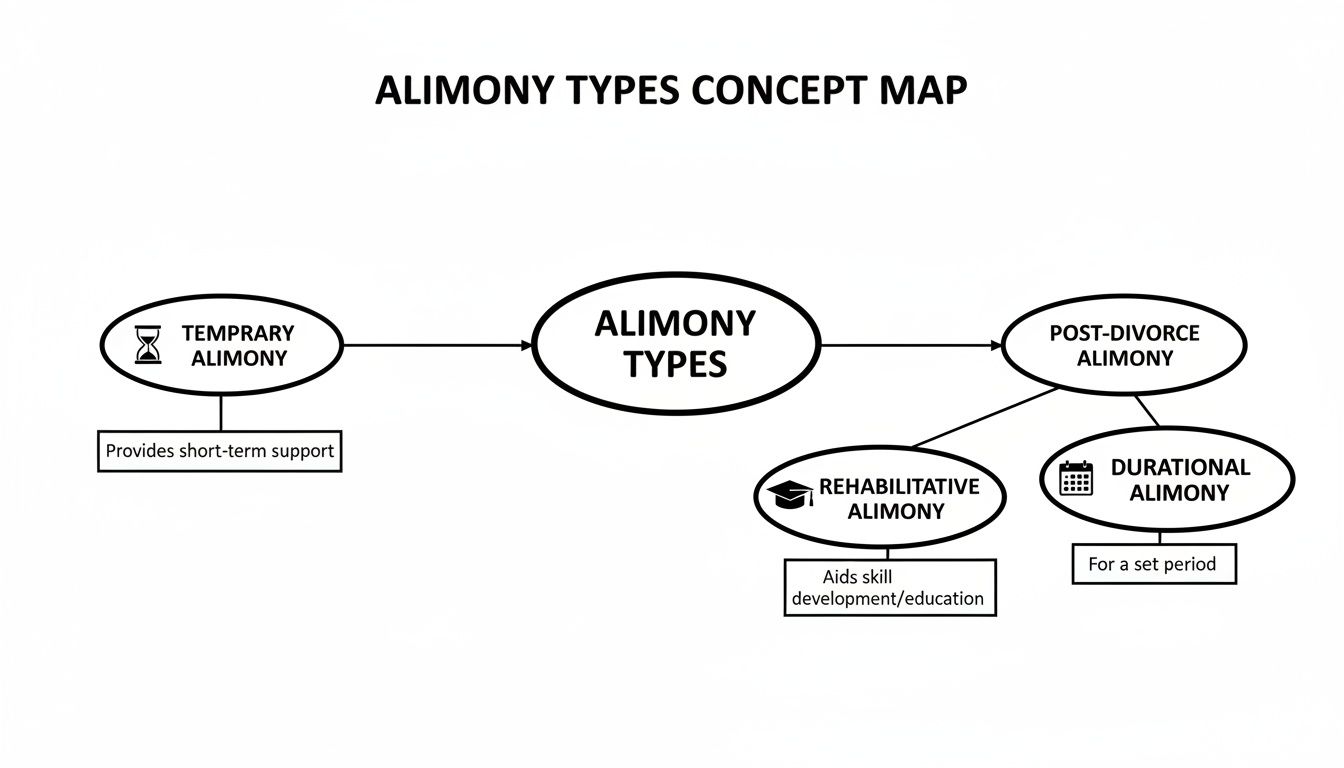
As you can see, alimony isn't just one thing. It's a set of tools—Temporary, Rehabilitative, and Durational—that a judge can use for specific purposes and timeframes.
Earning Capacity And Contributions To The Marriage
Finally, a judge will size up each person’s earning capacity, looking at their education, job skills, and professional experience. They'll also weigh any sacrifices one spouse made to advance the other's career or to raise the family.
And let’s be clear: non-financial contributions carry a lot of weight here. Things like:
- Being a homemaker and managing the day-to-day running of the household.
- Serving as the primary caregiver for the children, which freed up the other spouse to focus on work.
- Supporting a spouse while they went through college or got professional training.
This is all about fairness. It ensures that a spouse who might have a lower income on paper isn't penalized for having poured their time and energy into the family’s collective well-being instead of their own career. For families here in Pasco, Pinellas, or Hillsborough Counties, where pensions and retirement benefits are often the biggest assets, getting this part right is absolutely critical.
How Adultery Can Impact An Alimony Award
It’s one of the first questions people ask when infidelity is involved in a divorce: "Will the cheating affect the final outcome?" When it comes to alimony, the answer isn't a simple yes or no. While Florida is a "no-fault" divorce state—meaning you don't need to prove wrongdoing to end the marriage—adultery can absolutely play a role in a judge's final alimony decision.
But here’s the critical part: the court isn't interested in punishment or morality. The focus is almost entirely on the financial fallout. For an affair to matter legally, you have to prove that the cheating spouse spent marital funds to support or further that affair. That’s where the conversation shifts from personal betrayal to financial impact.
From Misconduct To Financial Impact
A brief affair with no real financial consequences? A judge will likely see it as irrelevant to the alimony calculation. But when marital money gets funneled into supporting the affair, judges in Pasco, Pinellas, and Hillsborough counties will definitely take notice. This is what we call the dissipation of marital assets.
Let's look at how this plays out in the real world:
- Scenario A (No Financial Impact): A spouse has a short-lived affair, but no marital money is spent on gifts, trips, or supporting the other person. In this case, the adultery probably won't move the needle on alimony.
- Scenario B (Clear Financial Impact): A spouse is using a joint credit card to bankroll expensive hotel stays, international flights, and lavish gifts for their affair partner. This direct hit to the marital finances can lead a judge to adjust the alimony award or property division to make the wronged spouse whole.
The key is to draw a straight, provable line from the affair to the depletion of the family's finances. The court's goal isn't to punish the cheater; it's to financially compensate the innocent spouse for the assets that were wasted.
Documenting The Financial Drain
If you suspect your spouse's affair has drained your shared finances, you have to prove it. Strong, clear evidence is your most powerful tool for convincing a judge that the adultery should be factored into the final alimony number. This means gathering documentation that tells the story of where the money went.
Evidence that really speaks to a judge often includes:
- Bank statements showing large or uncharacteristic cash withdrawals.
- Credit card bills detailing expenses for things like hotel rooms, jewelry, or intimate dinners for two.
- Travel itineraries or receipts for trips that were clearly not for family or business purposes.
Building a case around the financial impact of adultery is a strategic process. It’s not enough to just prove the affair happened—you have to prove it cost the marriage real money. For a deeper dive into the basics of divorce law, you can explore our article that answers the question, "Is Florida a no-fault divorce state?" Our firm is committed to helping all our clients in Pasco, Pinellas, and Hillsborough Counties, including those in the LGBTQ community, build the strongest possible case to secure a fair and just financial outcome.
Negotiating Or Contesting An Alimony Agreement

You have far more control over the alimony process than you might think. While a judge makes the final call in court, the reality is that most Florida divorce cases are settled outside the courtroom through direct negotiation. This is where we shift from legal theory to practical action.
Whether you're the spouse who needs support to get back on your feet or the one being asked to pay, you have options. Understanding these strategies is the first step toward taking control of your financial future.
Collaborative Approaches And Mediation
One of the most effective and humane ways to handle alimony is through collaborative methods like mediation. This process brings you and your spouse together with a neutral, third-party mediator to hammer out a fair Marital Settlement Agreement.
This path is almost always faster, less expensive, and infinitely less stressful than a courtroom battle. More importantly, it puts the decision-making power back in your hands. You get to create a customized solution that actually works for your family, rather than leaving your fate to a judge who only knows you from a stack of papers.
Building Your Case For Negotiation Or Court
No matter which path you take—mediation or litigation—a strong case is built on solid evidence. If you're fighting an unfair alimony demand or trying to secure the support you genuinely need, gathering the right financial documents is absolutely essential.
This isn’t just about grabbing a few pay stubs. It’s a meticulous review of:
- Financial Affidavits: These are the sworn financial statements that outline your complete picture of income, expenses, assets, and debts.
- Bank and Credit Card Statements: These documents tell the real story of spending habits and establish the marital standard of living.
- Tax Returns and Pay Stubs: This is the hard proof that verifies income and earning capacity for both parties.
- Business Records: If a business is in the mix, its valuation and true cash flow are critical pieces of the puzzle.
In some high-asset cases, especially here in Hillsborough, Pinellas, or Pasco counties, we often bring in a forensic accountant. These financial detectives can trace assets, uncover hidden income, and provide an expert opinion on a spouse's true ability to pay. Their work can be invaluable in a complex and contentious dispute.
An alimony agreement is never just about the monthly check. It’s about making sure the entire financial settlement is equitable, from how you divide retirement accounts to who takes on which debts. A well-negotiated agreement looks at the whole financial landscape.
Big marital assets can create major complexities. For instance, understanding the implications of selling the marital home before or after the divorce is final can dramatically impact your settlement and your leverage in alimony negotiations.
The Importance Of A Fair Resolution
Ultimately, the goal is to reach a fair resolution that protects your financial stability. Alimony often plays a central role in that. We just have to look at recent U.S. family law statistics to see why. Spousal support is frequently tied to child support, working together to keep single-parent homes stable.
The data is sobering: while over 79% of custodial mothers have a child support order, a shocking 65% of them get no support at all. This reality magnifies alimony's role as a potential financial lifeline.
At Foley Family Law, we fight for our clients in Pasco, Pinellas, and Hillsborough Counties—including those in the LGBTQ community—to achieve a fair outcome that honors their contributions to the marriage and secures their future. Whether we get there through skillful negotiation or determined litigation, there are clear strategies we can pursue. We are here to help you navigate this with confidence.
Common Questions About Florida Alimony
When you're facing a divorce, alimony is often one of the biggest and most personal sticking points. For our clients across Pasco, Pinellas, and Hillsborough Counties, the questions are always practical and rooted in real-world concerns. Let's clear up some of the most common questions we hear about how alimony actually works under Florida law.
Can We Agree On Alimony Without A Judge?
Absolutely. In fact, it’s often the best-case scenario. You and your spouse have the power to negotiate alimony terms on your own and formalize them in a Marital Settlement Agreement. This approach keeps you in the driver's seat, often leading to more creative and sustainable solutions than a judge might order.
But reaching a private agreement doesn’t mean you should DIY it. It is absolutely crucial to have an experienced family law attorney review any proposed deal. We make sure the agreement is fair, legally sound, and actually protects your financial rights before you put your signature on it.
Is Alimony Taxable In Florida?
This is a huge question, and the answer changed significantly a few years back. For any divorce agreement finalized after December 31, 2018, the old tax rules are out the window.
Here’s how it works now under federal law:
- For the person paying: Alimony payments are not tax-deductible.
- For the person receiving: Alimony is not considered taxable income.
This shift completely changed the financial planning around divorce. The paying spouse can no longer count on a tax deduction to soften the financial blow, while the receiving spouse gets the full amount, tax-free.
What If My Ex Remarries Or Our Incomes Change?
Life moves on after a divorce, and Florida law gets that. Most types of alimony aren't set in stone forever and can be adjusted when major life events happen.
As a general rule, the obligation to pay support automatically ends if the receiving spouse remarries or if either you or your ex passes away. Beyond that, a "substantial, material, and unforeseen change in circumstances" can be grounds to ask the court to modify the alimony amount or how long it’s paid.
Think of something like an involuntary job loss or a massive, unexpected promotion. But the change has to be significant and truly unforeseen—a minor pay bump or a voluntary career change that lowers your income probably won't be enough to convince a judge to make a change.
The entire point of alimony is to provide a financial safety net. Research consistently shows just how vital spousal support can be in preventing poverty after a divorce, especially for households with children. A comprehensive 2025 study found that single mothers were the most likely to receive alimony, and in some countries, these payments cut their household's risk of poverty by as much as 20-30%. Discover more insights about these alimony findings from the Luxembourg Income Study. This data really highlights why getting the alimony award right is so important.
What Happens If My Ex-Spouse Fails To Pay?
When a court orders alimony, it's not a suggestion—it's a legally binding order. If your ex-spouse simply stops paying, you have powerful legal tools to enforce it. The process usually kicks off when we file a motion for contempt with the court.
A judge can bring down serious consequences to force payment, like garnishing wages, seizing bank accounts, or even suspending their driver's license. The key is to act quickly and not let the unpaid alimony pile up.
Can LGBTQ Couples Receive Alimony In Florida?
Yes, without a doubt. In Florida, the laws on alimony apply equally to every married couple, period. Sexual orientation and gender identity have no bearing on it. At Foley Family Law, we are proud to handle divorce and all related issues for the LGBTQ community in Pasco, Pinellas, and Hillsborough Counties, ensuring every client gets the exact same fierce advocacy and legal protection. The same factors—need, ability to pay, length of the marriage, standard of living—are the metrics for every case.
Is There A Way To Avoid Paying Alimony?
While you can't just wish an alimony obligation away if the legal factors support it, there are definitely strategies to manage or even minimize it. Things like negotiating a lump-sum buyout or trading other marital assets (like equity in the house) instead of ongoing payments can be very effective. The best strategy is always tailored to the unique financial picture of your marriage.
Figuring out the nuances of how much alimony you might pay or receive isn't something you should do alone. At Foley Family Law, we give you the clear, strategic advice you need to protect your financial future. If you're in Pasco, Pinellas, or Hillsborough County, contact us today to schedule a consultation and let's build a plan of action.


