

When you're facing divorce, one of the first questions on your mind is almost always, "How long is this going to take?"
In Florida, the honest answer is: it depends. A straightforward, uncontested divorce can sometimes be wrapped up in just a few months. But if you and your spouse disagree on key issues, a contested divorce can easily stretch from six months to well over a year. Our firm handles all family and divorce issues for our clients in Pasco, Pinellas and Hillsborough Counties.
Your Florida Divorce Timeline: What To Expect

The best way to understand your potential divorce timeline in Florida is to think of it like choosing a lane on the highway. Are you headed for the express lane, or are you merging into unpredictable, stop-and-go traffic?
The single biggest factor that determines which lane you're in is how much you and your spouse agree on.
An uncontested divorce is your express lane. This is where you and your spouse have already agreed on all the critical issues—things like property division, alimony, and a parenting plan for your kids. It moves quickly because you’ve done the hard work of negotiating before ever filing with the court.
On the other hand, a contested divorce puts you in the slow lane. If even one major issue remains unresolved, you’re looking at a much longer journey. This path involves more legal steps, formal information gathering, court hearings, and potentially a full-blown trial. For anyone living in Pasco, Pinellas, or Hillsborough County, this choice will fundamentally shape your entire divorce experience.
To give you a clearer picture, here’s a quick rundown of what you can generally expect.
Florida Divorce Timelines At a Glance
Here are some general timelines you can expect based on the type of divorce. Remember, these are only estimates and your specific circumstances will determine the actual timeframe.
- Uncontested Divorce: The average timeline is 2–4 months. The key factor is having a full agreement on all issues before you file.
- Contested Divorce: This can take 6–18+ months. The timeline is extended due to disagreement on one or more major issues like assets or custody.
- High-Asset Divorce: Expect a timeline of 12–24+ months. This is due to the complexity of valuing assets such as businesses, investments, and real estate.
- Military Divorce: These cases often take 6–18+ months due to the added complexities of federal laws, deployment schedules, and pension division.
Keep in mind, these are just estimates. The unique details of your situation will always be the deciding factor.
The Ground Rules You Can’t Skip
Before your divorce can even get started, Florida law puts two foundational requirements in place. Think of these as the mandatory starting line for every single divorce in the state—they are non-negotiable.
- The Residency Requirement: One of you must have lived in Florida for at least six months right before filing the Petition for Dissolution of Marriage. This establishes that our state has the authority to handle your case.
- The Mandatory Waiting Period: After the petition is officially filed, Florida law requires a 20-day waiting period before a judge can sign the final judgment. This is essentially a "cooling-off" period built into the process.
These two rules set the absolute minimum timeframe for any divorce. No matter how simple your situation is, it can’t be finalized faster than this. You can get a more detailed breakdown of the six-month rule in our guide to Florida residency requirements for divorce.
This structured process is fairly typical for no-fault divorce states like Florida. While every case is personal, we see similar patterns across the board. In fact, on a global scale, divorce processing times in no-fault jurisdictions like the U.S. and EU average 6-12 months but can easily climb to 2-5 years in highly contested cases.
At our firm, we proudly represent all members of our community, including our clients in Pasco, Pinellas and Hillsborough Counties. We handle every family law matter—including gay divorce, gay custody issues, and other LGBTQ issues—with the respect, expertise, and dedication they deserve. We do not discriminate.
The Two Roads: Uncontested vs. Contested Divorce

When people ask how long a divorce takes, the honest answer is that it depends entirely on which path you and your spouse decide to take. Think of it like a road trip. You can take the direct, streamlined expressway, or you can wind your way down a scenic route filled with detours and traffic jams.
Both paths eventually lead to the same destination—a finalized divorce—but the time, expense, and stress involved are worlds apart.
The Express Path: Uncontested Divorce
The fastest and most straightforward route is an uncontested divorce. This path is only available if you and your spouse agree on every single issue before filing the final paperwork with the court.
There can be zero disputes. That means you’ve already worked through the division of all assets and debts, created a parenting plan and timesharing schedule, and settled any questions about alimony or child support.
The key that opens up this express lane is a comprehensive Marital Settlement Agreement. This is the legally binding contract that spells out every term you’ve agreed upon. Once it’s signed and submitted, the court process becomes largely a formality.
For couples in Pasco, Pinellas, and Hillsborough Counties, taking this cooperative approach often means the entire divorce can be finalized in just a few months.
An uncontested divorce isn't just about speed; it's about staying in the driver's seat. By making these critical decisions together, you and your spouse keep control over your family's future, rather than handing that power over to a judge.
This approach saves a tremendous amount of time, slashes legal fees, and dramatically lowers the emotional toll on everyone involved, especially children.
The Scenic Route: Contested Divorce
A contested divorce, on the other hand, is the journey with all the unexpected delays. This path begins the moment even one issue becomes a point of disagreement. It could be anything—who keeps the house, how retirement funds are split, or minor details in the parenting schedule.
Once a divorce is contested, the timeline stretches out significantly. A formal legal process must now unfold to resolve every conflict, and this process includes several mandatory steps that can add weeks or months to the calendar.
This journey almost always involves:
- Mandatory Discovery: A formal, often lengthy process where both sides are required to exchange financial records, statements, and other relevant information under oath.
- Financial Disclosures: Each spouse must complete and file detailed affidavits that outline every asset, debt, source of income, and monthly expense.
- Mediation: In Florida, you are required to attend mediation, where a neutral third party tries to help you and your spouse negotiate a settlement.
- Hearings and Trial: If you still can’t agree after mediation, your case moves on to court hearings and possibly a final trial, where a judge will make all the decisions for you.
For many families, exploring options like mediation early on can be the key to avoiding a long, drawn-out court battle. Understanding the differences between collaborative divorce vs mediation can help you find a more constructive way to resolve disputes, saving you time, money, and a great deal of emotional energy.
Factors That Accelerate or Stall Your Divorce
So you've decided whether to pursue an uncontested or contested divorce. What's next? Think of the divorce process like a river. Certain issues can create frustrating logjams, while others clear the path for a smooth, steady current toward resolution.
Beyond just the type of divorce, several key factors can act like speed bumps or accelerators in your proceedings. The number one reason we see for a significant delay? A complex financial picture. When spouses can't agree on how to divide their property, what should be a straightforward process can grind to a halt.
Understanding these elements from the get-go helps you anticipate, prepare, and potentially shorten your timeline.
Common Roadblocks That Extend Timelines
Disagreements over assets and children are the two main issues that can turn a months-long process into a year-long ordeal. For our clients here in Hillsborough, Pinellas, and Pasco Counties, just being aware of these potential sticking points is the first step toward overcoming them.
Here are the key issues that often cause delays:
- High-Value Assets: Dividing significant property, investment portfolios, or multiple real estate holdings requires detailed appraisals and careful, often lengthy, negotiation.
- Business Valuations: If a family-owned business is involved, figuring out its true value is a complicated process. It almost always requires hiring neutral financial experts, which can easily add months to the timeline.
- Hidden Assets or Debts: Suspicions that one spouse isn't being truthful about their finances will trigger a deep dive into financial records. This formal process is known as discovery. You can learn more about this in our detailed guide on the role of discovery in a Florida divorce.
- Parenting Plan Disputes: Conflicts over timesharing schedules, who has decision-making authority for the children, or one parent's request to relocate are incredibly emotionally charged. These disputes are tough to resolve without extensive mediation or even court intervention.
Accelerating Your Divorce Timeline
On the flip side, you have a surprising amount of control over how quickly your divorce can be finalized. A proactive and organized approach can significantly cut down the time you spend tied up in legal proceedings. Your actions—and your attitude—can directly influence the clock.
Your willingness to cooperate is the single most powerful tool you have to manage the clock. A mindset focused on fair compromise, rather than winning at all costs, can save you months of stress and thousands of dollars in legal fees.
Here are some practical steps you can take to speed things up:
- Be Meticulously Organized: Get all your financial documents together before you even file. We're talking bank statements, tax returns, deeds, and retirement account information. The more organized you are, the faster everything moves.
- Complete Disclosures Promptly: Florida law requires both spouses to exchange detailed financial information. Filling these forms out accurately and on time prevents unnecessary, and often frustrating, delays.
- Embrace Compromise: Go into mediation with a genuine willingness to negotiate. The goal isn't to get everything you want; it's to reach a fair agreement that you can both live with so you can move on.
Whether you are navigating a high-asset divorce or a sensitive LGBTQ family law matter, solid preparation and genuine cooperation are your best allies for an efficient, timely resolution.
Navigating High-Asset and Military Divorces
Some divorces just aren't straightforward. When certain life circumstances come into play, the typical timeline can get stretched out, and that’s especially true for many families here in Pasco, Pinellas, and Hillsborough Counties.
If significant wealth or military service is part of your story, the process requires a more patient, detailed approach. It's less about speed and more about getting it right. Think of it this way: high-asset divorces need financial precision, while military cases have an extra layer of federal law to navigate. Let's break down what that means for your timeline.
The Financial Deep Dive in High-Asset Cases
A high-asset divorce isn’t just about dividing up a checking account and a 401(k). It’s more like a full-blown financial audit. The timeline naturally gets longer because the stakes are higher and the finances are tangled. This isn't about manufacturing conflict; it's about making sure both spouses walk away with a truly fair and equitable outcome, and that simply takes more time.
To get an accurate picture of the marital estate, we often have to bring in specialized professionals.
- Forensic Accountants: These experts are absolutely essential for figuring out the true value of a business, a professional practice, or complex investment portfolios.
- Property Appraisers: They provide the official valuations for real estate, art collections, or other high-value personal property that can't just be looked up online.
- Financial Analysts: Their job is to trace assets—distinguishing what’s separate property from what's marital—and untangle things like stock options or deferred compensation plans.
Each one of these steps adds a necessary layer of investigation. It's not unusual for this detailed work to add several months, or even longer, to the divorce process. The goal is total transparency so that every last asset is identified, valued correctly, and divided according to Florida law.
Unique Timelines for Military Divorce
Military divorces bring their own set of distinct challenges that directly impact how long the process takes. There’s a constant interplay between Florida state law and federal laws designed to protect service members. Following this unique legal framework is non-negotiable.
One of the biggest factors is the Servicemembers Civil Relief Act (SCRA). This federal law can hit the pause button on a divorce if a service member is on active duty or deployed. This "stay" on the proceedings is designed to ensure a service member's duties don't prevent them from being able to fully participate in their own case.
A military divorce is not just a family law case; it's a blend of state and federal regulations. Properly addressing military retirement benefits, healthcare, and creating a workable long-distance parenting plan requires specialized knowledge and meticulous planning to avoid future legal complications.
On top of that, dividing military retirement benefits and crafting realistic parenting plans that work across state lines—or even international borders—requires a specific skill set. For anyone facing this situation, we offer a helpful resource to get you started; you can learn more by checking out our military divorce checklist. We understand these unique situations and have the experience to manage these complexities efficiently while safeguarding your interests. We proudly serve all families, including those in the LGBTQ community within Pasco, Pinellas and Hillsborough Counties, with the respect they deserve.
Mapping Your Journey Through The Divorce Process
To make the legal journey feel less intimidating, it helps to walk through the key milestones of a Florida divorce. Think of it like a roadmap—while the road might have some unexpected turns, the major landmarks are predictable, especially with the right guide. For our clients in Pasco, Pinellas, and Hillsborough Counties, understanding this sequence shows that the process, while potentially long, is structured and manageable.
The whole thing kicks off when one spouse files a Petition for Dissolution of Marriage with the court. This is the official document that gets the legal clock ticking.
The Initial Steps: Filing and Response
Once the petition is filed, it can’t just sit at the courthouse. It has to be formally delivered to the other spouse in a process called service. After being served, your spouse has exactly 20 days to file their official response.
This initial back-and-forth really sets the stage. Their response will show whether they agree with what you've requested, giving you the first clear sign of whether you're headed for a straightforward, uncontested divorce or a more complex, contested path.
Financial Disclosure: The Foundation of Your Case
Next up is one of the most critical phases in any Florida divorce: mandatory financial disclosure. This isn't just a suggestion; Florida law requires both spouses to swap detailed, sworn financial information. It's the bedrock upon which all fair negotiations are built.
Each person has to lay their financial cards on the table. We're talking about a complete picture, including:
- Income sources and recent pay stubs
- Statements for every bank, investment, and retirement account
- Tax returns and any loan applications
- A comprehensive list of every asset and every debt
This transparency is designed to make sure the division of property is fair and equitable. Trying to hide something or providing incomplete information will only cause serious delays and legal headaches down the road.
Discovery, Mediation, and Trial
If you and your spouse are at a standstill on key issues after the financial dust settles, the process moves into discovery. This is a more formal investigation where attorneys can dig for information using written questions (interrogatories) and sworn testimony under oath (depositions).
After discovery, the next major stop is mediation. In Florida, mediation is a required step for nearly every contested divorce. You'll sit down with your spouse and a neutral third-party mediator who helps you try to negotiate a settlement on your own terms.
Mediation is your last, best chance to control the outcome of your own case. It's often the final stop before you have to hand all the decision-making power over to a judge.
Only if mediation completely fails does the journey lead to a final trial. Here, both sides present their evidence and arguments, and a judge makes the final, binding decisions on every single unresolved issue.
This flow chart breaks down how certain complexities can stretch out the standard divorce timeline.
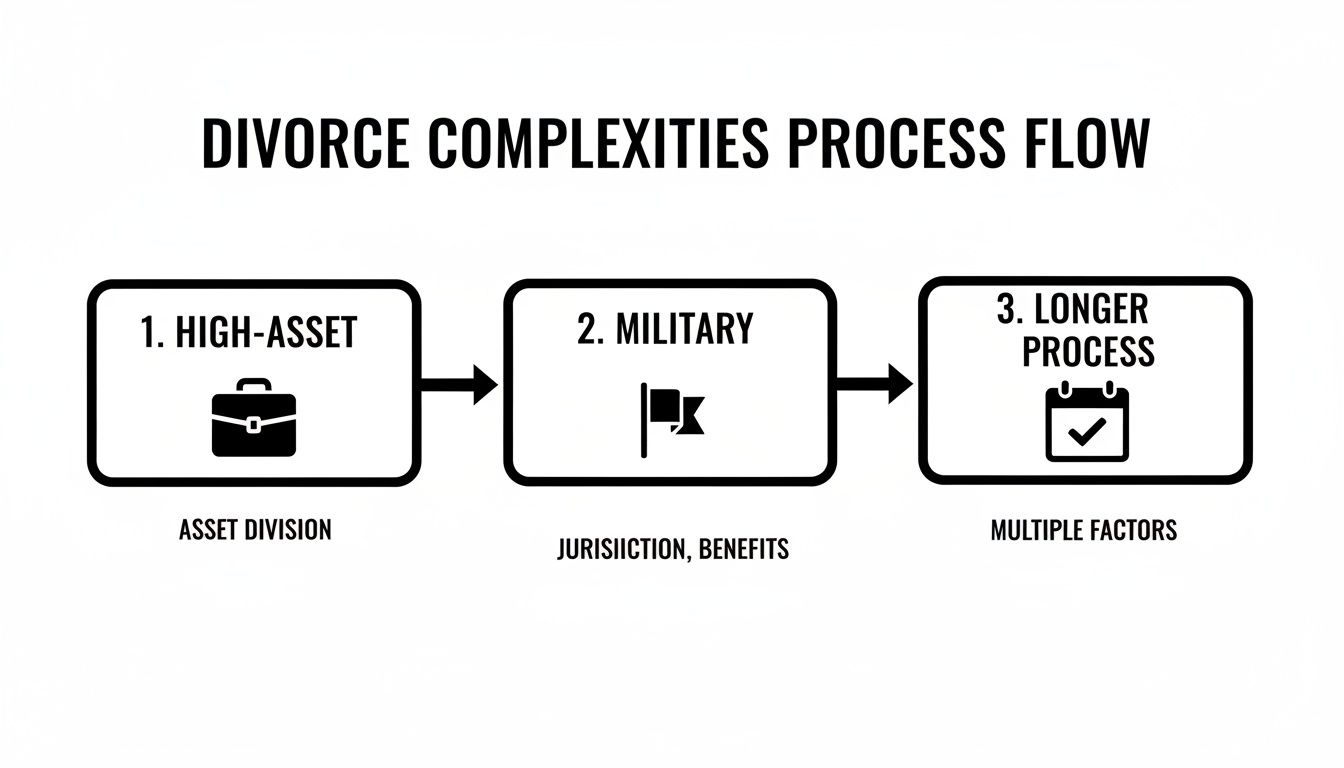
As you can see, things like significant assets or military service naturally add more layers and time to the process.
Statistics show that the average marriage ending in divorce lasts just eight years. Interestingly, in 75% of those cases, financial strain or career shifts are cited as a top reason. For folks here in the Tampa Bay area, this just highlights how important it is to have a clear strategy from day one to get through the legal process efficiently. You can discover more insights about these divorce statistics. We are here to support all families, including those in the LGBTQ community, every step of the way.
Common Questions About Florida Divorce Timelines
When you’re staring down the road to divorce, one of the first things you want to know is, "How long is this going to take?" It's a natural question. You need a sense of what to expect so you can prepare for what's ahead. We've compiled some of the most common questions we hear from our clients across Pasco, Pinellas, and Hillsborough Counties to give you the straight answers you need.
Our firm is proud to serve every family in our community, handling gay divorce, gay custody issues, gay or transgender name changes, and other LGBTQ issues with the same expertise and respect we bring to every case. We do not discriminate.
Can I Get Divorced In Less Than 20 Days in Florida?
The short answer is a hard no. Florida law has a mandatory 20-day waiting period that kicks in the day after you file your Petition for Dissolution of Marriage. Think of it as a non-negotiable "cooling-off" period.
This means that even in the most perfect, amicable, uncontested divorce where both of you have already signed a complete settlement agreement, a judge cannot legally sign the final judgment until at least 20 days have passed. It sets the absolute floor for any divorce timeline in the state.
Does It Matter Who Files for Divorce First?
For the most part, filing first doesn't really change how long your divorce will take. The timeline is almost always driven by how much you and your spouse disagree and how complicated your assets are, not who turned in the first piece of paper.
There is one minor strategic point to consider, though. The person who files the petition (the "Petitioner") usually gets to present their case first if the divorce goes all the way to a trial. But since the vast majority of cases settle long before a trial ever happens, this distinction rarely has any real impact on the outcome or the speed of the process.
How Do Children Impact The Divorce Timeline?
Bringing minor children into the equation can definitely add time to the divorce process. Disagreements over parenting plans, timesharing schedules, and child support are some of the most emotionally loaded and complex issues a couple can face.
When children are involved, the court’s primary focus shifts entirely to their best interests. This requires a more thorough process, including mandatory parenting courses and often in-depth mediation sessions to make sure every single decision supports the kids' well-being.
Heated custody battles can tack months, or even longer, onto your timeline. The most effective way to avoid these major delays is to reach an agreement through direct negotiation or mediation. If you're wondering about that step, you can get a better sense of how long divorce mediation takes in our related guide.
Does Florida Require A Separation Period Before Divorce?
No, Florida does not require you to be legally or physically separated for any length of time before you can file for divorce. As a "no-fault" state, the only legal reason you need to give is that the marriage is "irretrievably broken." You don’t have to prove someone did something wrong or live apart for a set period before you can get the ball rolling.
While this guide covers the legal timeline, we know the emotional journey is its own process. For a compassionate look at the path to recovery, you might find it helpful to learn how to heal after divorce.
At Foley Family Law, our goal is to give you the clear answers and steady guidance you need to move forward with confidence. If you have more questions or you’re ready to talk about your situation in Pasco, Pinellas, or Hillsborough Counties, contact us to schedule a consultation. We're here to protect your rights and help you build your fresh start. Learn more at https://wfoleylaw.com.


