

When someone asks, “how long do you have to get an annulment,” they’re usually asking one of two very different questions. The first is about the deadline for filing your case, and the second is about how long the court process actually takes.
Unlike a standard divorce, which you can file for at any time, getting an annulment in Florida hinges on acting quickly after you discover the reason it was invalid in the first place.
Understanding Florida's Annulment Timelines
The whole "how long" question isn't about the length of your marriage. It's all about timing and procedure.
Think of it like this: you buy a new appliance with a warranty. The warranty doesn't last forever. You have a specific window of time to make a claim once you discover a defect. An annulment works in a similar way. You have to act promptly once you learn about the fundamental issue—like fraud, duress, or incapacity—that made your marriage invalid from the very beginning.
This creates two critical timelines you need to understand:
- The Filing Deadline: How long do you have to file your annulment petition with the court? This window is directly tied to the specific legal reason, or "ground," for the annulment. If you wait too long, you could lose your right to have the marriage nullified.
- The Case Duration: Once you've filed, how long will it take for a judge to grant the annulment? This depends heavily on whether your spouse agrees with the annulment (uncontested) or decides to fight it (contested).
At Foley Family Law, we guide clients across Pasco, Pinellas, and Hillsborough Counties through these exact timelines. We are proud to handle all family and divorce matters for our clients, including those in the LGBTQ community, ensuring everyone receives the respectful and expert representation they deserve.
The Two Timelines Explained
If both parties agree on the facts and the outcome, an uncontested annulment can be relatively quick. Often, these can be wrapped up in just a few months.
However, if your spouse contests the annulment, the process gets much more complicated. You'll need to present evidence and potentially go to trial to prove your case. This can easily extend the timeline to six months, a year, or even longer.
To give you a quick overview, here is a simple breakdown of the two key timelines involved in a Florida annulment.
How Long Do I Have to File?
This refers to your filing deadline. In Florida, it’s a strict window of time that begins once you discover the grounds for the annulment (e.g., fraud). If you miss this deadline, you may lose your chance to have the marriage annulled.
How Long Does the Case Take?
This refers to the case duration. An uncontested case, where both parties agree, can take just a few months. In contrast, a contested case, where parties disagree, could take anywhere from six months to over a year, depending on its complexity.
Understanding these distinctions is the first step toward building a successful case.
The actual legal process can take just as long as a contested divorce, if not longer. You can learn more about how long divorce takes in our detailed guide.

An annulment isn't a shortcut to a divorce; it's an entirely different legal action. The whole case is about proving the marriage was invalid from the moment it began, which often requires a more detailed, evidence-heavy process than a simple no-fault divorce.
Getting a clear picture of these two timelines from the start is crucial for setting realistic expectations. The first step is always to figure out if you have valid grounds for an annulment and whether you’re still within the window to file your petition with the court.
Annulment vs. Divorce: Why the Difference Matters
Before we can even touch on the question of how long you have to get an annulment, we have to get one crucial thing straight: an annulment and a divorce are not the same thing. They aren't even in the same ballpark.
They are two completely different legal actions with wildly different outcomes. Getting a handle on this distinction is the key to understanding why Florida’s annulment laws are so strict and its deadlines so unforgiving.
Think of it this way: a divorce is the legal process for ending a valid marriage. It’s the law’s way of acknowledging that two people built a life together, it was legitimate, but now it's time to go their separate ways. The court helps them untangle their shared lives and dissolve the union.
An annulment, on the other hand, is a declaration that a valid marriage never existed in the first place. It doesn't end a marriage; it erases it, legally speaking. You’re asking the court to agree that the marriage was void from the moment the vows were exchanged because of some fundamental flaw.
The Faulty Contract Analogy
Imagine you sign a contract to buy a car, only to find out later that the seller rolled back the odometer by 100,000 miles. You wouldn't just ask to terminate the contract and walk away. You'd argue that the entire agreement was based on fraud, making it invalid from the get-go.
That’s what an annulment does. It argues that the "marriage contract" was invalid from the start due to things like fraud, duress, or an inability to consent. You’re not ending a valid marriage; you’re asking a judge to officially recognize it was never legally real.
This core difference is precisely why the grounds for an annulment are so narrow and the time limits are so tight. The law essentially gives you a limited window to challenge the very legitimacy of the marriage. If you wait too long, the law may treat the marriage as valid, leaving divorce as your only path forward.
For a deeper dive, check out our full guide on annulment vs. divorce and their legal distinctions.
Why This Matters for You
The legal outcome here has massive real-world consequences, especially when it comes to money and property. This is a point we can't stress enough for our clients, from high-net-worth individuals to military families who have spent careers building their assets.
- In a divorce, the court divides marital property—all the assets and debts you acquired together during the marriage—through what's called equitable distribution.
- In an annulment, since the marriage is treated as if it never happened, the goal is to return both people to the financial position they were in before they said "I do." The whole concept of "marital property" doesn't really apply.
An annulment essentially rewinds the clock, while a divorce simply stops it. The financial implications can be enormous, which is why the court demands such a high standard of proof to grant one.
For anyone in Pasco, Pinellas, and Hillsborough Counties, grasping this concept is the critical first step. At Foley Family Law, we help clients figure out if their situation meets Florida’s tough criteria for an annulment. We proudly serve everyone in our community, including all members of the LGBTQ community, ensuring every family law issue is handled with the expertise and dignity it deserves. Deciding whether you're pursuing a divorce or an annulment will shape the entire strategy for your case from day one.
Florida's Grounds for Annulment and Their Deadlines
When people ask, "how long can you get an annulment," the real answer is tied directly to the specific reason—what we call the "ground"—for wanting the marriage erased. Unlike a no-fault divorce, every single ground for annulment in Florida has its own timeline. Wait too long, and your case could be dead on arrival.
It's a common misconception that the clock starts ticking on your wedding day. In reality, it often begins the moment you discover the truth that invalidates the marriage.
This is why acting fast is absolutely crucial. Any significant delay can be seen by a judge as you "accepting" or "forgiving" the problem, which could torpedo your entire claim. For anyone in Pasco, Pinellas, and Hillsborough Counties, getting legal advice early on is one of the most important steps you can take.
The Connection Between Grounds and Timelines
In Florida, some grounds make a marriage void from the very beginning, while others make it voidable. Think of it like this: a void marriage was never legal in the first place and can be challenged at any time. A voidable marriage, however, is considered valid until a court officially annuls it—and these come with strict time limits.
This flowchart helps visualize the basic choice between having a marriage declared invalid from the start (annulment) or dissolving a marriage that was legally valid (divorce).
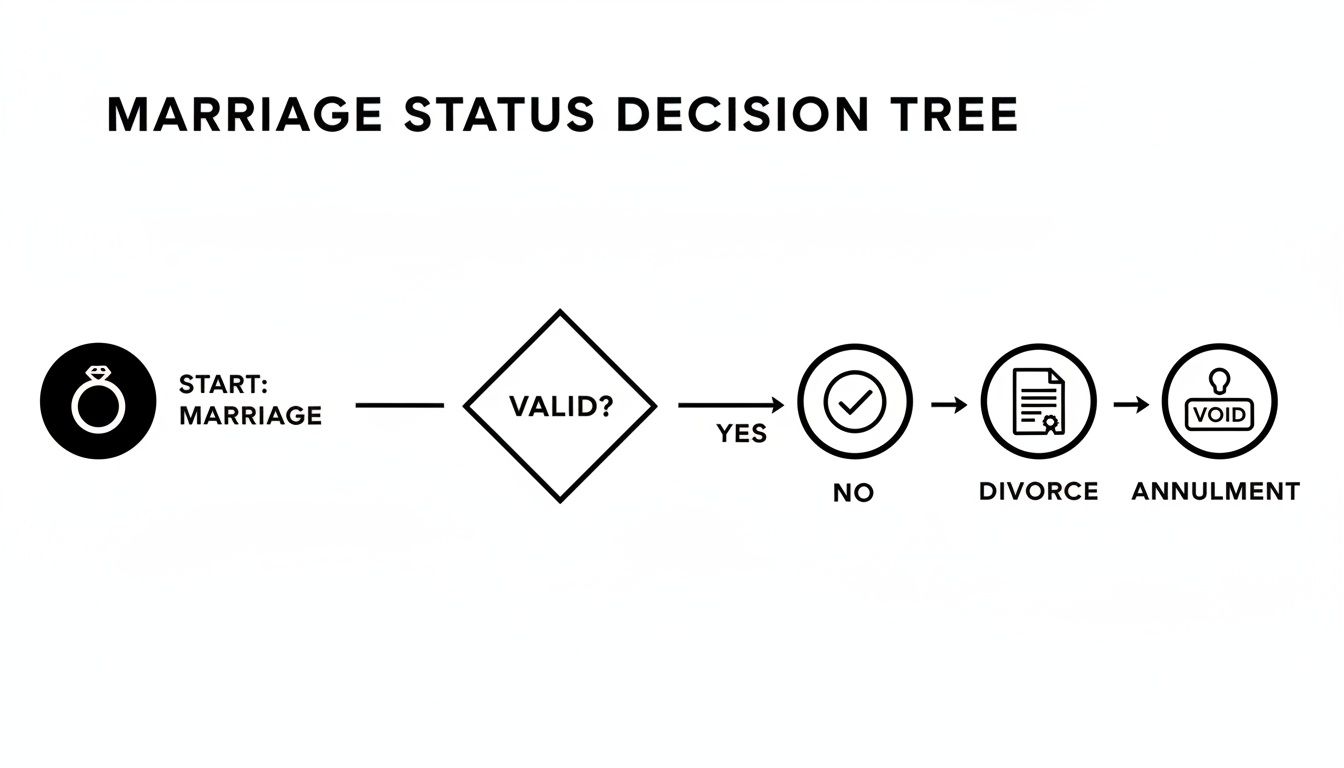
As you can see, an annulment is for marriages that were fundamentally flawed from day one. It's a completely different path from divorce, which is about ending a union that was perfectly legal when it started.
Common Annulment Grounds and Their Filing Deadlines
So, what are these grounds and how much time do you have? For most, Florida law requires you to file within a "reasonable time" after discovering the issue. While there isn't always a hard-and-fast number of days, any unreasonable delay gives your spouse a defense against your petition.
To give you a clearer picture, here’s a breakdown of common grounds and their general time sensitivity.
- Fraud or Misrepresentation: This occurs when one spouse intentionally lies about something central to the marriage, like their ability to have children or a major criminal past. The filing deadline is very time-sensitive. You must file promptly after discovering the fraud because continuing the marriage can be seen as "ratifying" or accepting it.
- Duress or Coercion: This applies if you were forced or threatened into marrying against your free will. The filing deadline is also very time-sensitive. The clock starts once you are free from the threat, and you must act quickly once you are safe.
- Mental Incapacity / Intoxication: This ground exists if, at the time of the ceremony, one person was too intoxicated or mentally incapable of consenting to marriage. This is time-sensitive. The person, or their guardian, must file once capacity is regained. Continuing the marriage after that point validates it.
- Bigamy (Already Married): This applies when one person was already legally married to someone else at the time of the wedding. There is no strict deadline for this, as the marriage was never legal to begin with (void) and its invalidity can be declared at any time.
- Incest (Close Relation): A marriage between closely related family members is illegal in Florida. Like bigamy, there is no strict deadline because this marriage is considered void from its inception and can be challenged at any time.
Let's dig into a few of these a bit more.
Fraud, Deceit, or Misrepresentation
This is one of the most frequent grounds we see. It happens when one person tricks the other into marriage by hiding or lying about something truly essential—like their desire or ability to have children, or a serious criminal record.
- The Deadline: You absolutely must file for an annulment as soon as you find out about the fraud. If you learn the truth and then continue living together as a married couple, the court will almost certainly say you've "ratified" (or accepted) the marriage, making it legally valid.
Duress or Coercion
If you were forced into marriage through threats or other forms of coercion, the union is voidable. Your consent wasn't freely given, which is a core requirement for a valid marriage.
- The Deadline: The clock starts ticking the moment you are free from the threat. It’s critical to file for the annulment once you are safe and able to do so. Staying in the marriage long after the danger has passed can seriously weaken your case.
Mental Incapacity or Intoxication
You have to be able to understand what you're doing to get married. If someone was so intoxicated or otherwise mentally impaired at the ceremony that they couldn't legally consent, the marriage might be annulled.
- The Deadline: The person who lacked capacity (or a legal guardian on their behalf) must file once they regain their senses. If they become lucid and then choose to continue the marital relationship, the marriage is typically considered ratified.
At Foley Family Law, we've helped clients from all walks of life, including first responders and members of the LGBTQ community, across Pasco, Pinellas, and Hillsborough Counties. We can help you navigate the specific annulment grounds relevant to your situation and figure out if you're still within the window to take action.
How Long the Annulment Process Actually Takes

So, you've figured out you're within the deadline to file. The next logical question is always, "How long will this actually take?" The answer really hinges on one simple thing: whether your spouse agrees with you or not.
Think of it like an insurance claim. A simple, clear-cut claim with all the right paperwork might get approved in a few weeks. But if the other party disputes the facts? That claim can get bogged down for months in investigations, back-and-forth arguments, and formal hearings.
An annulment works much the same way. There are two very different paths it can take, each with its own timeline.
The Uncontested Annulment Timeline
An uncontested annulment is the fast track. This is what happens when both you and your spouse agree on the reason for the annulment and are willing to sign all the necessary paperwork without a fight. In this scenario, things can move pretty quickly.
Since there are no arguments to settle, the case can often wrap up in just a few months. The main delays are just administrative—things like the court's filing schedule and waiting for a judge to review and sign off on the final order. For our clients here in Pasco, Pinellas, and Hillsborough Counties, we focus on making this process as efficient as possible when everyone is on the same page.
The Contested Annulment Timeline
But if your spouse fights the annulment, the timeline stretches out dramatically. A contested case is when one person disputes the very grounds you’re claiming. For instance, you might file based on fraud, but your spouse completely denies it and insists the marriage was legitimate.
When that happens, your case flips from a simple administrative filing into a full-blown legal battle. You now have the burden of proving your case to a judge, which means going through a formal court process.
A contested annulment can easily take anywhere from six months to over a year to resolve. The exact timing depends on a few key factors that can add significant delays.
The core difference in timelines comes down to agreement. An uncontested annulment is about paperwork and procedure; a contested annulment is about evidence, arguments, and ultimately, a judge's decision after a hearing or trial.
Factors That Delay a Contested Annulment
Several things can draw out a contested case. Knowing what they are from the start helps set realistic expectations—a principle we stand by at Foley Family Law for all our clients, including those in the LGBTQ community.
- Gathering Evidence: You can't just say there was fraud; you have to prove it. This phase, called "discovery," involves formally collecting documents, text messages, emails, financial records, and even sworn testimony from witnesses. It's a meticulous process that takes time.
- Court Schedules and Backlogs: The court systems in busy areas like Pasco, Pinellas, and Hillsborough Counties are often slammed. Just getting a date on the calendar for a hearing or trial can take months. Every motion that gets filed and every conference that gets scheduled adds to the overall clock.
- Hearings and Trials: If you and your spouse can't reach an agreement, your case is headed for trial. A judge will hear testimony from both of you, look at all the evidence, and then make a final ruling. The preparation alone can add a huge amount of time to your case, not to mention the trial itself.
This isn't just a Florida problem. Looking overseas, Spain's 2023 statistics on annulments and divorces show how court backlogs directly impact timelines. Their cases were resolved in a few different ways: 47,588 by judgment, 20,147 by decree, and 12,360 by public deed. This hints at faster tracks for simple agreements versus drawn-out judgments, which can take 6-18 months in their busier courts. You can see the breakdown in the official Spanish statistics on marriage dissolution.
At the end of the day, while everyone wants a quick resolution, a contested annulment is rarely a short journey. It demands patience, solid legal strategy, and a clear-eyed view of the road ahead.
Proving Your Case: The Evidence You Will Need
An annulment isn’t something the court grants just because you ask for it. It’s not about hurt feelings or simple regret; you have to prove, with cold, hard facts, that your marriage was invalid from the very beginning. Think of it like a legal argument where you’re the prosecutor—without solid proof, a judge has no reason to agree that the marriage should be wiped from the record.
The type of evidence you'll need hinges entirely on why you're seeking the annulment. Each legal ground has its own set of required proofs, and pulling this information together is arguably the most critical part of the process. This is where we spend a lot of time with our clients in Pasco, Pinellas, and Hillsborough Counties, helping them build a strong, evidence-based case for the court.
Matching Evidence to Annulment Grounds
To win an annulment, you have to strategically collect and present documents and testimony that directly back up your specific claim. It’s not enough to just tell the court you were tricked. You have to show the judge exactly how you were deceived and prove that the lie was so fundamental it went to the very heart of why you agreed to marry.
Here are a few real-world examples of the evidence needed for common annulment grounds in Florida:
- For Fraud: The evidence must point to a huge, intentional lie that was central to the marriage. This could be emails, text messages, or even dating app conversations where your spouse made false promises or claims. Testimony from friends or family who heard the same misrepresentations can also be incredibly persuasive.
- For Bigamy: This is often the most straightforward ground to prove. The slam-dunk evidence is the official marriage certificates from both marriages, clearly showing one person was legally married to two different people at the same time.
- For Mental Incapacity or Intoxication: Here, the proof has to focus on someone’s state of mind at the precise moment the ceremony took place. This might involve medical records, a psychological evaluation, or statements from witnesses who can testify that the person clearly lacked the capacity to give meaningful consent.
- For Duress or Coercion: You need to demonstrate that you were forced into the marriage against your will. Evidence could include threatening voicemails, text messages, or even testimony from people who witnessed the coercion as it happened.
The Importance of a Strategic Approach
Pulling all this evidence together can feel overwhelming, especially when you’re dealing with the emotional fallout. For our clients, including those with significant assets or those in the LGBTQ community, we always stress the need for a structured, methodical approach.
This process isn't unique to family law. For example, in the complex world of international arbitration, annulment proceedings are notoriously evidence-heavy and can drag on for years. This underscores just how tough it is to prove your case. The challenges are surprisingly similar to what families face right here in Florida when trying to void a marriage.
The strength of your annulment case rests almost entirely on the quality and presentation of your evidence. It’s not just about what you know; it’s about what you can prove in court.
If a key piece of your evidence is a foreign marriage certificate, you can't just hand the judge a photocopy. Courts have strict rules. You will almost certainly need a certified marriage certificate translation to ensure the document is admissible. The success of your entire petition can hinge on getting these formal requirements right, leaving no room for the other side to challenge the validity of your proof.
Navigating The Annulment Process With Foley Family Law
This journey requires a clear head and a steady hand. We've walked through the complicated question of "how long can you get an annulment," unpacking the two very different timelines involved: the hard deadline to file your case and the actual time it takes for the court process to play out. If there's one thing to take away, it's that the answer is always unique to your life and your circumstances.
At Foley Family Law, our job is to offer compassionate, professional guidance to everyone in our community. We are proud to serve clients across Pasco, Pinellas, and Hillsborough Counties, making sure every person—including our valued clients in the LGBTQ community—gets the dedicated legal support they deserve.
Your Next Step Toward Clarity
Thinking about an annulment can leave you feeling isolated and confused. What you need right now is a definitive plan of action, not more uncertainty. Our consultations are designed to give you exactly that. We’ll sit down with you, listen to your story, analyze the facts of your case, and give you a straightforward assessment of your options under Florida law.
We want to empower you to move forward with confidence. Just knowing you have an experienced team ready to fight for you can make all the difference. When you're considering a firm like ours, it helps to know what to expect from that very first conversation. In fact, a complete guide to law firm client intake can pull back the curtain on those initial steps, showing how a structured process builds the foundation for a strong case.
The goal of a consultation isn't just to get legal advice; it's to create a clear, actionable roadmap. You should leave with a full understanding of your legal standing, the potential challenges ahead, and the specific steps needed to pursue your goals.
Whether you're just starting to explore your options or you're ready to file a petition, the path to a fresh start begins with a single, informed step. Our team is here to make sure you take that step on solid ground. We're dedicated to protecting your rights and helping you secure a fair outcome so you can finally close this chapter and begin a new one.
To see how we can help, you can learn more about our local family law attorney services and what we offer clients right here in the Tampa Bay area.
Frequently Asked Questions About Florida Annulments
When you're exploring something as complex as an annulment, questions are bound to come up. Below, we've tackled some of the most common ones we hear from our clients right here in the Tampa Bay area. Our goal is to give you clear, straightforward answers to help you figure out your next steps.
Can I Get An Annulment If We Have Children Together?
Yes, absolutely. This is a big point of confusion for many people, but having children together does not automatically disqualify you from getting an annulment in Florida.
If the court agrees to annul the marriage, it essentially declares that the marriage never legally existed. However, the law is designed to fully protect the children's rights and well-being, no matter what.
The court will address all the critical issues just as it would in a divorce case, including:
- Establishing legal paternity.
- Creating a detailed parenting plan that covers parental responsibility and time-sharing.
- Ordering child support payments to ensure the children's financial needs are met.
The children's welfare is always the court's top priority, whether the parents' relationship ends through divorce or annulment.
What Happens To Property And Debt In An Annulment?
This is where an annulment and a divorce really part ways. In a typical divorce, Florida law requires the "equitable distribution" of all assets and debts accumulated during the marriage. But in an annulment, the whole point is to legally erase the marriage.
The goal is to put both people back in the same financial position they were in before they got married. Since the marriage is treated as if it never happened, the idea of "marital property" doesn't quite fit.
Generally, you’ll walk away with the assets and debts you brought into the union. Things get tricky when you've acquired property or taken on debt together. The court has to carefully unwind those joint finances to get a fair outcome. For high-net-worth couples in Pasco, Pinellas, or Hillsborough Counties, this process can be incredibly complex—making it crucial to have an experienced attorney protecting your financial future.
Is An Annulment Faster Or Cheaper Than A Divorce?
Not always. It’s a stubborn myth that an annulment is the quick and easy way out. The truth is, a simple, uncontested divorce is often much faster and more affordable than a contested annulment.
Why? It all comes down to the burden of proof.
To get an annulment, you have to prove specific legal grounds with hard evidence. If your spouse pushes back and disputes your claims, it can ignite a much more intense and drawn-out legal battle than a standard divorce would. The most efficient and cost-effective path truly depends on the specific facts of your situation.
At Foley Family Law, we provide the clear-headed guidance you need to understand all your options. If you are in Pasco, Pinellas, or Hillsborough Counties and have questions about the annulment process, contact us for a consultation to create your plan of action. Visit us at https://wfoleylaw.com to get started.


