

When it comes to figuring out alimony in Florida, the entire process hinges on one simple, two-part question: does one spouse have a real financial need for support, and does the other have the ability to pay it?
Before a single calculator comes out, the judge first has to answer "yes" to both parts of that question. This initial step, called establishing entitlement, is the foundation for everything that follows. Our firm handles all family and divorce issues, including for our LGBTQ clients, and we do not discriminate. We practice in Pasco, Pinellas, and Hillsborough Counties.
Understanding Alimony Need Versus Ability To Pay

It’s almost unheard of for two people to walk away from a marriage on perfectly equal financial footing. Often, one person put their career on the back burner to raise kids or manage the household, creating a major income gap over the years. Florida law sees this and uses alimony to prevent one spouse from falling into financial distress while the other continues to live the lifestyle you built together.
Think of it as a balancing act. On one side, you have the spouse asking for support. The court will dig into their monthly expenses, income, and what they could realistically earn to figure out their genuine need.
On the other side is the spouse who would be paying. The court looks at their income, assets, and their own reasonable expenses to determine their ability to pay without creating an unfair financial burden on them. The goal is to find a fair balance point.
The First Step: Are You Entitled to Alimony?
Before anyone starts crunching numbers, a judge has to decide if a spouse is even entitled to get alimony in the first place. It’s not a given. This is a critical first hurdle, and the court looks at several factors to make this call.
To help clarify this crucial first step, here’s a quick checklist of what a Florida court considers to establish entitlement before calculating any dollar amount.
Florida Alimony Entitlement Factors
- Length of the Marriage: Florida law has specific definitions for short-term, moderate-term, and long-term marriages. This heavily influences whether alimony is appropriate and for how long.
- Standard of Living: The lifestyle you and your spouse established during the marriage is the benchmark used to determine the receiving spouse's needs.
- Each Spouse's Financial Picture: This is a complete inventory of all income sources, assets (like retirement accounts and property), and debts for both parties.
- Age and Health: The physical and emotional condition of each spouse can impact their ability to work and support themselves.
- Contributions to the Marriage: The court looks at all contributions, including homemaking, childcare, and supporting the other spouse’s career or education.
- Parental Responsibilities: The needs of any minor children you share will be considered.
Once entitlement is confirmed, the actual calculation is surprisingly straightforward. Alimony is set at whichever amount is lower: the requesting spouse's proven need or the paying spouse's ability to pay after covering their own reasonable expenses. The Florida Bar provides detailed guidance on how courts determine income and need, which is the playbook judges follow.
This fundamental analysis of need and ability applies to everyone, including LGBTQ+ couples, across Hillsborough, Pinellas, and Pasco Counties. Our firm is dedicated to making sure every client, regardless of gender or sexual orientation, gets a fair shake. We handle every divorce and family law issue with the respect and expertise it deserves.
Exploring The Main Types Of Florida Alimony

Once a judge decides that alimony is appropriate in a divorce, the next question is: which kind? Florida law doesn’t use a one-size-fits-all approach. Instead, it offers several distinct types of alimony, each one a different tool designed for a specific financial purpose.
Figuring out the right tool for the job is a critical part of the process. The type of alimony awarded determines not only how much is paid but, just as importantly, for how long. The goal isn't to punish one spouse but to create a fair and manageable transition from married to single life. For our clients across Tampa Bay, in counties like Pasco, Pinellas, and Hillsborough, understanding these options is the first step toward picturing what their financial future might look like.
Bridge-The-Gap Alimony
Just like it sounds, Bridge-the-Gap Alimony is meant to cover specific, short-term needs that pop up as a spouse transitions to being single. Think of it as a financial bridge to get from point A to point B, not a long-term support system.
A classic example is helping a spouse get set up in their own place. Bridge-the-Gap funds could cover a security deposit and the first month’s rent on a new apartment. This type of support is meant for identifiable, immediate costs. It's set in stone—it can't be modified later, and it absolutely cannot last for more than two years.
Rehabilitative Alimony
Rehabilitative Alimony is an investment in a spouse’s future. It's awarded specifically to help someone get the education or training they need to become self-sufficient. This isn’t just a blank check; it's support tied directly to a concrete, court-approved plan.
To secure this type of alimony, the receiving spouse must present a detailed roadmap to the court. This plan might include:
- The specific degree or vocational program, including its cost and timeline.
- A clear outline of the steps needed to re-enter a former profession after being out of the workforce.
- Proof that the plan is realistic and will lead to actual employment.
Because it's tied to a plan, rehabilitative alimony can be modified. If the spouse finishes their degree early or, conversely, fails to keep up with the plan, the payments can be adjusted or terminated.
Key Takeaway: Rehabilitative alimony isn't just about financial support; it's about executing a plan. The court needs to see a specific, actionable strategy for a spouse to acquire the skills needed to stand on their own two feet.
Durational Alimony
When other forms of support just don't fit the situation, we often see Durational Alimony. It provides financial assistance for a set period of time, most commonly after a short or moderate-length marriage. This is often the default form of support when the marriage wasn't long enough to warrant something more substantial, but one spouse still has a clear need.
The key rule here is that the length of durational alimony cannot be longer than the marriage itself. If you were married for ten years, you can’t receive durational alimony for more than ten years. While the amount can be modified if there’s a significant change in either spouse's circumstances, the duration is typically fixed. Our firm has deep experience with these nuances in Pasco, Pinellas, and Hillsborough Counties.
Permanent Alimony
This is where the landscape has dramatically changed. As of July 1, 2023, Florida law eliminated Permanent Alimony for any new divorce case. This was a monumental shift in how long-term support is handled in our state.
Previously, permanent alimony was often awarded after long-term marriages to provide financial support for the rest of a spouse's life. Now, that option is off the table. Even in very long marriages, durational alimony is the primary tool the court will use. We are committed to helping all members of our community, including our gay and transgender clients, navigate these significant legal updates and what they mean for their futures.
The Key Factors That Determine Your Alimony Award
Once a Florida judge decides that one spouse is entitled to alimony and the other has the ability to pay, the real work begins. The next step is figuring out the exact amount and duration of the support. This isn't a simple math problem or a one-size-fits-all formula.
Instead, the court must carefully consider a specific list of factors outlined in Florida law. Think of these as the key ingredients the judge weighs to create a final alimony award. For our clients in Hillsborough, Pinellas, and Pasco Counties, building a strong case means presenting compelling evidence for each of these points.
Standard Of Living And Length Of The Marriage
The first two factors are often the most influential in the entire analysis. The standard of living you and your spouse established during the marriage acts as a benchmark. A judge's goal is to ensure the receiving spouse can maintain a lifestyle as close as reasonably possible to the one they had while married.
Next, the length of the marriage plays a massive role. A ten-year marriage is viewed very differently from a three-year one, and this duration directly impacts the type and length of any potential alimony award. As a general rule, longer marriages tend to result in longer-term support.
Age, Health, And Emotional Condition
The court takes a practical look at the age and physical and emotional health of both spouses. A healthy 40-year-old has a much different earning potential and ability to become self-sufficient than a 62-year-old dealing with a chronic illness.
Issues like a disability can severely limit a person's ability to work, making this a critical factor in the court's decision. The law demands a compassionate and realistic assessment of how each person's health will shape their financial future.
A judge must consider all relevant economic factors, including the age and health of each party. This ensures that the final alimony award is fair and reflects the real-world circumstances of both spouses as they move forward with their lives separately.
Financial Resources And Earning Capacity
Here, the court conducts a thorough review of the financial resources of each party. This includes both marital and non-marital assets and debts that are divided during the divorce. If one spouse receives an income-producing asset, such as a rental property, it will likely reduce their demonstrated need for alimony.
At the same time, the judge evaluates the earning capacities, educational levels, and vocational skills of each person. The court looks at not just what someone is earning, but what they could realistically be earning in the current job market with reasonable effort.
This is a critical area where our firm, which proudly serves all families including LGBTQ+ clients in Pasco, Pinellas, and Hillsborough Counties, provides immense value. We help you gather the necessary evidence to present a clear, accurate picture of your financial situation.
Contributions To The Marriage
Florida law is clear: contributions to a marriage aren't just about money. The court gives significant weight to a spouse's role as a homemaker, parent, and caregiver.
This includes:
- Managing the household and raising children, which allowed the other spouse to build their career.
- Supporting the other spouse's education or professional growth.
- Sacrificing one's own career ambitions for the good of the family.
Acknowledging these non-monetary contributions is essential for creating a fair alimony award that truly reflects the partnership that defined the marriage.
Parental Responsibilities And Tax Consequences
Finally, the court considers the responsibilities each spouse will have for any minor children. The needs of the children are always a top priority, and alimony calculations are made with their well-being in mind.
The tax treatment and consequences for both the paying and receiving spouse are also factored into the equation. The court needs to understand the true financial impact of the alimony award after taxes. All sources of income available to either party are put on the table to ensure a complete and equitable financial picture before a final decision is made.
How Informal Formulas Can Shape Your Settlement
Florida law is crystal clear: there is no official, statewide alimony calculator. A judge in Pasco, Pinellas, or Hillsborough County won't punch numbers into a spreadsheet to decide your case. But that doesn't mean lawyers start settlement talks from scratch.
Behind the scenes, we often use a few informal formulas as a reality check—a starting point for negotiations. Knowing what these are can take the mystery out of the initial numbers you see, giving you a better handle on where your attorney is coming from.
Think of them as negotiation tools, not legal mandates. They simply provide a practical framework to help both sides find a reasonable middle ground before ever setting foot in a courtroom.
A Common Starting Point: The Gross Income Differential
One of the most common back-of-the-napkin calculations we use looks at the gap between what you and your spouse earn each month. While it's not a hard-and-fast rule, it gives everyone a quick snapshot of a potential alimony range.
The approach is straightforward: we take a percentage of the difference between the higher earner's gross monthly income and the lower earner's. That percentage usually lands somewhere between 20% and 30%.
Let's imagine a Tampa couple:
- Spouse A’s Gross Monthly Income: $10,000
- Spouse B’s Gross Monthly Income: $3,000
- The Difference: $7,000
Using this informal method, a reasonable starting point for alimony talks might be between $1,400 per month (20% of $7,000) and $2,100 per month (30% of $7,000). Again, this isn't a final number, but it gives both sides a concrete range to begin their discussions.
Important Note: These formulas are just tools. The final alimony amount will always be shaped by the statutory factors, such as the standard of living, length of the marriage, and each person’s health and contributions.
Those factors are what truly matter. They provide the essential context that no simple calculation can capture. This chart shows how those core elements fit into the bigger picture.
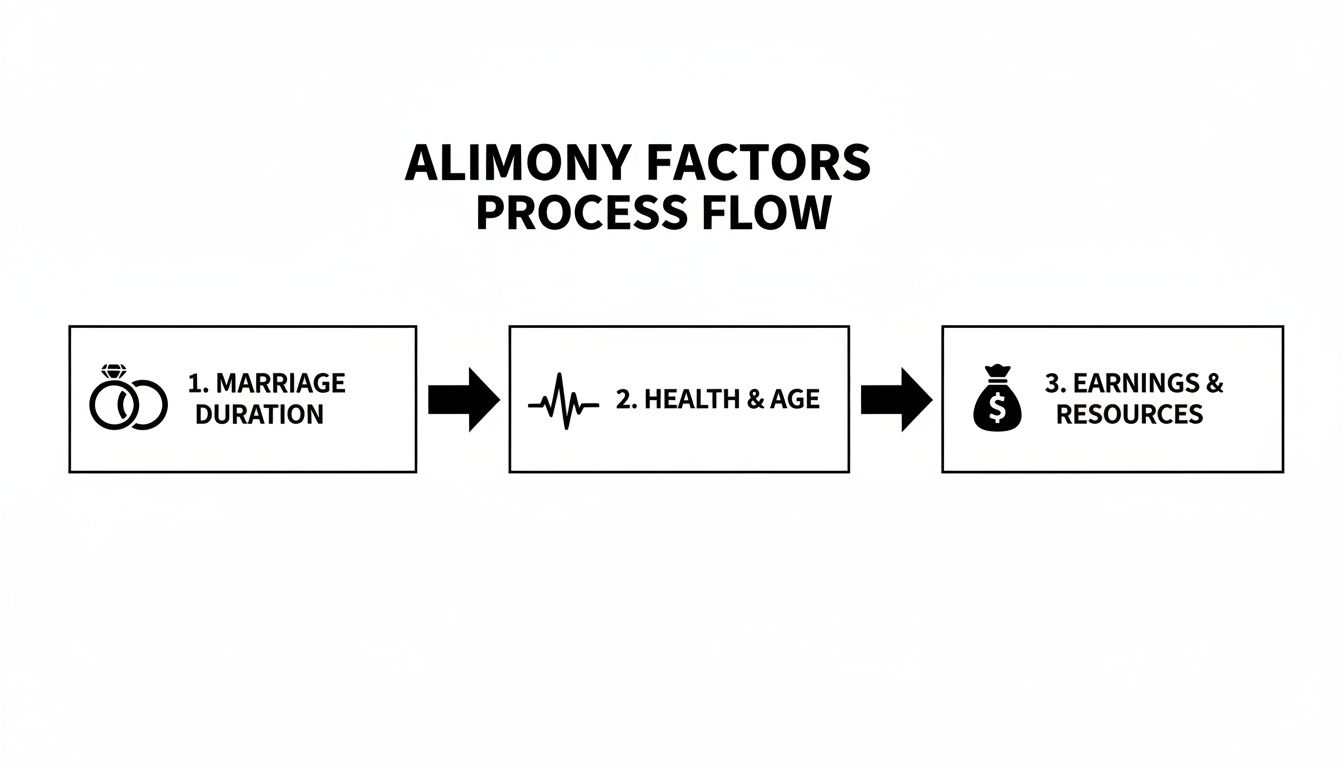
As you can see, critical details like the length of your marriage, your health, and what each of you can earn are the real foundation. At our firm, we’re committed to making sure these factors are applied fairly for all families, including those in the LGBTQ+ community in the Pasco, Pinellas, and Hillsborough county areas.
These formulas give us a place to begin, but the unique facts of your life are what ultimately fill in the details. To get a better sense of what this could look like in your situation, check out our guide on how much alimony to expect.
How Property Division And Child Support Affect Alimony

Alimony is never decided in a vacuum. It’s one critical piece of a much larger financial puzzle that includes dividing your marital property and, if you have kids, figuring out child support. Florida law sets out a very specific sequence for handling these interconnected parts, and understanding this order is the key to seeing the complete financial picture of your divorce.
Think of it as a legal domino effect—one decision directly knocks over the next. For anyone with assets or children in Pasco, Pinellas, or Hillsborough Counties, grasping this sequence helps you manage your expectations for the final outcome. It’s a process we’re deeply familiar with, and we make sure it’s applied correctly for all our clients, including gay and transgender individuals and families.
Equitable Distribution Comes First
Before a judge even thinks about an alimony figure, they must first divide your marital property and debts. This process, known as equitable distribution, is the first and most important domino. The result of property division directly shapes the alimony conversation that follows.
The assets and debts you walk away with fundamentally change your financial “need.” For example, if you receive an income-producing rental property during the division phase, your need for spousal support will likely go down. On the other hand, if you’re assigned a large chunk of marital debt, your need for support might go up.
This first step sets the financial stage for everything else. Our clients in the Tampa Bay area, including Pasco, Pinellas, and Hillsborough counties, benefit from Florida’s distinct approach, where putting equitable distribution first often helps protect assets, especially in high-asset divorces.
Alimony Is Figured Before Child Support
Once the marital property is divided, the court then turns to alimony. It is only after an alimony amount has been determined that the court will calculate child support. This order is non-negotiable and has a massive impact on the final numbers.
The reason for this is simple: alimony payments are counted as income for the person receiving them and are a deduction from the income of the person paying them. This shift changes the net income figures used for both parents.
This sequence is vital: Alimony payments directly alter the incomes used in the Florida Child Support Guidelines Worksheet. Calculating child support first would lead to an incorrect result, as it would not account for the financial shift created by the alimony award.
This means the alimony decision absolutely must be finalized before you can accurately figure out the child support obligation. It directly influences how much money each parent has available to support the children.
Because these calculations are so tightly woven together, it’s critical to have a clear strategy that addresses all three pieces—property, alimony, and child support—as a whole. Our firm has extensive experience in this area, and you can dive deeper by reading our guide on how to calculate child support in Florida.
How An Attorney Can Guide Your Alimony Strategy
Trying to figure out alimony in Florida can feel like assembling a 1,000-piece puzzle without the picture on the box. You know the core pieces are there—one spouse’s financial need versus the other’s ability to pay. But the final picture is shaped by a long list of legal factors and is directly tied to how your property is divided and how child support is calculated.
Going it alone is not just overwhelming; it can lead to financial mistakes that last for years. This is where an experienced family law attorney isn't just helpful—they're essential. A good lawyer does far more than file paperwork. They build a clear, practical strategy to protect your rights and secure a fair financial future.
Building a Clear Path Forward
A skilled attorney translates the dense language of Florida law into a concrete game plan. They’ll help you dig up the right financial documents, coach you on how to present your case, and give you a realistic idea of how a judge in Pasco, Pinellas, or Hillsborough County will likely see your situation. That kind of local insight is priceless, whether you're trying to negotiate a settlement or gearing up for a court battle.
Your attorney’s job is to:
- Dig into the financials to build a rock-solid case for need or ability to pay.
- Gather the proof needed to back up your position on key factors, like the standard of living during the marriage or each spouse's contributions.
- Explain the "back-of-the-napkin" math that often drives initial settlement offers, so you know a good deal when you see one.
- Fight for an outcome that actually works for your life, not just on paper.
A strong alimony case is really about telling the story of your marriage. It’s about presenting the financial reality—backed by hard evidence—in a way that is compelling and legally sound. Your attorney is the one who helps you tell that story effectively.
A Firm for Every Family
Our firm is built on the idea of helping all kinds of families get back on their feet during a divorce. We have deep roots in the Tampa Bay area, with years of experience assisting clients from every walk of life in Pasco, Pinellas, and Hillsborough Counties.
We are also proud to offer inclusive and respectful representation for all LGBTQ+ issues. From navigating a gay divorce or custody issues to handling a gay or transgender name change, we ensure every single client receives the dedicated, knowledgeable advocacy they deserve. We do not discriminate and handle all LGBTQ family and divorce issues.
The decisions made about alimony will shape your life for years to come. Making sure they're the right ones starts with getting the right advice. If you're looking for guidance, our article on how to choose a divorce attorney in Florida is a great place to start. The next step is to schedule a consultation so we can start building a plan tailored to you.
Frequently Asked Questions About Florida Alimony
When a marriage ends, questions about alimony are almost always at the top of the list. In our work with clients across Pasco, Pinellas, and Hillsborough Counties, we’ve heard just about every concern you can imagine. This section cuts straight to the chase, providing clear answers to the practical questions we hear most often.
Our firm is committed to guiding every family through this process with the respect and diligence they deserve. That includes our LGBTQ+ clients navigating divorce, custody, or other family law matters.
Can I Modify My Alimony Payments?
Yes, in many cases. Most types of Florida alimony can be modified, but only if there has been a substantial, material, and unanticipated change in circumstances for either you or your former spouse. This could be a major, involuntary job loss, a significant promotion, or reaching retirement age.
The key word here is "unanticipated." A change that was expected when the alimony was first ordered won't be enough. The spouse asking for the modification has the burden of proving to the court that the change is real and justifies a new alimony amount.
What Happens If My Ex Stops Paying Alimony?
If the alimony checks stop coming, you have powerful legal options. The first step is usually to file a Motion for Contempt and Enforcement with the court that issued the original order. A judge doesn't take non-payment lightly.
A court can enforce the order using several tools, including:
- Ordering immediate payment of all past-due amounts, often with interest.
- Garnishing your ex-spouse's wages directly from their paycheck.
- Suspending their driver’s license.
- In extreme cases of willful refusal to pay, even ordering jail time.
Key Insight: An alimony award is a binding court order. Failing to pay has serious legal consequences, and the courts provide strong tools to make sure the receiving spouse is protected.
Does Adultery Affect How Alimony Is Figured?
This is a common question, and the answer often surprises people. While cheating can feel like the ultimate betrayal, it generally has a very limited impact on alimony calculations in Florida. That’s because Florida is a "no-fault" divorce state, which means you don’t have to prove someone did something wrong to end the marriage.
However, adultery can matter if it involved spending marital money. For example, if one spouse spent thousands on expensive gifts, lavish trips, or otherwise supported an affair partner using family funds, a judge can consider that financial waste when dividing property and awarding alimony. To get clear guidance on how the specifics of your case might play out, it's vital to speak with expert family lawyers.
How Is Alimony Taxed?
For any divorce or separation agreement finalized after December 31, 2018, the tax rules are straightforward.
Under the federal Tax Cuts and Jobs Act of 2017, alimony payments are no longer tax-deductible for the person who pays them. On the flip side, the payments are not considered taxable income for the person who receives them.
Making sure your rights are protected during an alimony case requires a strategic and knowledgeable approach. The team at Foley Family Law is here to provide the guidance you need. Contact us today to schedule a consultation and create a plan of action for your future. Visit us at https://wfoleylaw.com.


