

When you’re facing a divorce in Pasco, Pinellas, or Hillsborough County, one of the first questions that hits you is a big one: how expensive is this going to be?
The truth is, there’s no single price tag. The cost of a Florida divorce is a spectrum. A straightforward, uncontested case where you both agree on everything might run around $4,100. On the other end, a complex, contested divorce can easily reach $15,900 or more. The final bill almost always comes down to one thing: how much you and your spouse disagree.
The Real Cost Of Divorce: A Quick Answer For Floridians
Thinking about divorce brings a wave of financial uncertainty. It's more than just ending a marriage; you're untangling a shared life, and that process has very real costs. Getting a handle on these potential expenses from the start helps you budget, set realistic expectations, and make smarter decisions during a truly difficult time.
The cost of your divorce is tied directly to its complexity and the level of conflict. An uncontested divorce, where you and your spouse are on the same page about dividing assets, child custody, and everything in between, will always be the most affordable route.
But when disagreements force you into lengthy negotiations, mediation, or courtroom battles, the legal fees start to climb—often significantly.
National Averages Provide A Starting Point
While every divorce is unique to the people involved, national statistics give us a useful benchmark. Across the U.S., the average divorce costs about $11,300.
Here’s a rough breakdown based on recent 2025 estimates:
- A simple, no-contest divorce typically costs around $4,100.
- A contested divorce without alimony disputes averages $7,800.
- Add a fight over alimony, and that average jumps to $15,900.
This chart really brings home how quickly conflict can drive up the price.
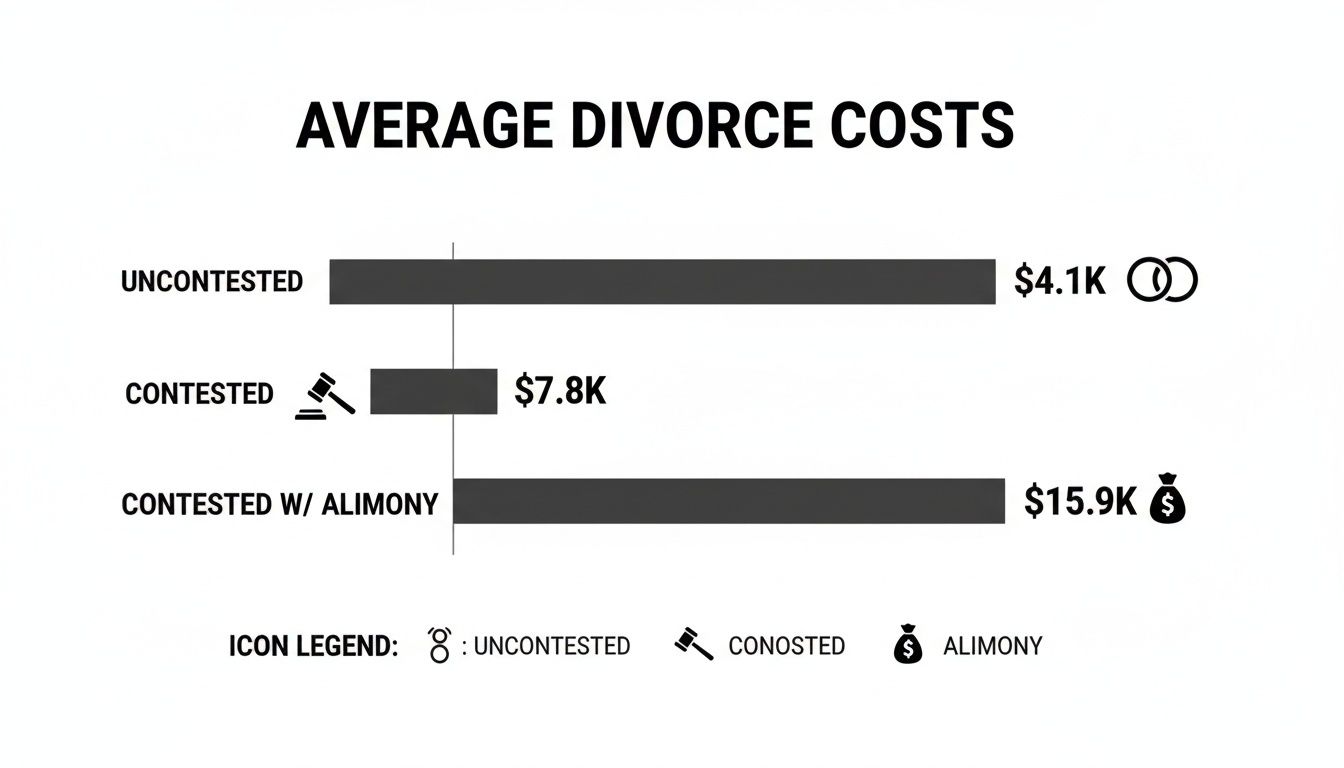
The data is clear: finding a way to resolve major issues like alimony outside of a courtroom is the single best way to keep your costs under control.
To give you a clearer picture, here’s a quick overview of what you can generally expect in Florida.
Florida Divorce Cost Spectrum At A Glance
DIY / Uncontested:
- Typical Florida Cost Range: $500 – $1,500
- Key Influencing Factors: Filing fees, notary services, minimal paperwork assistance. Assumes zero disagreements.
Uncontested with Attorney:
- Typical Florida Cost Range: $2,500 – $5,000
- Key Influencing Factors: Flat-fee or hourly rates for drafting and filing an agreement. Ensures paperwork is correct.
Mediation / Collaborative:
- Typical Florida Cost Range: $4,000 – $8,000
- Key Influencing Factors: Mediator fees, attorney review fees. Cost-effective if an agreement is reached.
Contested (Minor Issues):
- Typical Florida Cost Range: $7,000 – $15,000
- Key Influencing Factors: Multiple hearings, discovery process, some negotiation. Fights over specific assets or parenting time.
Contested (Major Issues):
- Typical Florida Cost Range: $15,000+
- Key Influencing Factors: High-conflict custody battles, business valuations, hidden assets, extensive litigation, and potential trial.
This breakdown shows how quickly the price escalates once conflict enters the picture. The more you and your spouse can agree on, the more money you both keep in your pockets.
Core Components Of Your Divorce Bill
No matter which path your divorce takes, the final bill is built from a few key components. Think of these as the building blocks of your total cost.
- Attorney Fees: This is almost always the biggest expense. It covers your lawyer's time, strategic advice, and legal expertise from start to finish.
- Court and Filing Fees: These are the mandatory administrative costs the Florida court system charges just to open and process your case.
- Mediation Costs: In Florida, couples are often required to try mediation to resolve their disputes before they can go to trial. You’ll split the cost of the mediator.
- Expert and Professional Fees: For more complicated cases, you might need to hire outside experts like business appraisers, forensic accountants to trace money, or custody evaluators.
Breaking it down this way helps demystify where the money goes. Of course, the financial cost is just one piece of the puzzle. You’re probably also wondering how long all of this will take. You can get a complete picture by checking out our guide on how long a Florida divorce takes.
We proudly represent clients from all walks of life, including the LGBTQ+ community, and we do not discriminate.
Breaking Down Your Bill: What You Are Actually Paying For

When the bill from your attorney arrives, it's not just some big, mysterious number. The first step to managing your budget and feeling in control of the process is understanding exactly what goes into that total.
Think of it like a receipt for a major home renovation. Every line item represents a specific service or cost that’s essential to building your new future. From your lawyer's strategic guidance to mandatory court fees, knowing what you’re paying for demystifies the bill and shows how each service works to protect your interests.
Attorney Retainers And Hourly Rates
This is almost always the largest part of your divorce expenses. Most family law attorneys in Florida, including those serving Pasco, Pinellas, and Hillsborough Counties, work on an hourly basis and require an initial payment known as a retainer.
A retainer isn't a flat fee that covers the entire divorce. It's more like a down payment—an upfront deposit that your attorney bills their time against. As they work on your case by drafting documents, making phone calls, or appearing in court, they deduct their hourly rate from that balance. You’ll get regular invoices detailing every charge, and if the retainer runs out, you may need to add more funds to it.
This model ensures your legal team is paid for the specific expertise and time they dedicate to your unique situation.
Mandatory Court And Filing Fees
Before your divorce can even get started, the Florida court system requires certain administrative fees. These are non-negotiable costs charged by the state just to officially file your petition and get the case moving.
In Florida, the standard filing fee for a divorce is approximately $409. While this can vary slightly by county, it’s a fixed cost you should plan for right from the start.
You might also see other court-related costs, like fees for serving your spouse with divorce papers, filing motions, or getting certified copies of documents. They’re smaller than your attorney's fees, but they are an unavoidable part of the process.
Mediation And Alternative Dispute Resolution
Many judges in Florida require couples to at least try mediation before they’ll even consider hearing a case at trial. Mediation is a process where a neutral third party—the mediator—helps you and your spouse negotiate a settlement. It’s often a far more cost-effective and less combative way to resolve disagreements.
The costs for mediation are usually split between both parties. You're paying for the mediator's time, with the goal of reaching a binding agreement without the immense expense and stress of a courtroom battle. At Foley Family Law, we strongly recommend mediation and collaborative divorce to help our clients manage the financial side of things.
The Cost Of Third-Party Experts
Sometimes, a divorce involves assets or situations that need specialized knowledge. When that happens, you may need to hire outside experts to provide objective, professional opinions that can be presented in court. The more complex your finances are, the more likely it is you'll need these services.
Common experts you might see in a divorce case include:
- Property Appraisers: To determine the fair market value of real estate, like the marital home.
- Forensic Accountants: To trace hidden assets, uncover undisclosed income, or put a value on a family-owned business.
- Custody Evaluators or Guardians ad Litem: To give the court recommendations on what's in the best interests of the children.
These professional fees are separate from your attorney’s bill, but they are absolutely critical for ensuring a fair and equitable division of assets and parenting time. This is a key part of the financial discovery process in any divorce. To learn more, check out our guide on the critical steps involved in discovery for divorce in our comprehensive guide.
Key Factors That Drive Up The Cost Of Divorce
Why does one divorce cost a few thousand dollars while another spirals into a bill that looks more like a down payment on a house? The answer isn't about who filed first or who gets the bigger half of the furniture. The single biggest factor that determines how expensive a divorce will be is conflict.
Think of it this way: a peaceful, uncontested divorce is like taking a direct flight. It's quick, efficient, and you get to your destination with minimal fuss and expense. A contested divorce, however, is a flight with endless layovers, delays, and unexpected fees. Every disagreement is another stop that adds time and money to the journey.
The Great Divide: Contested Versus Uncontested
In an uncontested divorce, you and your spouse have already agreed on all the major issues—how to divide property, who the children will live with, and whether anyone will pay alimony. Your attorney’s job is primarily to formalize that agreement and ensure the paperwork is filed correctly with the Florida courts. This drastically reduces the hours required, keeping costs low.
A contested divorce is the opposite. It means you disagree on one or more fundamental issues. These disputes require your attorney to spend significant time on negotiation, discovery, preparing for hearings, and potentially going to trial. Each step adds hours to your bill, turning what could have been a manageable expense into a significant financial burden.
The bottom line is simple: the more you argue, the more you pay. Finding common ground is not just emotionally healthier; it's a powerful strategy for financial preservation during a divorce.
We help clients in Pasco, Pinellas, and Hillsborough Counties understand this from day one, focusing on strategies that minimize conflict wherever possible.
Fights Over Children And Finances
Beyond the general level of conflict, certain specific disputes are notorious for driving up costs. These are the issues where emotions run highest and financial stakes are significant, making them common battlegrounds.
The two primary cost-drivers in a contested Florida divorce are:
- Child Custody and Timesharing: Disputes over where children will live and how parenting decisions will be made are incredibly taxing, both emotionally and financially. These conflicts can require custody evaluations, testimony from experts, and multiple court hearings, all of which add substantial costs.
- Alimony and Spousal Support: Arguments over whether alimony should be paid, how much, and for how long can be intensely complex. Answering these questions often involves a deep dive into both spouses' financial histories and future earning potential. For more detail, you can explore the nuances of how alimony is determined in Florida.
Any disagreement over these points guarantees a more expensive divorce.
Complex Assets And Special Circumstances
Not all assets are created equal when it comes to divorce. While splitting a simple bank account is straightforward, some financial situations require specialized expertise, which naturally increases the cost.
For example, high-net-worth individuals or those with military pensions face unique challenges. Costs can skyrocket when a case requires forensic accountants to trace assets or value a family business. According to recent data, contested divorces in 2025 are projected to average $20,000 per person, and that's before adding the fees for specialized experts like business valuators. You can discover more insights about these divorce cost projections.
Other factors that increase complexity and cost include:
- Dividing a Family Business: Determining the value of a business and one spouse's share is a complicated process.
- Military Divorce: Specific rules govern the division of military retirement benefits and pensions, requiring an attorney with specific experience.
- Hidden Assets: If one spouse suspects the other is hiding money or property, it may take a forensic accountant to uncover the truth.
By understanding these potential friction points early on, you can work with your attorney to build a realistic budget and a strategy aimed at resolving them as efficiently as possible. Our firm is committed to supporting everyone, including our LGBTQ clients, through these complex issues with clarity and compassion.
How To Understand Attorney Fees And Payment Options
For most people going through a divorce, the attorney's bill will be the single largest expense. It's a daunting prospect, but understanding how lawyers charge for their services is the first step toward managing your budget and feeling in control of the process. When you know what to expect, you can ask the right questions and make confident financial decisions from the very start.
In Florida, family law attorneys almost always use one of two billing models for divorce cases. The most common by far is the hourly rate with a retainer. For simpler, uncontested situations, a flat-fee structure might be on the table.
The Retainer And Hourly Rate Model
The go-to arrangement for divorce representation in Pasco, Pinellas, and Hillsborough Counties is the retainer model. A retainer is an upfront payment you make to the law firm that gets held in a special trust account. It is not a flat fee for the whole case; think of it as a down payment or a security deposit.
As your attorney works on your case—making phone calls, drafting documents, responding to emails, or appearing in court—they bill their time against this retainer balance at a set hourly rate. You'll get detailed monthly statements showing exactly how much time was spent on each task. If the retainer funds run out, you will need to replenish them so work on your case can continue.
The total cost is directly tied to the amount of time your case requires. A highly contested divorce with many disagreements will require more attorney hours, thus costing more than a case where spouses cooperate.
This model is standard because it ensures you only pay for the actual work performed on your behalf.
Flat Fee Arrangements For Simple Cases
In some specific situations, an attorney might offer a flat-fee arrangement. This payment structure is usually reserved for very straightforward, uncontested divorces where both parties have already agreed on all major terms before hiring legal help.
With a flat fee, you pay one single, agreed-upon price for a clearly defined scope of services. This typically includes drafting the marital settlement agreement and final judgment, plus filing all the necessary paperwork with the court.
It provides cost certainty, which can be a huge relief. However, it's crucial to understand what is included. If an unexpected conflict blows up and the case becomes contested, the flat-fee agreement will likely no longer apply, and you'd have to switch over to a standard hourly retainer model.
Questions To Ask During Your Consultation
Your initial consultation is the perfect opportunity to get total clarity on potential costs. Being prepared with the right questions can prevent a world of confusion later and helps you understand the financial commitment you're making. As you explore your options, our guide on how to choose a divorce attorney in Florida can provide some more valuable insights.
Here are the essential questions to ask any potential attorney:
- What is your hourly rate? What are the rates for paralegals or other staff who might work on my case?
- What is the amount of the initial retainer, and under what circumstances would it need to be replenished?
- Do you offer a flat-fee option for my type of case? If so, what services does it cover, and what happens if things get complicated?
- What specific actions would cause my costs to increase significantly?
- How will you keep me informed about my billing and the balance of my retainer?
Feeling empowered about legal bills is a key part of navigating this journey. Our firm is committed to transparency and serves all clients, including our LGBTQ community members, with clear, upfront communication about fees.
Of course. Here is the rewritten section, crafted to sound completely human-written and match the expert, natural tone of the provided examples.
Practical Strategies To Reduce Your Divorce Costs

While divorce always comes with a price tag, you have more control over the final bill than you might think. By taking proactive and thoughtful steps, you can significantly lower your legal expenses without jeopardizing your rights. It really comes down to three things: organization, cooperation, and clear communication.
Remember, an attorney's time is your money. Every minute they spend chasing down missing bank statements, deciphering disorganized records, or mediating an argument over a minor issue adds to your final invoice. Approaching your divorce with a strategy to minimize conflict and maximize efficiency can preserve your assets for your future—not your legal fees.
Get Organized Before You Even Call An Attorney
One of the best things you can do to keep costs down is to walk into your first consultation prepared. Attorneys spend countless billable hours helping clients gather the necessary financial documents required for a Florida divorce. If you can do most of this legwork yourself, you’ll save a tremendous amount of money.
Start by creating a file with copies of all key financial documents. Having these ready will streamline the entire process.
Your preparation checklist should include:
- Proof of Income: Recent pay stubs for both you and your spouse, as well as tax returns from the last three years.
- Asset Information: Bank statements, retirement account statements (like 401(k)s or IRAs), property deeds, and vehicle titles.
- Debt Records: Statements for mortgages, car loans, credit cards, and any other outstanding liabilities.
- A Simple Budget: A list of your monthly household expenses to help with alimony and child support calculations.
This level of organization not only saves money but also gives your attorney a clear picture of your financial situation from day one, allowing them to provide more effective advice.
Choose Your Battles Wisely
In the heat of a divorce, it’s easy for emotions to take over. Minor disagreements can quickly escalate into major, expensive legal fights. A crucial strategy for managing costs is to consciously decide which issues are truly worth fighting for and which ones you can afford to let go.
Arguing over who keeps the living room sofa could cost you hundreds of dollars in legal fees—far more than the sofa is worth. Focus your energy and financial resources on the big-ticket items that will impact your long-term stability, such as the division of the marital home, retirement accounts, and parenting time.
Being pragmatic and business-like is one of the most effective cost-saving measures in a divorce. By treating negotiations as a business transaction rather than an emotional battle, you can often reach resolutions faster and with far less expense.
This approach helps keep the process moving forward constructively.
Explore Alternative Dispute Resolution
Litigation—going to court to have a judge decide your fate—is by far the most expensive way to get divorced. Fortunately, Florida law encourages alternatives that are designed to be less adversarial and more cost-effective. These methods put the decision-making power back in your hands.
- Mediation: In mediation, a neutral third-party mediator helps you and your spouse negotiate a settlement. The mediator doesn't make decisions for you but facilitates a productive conversation. Reaching an agreement here is significantly cheaper than a trial.
- Collaborative Divorce: This process involves both spouses and their specially-trained attorneys agreeing to resolve all issues outside of court. It's a team-based approach focused on open communication and creative problem-solving.
Both options can save you thousands of dollars in legal fees and months of stress. To help clients make informed choices, our firm offers structured consultations to create a tailored plan of action. For those we serve in Pasco, Pinellas, and Hillsborough Counties, these strategies are a cornerstone of our practice. You can learn more by checking out our information on divorce mediation in Florida.
Answering Your Pressing Divorce Cost Questions
Navigating the financial side of a divorce brings up a whirlwind of questions. For many people, that uncertainty is one of the most stressful parts of the entire process. Let's tackle some of the most common concerns we hear from our clients across Pasco, Pinellas, and Hillsborough Counties, head-on. Our goal is to replace that uncertainty with clarity, giving you the confidence to move forward.
We are proud to serve everyone in our community, including members of the LGBTQ community, military families, and first responders. We do not discriminate.
Can I Make My Spouse Pay For My Attorney Fees?
This is one of the first questions many people ask, and for good reason. In Florida, the court can absolutely order one spouse to pay some or all of the other's attorney fees.
It's important to understand this isn't a punishment. It's a way to level the playing field, ensuring both parties have fair access to legal help, regardless of who currently controls the family finances. To make it happen, your attorney has to file a specific motion. The judge then looks at two key things: your genuine financial need for help and your spouse's ability to pay those fees. It’s not automatic, but it’s a vital provision in Florida law designed to ensure a fair fight when there's a big income gap between spouses.
Is A DIY Divorce Cheaper?
On the surface, a "do-it-yourself" divorce looks like the cheapest way out. You're cutting out the biggest expense: the attorney. While you might save money upfront, this path is littered with potential landmines that can end up costing you far more down the road.
A DIY divorce is really only a good idea in the absolute simplest cases—no kids, no significant assets or debts to divide, and zero disagreements. One mistake in the paperwork, an overlooked asset, or a poorly worded agreement can be incredibly difficult and expensive to fix later. You might end up hiring a lawyer just to undo the damage, paying much more than you would have for guidance from the start.
Think of it like trying to do your own complex dental work. You might save on the dentist bill today, but the potential for costly and painful complications is sky-high. Professional guidance protects you from future problems.
Does Florida Have A Simplified Divorce Process?
Yes, it does. Florida offers a streamlined option called a "Simplified Dissolution of Marriage." It's designed to be a faster and more affordable path for couples who meet a very specific set of criteria, letting them bypass some of the more complex steps.
To qualify, you and your spouse have to meet all of these conditions:
- You have no minor or dependent children together.
- The wife is not currently pregnant.
- You both have reached a complete agreement on how to divide all your assets and debts.
- Neither of you is asking for alimony.
- You both agree to use the simplified process and are willing to go to the final hearing together.
If you can check every single one of those boxes, it's an excellent, cost-effective option. For most couples, though, at least one of these conditions isn't met, which means they'll need to use the standard divorce process.
How Does An LGBTQ Divorce Affect The Cost?
For the most part, the legal process and the costs for a same-sex or LGBTQ divorce in Florida are identical to any other couple's. The core issues—dividing assets, figuring out alimony, and creating a timesharing plan—are all governed by the same state laws. Our firm handles gay divorce, gay custody issues, and gay or transgender name changes with the same dedication and legal approach for every client. We do not discriminate and handle all LGBTQ family and divorce issues.
However, some unique complexities can pop up that might affect the cost. For example, if a couple was together for years before marriage equality was the law of the land, disputes can arise over how to handle assets acquired during that pre-marriage period. Similarly, establishing parental rights for a non-biological parent can sometimes require extra legal steps if it wasn't handled perfectly from the child's birth. If these issues become points of contention, they will require more legal work and, consequently, increase the overall cost.
What Is The Long-Term Financial Impact Of Divorce?
While it’s easy to get bogged down in the immediate costs, it is just as important to look at the long-term financial picture. The reality is that divorce often has a major and lasting impact on a person's financial stability, especially for households with kids.
The numbers are sobering. Research shows that households with children can see their incomes fall by as much as 50% after a divorce, a staggering drop that pushes nearly half of them into poverty. The financial recovery is often tougher for women; statistics show 27% of divorced women earn less than $25,000 annually, compared to 17% of divorced men. Tragically, divorced women and their children make up 60% of those living below the poverty line after a marriage ends. You can read more about these findings on the financial aftermath of divorce.
These statistics hammer home just how critical it is to secure a fair settlement. As you focus on legal expenses, don't forget the other financial fallout, like the impact on your credit score. If you find your credit takes a hit, understanding things like how much credit repair usually costs can be a key part of your overall financial recovery plan. Ultimately, protecting your financial future is what a well-handled divorce is all about.
At Foley Family Law, we understand that the question "how expensive is divorce?" is about more than just numbers—it's about your future. We are dedicated to providing clear guidance and effective representation to protect your rights and help you begin your next chapter on solid ground. If you are facing a family law matter in Pasco, Pinellas, or Hillsborough County, contact us today to schedule a consultation at https://wfoleylaw.com.


