

In Florida, there's no magic calculator for spousal maintenance. Instead, a judge will look at one spouse's actual financial need and the other's ability to pay. Think of it less like a math problem and more like a comprehensive financial review of the marriage, with the goal of reaching a fair and supportive outcome.
Understanding How Alimony Works In Florida

When you're facing a divorce in Pasco, Pinellas, or Hillsborough County, one of the biggest worries is almost always financial stability. Spousal maintenance, known as alimony in Florida, is designed to tackle this head-on by providing support to a lower-earning or non-earning spouse. The entire point is to make sure neither person faces an unfair economic hit after the marriage ends.
The core principle here is equitable support. The court's goal is to help the receiving spouse maintain a lifestyle that’s reasonably comparable to the one they had during the marriage. But—and this is a big but—that's only after considering the paying spouse's ability to contribute without putting them into financial hardship. It's a delicate balancing act, guided by specific legal factors, not a rigid formula.
The Different Types Of Alimony In Florida
It’s crucial to understand that there are several kinds of alimony. The type a judge awards depends heavily on the specifics of your marriage, especially its length. A judge will figure out which form of support makes the most sense for your unique situation.
Here are the main types you'll likely hear about:
- Temporary Alimony: This is support paid only while the divorce is ongoing. It helps the lower-earning spouse cover their living expenses until the judge makes a final ruling.
- Rehabilitative Alimony: If a spouse needs help getting back on their feet professionally, this support provides funds for education, training, or certifications to become self-sufficient. To get this, you must have a specific, viable plan in place.
- Durational Alimony: Typically used for short- or moderate-term marriages, this provides financial help for a set period of time. A key rule is that the duration of this support can't be longer than the marriage itself.
- Bridge-the-Gap Alimony: This is a short-term fix, usually lasting no more than two years. It’s meant to help a spouse transition from married to single life by covering identifiable, short-term needs like securing a new place to live or a vehicle.
It's essential to remember that alimony is never automatic. A spouse first has to prove they have a genuine financial need for support. Only after that need is established will the court look at the other spouse's ability to pay.
Alimony Is Distinct From Child Support
A common point of confusion is the difference between alimony and child support. While both involve payments from one former spouse to another, they have entirely separate legal purposes. Child support is calculated using state guidelines and is strictly for the care and needs of the children.
Alimony, on the other hand, is support for the spouse. The financial analysis for each is done independently. For a more detailed breakdown, you can learn more about alimony in Florida in our dedicated article. This distinction is critical because one award doesn’t directly impact the other, though both obligations are considered when looking at a person’s total financial picture.
Our firm is committed to guiding individuals through these complex family law issues with clarity and respect. We proudly handle all family and divorce matters, including for the LGBTQ community, ensuring every client in Pasco, Pinellas, and Hillsborough Counties receives fair and knowledgeable representation.
The Key Factors That Shape Alimony Awards
Since there's no magic formula for calculating spousal maintenance in Florida, judges in Hillsborough, Pinellas, and Pasco Counties have to roll up their sleeves and do a detailed analysis. They weigh a specific set of factors laid out in state law to decide if alimony is even on the table—and if so, how much to award and for how long. Understanding these factors is the single most important part of figuring out what might happen in your case.
The court’s entire decision boils down to a two-step analysis. First, does one spouse have a genuine need for financial support? Second, does the other spouse have the ability to pay it? Both boxes must be checked before a judge will even consider an award.
Duration Of The Marriage And Standard Of Living
How long you were married is one of the biggest pieces of the puzzle. Florida law actually puts marriages into categories, which has a massive impact on the type and length of alimony a court might award.
- Short-term marriage: Generally, this is a marriage that lasted less than 10 years.
- Moderate-term marriage: This covers marriages that were between 10 and 20 years.
- Long-term marriage: Any marriage that hit the 20-year mark or more falls into this category.
Right alongside duration, the court takes a hard look at the standard of living you both established during the marriage. This isn't about guaranteeing an identical lifestyle post-divorce, but it creates a crucial benchmark for figuring out financial needs. A judge will look at everything from the kind of house you lived in and your vacation habits to daily spending to get the full picture.
Financial Resources And Earning Capacity
A deep dive into each person's finances is central to the process. The court will assess every source of income, whether it’s earned (like a salary) or unearned (like investment returns). It also takes stock of all financial assets and debts for each party after the marital property has been divided.
But it’s not just about what you earn today. The court also evaluates your earning capacity—what you could be making. This involves looking at:
- Age and physical health
- Emotional condition and stability
- Education levels and professional skills
- Employability and how long it might take to get training to find a job
For instance, if one spouse was a stay-at-home parent for 15 years, the court absolutely values their contributions to the marriage and understands that their earning potential has taken a hit. Their work managing the household, raising kids, and supporting the other spouse's career is given significant weight.
The court's goal is to create a fair outcome based on the realities of the marriage. The contributions of a non-working or lower-earning spouse are legally recognized as valuable and are a key part of the alimony analysis.
Contributions During The Marriage
Florida courts look at more than just who brought home the bigger paycheck. A judge will consider each spouse's role in the partnership, including contributions to the home, childcare, and helping the other spouse build their career. This ensures that someone who sacrificed their own professional growth for the family’s benefit isn't left at a disadvantage. This principle applies to everyone, including same-sex partners where one person may have supported the other's career.
While Florida doesn't use a strict formula, legal professionals often look at benchmarks to get some perspective. One of the most referenced guidelines in the U.S. suggests taking 30% of the paying spouse’s gross income and subtracting 20% of the receiving spouse’s gross income. It isn't legally binding here, but knowing about models like this can be helpful in negotiations.
Before we go further, it helps to see all these factors in one place. Here’s a quick summary of what a Florida court is required to consider.
Florida Alimony Factors At A Glance
- Standard of Living: The lifestyle enjoyed during the marriage sets the baseline for determining need.
- Duration of Marriage: The length of the marriage heavily influences the type and duration of potential alimony.
- Financial Resources: Includes all assets (marital and non-marital) and liabilities of each party after property division.
- Earning Capacities: Considers education, skills, employability, and the time needed to become self-supporting.
- Contributions to Marriage: Recognizes non-financial contributions like homemaking, childcare, and career support.
- Age & Health: The physical and emotional condition of both spouses can impact need and ability to pay.
- Responsibilities for Children: The court considers parental responsibilities for any minor children you share.
- Tax Consequences: How an alimony award will impact the taxes of both the payer and the recipient.
- All Sources of Income: Includes income from all assets, such as investments, available to either party.
- Any Other Relevant Factor: A catch-all that allows the court to consider any other fact necessary for a fair result.
Ultimately, every case is unique. For a first responder in Tampa, their complex overtime and pension structure will be a major factor in determining their "ability to pay." For a high-asset couple in St. Petersburg, the focus might be more on preserving the marital lifestyle. You can read our guide on how Florida determines alimony for a more detailed look at the legal framework. Our firm, which serves Pasco, Pinellas, and Hillsborough Counties, has extensive experience navigating these factors to build a strong and fair case for our clients, regardless of their background or family structure.
Getting to the Bottom of Each Spouse's True Income
At its core, calculating alimony boils down to two simple ideas: one spouse's financial need and the other's ability to pay. But getting to those numbers is rarely simple. The whole process is built on figuring out each person's true income, and that often means looking far beyond a basic salary. For our clients in Pasco, Pinellas, and Hillsborough Counties, this is where the real work begins—and it demands complete financial honesty.
Florida courts define "income" in the broadest possible terms. It's not just what's on a W-2. A judge is going to scrutinize every possible source of cash flow to paint a realistic picture of each spouse's financial life. This is the only way to make a fair and equitable decision on alimony.
What Actually Counts As Income in Florida?
When it comes to tallying up income for alimony, the net is cast incredibly wide. A proper analysis will always include regular paychecks, but it also dives into a whole range of other financial resources.
Here’s a glimpse of what the courts are looking at:
- Salary and Wages: This is the obvious starting point.
- Bonuses, Commissions, and Overtime: For many people, these fluctuating payments are a huge part of their total earnings and absolutely count.
- Self-Employment and Business Income: This isn't just about what a business owner pays themselves. It requires a deep dive into the books to see what income is truly available after accounting for legitimate business expenses.
- Disability Benefits: Payments from both private and government disability programs are generally included.
- Investment Income: Think dividends from stocks, interest from savings, and any profits from selling assets (capital gains).
- Rental Income: The net income generated from rental properties is also thrown into the pot.
This infographic breaks down the fundamental logic: the court first looks at the marriage itself, then determines one spouse's need, and finally sizes up the other's ability to pay based on this complete income picture.
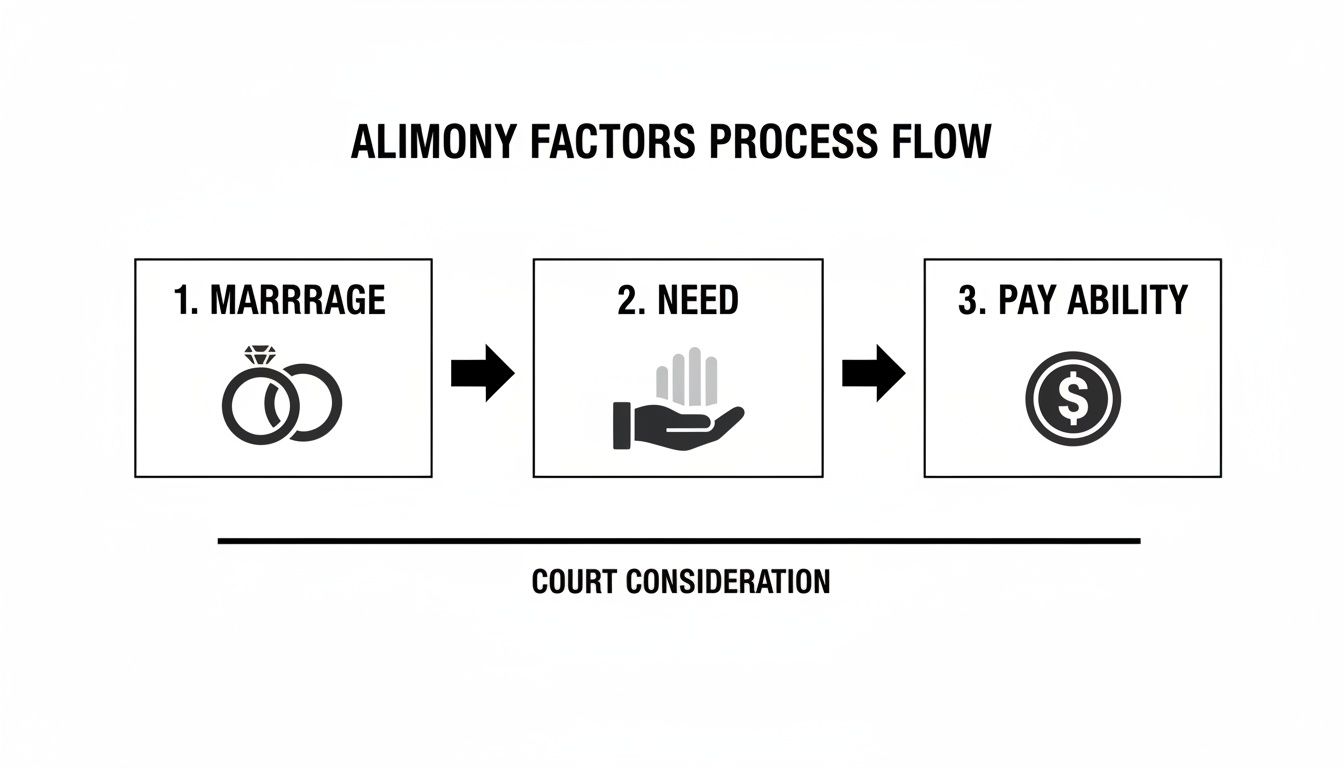
As you can see, figuring out the real income is the crucial step that connects a proven financial need with the ability to actually meet it.
The Idea of "Imputed Income"
So what happens if one spouse is perfectly capable of working but suddenly decides not to? Or maybe they take a much lower-paying job right as the divorce gets underway to try and dodge an alimony payment. Florida law has a tool for this exact situation: imputed income.
This is where a court can assign an income to a spouse who is voluntarily unemployed or underemployed. The amount is based on what they should be earning given their skills and the job market.
For instance, if a spouse with an active nursing license and years of experience quits their job just before filing for divorce, a judge isn't going to just accept that they have zero income. The court can review their work history, qualifications, and available nursing jobs in the Tampa Bay area and "impute" an income that reflects their true earning potential. It’s a mechanism to prevent people from gaming the system.
A court won't impute income if there's a good reason for unemployment, like a legitimate disability or being the primary caregiver for a very young child. The key factor is whether the lack of income is voluntary.
High-Asset Cases and Messy Financials
When dealing with high-asset divorces, calculating income can get incredibly complicated. We start seeing things like complex business profits, deferred compensation packages, stock options, and trusts that can obscure the true financial picture.
In these situations, it's pretty standard to bring in a forensic accountant to trace every dollar and make sure all income is on the table. Our firm handles these intricate cases across Pasco, Pinellas, and Hillsborough Counties, and we know that a detailed financial investigation is absolutely non-negotiable.
Organizing complex financial data is a major hurdle. While we handle the heavy lifting, some clients find it helpful to get a head start. For those comfortable with spreadsheets, tools like Excel AI to automate data cleaning and analysis can help get financial records in order before you even sit down with an attorney.
It's interesting to note that some other states try to simplify this. For example, some jurisdictions use a spousal maintenance formula like: 40% of the higher earner’s gross monthly income minus 50% of the lower earner’s. This kind of mathematical approach aims for more predictability. While Florida doesn't use a strict formula, knowing how these models work can provide useful context during negotiations, especially for our diverse clients who deserve a process that is both fair and clear.
Putting It All Together With Real-World Scenarios

Legal theory and financial spreadsheets can feel abstract. To really get a handle on how spousal maintenance works in Florida, you need to see how the rules play out for real people.
These scenarios bring the law to life, showing how a judge in Pasco, Pinellas, or Hillsborough County might connect the dots. They're the best way to understand the balancing act between one spouse's need and the other's ability to pay.
Scenario One: The Moderate-Term Marriage
Let's start with a couple married for 15 years in Hillsborough County. He's a successful surgeon with a high income. She left a promising marketing career years ago to raise their two kids and run the household, allowing him to focus entirely on building his practice.
Now they're divorcing. She has a clear need for support—she's been out of the workforce for over a decade and can't just jump back into a job that supports the lifestyle they built together. He, in turn, has an undeniable ability to pay.
A likely outcome here is durational alimony. The court will recognize her sacrifices and give her support for a set period, allowing her to maintain a similar lifestyle while she gets the training or education needed to re-enter the job market. Critically, that duration won't be longer than the 15-year marriage, giving both sides a clear end date.
Scenario Two: The High-Asset, Long-Term Marriage
Next, picture a couple in Pinellas County, married for 25 years. Both worked, but one spouse founded a tech company that became wildly successful. They've accumulated millions in assets—real estate, complex investments, and significant retirement funds. Their standard of living was exceptionally high.
In a long-term marriage like this, the marital lifestyle is front and center. The lower-earning spouse needs support to live a life reasonably comparable to the one they shared for a quarter-century. The tech founder has a substantial ability to pay from business income and investment returns.
A judge would likely consider long-term durational alimony. Asset division also plays a massive role here, potentially involving a significant lump-sum payment.
The core principle in these cases is ensuring the lower-earning spouse is not unfairly disadvantaged after dedicating decades to a marital partnership. The lifestyle they built together is a key benchmark for determining need.
Scenario Three: The Same-Sex Couple and a Family Business
Finally, consider a same-sex couple married for 12 years in Pasco County. Together, they built a beloved local restaurant from the ground up. One partner was the public face—the chef and manager—while the other handled everything behind the scenes: accounting, payroll, and vendor relationships. This "back-of-house" partner sacrificed their own career to make the joint venture a success.
When they divorce, the law applies exactly the same way. A judge will look at the business income and the unique contributions each partner made. The partner who handled operations may have a lower "on-paper" salary but has a clear need for support to pivot into a new career. The chef, who continues to run the successful restaurant, has the ability to pay.
This is a perfect example where a fair alimony award is crucial to an equitable outcome. Our firm proudly handles all LGBTQ family and divorce issues, ensuring the principles of fairness are applied to every client, without exception.
Why You Should Not Trust Online Alimony Calculators
When you're staring down the uncertainty of a divorce, it's completely natural to want a quick, solid answer. A fast search for a "Florida Alimony Calculator" brings up dozens of tools promising just that—plug in a few numbers and get an instant result. But I'm here to tell you, as an attorney who deals with this every day, relying on these tools is a huge mistake. It often creates false hope and can seriously complicate things down the road.
The core issue is simple: Florida law does not use a mathematical formula to calculate spousal support. Unlike child support, which follows strict state guidelines, alimony is decided by a judge who has to weigh a whole set of complex, often subjective, factors. Those online calculators aren't based on Florida law because there's no formula for them to use in the first place.
The Misleading Math Behind The Screen
So, what exactly are those online tools doing? Most of them are just applying formulas from other states, which have zero legal weight in a Florida courtroom. They're programmed to take simple percentages of income, but they can't possibly account for the nuances a judge in Pasco, Pinellas, or Hillsborough County is legally required to consider.
These calculators completely ignore the factors that actually matter in a real case, such as:
- The standard of living you both established during the marriage.
- The age and physical and emotional health of each spouse.
- The contributions one of you made to the other’s career or education.
- The real financial needs of the person requesting support.
- How your marital assets and debts are being divided.
Trusting a number spit out by a generic online tool can set wildly unrealistic expectations. This makes good-faith negotiations incredibly difficult. When one person walks into the room armed with a figure that has no basis in Florida law, it just leads to frustration and unnecessary conflict.
Why A Calculator Cannot Replace Legal Judgment
Think of it this way: a calculator can add and subtract, but it can't understand a story. It doesn't know that one spouse stayed home for fifteen years to raise the kids, sacrificing their own career and earning potential. It can't factor in a chronic health condition that makes it tough to work full-time. And it certainly can't analyze a complex business valuation or untangle hidden assets.
An online calculator gives you a guess based on irrelevant math. An experienced family law attorney provides a realistic assessment based on Florida law, local judicial tendencies, and the unique facts of your life. These are two completely different things.
At best, these tools are a very rough starting point for a conversation—nothing more. They are not a tool for legal strategy. For anyone facing divorce, truly understanding how alimony is determined is critical. We actually have a guide that explores some related strategies, where we discuss how to avoid alimony in Florida.
Ultimately, the only way to get a reliable projection of what could happen with alimony is to sit down with a seasoned attorney who practices right here in your local area. An expert who knows the law and has real experience with the judges in Hillsborough, Pinellas, and Pasco Counties can give you the clarity and guidance you actually need. Our firm is dedicated to providing just that, making sure all our clients, including those in the LGBTQ community, get advice grounded in reality, not online fiction.
Common Questions About Florida Alimony
Going through a divorce brings up a whirlwind of questions, and many of them circle back to the financial unknowns of alimony. For those of us in Pasco, Pinellas, and Hillsborough Counties, getting clear, direct answers grounded in Florida law is non-negotiable. Here are some of the most common questions we tackle for our clients every day.
How Does The Length Of Our Marriage Impact Alimony?
The duration of your marriage is one of the heaviest-hitting factors a Florida court considers. It’s not just a number; it’s a legal framework that guides the entire alimony discussion.
State law sorts marriages into categories to help judges decide what type of support, if any, makes sense. For a short-term marriage, which is usually under 10 years, a judge might only consider something temporary like bridge-the-gap alimony to help a spouse get back on their feet.
When a marriage is in the moderate-term range, typically between 10 and 20 years, the conversation might shift to durational alimony—support paid for a set amount of time. For long-term marriages of 20 years or more, the court’s focus is different. The goal often becomes ensuring the lower-earning spouse can maintain a lifestyle that’s reasonably close to what they had during the marriage.
Can Alimony Be Changed After The Divorce Is Final?
Yes, in many situations, alimony can be changed. This is legally known as a modification. But you can’t just ask for a change on a whim. Florida law is strict here: you must prove a substantial, material, and unforeseen change in circumstances to even get the court to consider it.
What qualifies? Some common reasons include:
- A significant, involuntary drop in the paying spouse's income.
- A major, unexpected increase in the receiving spouse's income.
- The paying spouse's retirement.
Alimony can also be terminated completely. The most straightforward reasons are the death of either person or the remarriage of the spouse receiving payments. But there’s another scenario: if the recipient enters into a "supportive relationship" that functions like a marriage, the paying spouse can ask the court to reduce or even end the alimony payments.
Is Alimony Taxable In Florida?
This is a huge one, and the answer changed dramatically a few years ago. Because of a major shift in federal tax law, any divorce finalized after December 31, 2018, has a new set of rules.
Alimony payments are no longer tax-deductible for the person paying. On the flip side, the payments are no longer considered taxable income for the person receiving them.
This change completely alters the negotiation landscape. The old tax deduction often made it easier for the paying spouse to agree to a higher amount. Now, that incentive is gone. Every dollar paid comes from post-tax money, which can make settlement talks much tougher. It's absolutely essential to factor this new tax reality into any discussion.
The current tax law places the entire tax burden on the paying spouse. This shift demands careful financial planning and savvy negotiation to craft a settlement that's truly fair for both sides.
What If I Suspect My Spouse Is Hiding Income?
It's an unfortunate reality, but it’s not rare for one spouse to try and hide assets or downplay their income to dodge a fair alimony payment. If your gut is telling you something is off, it’s critical to act.
Florida law gives us powerful tools to get to the truth. We kick things off with a process called financial discovery. This isn't just asking nicely; we can legally compel your spouse to hand over bank statements, tax returns, business records, and other financial documents.
If the finances are a tangled mess—think family-owned businesses or complex investments—we bring in a forensic accountant. These financial detectives are experts at tracing money trails and spotting red flags. Their job is to make sure the final alimony calculation is based on the real numbers, not a doctored version. Our firm is dedicated to ensuring a fair process for all our clients, and that includes those in the LGBTQ community who sometimes face unique financial complexities.
At Foley Family Law, we know that every question you have is a big deal. If you're facing a divorce in Hillsborough, Pinellas, or Pasco County and need straightforward answers and a solid game plan, we're here for you. Contact us today for a consultation to protect your rights and secure your future.


