

In Florida, there are two main paths to establish paternity for a child. The first is straightforward: both parents sign a Voluntary Acknowledgment of Paternity form, which often happens right at the hospital after the baby is born. The second path involves one parent filing a Petition to Establish Paternity with the court, a process that might require DNA testing to confirm the biological father.
For an unmarried father, this legal process isn't just a formality—it's the only way to secure fundamental parental rights like timesharing and a say in his child's upbringing.
Why Establishing Paternity Matters In Florida

Figuring out "how do I establish paternity" goes far beyond simply adding a name to a birth certificate. When parents aren't married in Florida, paternity is the legal bridge that connects a father to his child.
Without it, a father has zero legal claim to custody or a timesharing schedule. At the same time, the child has no legal right to receive financial support, inheritance, or other benefits from their father. It's the critical step that creates a formal parent-child relationship in the eyes of the law, setting the foundation for all future rights and responsibilities.
The Father's Rights And Responsibilities
For fathers across Hillsborough, Pasco, and Pinellas Counties, establishing paternity is the gateway to becoming a legal parent. Until that happens, a father can't walk into court and ask for a timesharing schedule or demand a voice in major decisions about his child’s life.
Establishing paternity is the essential first step for an unmarried father to secure his legal right to be involved in his child's life. It transforms a biological connection into a legally recognized relationship with enforceable rights to timesharing and parental responsibility.
Once paternity is legally established, a father finally has the standing to:
- Request Timesharing: He can petition the court for a legally enforceable schedule to spend time with his child.
- Share Parental Responsibility: He gets a say in crucial decisions about the child's healthcare, education, and religious upbringing.
- Access Records: He gains the right to see his child's school and medical records.
Of course, these rights come hand-in-hand with the significant responsibility of providing financial support through child support.
The Child's Rights And Protections
Ultimately, establishing paternity is about protecting the child's future. It gives them a legal link to both parents, unlocking a host of benefits that are vital for their long-term well-being. A child with legally established paternity has the right to far more than just financial help. If you want to dive deeper into this, you can learn more about what is paternity in our detailed article.
Legally recognizing a father ensures the child can:
- Receive Financial Support: This includes monthly child support payments that help cover daily living expenses.
- Access Health Insurance: The father can add the child to his health insurance plan.
- Claim Inheritance Rights: The child can legally inherit from their father's estate if he passes away without a will.
- Receive Government Benefits: This can include Social Security survivor benefits or military benefits if the father dies or becomes disabled.
Another critical, and often overlooked, benefit is access to the father's family medical history. This information can be incredibly important for a child's health down the road.
Our firm is committed to helping all families, including those in the LGBTQ+ community, navigate this process to secure these essential protections. We proudly serve clients throughout the Tampa Bay area, including Pasco, Pinellas, and Hillsborough Counties.
The Voluntary Acknowledgment Of Paternity Path
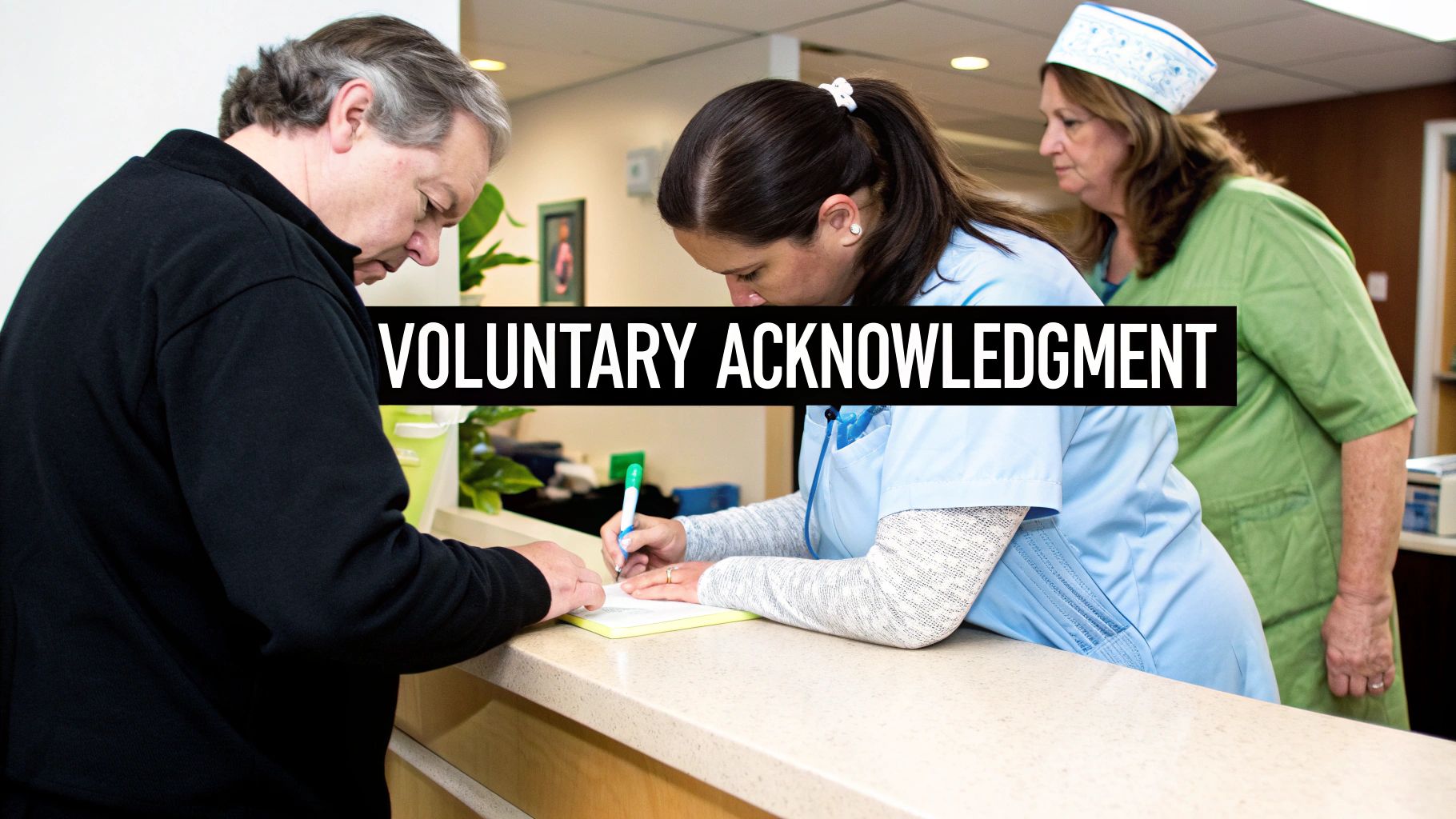
For unmarried parents in Pasco, Pinellas, and Hillsborough Counties who are on the same page about the child's father, the most direct route is a Voluntary Acknowledgment of Paternity (VAP). It’s a straightforward legal document, but don't let the simplicity fool you—once signed, it has the full force of a court order.
Most of the time, this all happens right in the hospital just after the baby is born. The staff will provide a specific state form. Signing this document is a simple, no-cost way to make a father's legal status official without ever setting foot in a courthouse.
What Signing The VAP Really Means
Putting your signature on the VAP is about much more than just getting the father's name on the birth certificate. It’s a legally binding admission of fatherhood. By signing, both parents are swearing under oath that the man is, in fact, the child's biological father.
That simple signature creates a permanent legal relationship with very real consequences. It gives the father the right to seek timesharing and be involved in the child's life, but it also creates a legal duty to provide financial support. It's a critical step that should only be taken when both parents are 100% certain about paternity.
The Critical 60-Day Window To Change Your Mind
Even though a VAP is meant to be final, Florida law provides a very specific, limited opportunity to back out if doubts come up later.
Once signed, either parent has exactly 60 days to rescind the Voluntary Acknowledgment of Paternity. This must be done in writing. After that window closes, the acknowledgment is set in stone and becomes much harder to challenge.
Miss that 60-day deadline, and your only option is to go to court and prove there was fraud, duress, or a material mistake of fact. That’s a much higher legal mountain to climb than just filing a rescission form within the first two months.
What If You Don't Sign At The Hospital?
Not every couple is ready to sign legal forms in the hours after a child is born, and that is perfectly fine. If you decide to wait, you can still complete the VAP later. The process is the same; you’ll just need to get the form and fill it out correctly.
You can establish paternity this way anytime before the child turns 18, as long as both parents are in full agreement. This flexibility is there for parents who need a little more time to be sure.
Our firm is experienced in guiding all parents, including those in the LGBTQ+ community, through the details of paternity law. It's especially important for unmarried parents to know how establishing paternity works with Florida’s new custody laws. For a closer look, check out our guide on how new custody laws affect unmarried parents in Florida. Whether you're at the hospital or handling this months later, we serve families across Hillsborough, Pinellas, and Pasco Counties, making sure the process is done right to protect your rights and your child’s future.
DNA Testing When Paternity Is a Question Mark
Sometimes, a Voluntary Acknowledgment of Paternity just isn't in the cards. When one or both parents have real doubts, DNA testing offers a clear, scientific answer. But in Florida, you have to be careful—not all DNA tests carry the same legal weight.
Those at-home kits you see online are fine for satisfying personal curiosity. However, they won't hold up in a courtroom in Pasco, Pinellas, or Hillsborough County. To legally establish who a child's father is, the court demands a legally admissible DNA test. This is a much more formal process, designed from top to bottom to guarantee the results are rock-solid.
At-Home Kits vs. Legally Admissible Tests
So, what's the big difference between an at-home kit and a court-approved test? It all comes down to something called the chain of custody. This is a strict, documented trail that tracks the DNA samples from the exact moment of collection all the way to the final report.
Think about it: with an at-home kit, there's no official proof of who actually provided the cheek swab. A judge needs absolute certainty that the samples belong to the correct mother, child, and potential father.
For a DNA test to be legally admissible in Florida, it has to follow a specific protocol:
- A Neutral Third-Party Collector: A trained professional at an approved lab or clinic is the only one who can collect the samples.
- Photo Identification: Everyone involved must show a government-issued ID to prove who they are.
- Secure Handling: The samples are sealed with tamper-evident tape right then and there, then shipped directly from the collection site to the testing lab.
This airtight process ensures the results are accurate and untainted, giving a judge the reliable evidence needed to make a final ruling on paternity.
Who Can Ask the Court for a DNA Test?
When paternity is in dispute, several people have the right to ask the court to order genetic testing. This isn't just a tool for one side of a disagreement; it's a way to get to the truth for the child's benefit.
A court-ordered DNA test can be requested by:
- The Mother: She might be uncertain who the father is or need to legally confirm paternity to get a child support order in place.
- A Potential Father: He may firmly believe he is the father and want to establish his parental rights. On the flip side, he might have been named as the father but has serious doubts.
- The State of Florida: It's common for the Department of Revenue to start a paternity action to establish child support, especially if the mother is receiving public assistance.
Our firm is experienced in guiding all families through these sensitive situations, including those in the LGBTQ+ community who need to clarify parental roles with legal precision.
A legally admissible DNA test provides more than just a biological answer; it offers the legal certainty required to establish parental rights, secure financial support, and give a child a connection to their heritage. Its near-perfect accuracy—often 99.9% or higher—makes it the gold standard in contested paternity cases.
Understanding the Process and Costs
Once a judge in Hillsborough, Pasco, or Pinellas County orders genetic testing, everyone involved has to comply. Refusing to submit to a DNA test is a bad move. A judge can enter a default judgment against the person who refuses, which could mean establishing paternity without the test ever happening.
The cost for a legally admissible test can vary. The court will decide who has to foot the bill. Sometimes the cost is split between the parents, but in other situations, one parent might be ordered to pay the whole fee.
The results are sent directly to the court and to the parties. If the test confirms the man is the biological father, the court will issue a final order of paternity. This order legally makes him the father, paving the way to resolve critical issues like timesharing, parental responsibility, and child support.
If that last part worries you, it's smart to understand the serious implications of paying child support for a child that is not yours, because trying to undo a paternity finding later is an incredibly difficult, uphill battle.
When You Have To Go To Court To Establish Paternity
When parents can't agree on who the father is, or if one parent simply refuses to cooperate, the next step is the courthouse. In Florida, this means filing a formal Petition to Establish Paternity. This legal action is your way of asking a judge to step in, make a final decision, and legally define the rights and responsibilities that come with fatherhood.
This court process isn't just a rubber stamp. It's designed to be thorough, resolving not just the biological question but all the related family law issues in one comprehensive case. For families in Pasco, Pinellas, and Hillsborough Counties, it's the only way to get a legally binding, enforceable order when you can't reach an agreement on your own.
The flowchart below gives you a bird's-eye view of how a simple at-home DNA test differs from the formal, court-ordered process that actually creates legal rights.
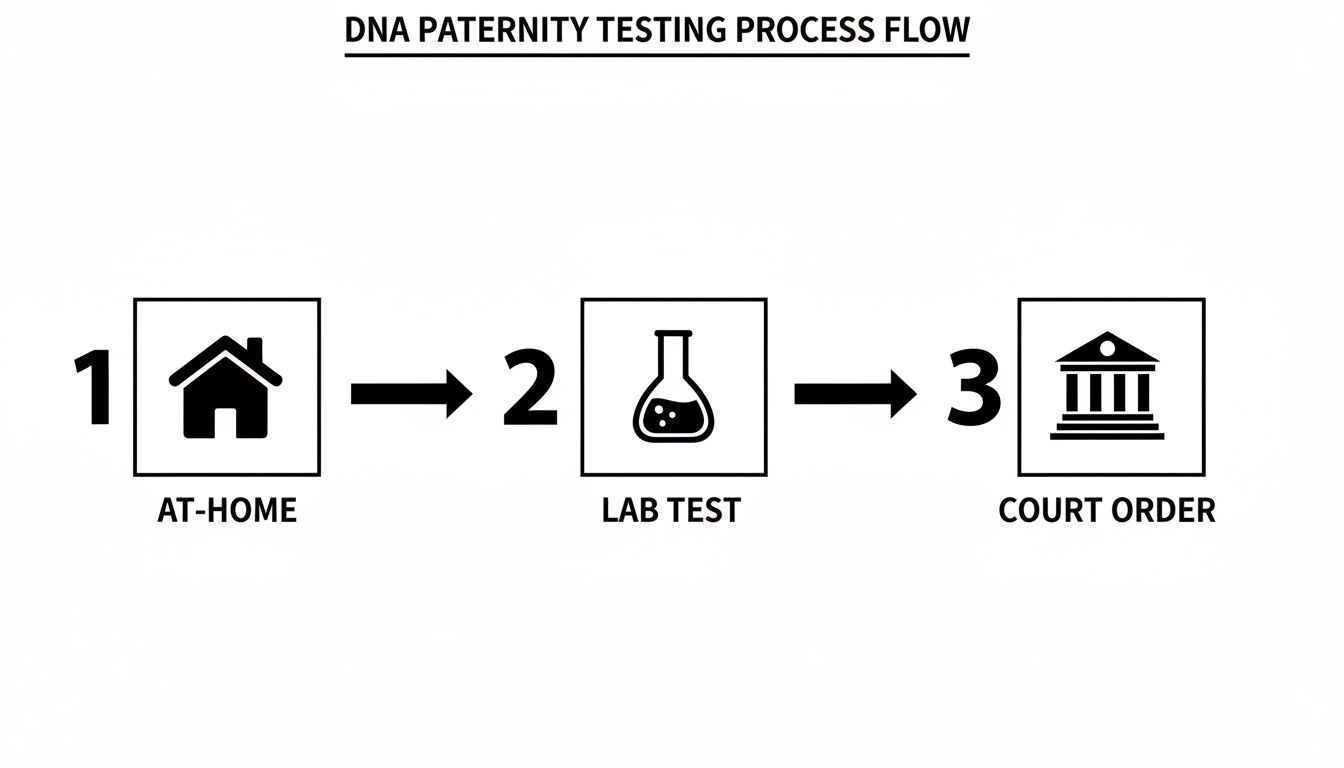
As you can see, while an at-home kit might give you personal peace of mind, it won't hold up in court. Only a test with a strict, documented chain of custody is considered legally admissible evidence to establish paternity.
To help you understand the different ways you can establish legal fatherhood in Florida, here's a quick look at the main pathways.
Comparing Methods To Establish Paternity In Florida
- Voluntary Acknowledgment: This method is used by unmarried parents, often at the hospital when the child is born. The key requirement is that both parents agree and sign the form together. This path typically involves minimal to no cost.
- Administrative Order: This process is often initiated when a parent seeks child support through the Florida Department of Revenue. It requires cooperation with the DOR process, which may include DNA testing, and is generally low-cost.
- Court Action (Petition): This is the necessary route when parents disagree or one parent is uncooperative. It involves filing a lawsuit and obtaining a judge's order, and costs include court filing fees, attorney's fees, and process server costs.
Each path serves a different purpose, but when cooperation breaks down, a court action is the only remaining option to get a final, enforceable answer.
Kicking Off The Paternity Lawsuit
The legal process starts when one parent files the Petition to Establish Paternity with the circuit court in the county where the child lives. It doesn't matter who files—either the mother or the man believed to be the father can get the ball rolling. The person who files is known as the "Petitioner," and the other parent is the "Respondent."
Next comes a critical step: service of process. This isn't as simple as dropping papers in the mail. It requires a sheriff's deputy or a licensed process server to physically hand-deliver the lawsuit to the Respondent. This formal delivery is proof that the other party was officially notified and has a chance to respond.
Once served, the Respondent has a strict deadline—typically 20 days in Florida—to file a formal, written answer with the court. Ignoring this is a huge mistake. It can lead to a default judgment, meaning the judge could rule in the Petitioner's favor without ever hearing the Respondent's side of the story.
What The Court Decides In A Paternity Case
A paternity lawsuit is about much more than just a DNA swab. The judge's final order will create a comprehensive legal framework for the parent-child relationship for years to come.
A single paternity action will resolve these key issues:
- Paternity: The court will issue a final declaration that the man is the child's legal father.
- Parenting Plan: This is a detailed roadmap outlining how parents will share responsibility for major decisions like healthcare, education, and religion.
- Timesharing Schedule: The judge will create a specific, enforceable calendar that details exactly when the child will be with each parent, including holidays and vacations.
- Child Support: A monthly support obligation will be calculated based on Florida's official guidelines and ordered to be paid.
In particularly contentious cases, the court might appoint a neutral third party to investigate and represent the child's best interests. To learn more about this role, you can read our detailed article on what is a Guardian ad Litem.
The Journey Through The Court System
From the initial filing to the final judgment, the case moves through several distinct phases. After the petition is filed and answered, the case enters "discovery." This is where both sides exchange relevant information and evidence, like financial records needed to calculate child support.
While many paternity cases settle out of court, having an experienced attorney is non-negotiable. A skilled lawyer protects your rights at every turn, whether you're negotiating a fair settlement or fighting for your family before a judge in the Hillsborough, Pinellas, or Pasco County courts.
Mediation is almost always a required step. Here, a neutral mediator helps both parents try to find common ground and reach an agreement. If you can agree, the settlement is submitted to the judge for approval. If not, the case moves toward a final hearing or trial where both sides present their case, and the judge makes the final call. The court requires a lot of paperwork, and exploring effective document management and e-signature solutions can help keep everything organized and submitted on time.
Our firm is committed to guiding all families, including those in the LGBTQ+ community, through this often-intimidating legal process with clarity and compassion. We serve clients in Pasco, Pinellas, and Hillsborough Counties.
The Legal Rights And Responsibilities After Paternity Is Established
Once a judge signs an order or a Voluntary Acknowledgment of Paternity becomes final, the entire legal landscape shifts for both parents and the child. This isn't just about shuffling papers; it’s the moment a biological tie becomes a formal, legal relationship, complete with a full set of rights and obligations under Florida law.
For fathers in Pasco, Pinellas, and Hillsborough Counties, this is a pivotal moment. It’s the key that unlocks the door to having a meaningful, legally protected role in your child's life. At the same time, it cements your legal duty to provide for their well-being.
What Paternity Means For Fathers
Establishing paternity is the essential first step for a father who wants to truly parent. Before this legal recognition, a father has no enforceable rights, no matter how much he’s already involved. Afterward, he gains the legal standing to ask the court for specific rights and take on formal responsibilities.
This transformation gives you the right to:
- Request Timesharing: You can now petition the court for a legally enforceable schedule to spend time with your child. This moves you beyond informal agreements and into a structured, predictable plan.
- Share In Major Decisions: You get a say in the big-picture choices about your child's education, non-emergency healthcare, and religious upbringing. This is often called shared parental responsibility.
- Access Important Information: You gain the legal right to see your child’s school records and medical information directly from the providers themselves.
Of course, these rights come hand-in-hand with the profound responsibility of financial support. The court will establish a child support order based on Florida's guidelines, making sure you contribute financially to your child's needs. If you're wondering what this looks like in practice, our firm provides detailed guidance on a father's visitation rights in Florida.
What Paternity Means For The Child
While fathers gain crucial rights, the real purpose of establishing paternity is to protect the child. It solidifies their identity and provides a lifetime of legal, financial, and emotional benefits that every child deserves to have from both of their parents.
Legally establishing paternity is the single most important action to ensure a child has access to the full range of benefits and support from their father. It creates a safety net that extends from financial security to invaluable family and medical history.
A child with a legally recognized father now has the right to:
- Receive Child Support: A court order ensures consistent financial support is an obligation, not a choice.
- Inherit: The child can legally inherit from their father’s estate, even if there isn't a will.
- Access Health Insurance: A father can add the child to his employer-provided or private health insurance plan.
- Receive Government Benefits: The child is now eligible for the father's Social Security, disability, or veterans' benefits.
- Know Their Family Medical History: Access to a father’s medical background can be critical for future health diagnoses and preventative care.
These aren't just abstract concepts; they have a real-world impact on a child's stability, health, and future opportunities.
Practical Next Steps After Paternity Is Finalized
With paternity established, one of the first practical steps is usually updating the child’s birth certificate to add the father’s name. If a judge determined paternity, the court order itself will direct the Florida Bureau of Vital Statistics to amend the record.
Now that both parents share legal rights and responsibilities, co-parenting becomes the new reality. This journey isn't always smooth and can present significant challenges, such as managing co-parenting with a narcissist. It’s critical to remember that this new legal relationship demands communication and cooperation for the child's sake.
Our firm is committed to helping all parents in the Tampa Bay area, including LGBTQ+ individuals and couples, secure these fundamental rights and understand their new responsibilities in Pasco, Pinellas, and Hillsborough Counties.
Common Questions About Florida Paternity Law
When you're trying to figure out how to establish paternity, a lot of specific questions pop up. In our work with families across Pasco, Pinellas, and Hillsborough Counties, we see the same concerns come up again and again, even when the situations feel unique.
Let's walk through some of the most common questions we hear.
Can I Establish Paternity If The Other Parent Lives Out Of State?
Yes, you absolutely can. If the child lives in Florida, our state courts generally have the authority—what lawyers call "jurisdiction"—to handle the paternity case. This is true even if the other parent is living hundreds of miles away.
The process kicks off when you file a Petition to Establish Paternity right here in the Florida county where your child resides, whether that's Hillsborough, Pinellas, or Pasco.
The biggest hurdle is usually making sure the out-of-state parent is properly notified of the lawsuit. This formal step, known as service of process, has very specific legal rules that must be followed perfectly to be valid. Once they've been served, the out-of-state parent is legally required to respond to the Florida court.
What Happens If The Man On The Birth Certificate Is Not The Biological Father?
This is a tangled and highly sensitive issue, and it’s one that requires immediate legal advice. If a man signed a Voluntary Acknowledgment of Paternity at the hospital but later discovers he isn't the biological father, he might be able to undo it. But you have to act fast.
Florida law gives a very tight deadline. If more than 60 days have gone by since the acknowledgment was signed, it becomes legally binding.
To challenge it after that point, you must file a formal petition to disestablish paternity. You'll need to prove there was fraud, duress, or a significant mistake of fact. A DNA test proving he’s not the father is a critical piece of evidence, but it’s not always enough on its own—especially if he has been acting as the child's father for a long time.
A birth certificate creates a powerful legal assumption of fatherhood, but it's not set in stone. Overturning that assumption requires a court process called disestablishment of paternity, and the judge's top priority will always be the child's stability and best interests.
Does Establishing Paternity Automatically Mean 50/50 Custody?
No, not at all. Think of it this way: establishing paternity is the key that unlocks the door. It gives a father the legal right to ask the court for timesharing, but it doesn’t automatically result in a 50/50 schedule. The two issues are handled separately by the court.
Once paternity is legally established, the next step is for the court to create a parenting plan and a timesharing schedule. While Florida law does now start with a presumption that equal timesharing is in the child's best interest, that's just a starting point for the conversation.
The final decision is always up to the judge, who will look at a long list of factors related to the child’s best interests.
These factors can include things like:
- Each parent’s ability to provide for the child's emotional and physical needs.
- The depth of the relationship between each parent and the child.
- How stable each parent's home life is.
- Any history of domestic violence, substance abuse, or other issues that could put the child at risk.
Our firm is committed to guiding all families through these matters, including those in the LGBTQ+ community. We work to ensure every parent in Pasco, Pinellas, and Hillsborough Counties has a fair opportunity to build a strong, legally protected relationship with their children.
Navigating the complexities of paternity law requires clear guidance and strong advocacy. At Foley Family Law, we are dedicated to helping clients in Hillsborough, Pinellas, and Pasco Counties secure their parental rights and protect their children's futures. If you need assistance, contact us to create a plan of action for your case.


