

TL;DR:
- High net worth divorces involve complex assets exceeding one million dollars and require specialized valuation expertise. Proper early asset identification, tax-aware strategies, and professional team coordination are essential for a fair and efficient settlement. Delaying or rushing these cases can lead to costly disputes and overlooked assets.
A high net worth divorce is defined by the significant complexity and value of marital assets, typically exceeding $1 million in combined holdings, and requiring specialized knowledge that goes far beyond a standard dissolution of marriage. No uniform legal definition exists across Florida family courts, but these cases consistently involve components like executive compensation, business interests, investment portfolios, and multi-property real estate. The financial stakes are high, the legal issues are layered, and the margin for error is costly. Whether you are a business owner, a corporate executive, or a professional with substantial accumulated wealth, understanding what sets these cases apart is the first step toward protecting what you have built.
What makes a high net worth divorce different?
High net worth divorce cases are distinguished by the sheer variety and complexity of assets subject to division. A typical divorce might involve a marital home, retirement accounts, and a joint bank account. A high asset divorce often involves stock options, restricted stock units, carried interest, deferred bonuses, private equity stakes, and ownership interests in closely held businesses. Each of these requires a different valuation method and carries its own legal and financial risks.
Florida is an equitable distribution state, meaning courts divide marital assets fairly, though not always equally. That standard sounds straightforward, but it becomes genuinely complex when the assets are illiquid, contingent on future performance, or tied to compensation structures that span multiple years. Incentive compensation that is deferred and contingent requires precise valuation and equitable distribution to avoid future litigation. Getting that valuation wrong at the settlement stage can mean years of post-divorce disputes.
The professionals involved in these cases also differ. A standard divorce may require only attorneys and a mediator. A high asset divorce typically demands forensic accountants, certified divorce financial analysts (CDFAs), business valuation experts, and often estate planning attorneys. Building that team early is not optional. It is the foundation of a sound strategy.
What types of assets are involved and how are they valued?
The asset mix in a high net worth case is rarely simple. Common categories include:
- Business interests: Closely held companies, professional practices, and partnership stakes require formal business valuation using market, income, or asset approaches.
- Executive compensation: Stock options, RSUs, and deferred bonuses often have vesting schedules that span the marriage and post-separation period, complicating the marital versus separate property analysis.
- Real estate: Multiple properties, including investment and vacation properties, require independent appraisals and may carry significant capital gains exposure.
- Alternative investments: Private equity, hedge funds, and collectibles require specialized valuation and division approaches, often through offsetting strategies or deferred distributions, because fund managers frequently restrict transfers.
- Retirement accounts: Pre-tax accounts like 401(k)s and traditional IRAs differ materially in net value from Roth accounts, even when the nominal balances match.
Valuation of illiquid assets often relies on coverture fractions, which divide the number of months an asset accrued during the marriage by its total service period, then adjust for vesting schedules and performance contingencies. This method is technical and contested, and courts in Florida have accepted varying approaches depending on the asset type.
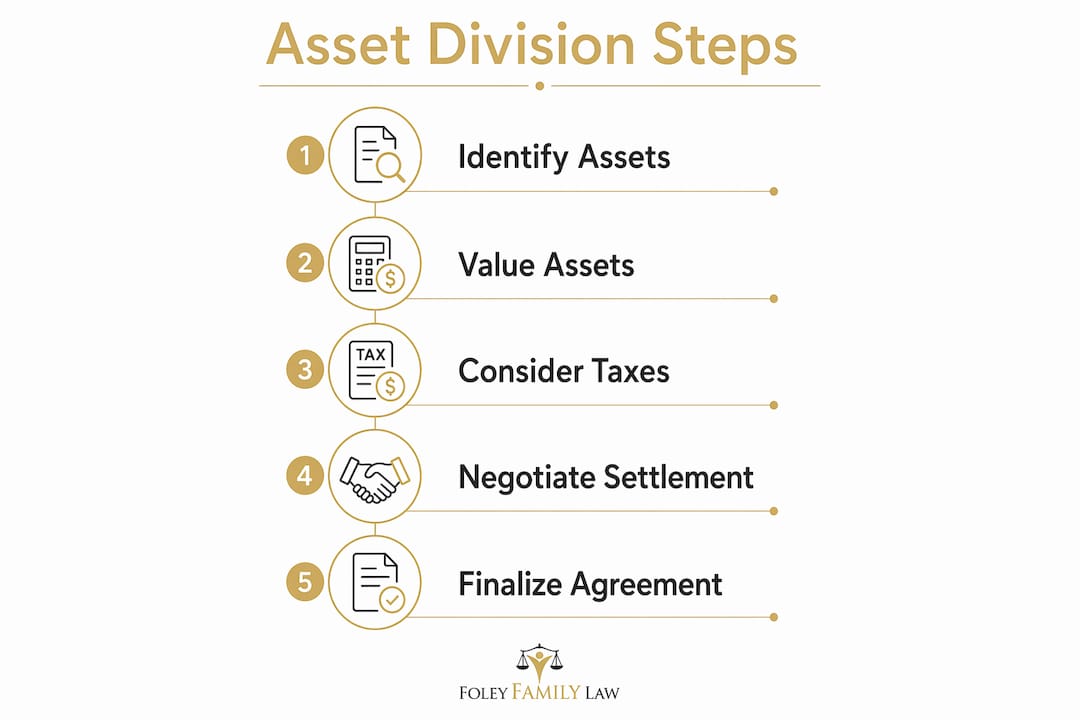
Pro Tip: Identify and document every asset category before mediation begins. Discovering a deferred compensation plan or a restricted partnership interest after a settlement is signed creates expensive litigation to unwind.

For business valuation in divorce, the income approach is most common for operating businesses, while the asset approach suits holding companies or real estate entities. Each method produces a different number, and the gap between competing valuations can be substantial.
How do tax considerations affect asset division and settlement?
Tax implications are one of the most underestimated factors in a divorce financial settlement. Two assets with identical face values can produce dramatically different after-tax outcomes depending on their basis, account type, and holding period.
Key tax issues to address before finalizing any agreement include:
- Capital gains on appreciated assets: Transferring a stock portfolio with a low cost basis to one spouse shifts the embedded tax liability. The spouse receiving that portfolio will owe capital gains tax when they sell, reducing the real value of what they received.
- Pre-tax versus post-tax retirement accounts: Ignoring pre-tax versus post-tax differences leads to unequal net worth division. A $1 million 401(k) is worth less than a $1 million Roth IRA after taxes are applied. Treating them as equivalent in a settlement is a costly mistake.
- QDROs for retirement plan division: A Qualified Domestic Relations Order is legally required to divide most employer-sponsored retirement plans without triggering taxes or early withdrawal penalties. The QDRO must specify amounts, calculation methods, and comply with federal law.
- Marital home sale exclusion: Married couples can exclude up to $500,000 in capital gains on a primary residence sale. Divorcing spouses may lose part of that exclusion depending on timing and occupancy rules.
- State income tax and residency: Florida has no state income tax, which is a genuine advantage for residents. However, if either spouse relocates to a high-tax state post-divorce, the tax impact on investment income and retirement distributions changes significantly.
Pro Tip: Retain a CPA or tax attorney who specializes in divorce tax planning before you agree to any asset split. A settlement that looks balanced on paper can be deeply unequal after taxes are applied.
What special issues arise with trusts and estate planning structures?
Many high net worth families have spent years building estate plans designed to minimize taxes and protect generational wealth. Those structures create real complications when a marriage ends.
Common estate planning vehicles that appear in these cases include revocable living trusts, irrevocable life insurance trusts (ILITs), spousal lifetime access trusts (SLATs), grantor retained annuity trusts (GRATs), and family limited partnerships. Each was designed with a specific tax or asset protection purpose, and none was designed with divorce in mind.
The core problem is that these structures are often not divorce-proof. Trust structures like SLATs and ILITs are not divorce-proof and require careful, costly unwinding with potential unintended tax consequences. A SLAT, for example, is funded by one spouse for the benefit of the other. When the marriage ends, the beneficiary spouse may lose access to those assets, but the grantor spouse cannot simply reclaim them without triggering gift or estate tax issues.
Here are the most common trust-related problems that arise in high asset divorce cases:
- Irrevocable trusts cannot be easily modified. Once funded, these trusts generally cannot be undone without court involvement or unanimous beneficiary consent.
- SLATs create a reciprocal trap. Couples who created mirror SLATs for each other may find that unwinding one triggers scrutiny of both under IRS reciprocal trust doctrine.
- ILITs hold life insurance policies outside the estate. The cash value and death benefit may be marital property depending on how premiums were paid, but accessing or dividing the policy requires careful handling to avoid lapse or tax consequences.
- Family limited partnerships restrict transfers. Valuation discounts applied at formation may be challenged in divorce proceedings, and transferring partnership interests to a non-family member may violate the partnership agreement.
Resolving these issues requires the original estate planning attorney, the family law attorney, and a tax advisor working together. Attempting to unwind a complex trust structure without all three creates serious risk.
How can legal and financial strategies protect your interests?
Protecting your financial interests in a high asset divorce requires more than a good attorney. It requires a coordinated team and a deliberate process.
Hidden assets are common in high net worth divorces and are detectable by forensic accountants through unexplained transfers, tax anomalies, and lifestyle inconsistencies. Early detection is critical. Waiting until trial to uncover financial discrepancies is expensive and often too late to fully remedy.
Effective strategies include:
- Assemble a multi-disciplinary team before filing. Your team should include a family law attorney, a CPA, a forensic accountant, and ideally a CDFA.
- Request full financial disclosure early. Florida courts require mandatory disclosure, but voluntary early exchange reduces delays and signals good faith.
- Consider collaborative divorce or mediation. High-profile parties often prefer mediation to avoid publicity, protect privacy, and retain control over the outcome. Court proceedings are public record. Mediated settlements are not.
- Use confidentiality agreements. These can protect sensitive business information and financial details disclosed during the divorce process.
- Do not rush the settlement. Settling quickly without full financial transparency is a major risk. Hidden assets and false income reporting are prevalent in high net worth cases.
Pro Tip: If your spouse controls the family business or manages the investment accounts, retain a forensic accountant before you file. The financial picture presented in early negotiations may not reflect reality.
For guidance on uncovering hidden assets or protecting assets during divorce, early legal counsel makes the difference between a fair outcome and a costly one.
Key Takeaways
A successful high net worth divorce outcome depends on early professional involvement, thorough asset identification, and tax-aware settlement structuring before any agreement is signed.
| Point | Details |
|---|---|
| Define assets early | Identify all asset categories, including deferred compensation and alternative investments, before mediation begins. |
| Account for taxes | Compare after-tax values, not face values, when dividing retirement accounts, real estate, and investment portfolios. |
| Use a QDRO correctly | A Qualified Domestic Relations Order is legally required to divide employer retirement plans without tax penalties. |
| Address trust structures | SLATs, ILITs, and family limited partnerships require estate planners and tax advisors to unwind safely. |
| Choose privacy-focused resolution | Mediation and collaborative divorce protect financial details from public court records. |
What experience with these cases has taught us
At Foley Family Law, the cases that concern us most are the ones where a client comes in after a settlement has already been signed. By that point, the options are limited and the costs are high.
The most consistent pattern we see is clients who underestimated the complexity of their own financial picture. They knew they had a business, some retirement accounts, and a few properties. What they did not realize was that the deferred compensation plan, the SLAT funded five years ago, and the carried interest in a private equity fund were all going to require expert analysis before any fair number could be put on the table.
The second pattern is speed. There is real pressure in these cases to settle quickly, often driven by a desire to reduce conflict or legal fees. That pressure is understandable. But rushing a settlement on a $5 million marital estate to save $30,000 in professional fees is a trade-off that rarely works in your favor. Deliberate settlement language, covering contingent assets, future distributions, and indemnification for tax liabilities, prevents the disputes that show up two years later.
Florida’s equitable distribution standard gives courts meaningful discretion. That discretion cuts both ways. The spouse with better financial documentation, a stronger expert team, and a clear-eyed view of the full asset picture consistently achieves better outcomes. Patience, preparation, and the right professionals are not luxuries in these cases. They are the strategy.
— Foley Family Law
Foley Family Law’s approach to complex divorce cases
Facing a high asset divorce in Hillsborough, Pinellas, or Pasco County is a serious undertaking, and you should not face it without experienced legal counsel by your side.

Foley Family Law works exclusively in family law, with a focus on complex and high net worth divorce cases that require coordinated financial and legal expertise. The firm connects clients with forensic accountants, business valuation specialists, and tax advisors as part of a complete case strategy. Privacy, equitable outcomes, and transparent communication are the priorities at every stage. If you are preparing for a high asset divorce, financial preparation for divorce is the right place to start. For immediate guidance on your specific situation, the experienced Tampa complex divorce lawyers at Foley Family Law are ready to help.
FAQ
What qualifies as a high net worth divorce in Florida?
High net worth divorces generally involve combined marital assets exceeding $1 million or complex components like business interests and executive compensation. No uniform legal definition exists in Florida, but these cases consistently require specialized valuation and legal expertise.
How are illiquid assets like private equity divided in divorce?
Illiquid alternative assets such as private equity and hedge funds often cannot be transferred directly due to manager restrictions. Courts and attorneys typically use offsetting strategies or deferred “if, as, and when” distributions to achieve equitable division.
What is a QDRO and why does it matter?
A Qualified Domestic Relations Order is a court order legally required to divide most employer-sponsored retirement plans without triggering taxes or early withdrawal penalties. Without a properly drafted QDRO, the receiving spouse may face significant tax liability.
Can a trust protect assets from division in a Florida divorce?
Trust structures like SLATs and ILITs are not divorce-proof. They often require costly unwinding and can trigger unintended tax consequences, making early involvement of estate planning attorneys critical.
Is mediation better than litigation for high net worth divorce cases?
High-profile parties consistently prefer mediation or collaborative divorce to protect privacy and retain control over settlement terms. Court proceedings are public record; mediated agreements are not.


