

TL;DR:
- A high-conflict parenting plan is a detailed custody agreement designed to minimize parental contact and avoid disputes through fixed schedules and clear communication rules. It emphasizes division of decision-making, structured exchanges, and documentation to protect children and facilitate enforcement in Florida courts. Implementing specific provisions and maintaining factual records helps enforce the plan and reduces conflicts in high-stakes custody cases.
A high-conflict parenting plan is a legally binding custody document designed to minimize direct parental interaction while protecting children’s stability through rigid schedules, written communication rules, and predefined dispute resolution. Unlike a standard parenting plan, this structure assumes cooperation is not possible. The goal is not to improve the relationship between parents. The goal is to remove the relationship from daily decision-making entirely. For parents in Hillsborough, Pinellas, and Pasco counties, understanding what a strong example parenting plan high conflict looks like is the first step toward protecting your child from ongoing hostility.
What are the essential components of a high-conflict parenting plan?

A high-conflict custody agreement works because it eliminates judgment calls. Ambiguity in parenting plans is the single biggest source of post-divorce litigation. Every provision that requires parents to “agree” or “communicate” creates a new opportunity for conflict.
The core components of any effective high-conflict parenting plan include:
- Fixed schedules set years in advance. Specify exact days, pickup times, and drop-off locations. Do not leave school-year medical appointments, holiday closures, or sports schedule conflicts to negotiation. Plans must include specific provisions for each of these scenarios to avoid judgment calls entirely.
- Structured exchange protocols. Exchanges happen at neutral locations such as schools, libraries, or police station parking lots. Exchange protocols define exact times, who waits where, and what happens if one parent is late, removing confrontation from transitions.
- Written-only communication with response windows. All parenting communication goes through email or a court-approved app. Communication limited to 24–48 hour response windows reduces reactivity and eliminates silence as a power tactic.
- Divided decision-making authority. Each parent holds clear authority over specific categories. Medical decisions, educational choices, and extracurricular activities are assigned by category, not shared jointly, to prevent stalemates.
- Predefined dispute resolution. The plan names a parenting coordinator or mediator and outlines the exact process for raising objections before either parent can file a court motion.
Pro Tip: Include a clause stating that messages about parenting style or the other parent’s personal life do not require a response. Limiting messages to child-focused facts removes the most common triggers for escalation.
How does parallel parenting minimize conflict in high-conflict situations?
Parallel parenting is the recognized model for high-conflict custody cases. It differs from traditional co-parenting in one critical way: it does not ask parents to collaborate. Each parent operates independently within their own parenting time, without consulting or updating the other parent on routine decisions.
The table below shows how parallel parenting and traditional co-parenting differ in practice.
| Feature | Traditional co-parenting | Parallel parenting |
|---|---|---|
| Communication frequency | Regular, often informal | Minimal, written only |
| Decision-making | Joint on most issues | Divided by category |
| Exchange style | Flexible, parent-to-parent | Neutral location, structured |
| Conflict exposure for children | Higher when parents disagree | Lower due to reduced contact |
| Plan rigidity | Moderate, allows flexibility | High, anticipates every scenario |
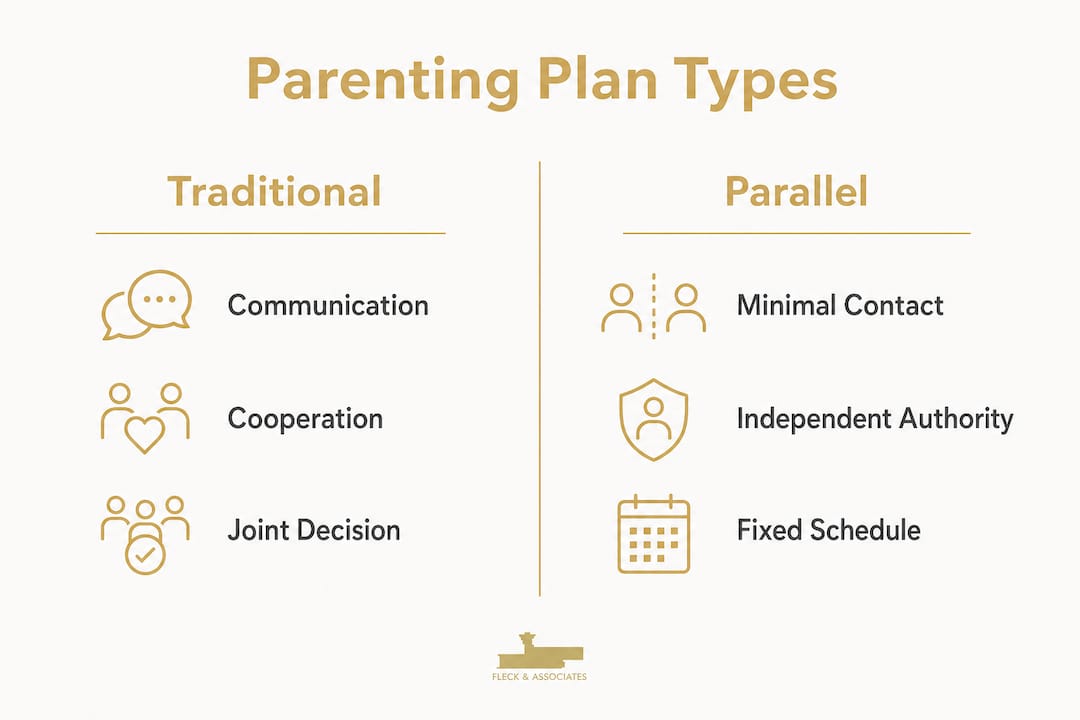
Children in parallel parenting structures stabilize emotionally within 6–12 months by reducing their exposure to parental hostility. That stabilization does not happen when parents are forced into frequent contact. A Florida parallel parenting agreement formalizes this separation legally, giving each parent a clear lane and removing the expectation of ongoing cooperation.
The practical features of a parallel parenting plan include separate parent-teacher conference times, separate medical appointment attendance, and separate communication with coaches or activity leaders. Neither parent attends the other’s scheduled events unless the plan explicitly permits it. This structure feels rigid at first. For children, that rigidity is the point.
What do real high-conflict parenting plan examples look like?
Concrete plan language removes the guesswork. The following examples reflect the kind of specificity that courts in Florida expect and that detailed plans preferred by judges actually contain.
Sample schedule provision
“Parent A shall have the child every Monday and Tuesday. Parent B shall have the child every Wednesday and Thursday. Weekends alternate, beginning Friday at 3:00 PM school pickup and ending Sunday at 6:00 PM drop-off at the child’s school or, when school is not in session, at the Hillsborough County Public Library on [address].”
Sample communication provision
“All communication between parents shall occur via [approved app] only. Each parent shall respond within 48 hours to child-related inquiries. Messages regarding parenting style, personal conduct, or non-child matters require no response.”
Sample decision-making provision
“Parent A holds final decision-making authority for routine medical care and dental appointments. Parent B holds final decision-making authority for educational enrollment and extracurricular activities. Emergency medical decisions may be made by the parent present, with written notice to the other parent within 24 hours.”
Holiday and vacation scheduling
High-conflict parenting plan templates assign holidays years in advance by alternating on a fixed rotation. Parent A receives Thanksgiving in odd years; Parent B receives Thanksgiving in even years. Vacation requests require written notice at least 60 days in advance, with no approval required from the other parent once notice is given.
Pro Tip: Right of first refusal clauses protect parenting time but can be weaponized in high-conflict cases. Set a minimum threshold of 8–12 hours before the clause activates to prevent constant schedule disruption.
The following checklist summarizes the provisions every high-conflict parenting plan template should include:
- Fixed weekly schedule with exact times and locations
- Holiday rotation assigned through at least the child’s 18th birthday
- Neutral exchange location with lateness protocol
- Written-only communication channel with response time limit
- Decision-making authority divided by category
- Right of first refusal with minimum hours threshold
- Named parenting coordinator with defined authority
- Dispute resolution pathway before court filing is permitted
How do you document and enforce a high-conflict parenting plan?
Documentation is the enforcement mechanism. Without it, even the most detailed plan becomes unenforceable when one parent deviates.
Keep a factual, dated communication log. Record every exchange, missed pickup, and written message with the date, time, and exact content. Neutral, factual records carry far more weight in court than emotional accounts. Judges rely on objective documentation when assessing compliance and deciding whether to modify the plan.
Use a parenting coordinator. A parenting coordinator is typically a licensed therapist or attorney empowered to make binding decisions on minor disputes without requiring a court hearing. This role prevents constant return to litigation over day-to-day issues.
Document deviations without editorial comment. Write “Parent B did not appear at the scheduled 3:00 PM exchange on March 4, 2026” rather than “Parent B ignored the plan again.” Courts respond to facts, not frustration.
Understand your enforcement options. In Florida, a parent who violates a parenting plan can face a motion for contempt, makeup time orders, or plan modification. Courts view detailed plans that anticipate disputes as proactive and are more willing to enforce them strictly. If you need to change a custody agreement, documented violations are your strongest evidence.
Store all records securely. Use a dedicated folder, app, or cloud storage that is date-stamped and accessible. If you ever need to present evidence, organization matters. Some parents also consult resources on custody investigation procedures to understand what documentation standards courts and investigators expect.
Key Takeaways
A high-conflict parenting plan succeeds when it removes the need for parental communication by specifying every schedule, decision, and dispute process in advance.
| Point | Details |
|---|---|
| Eliminate ambiguity | Fixed schedules, exact exchange locations, and pre-assigned holidays prevent negotiation conflicts. |
| Use parallel parenting | Divided decision-making and minimal contact reduce children’s exposure to hostility. |
| Write specific plan language | Sample provisions with exact times, apps, and thresholds give courts clear rules to enforce. |
| Document everything factually | Dated, neutral communication logs are the strongest evidence for enforcement or modification. |
| Name a parenting coordinator | A coordinator with binding authority resolves minor disputes without returning to court. |
What I’ve learned drafting high-conflict plans in Florida
The most common mistake I see parents make is treating a high-conflict parenting plan as a relationship repair tool. It is not. The plan’s primary goal is to minimize the need for communication by structuring boundaries so rigidly that communication becomes almost unnecessary. That shift in mindset changes everything about how you draft the document.
Parents who approach the plan as a business contract, not a co-parenting agreement, write better provisions. They stop trying to include language about “mutual respect” and start writing language about response windows and exchange protocols. The children in those cases adjust faster. They feel the stability of the structure even when they cannot articulate it.
The other mistake is underestimating how much detail courts actually want. Judges in Hillsborough, Pinellas, and Pasco counties have seen vague plans fail repeatedly. A plan that says parents will “communicate as needed” is an invitation to litigation. A plan that says all communication happens through a named app, with a 48-hour response window, and that messages about personal conduct require no reply, is a plan a judge can actually enforce. Detailed plans protect your child. They also protect you.
— Foley Family Law
How Foley Family Law helps parents build high-conflict parenting plans
Foley Family Law works exclusively in family law, which means every parenting plan the firm drafts reflects deep experience with what Florida courts actually enforce. For parents in Hillsborough, Pinellas, and Pasco counties, that specificity matters.

Whether you are starting from scratch or need to strengthen an existing parenting plan in a divorce, Foley Family Law provides legal consultation and full plan drafting tailored to high-conflict situations. The firm’s approach prioritizes your child’s stability and your legal protection. Understanding what family law attorneys do in these cases, from drafting enforceable provisions to representing you in enforcement hearings, gives you a clearer picture of the support available. Contact Foley Family Law to discuss your situation with an attorney who handles nothing but family law.
FAQ
What is a high-conflict parenting plan?
A high-conflict parenting plan is a detailed custody document that minimizes direct parental contact through fixed schedules, written-only communication rules, and divided decision-making authority. It is designed for situations where cooperation between parents is not realistic.
How is parallel parenting different from co-parenting?
Parallel parenting removes the expectation of cooperation by giving each parent independent authority during their parenting time. Traditional co-parenting requires ongoing collaboration, which increases conflict exposure for children when the parental relationship is hostile.
What should a high-conflict parenting plan checklist include?
A complete checklist covers fixed weekly schedules, pre-assigned holiday rotations, neutral exchange locations, written-only communication channels, divided decision-making by category, a right of first refusal threshold, and a named parenting coordinator.
Can a high-conflict parenting plan be enforced in Florida?
Yes. Florida courts enforce detailed parenting plans through contempt motions, makeup time orders, and plan modifications. Courts favor plans that anticipate common disputes because they provide clear rules for enforcement.
When should a right of first refusal clause include a time threshold?
A right of first refusal clause should activate only after a minimum absence of 8–12 hours to prevent the clause from being used as a tool for constant schedule disruption in high-conflict cases.


