

If you’re over 50 and contemplating the end of a long marriage, you are far from alone. This trend, often called a gray divorce, is becoming more and more common here in Florida and across the country. It captures a major shift: older adults are increasingly choosing to end their marriages, a step that was almost unheard of just a generation ago.
What Is Gray Divorce and Why Is It on the Rise?

This isn’t just about statistics; it's a profound cultural change in how we think about marriage, retirement, and what it means to be happy in our later years. The goal is no longer just to "stick it out." For many people in Pasco, Pinellas, and Hillsborough Counties, it’s about genuinely reevaluating what they want from the next chapter of their lives.
Interestingly, the rise in gray divorce is happening while the overall divorce rate in the United States has been falling for decades. After peaking around 1980 at 22.6 divorces per 1,000 married women, the general rate had dropped to just 14.4 by 2023. Gray divorce is the outlier, making it a critical area of focus for family law. You can see more of the data on these trends from the Pew Research Center.
Evolving Perspectives on Marriage and Life
So, what’s driving this trend? A big part of it is that we're living longer, healthier lives. A partnership that felt right while raising kids and building careers can feel entirely different in an empty nest. You suddenly have decades of life ahead of you, and that prompts some serious reflection.
Personal happiness has also moved to the forefront. There's far less willingness to stay in a relationship that feels empty or unfulfilling just because of tradition or expectation. The focus has shifted to finding a true partner for the adventures that retirement can bring.
Some of the most common reasons we see for a gray divorce include:
- Growing Apart: After years focused on careers and kids, some couples wake up and realize they're strangers with very little in common.
- Desire for Independence: Financial independence, especially for women, has removed one of the biggest barriers that once kept people in unhappy marriages.
- Different Retirement Goals: One spouse might dream of traveling the world in an RV, while the other wants to stay close to the grandkids. These aren't small disagreements; they're fundamental differences in how you want to live your remaining years.
Navigating a gray divorce involves more than just ending a marriage; it's about thoughtfully redesigning your future. The legal and financial complexities are unique, especially when decades of shared assets and memories are involved.
In Florida, the legal process for a gray divorce has its own specific hurdles. Because these marriages are often long-term, issues like alimony, splitting retirement accounts, and figuring out healthcare are front and center. Florida is an equitable distribution state, which means marital assets and debts are divided fairly—but that doesn't always mean a clean 50/50 split. You can learn more about how property is divided in our article on Florida's property laws. At Foley Family Law, we handle all family and divorce matters, including for our LGBTQ+ clients, ensuring everyone receives respectful and expert representation.
The Reasons Behind a Later-Life Divorce
Divorce later in life rarely happens because of one big, dramatic fight. It’s usually the result of a slow, quiet drift apart that happens over many years. This shift is fueled by big changes in what we value personally and what society expects from marriage. The old promise of "'til death do us part" is now being looked at through a new lens—one of personal happiness and fulfillment, especially since we're all living longer, healthier lives.
Decades ago, the roles in a marriage were pretty clear-cut. But today, those expectations have completely changed. Many people in their 50s and 60s aren't just looking for someone to run a household with. They want a real partner, a co-adventurer for their retirement years. When the daily grind of raising kids and building careers finally slows down, some couples look at each other and realize they have very little in common. That's when they start asking if they really want to spend the next 20 or 30 years in a partnership that doesn't bring them joy anymore.
How Our Expectations for Marriage Have Changed
This deep desire for a real connection is a huge driver behind later-life separations. Modern relationships come with higher expectations than ever before. We often hope our partner will be our best friend, romantic lover, and equal supporter, all wrapped into one. When a long-term marriage doesn't live up to that ideal, the idea of starting over can feel more hopeful than scary.
Several key factors are pushing this trend, including longer life expectancies and greater financial independence for both partners. It all adds up to a new way of looking at life's later chapters. As family studies experts point out, people are just less willing to stick it out in unhappy marriages for decades on end and are more optimistic about finding a new partner. You can hear more about these evolving relationship dynamics on whyy.org.
At Foley Family Law, we get that these are deeply personal decisions. We’re here to support clients from all walks of life, including the LGBTQ+ community, as they navigate these tough emotional and legal journeys right here in Pasco, Pinellas, and Hillsborough Counties.
The Power of Financial Independence
One of the biggest changes giving people the freedom to choose a gray divorce is financial independence, especially for women. In past generations, relying on a spouse financially kept many people—particularly women who may have left the workforce to raise a family—stuck in unfulfilling marriages. Today, more women have their own careers, retirement savings, and a solid grasp of their finances, which removes a massive barrier to leaving a relationship.
This financial freedom gives them the security to imagine and actually build a future on their own terms. It changes the dynamic from one of dependency to one of choice. When staying married is no longer a financial necessity, people are free to ask themselves if the relationship is truly meeting their emotional needs.
A gray divorce isn't just an ending. It's a conscious choice to redefine what happiness looks like for the next chapter of your life. It’s about choosing to live authentically, even if it means walking a different path than you originally planned.
The fact that divorce doesn't carry the same social stigma it once did also plays a huge part. What used to be seen as a personal failure is now widely accepted as a valid, understandable life choice. This change in attitude empowers older adults to make decisions based on their own well-being, without fearing the judgment their parents’ generation might have faced. Understanding these powerful undercurrents can help you feel more confident in the decisions you are facing here in Florida.
The Unique Financial Stakes Of Divorcing After 50
When you've spent decades building a life and accumulating assets together, untangling your finances is almost always the most complicated and emotionally draining part of a gray divorce. There's simply less time to bounce back from a financial misstep. Every single decision is critical for your long-term security.
While Florida law is focused on a fair division, what's "fair" when you're facing retirement requires a deep, strategic understanding of every asset. For couples here in Pasco, Pinellas, and Hillsborough Counties, this means meticulously valuing and dividing everything you acquired during the marriage—not just the cash in the bank, but the retirement funds, investments, and future income streams you were both counting on.
Dividing Your Retirement and Investments
After a long marriage, retirement accounts like 401(k)s, IRAs, and pensions are often the largest assets on the table. But they aren't simple to divide. Under Florida law, the portion of these accounts that grew during the marriage is considered marital property, which means it’s subject to equitable distribution.
Splitting retirement accounts in a Florida divorce requires a specific legal document from the court. Without a perfectly executed order, you could be hit with massive tax penalties or, even worse, lose your rightful share of these essential funds.
We've put together a guide to help you learn more about dividing retirement accounts in a Florida divorce and understand why getting it right is so important.
Alimony and Long-Term Financial Support
In a gray divorce, alimony—what we call spousal support—often plays a pivotal role. After a long-term marriage, a Florida court is much more likely to award some form of alimony. The goal is to ensure both spouses can maintain a standard of living similar to what they had during the marriage.
To decide on alimony, Florida courts weigh several factors:
- The actual length of the marriage
- The standard of living you both established
- The age and health of each of you
- Your individual earning capacity and educational background
- The contributions each of you made to the marriage, including non-financial ones like being a homemaker or raising children
For many people who have been out of the workforce for years, alimony isn't just a bonus—it's the foundation of their financial stability.
Overlooked Assets and Future Benefits
Beyond the obvious accounts, several other financial pieces need careful attention. These are easy to overlook but can have a huge impact on your future.
In a gray divorce, the goal isn't just to divide what you have now. It’s to secure what you will need for the rest of your life. This demands a forward-looking strategy that accounts for healthcare, insurance, and all potential sources of income.
One of these is Social Security. If you were married for 10 years or longer, you might be entitled to claim benefits based on your ex-spouse's work record once you reach retirement age. The best part? This claim doesn't reduce your ex-spouse's benefits at all and can provide a significant boost to your own retirement income.
Another critical point is health insurance. Losing coverage from a spouse's plan can be a major financial shock, especially if you're not yet eligible for Medicare. You absolutely must factor in the cost of COBRA or a new marketplace plan as part of the financial settlement.
The financial stakes are particularly high when high-net-worth couples navigate the complexities of later-life separation, making specialized insight into finance and divorce for high net worth individuals crucial. Protecting your future in a gray divorce requires a meticulous and strategic approach.
Key Financial Considerations In A Florida Gray Divorce
To help you get organized, here are the primary financial areas you'll need to address. Think of this as a starting checklist for getting your financial life in order as you prepare for the process.
- Retirement Accounts: The marital portion of 401(k)s, IRAs, and pensions is subject to equitable distribution. Improper division can result in major tax penalties or loss of benefits.
- Pensions: Benefits earned during the marriage are marital assets. Survivor benefits are a key negotiating point, providing a stable, predictable income stream for long-term security.
- Social Security: If married 10+ years, you may claim spousal benefits on your ex's record without affecting their benefits. This can significantly increase your monthly retirement income.
- Alimony/Spousal Support: For long-term marriages, alimony is common to maintain the marital standard of living. It's essential for a spouse with lower earning capacity.
- Health Insurance/Medicare: Loss of spousal coverage before Medicare eligibility creates a significant expense that must be planned for. The cost of new insurance must be factored into the budget.
- Marital Home & Real Estate: The home is often the largest asset. Options include selling and splitting proceeds, or one spouse buying out the other. This decision impacts your budget and emotional well-being.
- Investments & Brokerage: Stocks, bonds, and mutual funds acquired during the marriage are marital property to be valued and divided.
- Life Insurance: Policies may be used to secure alimony or other obligations. Beneficiary designations must be updated to protect your financial future.
Each of these areas involves complex rules and requires careful planning. Working with an experienced attorney ensures that nothing is overlooked and that your financial future is protected.
How The Florida Divorce Process Works For Older Couples
When you've been married for decades, the thought of navigating Florida's divorce process can feel overwhelming. It’s a series of structured, logical steps, and while the emotional journey is its own challenge, the legal path is clearly defined. For couples in Pasco, Pinellas, and Hillsborough Counties, knowing what to expect can bring a sense of control during an otherwise turbulent time.
The entire process is designed to make sure both spouses have a full and fair chance to lay out their financial picture before any final decisions are made.
It all kicks off when one spouse files a Petition for Dissolution of Marriage with the court. This is the formal document that gets the ball rolling. Once filed, your spouse has to be officially "served" with the papers and is given time to file a response. This simple but critical step ensures everyone is legally notified and can participate from the very beginning.
This flow chart gives a bird's-eye view of the core financial areas we'll be looking at.
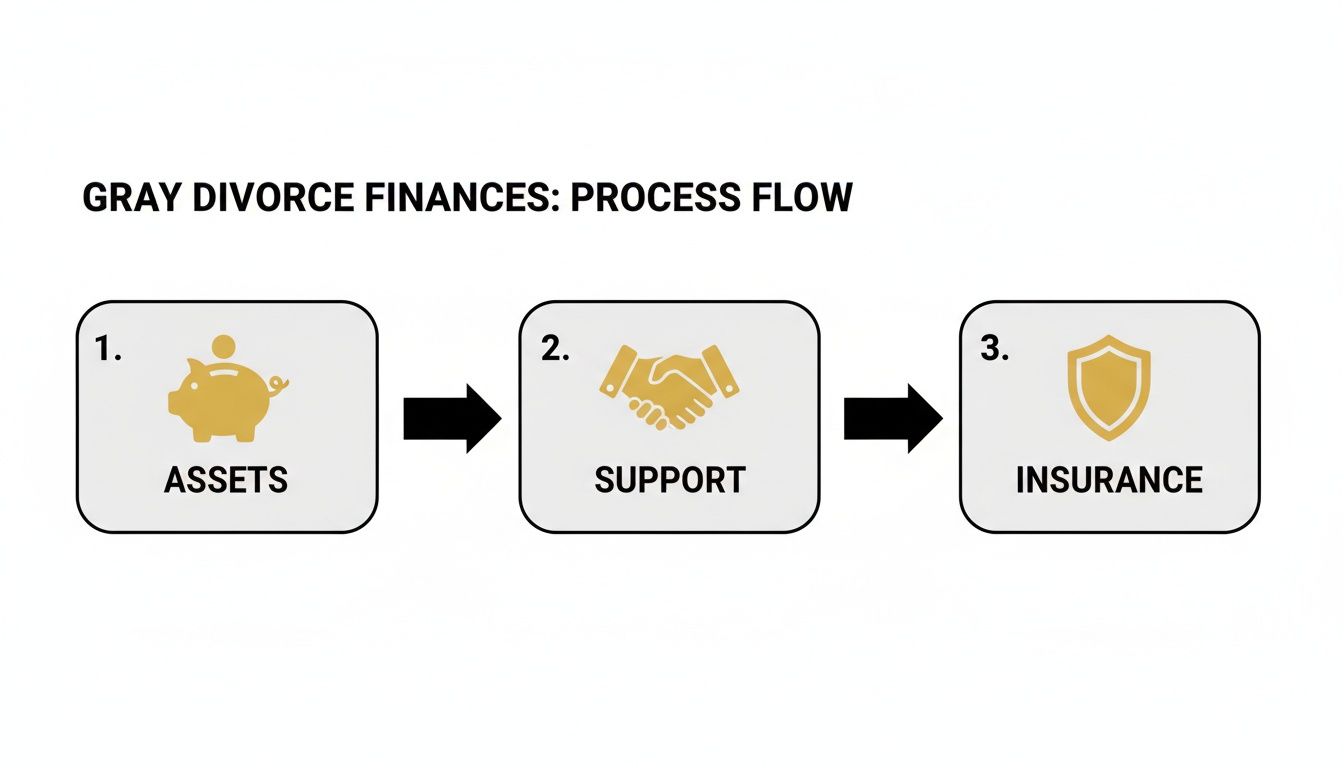
As you can see, it's not just about splitting up what you own; it's also about figuring out future support and making sure everyone is financially protected with the right insurance.
Mandatory Financial Disclosures
One of the most crucial stages—especially in a gray divorce with a lifetime of accumulated assets—is the mandatory financial disclosure. Florida law is very clear on this: both spouses must provide a complete and honest accounting of their finances. This isn't just a suggestion; it's a required step to ensure transparency and fairness.
Each of you will complete a detailed financial affidavit and exchange a specific set of documents. Think of it as putting all your financial cards on the table. This typically includes:
- Tax returns from the last three years
- Bank and credit card statements
- Deeds to real estate and any property appraisals
- Statements for all retirement and pension accounts
- Recent pay stubs and other proof of income
This exchange is the bedrock of the entire divorce. It provides the hard data needed to start negotiating how assets will be divided and whether alimony is appropriate.
Equitable Distribution Explained
Once all the financial information is out in the open, the next job is to divide the marital property. Florida is an equitable distribution state, a term that often causes confusion. It does not automatically mean a strict 50/50 split. "Equitable" simply means "fair," and the court will divide assets and debts in a way it determines is just under the circumstances.
In a long-term marriage, a judge will often start from the presumption of a 50/50 division. However, the court can move off that number based on specific factors, like one spouse making significant sacrifices for the other's career or if one spouse wasted marital assets.
The ultimate goal is to reach a settlement that allows both of you to move forward on stable financial footing.
Choosing Your Path to Resolution
Thankfully, not every divorce has to end in a drawn-out courtroom battle. In fact, most don't. You have several ways to reach a final agreement, and the path you choose will have a huge impact on the cost, stress, and timeline of your divorce.
- Mediation: Here, a neutral, third-party mediator helps you and your spouse negotiate a settlement. The process is confidential and is actually required in most Florida divorce cases before you can schedule a final hearing with a judge.
- Collaborative Divorce: This is a team-based approach where both spouses and their specially trained attorneys agree from the outset to work together and resolve all issues without going to court. It's focused on finding creative, respectful solutions.
- Litigation: If you and your spouse are simply too far apart to agree, litigation might be the only option. This means your case will be presented to a judge, who will then make the final decisions on any and all unresolved issues.
Florida operates as a "no-fault" state, which helps simplify the initial grounds for divorce. You can learn more about Florida no-fault divorces in our detailed guide. Here at Foley Family Law, we're experienced in all of these resolution methods and help clients, including our LGBTQ+ clients, choose the approach that best fits their unique family situation and goals.
Your Practical Checklist For A Gray Divorce

It’s completely normal to feel overwhelmed when you first start thinking about divorce. The best way to regain a sense of control is to get organized. By tackling this process systematically, you can turn a mountain of uncertainty into a clear, manageable plan.
This practical checklist will walk you through the essential first steps.
The foundation of any fair divorce settlement is a complete and transparent financial picture. This means it’s time to start gathering documents. Putting in the effort now will save you a massive amount of time, stress, and money down the road.
Gather Your Essential Financial Documents
Think of yourself as a detective on an information-gathering mission. Your goal is to create a comprehensive snapshot of your entire marital estate. Even if you can’t get your hands on everything, collect what you can.
Here’s what you should start looking for:
- Income Records: Pull together recent pay stubs for both you and your spouse. You'll also need personal and business tax returns from the past three to five years.
- Bank Statements: Collect several years' worth of statements for all checking, savings, and money market accounts.
- Investment and Retirement Accounts: Find the most recent statements for any 401(k)s, IRAs, pension plans, brokerage accounts, and stock options. These are critically important in a gray divorce.
- Property Documents: Locate the deeds to your home and any other real estate, along with vehicle titles and recent property tax bills.
- Debt Information: Make a file with statements for mortgages, home equity lines of credit (HELOCs), car loans, student loans, and credit cards.
- Insurance Policies: Dig up the paperwork for life, health, and disability insurance policies.
This isn’t just busywork; it's a core part of the formal legal procedure. To understand why this is so critical, you can learn more about the discovery process for divorce in Florida and see how it ensures a fair outcome for everyone.
Questions To Ask A Potential Attorney
Choosing the right legal partner is single-handedly the most important decision you'll make in this process. Not every family lawyer has deep experience with the unique financial puzzles of a gray divorce.
When you meet with potential attorneys in Pasco, Pinellas, or Hillsborough Counties, go in prepared with questions that cut to the heart of their expertise in this specific area.
The right attorney does more than just file paperwork; they act as your strategic guide, protecting your long-term financial security at a time when you have less runway to recover from mistakes.
Make sure you ask these questions:
- How much of your practice is dedicated to gray divorce cases involving long-term marriages?
- What's your experience with dividing complex retirement assets like pensions and 401(k)s?
- How do you typically approach negotiating alimony for clients in a situation like mine?
- What strategies do you use to tackle the issue of post-divorce health insurance?
- Can you explain your philosophy on negotiation versus going to court?
The answers will give you a gut feeling for their experience and whether their approach lines up with what you want to achieve. At Foley Family Law, we welcome these questions. We are committed to making sure our clients, including those in the LGBTQ+ community, feel completely confident and understood from day one.
Protecting Your Future With Experienced Legal Guidance
When you're facing a gray divorce, you're not just closing a chapter; you're writing the preface to your next one. The decisions made now will echo for decades, and navigating the complexities—from untangling a lifetime of finances to managing the emotional toll—requires more than just standard legal advice.
You need a strategic partner who gets it. Someone who understands the unique stakes of divorcing later in life. This is where an experienced, compassionate lawyer becomes your most valuable asset.
Choosing the right attorney isn't just a box to check; it’s a decision that will fundamentally shape your post-divorce reality. A lawyer who specializes in gray divorce knows there's no time for a do-over. They understand the nuances of dividing retirement accounts built over 40 years, the subtle art of negotiating fair alimony for a long-term marriage, and the hard truth that you have less time to recover from a financial mistake.
Why Specialized Experience Matters
In a gray divorce, the legal and financial threads are woven so tightly together they're impossible to separate. Your attorney's job isn't just about filing paperwork; it's about crafting a forward-looking strategy that protects everything you've spent a lifetime building.
Our firm has deep experience handling the specific challenges these cases present, including:
- Complex Asset Division: We meticulously analyze and value intricate portfolios, from 401(k)s and pensions to investment accounts and real estate, to ensure a fair and equitable split under Florida law.
- Alimony Negotiations: We are fierce advocates for spousal support agreements that truly reflect the length of your marriage and your future needs, giving you the stability you deserve.
- Client-Focused Advocacy: We listen. We provide personalized, compassionate guidance so you feel heard, understood, and confident every step of the way.
Your future stability depends on the choices you make today. A consultation with an experienced attorney is the first and most critical step toward creating a legal strategy that secures a stable, independent future.
At Foley Family Law, we are steadfastly committed to serving our communities in Pasco, Pinellas, and Hillsborough Counties. We are proud to have extensive experience handling all family and divorce issues for LGBTQ+ individuals and families with the respect and dedication they deserve. We firmly believe that everyone is entitled to expert legal advocacy during this significant life transition.
Getting strong legal representation on your side early is key. To help you prepare, check out our guide on how to choose a divorce attorney to make sure you find the right fit for your unique situation.
A consultation is your chance to get clarity, understand your rights, and start building a plan that protects not just your assets, but your peace of mind for all the years to come.
Your Gray Divorce Questions, Answered
When you’ve built a life over decades, the questions that come with a later-in-life divorce are unique. Here are some straightforward answers to the most common concerns we hear from our clients across Pasco, Pinellas, and Hillsborough Counties.
Am I Entitled To My Spouse's Social Security Benefits?
Yes, this is often possible. You may be able to claim Social Security benefits based on your ex-spouse's work record if you meet a few key criteria: the marriage lasted 10 years or longer, you are currently unmarried, and you're at least 62 years old.
This is a critical piece of your retirement puzzle. And, importantly, your claim doesn't reduce or affect the benefits your former spouse receives. The rules can get a little complex, but an experienced attorney can walk you through your rights and make sure you know how to apply for these deserved benefits.
How Is The Family Home Handled In A Florida Gray Divorce?
The marital home is frequently the biggest financial and emotional asset in a long-term marriage. Under Florida's equitable distribution laws, it's a piece of the property puzzle that has to be addressed fairly.
There are a few common ways this plays out:
- One spouse buys out the other's share, which allows one person to stay in the home.
- The house is sold, and the proceeds are split between both spouses.
- A deferred sale is arranged, though this is less common and usually tied to very specific situations.
The right path forward really depends on your financial reality, your emotional attachment to the home, and how it fits into your overall settlement strategy. It's a major decision that will shape your post-divorce life.
What Happens To Health Insurance After Divorcing?
Losing a spouse’s health insurance is a huge worry, especially for anyone not yet eligible for Medicare at age 65. This isn't just an inconvenience; it's a financial reality that has to be planned for carefully.
You might be able to continue your coverage for a short time under a federal program, but the premiums are often shockingly expensive. Other routes include finding a new plan on the Affordable Care Act (ACA) marketplace or buying a private policy. We make it a priority to ensure the costs of your future healthcare are a key part of the negotiation in your final settlement.
A gray divorce is not just the end of a marriage; it's the beginning of a new, independent financial life. Addressing these key questions with clarity and strategic foresight is essential for securing your future.
At our firm, we provide respectful and knowledgeable legal support for everyone, including handling all LGBTQ+ family and divorce issues without discrimination.
Navigating the complexities of a gray divorce requires an attorney who understands the unique financial and emotional stakes involved. At Foley Family Law, we are dedicated to protecting your future and helping you start your next chapter with confidence. Contact us to schedule a consultation and create a clear plan of action.


