

What are grandparents’ visitation rights in Florida?
Grandparents in Florida do not have automatic visitation rights. Under Florida Statute 752.011, the law grants grandparents the ability to petition for court-ordered visitation only under narrow, specific circumstances. Florida courts treat parental authority as a constitutionally protected right, which means a fit parent’s decision to limit grandparent contact generally stands.
Here is what the current law allows:
- Grandparents may petition when both parents are deceased, missing, or in a persistent vegetative state.
- Grandparents may petition when one parent is deceased, missing, or incapacitated and the other has been convicted of a felony or a violent offense threatening the child’s welfare.
- Under the 2022 Markel Act, a presumption of visitation applies when one parent caused the death of the other.
- Courts award visitation only when it serves the child’s best interest and will not materially harm the parent-child relationship.
- The term “grandparent” under Florida Statute 752.001 includes great-grandparents; step-grandparents are included only in the Markel Act scenario.
If both parents are alive, present, and not subject to qualifying convictions, Florida grandparents have no statutory path to petition for court-ordered visitation.
When can Florida grandparents petition for visitation?
The conditions are strict, and most grandparents do not qualify. Florida courts have repeatedly held that fit parents hold the constitutional right to direct their child’s upbringing, including decisions about extended family contact.
The qualifying scenarios under current statute are:
- Both parents deceased, missing, or in a persistent vegetative state. This is the broadest qualifying condition.
- One parent incapacitated, the other convicted of a qualifying offense. The conviction must involve a felony or violence posing a substantial threat to the child’s health or welfare.
- Markel Act presumption. When one parent has been held criminally or civilly liable for the death of the other parent, a presumption favors visitation for the grandparent who is the parent of the deceased.
Even when a grandparent qualifies to file, the court still requires prima facie evidence of parental unfitness or significant harm to the child. A general objection by a fit parent is enough to bar the petition entirely.
Pro Tip: If you are unsure whether your situation qualifies, consult a family law attorney before filing. A petition that lacks sufficient evidence can result in dismissal and an order requiring you to pay the other party’s attorney fees.
What did the 2022 Florida grandparents rights law change?
Governor DeSantis signed HB 1119, known as the Markel Act, in 2022. The law was named in memory of Dan Markel, a Florida State University law professor murdered in 2014, whose children were subsequently denied contact with his parents.
The Markel Act added one significant provision to Florida Statute 752.011: when a court finds that one parent caused the death of the other parent, either through criminal liability or civil liability for an intentional tort, there is a presumption in favor of granting reasonable visitation to the petitioning grandparent or step-grandparent, provided that grandparent is the parent of the deceased. That presumption can be overcome only if the court finds visitation is not in the child’s best interest.
This is a narrow expansion. It does not create broad grandparent visitation rights across Florida. For families outside this wrongful-death scenario, the rest of Section 752.011 still controls, and most grandparents seeking visitation still have no statutory path if parents are fit and living.
How does the Florida court process work for grandparent visitation?
Filing a petition is only the beginning. The process involves multiple stages, each with its own legal standard.
- File the petition in the county where the child primarily resides, per Section 752.011(12).
- Preliminary hearing. The court evaluates whether the grandparent has made a prima facie showing of parental unfitness or significant harm to the child. No such showing means immediate dismissal, and the court may award attorney fees against the petitioner.
- Guardian ad litem. If the prima facie case is established, the court may appoint a guardian ad litem to represent the child’s independent interests.
- Mandatory mediation referral. The case moves to family mediation under Florida Statute 752.015 before any final hearing.
- Final hearing. If mediation fails, the court holds a hearing and applies the “clear and convincing evidence” standard, requiring proof that a parent is unfit or the child faces significant harm, that visitation serves the child’s best interest, and that visitation will not materially harm the parent-child relationship.
- Modification. An existing order can be modified if the petitioner shows a substantial change in circumstances and that modification serves the child’s best interest.
Visitation and custody are distinct legal processes. Grandparent custody rights fall under Florida Chapter 751, which applies when a grandparent is already raising the child, not merely seeking contact.
Why does Florida require mediation in grandparent visitation cases?

Florida’s public policy, stated directly in Florida Statute 752.015, is that families should resolve grandparent visitation disputes within the family first. When that fails, the statute directs families toward mediation before litigation.
Mediation offers real advantages in these cases. It tends to be faster and less expensive than a full hearing, and it reduces the emotional toll on everyone involved, especially the child. Agreements reached through mediation can include detailed visitation schedules tailored to the family’s actual circumstances, something a court order rarely achieves with the same flexibility. The court will only proceed to a final hearing if family law mediation does not resolve the dispute.
Step-by-step: how to file for grandparent visitation rights in Florida
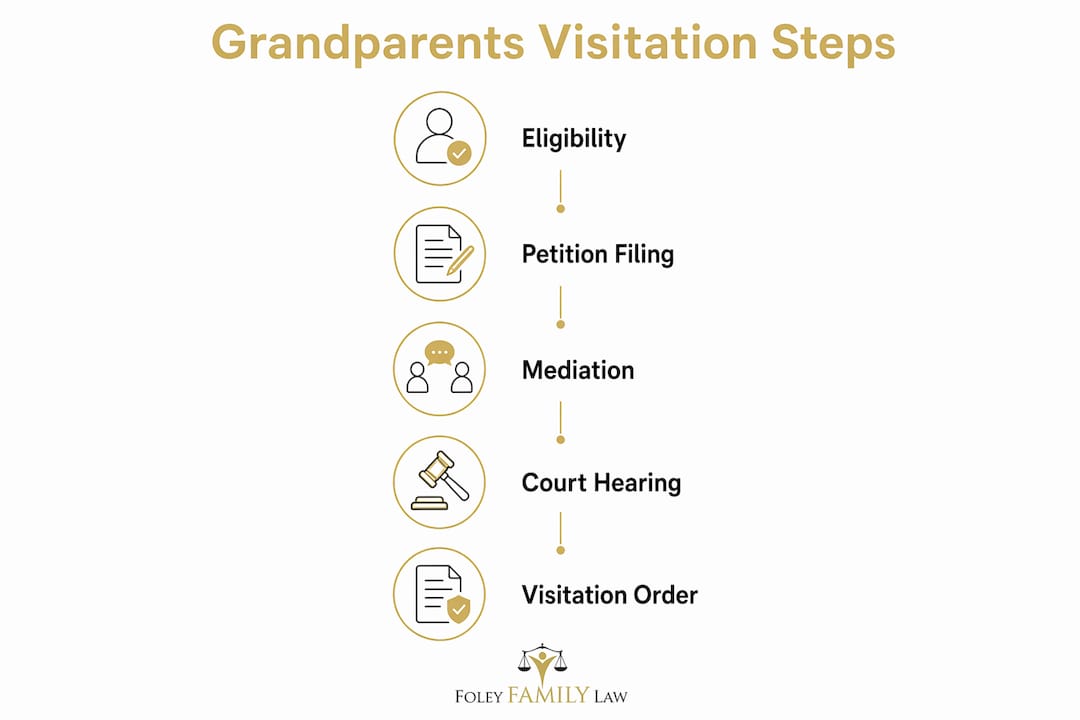
- Confirm eligibility. Verify your situation meets one of the qualifying conditions under Section 752.011 before spending time or money on a petition.
- Gather documentation. Collect evidence of parental unfitness or significant harm to the child, such as police reports, medical records, or school records.
- Complete the petition form. Use Florida Family Law Form 12.975(a), the official form for grandparent visitation petitions.
- File in the correct county. Venue is the county where the child primarily resides.
- Serve notice. Parents must be served notice of the petition under Chapter 48 of Florida Statutes.
- Attend the preliminary hearing. Present your prima facie case. If the court dismisses it here, the process ends and you may owe attorney fees.
- Participate in mediation. If the case advances, engage fully in mediation. A cooperative approach here often produces better outcomes than litigation.
- Prepare for the final hearing. If mediation fails, work with your attorney to present clear and convincing evidence at the final hearing.
How recent Florida case law affects grandparents’ rights
Florida’s courts have consistently narrowed grandparent visitation rights over three decades. By the early 2000s, the Florida Supreme Court had struck down virtually every provision of the original Chapter 752 as unconstitutional under the Florida Constitution’s privacy clause. The 2015 statute, Section 752.011, was drafted specifically to fit within the narrow constitutional space the court had left.
The Markel Act represents the legislature’s most recent attempt to expand rights while staying within constitutional limits. Courts applying the Markel Act presumption still weigh the child’s best interest, so the presumption is not automatic relief. For grandparents seeking visitation rights, understanding this case law history explains why the statutory path is so narrow and why evidence quality matters so much.
Tips for preparing for your grandparent visitation court hearing
- Document the relationship. Photos, letters, school records showing your involvement, and testimony from teachers or counselors all help establish the depth of your bond with the child.
- Show harm, not just preference. The court needs evidence of significant harm to the child, not simply that you miss them or disagree with the parent’s decision.
- Address criminal conduct carefully. If the qualifying condition involves a parent’s criminal conviction, work with an attorney who understands both family and criminal defense issues, since the conviction’s details directly affect your petition.
- Prepare the child’s guardian ad litem. If one is appointed, cooperate fully. Their recommendation carries real weight with the judge.
- Stay focused on the child. Every argument you make should circle back to the child’s emotional and physical well-being, not your own loss or grievance.
What outcomes are possible, and how are orders enforced?
If the court grants visitation, the order will specify a schedule, conditions, and any restrictions. Visitation orders are enforceable like any other family court order. If a parent violates the order, the grandparent can return to court to seek enforcement, which may include contempt proceedings.
If the petition is denied, a grandparent may not file again for two years unless there is good cause showing the child is suffering significant and demonstrable mental or emotional harm that was not known at the time of the earlier filing. Orders can also be modified later if circumstances change substantially and modification serves the child’s best interest.
Resources for grandparents navigating Florida family law
- Florida Senate website (flsenate.gov): Full text of Chapter 752 and related statutes, updated annually.
- Florida Courts website (flcourts.gov): Official family law forms, including Form 12.975(a) for grandparent visitation petitions.
- Florida Department of Children and Families: For situations involving abuse, neglect, or dependency proceedings under Chapter 39, which provide broader access than Section 752.011.
- Local circuit court family law self-help centers: Many Florida counties offer free or low-cost assistance with form preparation and procedural questions.
- Foley Family Law: Serving Hillsborough, Pinellas, and Pasco counties, the team at Foley Family Law handles grandparent visitation and temporary custody matters with direct, practical guidance.
Understanding what a family law attorney does in these cases can help you decide whether to pursue your petition and how to build the strongest possible case.

Foley Family Law, led by William S. Foley, focuses exclusively on family law in the Tampa Bay area. If you are a grandparent in Hillsborough, Pinellas, or Pasco County trying to understand your options, reach out for a consultation. The law is narrow, but knowing exactly where you stand is the first step.
Key Takeaways
Florida grandparents have no automatic visitation rights; the law grants access only under narrow statutory conditions, and courts apply a clear and convincing evidence standard at the final hearing.
| Point | Details |
|---|---|
| No automatic rights | Grandparents must meet specific conditions under Florida Statute 752.011 to petition for visitation. |
| 2022 Markel Act | Creates a presumption of visitation when one parent caused the other’s death, overridden only if contrary to the child’s best interest. |
| Preliminary hearing risk | A petition lacking prima facie evidence is dismissed, and the grandparent may owe the other party’s attorney fees. |
| Mediation is mandatory | Florida Statute 752.015 requires mediation referral before any final hearing if services are available in the circuit. |
| Visitation vs. custody | Custody for grandparents falls under Chapter 751, a separate and broader path when the grandparent is already raising the child. |
FAQ
What is the new law for grandparents rights in Florida?
The 2022 Markel Act (HB 1119), signed by Governor DeSantis, added a presumption of visitation under Florida Statute 752.011 when one parent has been held criminally or civilly liable for the death of the other parent. Outside this narrow circumstance, the general framework of Section 752.011 still controls.
Can parents keep their children away from grandparents in Florida?
Yes. Florida courts treat parental authority as a constitutionally protected right, so a fit parent can legally deny grandparent contact. Grandparents have no statutory right to petition for visitation unless they meet the specific conditions in Florida Statute 752.011.
Can a parent deny a grandparent visitation in Florida?
A fit parent can deny visitation, and the court will not override that decision unless the grandparent qualifies under Section 752.011 and proves by clear and convincing evidence that a parent is unfit or the child faces significant harm.
What is the grandparents clause in Florida?
The “grandparents clause” refers to Florida Statute 752.011, which sets out the narrow conditions under which grandparents may petition for court-ordered visitation. It limits petitions to cases involving deceased, missing, or incapacitated parents, or the Markel Act wrongful-death scenario.


