

TL;DR:
- Once an unmarried father establishes paternity in Florida, he becomes a natural guardian with rights similar to the mother, but this does not automatically create custody or a parenting schedule. Fathers must file a separate court action to obtain a parenting plan or time-sharing schedule after paternity is established. Acting promptly, signing acknowledgment forms at the hospital, and consulting legal counsel can protect parental rights effectively.
House Bill 775, known as the Good Dad Act, took effect July 1, 2023, and made one thing clear: once an unmarried father establishes paternity in Florida, he is a natural guardian of his child with the same rights and responsibilities as the mother under Fla. Stat. §744.301. What the law does not do is automatically create a custody arrangement or time-sharing schedule. That requires a separate court action. If you are an unmarried biological father in Florida, the most important steps you can take right now are:
- Sign the Voluntary Acknowledgment of Paternity (Form DH-511) at the hospital before you leave, if the mother agrees.
- If the birth has not yet occurred and adoption is a possibility, file a notarized claim with the Florida Putative Father Registry under Chapter 63.
- Preserve every record of your involvement: texts, receipts, photos, schedules.
- Consult a Florida family law attorney before deadlines pass.
The governing authorities are HB 775 (effective July 1, 2023), Fla. Stat. §742.10, and Fla. Stat. §744.301. Every right discussed in this article flows from those three sources.
What does the Good Dad Act actually change for Florida fathers?
The Good Dad Act amended three statutes: §742.011, §742.10, and §744.301. Before July 1, 2023, Florida law treated the mother of a child born out of wedlock as the sole natural guardian by default. HB 775 changed that default by adding language to §744.301 specifying that both the mother and a father who has established paternity are natural guardians, equally entitled and subject to the rights and responsibilities of parents.
The bill also amended §742.011 to explicitly authorize a parent to request a determination of parental responsibility, child support, and the creation of a parenting plan and time-sharing schedule after paternity is established. Previously, that pathway was less clearly defined for unmarried fathers. The legislative analysis confirms the Act’s intent: to put established fathers on equal legal footing with mothers from the moment paternity is recognized.
Quick timeline:
- HB 775 passed the Florida Legislature in the 2023 session.
- Effective date: July 1, 2023.
- Fathers who establish paternity after that date are immediately covered by the natural guardianship language.
- Fathers who established paternity before July 1, 2023, can still benefit by filing a parenting plan action under the updated §742.011.
What rights and responsibilities does an established father gain?
Establishing paternity under the Good Dad Act gives you a defined legal standing. Here is what that means in practice:
Rights you gain:
- Natural guardian status, equal to the mother’s, under §744.301.
- The right to be listed on the child’s birth certificate.
- The right to seek shared parental responsibility and joint decision-making on education, healthcare, and religious upbringing.
- The ability to petition the court for a parenting plan and time-sharing schedule under §742.011 or Chapter 61.
- Standing to contest adoption or termination of parental rights proceedings.
Responsibilities that come with it:
- Child support obligations, which the Department of Revenue can establish administratively.
- Medical decision-making responsibilities when the child is in your care.
- A legal duty to financially support the child regardless of whether a parenting plan exists.
One deadline that catches many fathers off guard is the rescission window for voluntary acknowledgment. Under §742.10(4), a signed voluntary acknowledgment creates a rebuttable presumption of paternity and may be rescinded within 60 days. After that, the acknowledgment can only be challenged in court on grounds of fraud, duress, or material mistake of fact. Child support obligations from the acknowledgment continue even during a challenge unless a court finds good cause to suspend them.
Pro Tip: If you have any doubt about biological paternity, raise it before signing the voluntary acknowledgment or within the 60-day window. Once that period passes, undoing the acknowledgment is a difficult, expensive legal process.

How do you establish paternity in Florida?
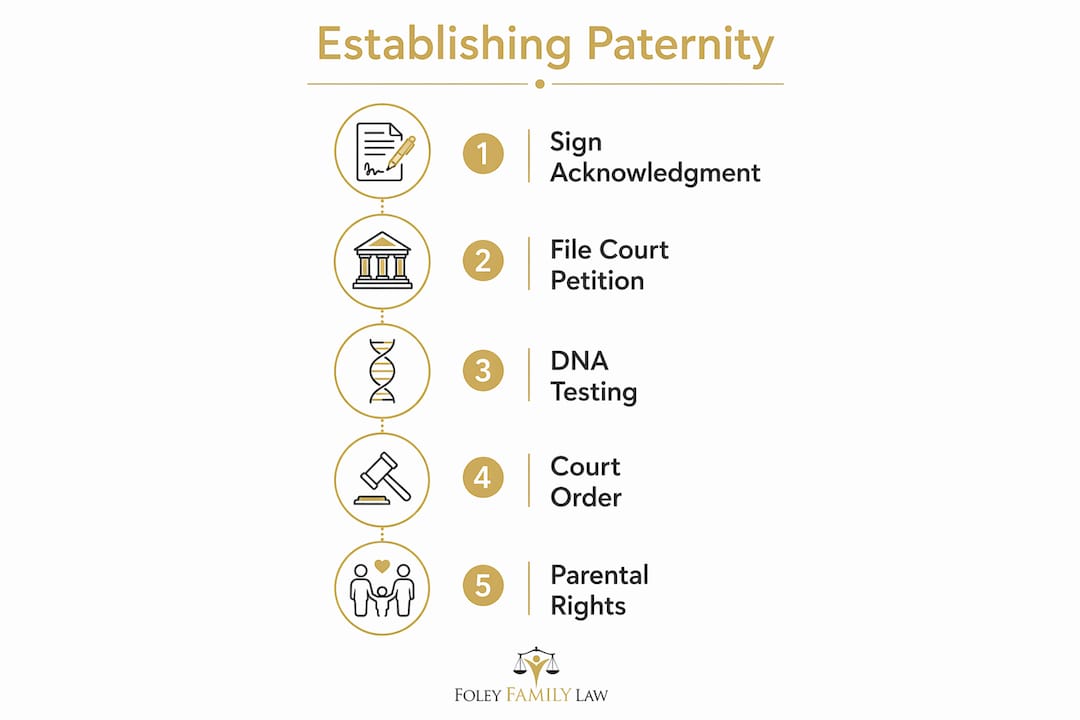
Florida law under §742.10 recognizes five distinct methods. The fastest and most common for cooperative parents is the hospital acknowledgment.
Step-by-step: signing the DH-511 at the hospital
- Request the form. Ask the hospital’s birth registrar for Form DH-511 (Voluntary Acknowledgment of Paternity) before or shortly after the birth.
- Both parents sign. The mother and the father both sign the form. Both must provide their Social Security numbers.
- Hospital forwards the form. The hospital sends the completed DH-511 to the Florida Bureau of Vital Statistics, which records the father on the birth certificate.
- Legal effect. The Florida Child Support Program confirms that once both parents sign, the man becomes the legal father. No court appearance is required.
This is the quickest route when both parents agree. For a deeper look at the full process, Foley Family Law’s guide on establishing paternity in Florida walks through each method in detail.
Other paths to legal paternity
- Post-birth notarized acknowledgment (DH-432). If you did not sign at the hospital, you can complete a notarized voluntary acknowledgment afterward. Both parents sign before a notary or two witnesses. File it with the Bureau of Vital Statistics.
- Administrative determination through the Florida Child Support Program. The Department of Revenue can order DNA testing without court involvement. If the test is positive, the administrative order carries the same legal weight as a court judgment. This is a practical option when the mother does not cooperate but you want to avoid a full court case.
- Court adjudication. Either parent, the child, or the state can file a paternity action in circuit court under §742.011. The court determines paternity and can simultaneously address parental responsibility, child support, and a parenting plan.
If adoption or termination of parental rights is a real possibility before paternity is established, file a notarized claim with the Florida Putative Father Registry under Chapter 63 immediately. Failure to register before a termination petition is filed can permanently eliminate your right to contest the adoption.
Does establishing paternity automatically give you custody or time-sharing?
No. This is the most common misunderstanding fathers have after learning about the Good Dad Act. Establishing paternity, whether by DH-511, notarized acknowledgment, or court order, does not create a parenting plan or time-sharing schedule. Under §742.10(5), the creation of a parenting plan and time-sharing schedule must be established in a separate action brought under §742.011.
If a paternity judgment is entered with no parenting plan attached, Florida law presumes the mother has all time-sharing and sole parental responsibility. That presumption can be overcome, but only by filing and litigating a parenting plan action. Learn more about how parenting plans work under Florida law.
What you need to file to get an enforceable schedule:
- A petition under §742.011 or a supplemental petition under Chapter 61 if paternity is already established.
- A proposed parenting plan that addresses time-sharing, decision-making authority, and communication.
- Financial disclosure documents, since child support is typically addressed in the same proceeding.
Factors the court weighs when setting time-sharing:
- Each parent’s demonstrated capacity to meet the child’s daily needs.
- The child’s relationship with each parent and any siblings.
- Geographic proximity of the parents’ homes.
- Each parent’s willingness to support the child’s relationship with the other parent.
- Any history of domestic violence, substance abuse, or neglect.
- The child’s preference, depending on age and maturity.
Time-sharing also directly affects child support calculations. The more overnights you have, the lower your support obligation may be under Florida’s income shares model. Documenting your actual parenting time from the start is worth doing carefully.
Common mistakes fathers make and how to avoid them
Several avoidable errors can seriously weaken a father’s legal position. Knowing them in advance is half the battle.
- Assuming the birth certificate equals custody. Being listed as the father on the birth certificate is meaningful, but courts still require a separate parenting plan action. The birth certificate alone does not give you scheduled parenting time.
- Missing the rescission window for voluntary acknowledgment. If you signed a voluntary acknowledgment and later have doubts about paternity, you must act within 60 days. After that, the standard for challenging the acknowledgment is fraud, duress, or material mistake of fact.
- Failing to register with the Putative Father Registry. If the mother is considering adoption or if termination proceedings are possible, an unregistered father may lose all legal standing to object. Filing a notarized claim under Chapter 63 is a protective step that costs little but preserves significant rights.
- Not documenting involvement. Courts look at the history of parental involvement when setting time-sharing. Fathers who cannot show consistent engagement often receive less parenting time than they expected.
- Waiting too long to get legal advice. Statutory deadlines in paternity and adoption cases are strict. An attorney can identify which deadlines apply to your situation before they pass.
Pro Tip: Keep a simple log of every interaction with your child: dates, activities, expenses, and any communications with the mother about the child. Screenshots of texts, receipts for diapers or medical co-pays, and photos with timestamps are exactly the kind of evidence courts find credible when evaluating parental involvement.
How Foley Family Law can help you protect your parental rights
Foley Family Law handles paternity and custody matters exclusively within Florida family law, serving fathers in Hillsborough, Pinellas, and Pasco counties. For fathers navigating the Good Dad Act, the firm’s work typically covers:
- Paternity establishment. Advising on which method (VAP, administrative, or court action) fits your situation and handling the filings.
- Parenting plan litigation. Drafting proposed parenting plans, negotiating with the other parent, and representing you at contested hearings if agreement is not possible.
- Time-sharing and child support. Calculating the interaction between parenting time and support obligations, and advocating for a schedule that reflects your actual involvement.
- Putative Father Registry filings. Identifying when registration is necessary and completing the notarized claim before a termination petition is filed.
- Department of Revenue proceedings. Representing fathers in administrative child support determinations when the other parent has opened a case.
What to expect when you contact the firm: an initial consultation to review your situation, a document checklist (birth certificate, any signed VAP, proof of your involvement with the child), and a clear explanation of the likely next filings and realistic timelines for circuit court actions in Hillsborough, Pinellas, and Pasco counties. William S. Foley and the team focus on transparent communication so you understand what is happening at every stage.
Key Takeaways
The Good Dad Act (HB 775) confirms natural guardian status for established fathers in Florida, but a separate court filing is still required to obtain an enforceable parenting plan or time-sharing schedule.
| Point | Details |
|---|---|
| HB 775 effective date | The Good Dad Act took effect July 1, 2023, amending §742.011, §742.10, and §744.301. |
| Paternity does not equal custody | Establishing paternity does not auto-create time-sharing; a separate action under §742.011 is required. |
| Rescission window for voluntary acknowledgment | A voluntary acknowledgment can be rescinded within 60 days; after that, only fraud, duress, or material mistake can undo it. |
| Putative Father Registry | Filing a notarized claim under Chapter 63 before a termination petition is filed preserves your right to contest adoption. |
| Foley Family Law | Serves fathers in Hillsborough, Pinellas, and Pasco counties on paternity, parenting plans, and time-sharing matters. |
Why early action on paternity matters more than most fathers realize
Most fathers who contact Foley Family Law after a paternity dispute has escalated share one thing in common: they waited. They assumed that being present at the birth, signing the birth certificate, or providing financial support was enough to protect their position. It rarely is, on its own.
The Good Dad Act is a genuine improvement in Florida law. It closes a gap that left established fathers in legal limbo. But the statute’s plain language makes clear that natural guardianship is a starting point, not a finish line. The fathers who fare best are the ones who treat the day paternity is established as the day they begin building a legal record, not the day they stop worrying.
What that looks like in practice: sign the acknowledgment at the hospital, consult an attorney within the first few weeks, and file for a parenting plan before any dispute hardens into litigation. Those steps cost far less, financially and emotionally, than trying to recover ground after the other parent has established a pattern of sole custody.
Ready to protect your parental rights in Florida?
Foley Family Law offers consultations specifically for unmarried fathers in Hillsborough, Pinellas, and Pasco counties who need to act under the Good Dad Act. The firm handles the full range of paternity matters: from signing guidance on the DH-511 to contested parenting plan hearings in circuit court.

When you schedule a consultation, bring what you have: the birth certificate, any signed voluntary acknowledgment, and documentation of your involvement with your child. The team will review your situation, identify any immediate deadlines (including Putative Father Registry filings if adoption is a concern), and outline the next filings. Understand what a family law attorney actually does on your behalf before you commit. The firm works on a retainer basis for contested matters, with flat fees available for certain uncontested filings. For a clear picture of what your case involves, start with a consultation at wfoleylaw.com.
Authoritative sources and official forms
| Resource | What it contains | Why you would use it |
|---|---|---|
| HB 775 bill text (enrolled) | Full statutory amendments to §742.011, §742.10, and §744.301 | Read the exact language of the Good Dad Act |
| HB 775 legislative analysis | Committee analysis explaining the Act’s purpose and scope | Understand legislative intent behind the changes |
| Fla. Stat. §742.10 (Florida Senate) | Full text of paternity establishment statute, including VAP rules and 60-day rescission | Verify the legal methods and deadlines for paternity |
| Fla. Stat. §744.301 (via HB 775) | Natural guardianship language as amended by HB 775 | Confirm natural guardian rights for established fathers |
| Florida Child Support Program — Establish Paternity | DH-511 form information, administrative DNA testing, and paternity process | Sign at hospital or request administrative determination |
| Chapter 63, §63.054 — Putative Father Registry | Statute governing the registry and filing requirements | File a notarized claim to preserve adoption notice rights |
| Florida House — HB 775 bill detail | Bill history, sponsors, and official legislative record | Verify the bill’s passage and effective date |
FAQ
What is the Good Dad Act in Florida?
The Good Dad Act is the informal name for House Bill 775, which took effect July 1, 2023. It amended Florida law to recognize an unmarried father who has established paternity as a natural guardian of his child, equal in rights and responsibilities to the mother under §744.301.
Does the Good Dad Act automatically give a father custody or parenting time?
No. Under §742.10(5), establishing paternity does not create a parenting plan or time-sharing schedule. A father must file a separate action under §742.011 or Chapter 61 to obtain an enforceable custody arrangement.
What is the new child custody law in Florida for unmarried fathers?
HB 775 (the Good Dad Act) is the primary 2023 change. It clarified that both parents are natural guardians once paternity is established, and it explicitly authorized fathers to petition for parental responsibility, child support, and a parenting plan through the circuit court.
What is the deadbeat dad law in Florida?
Florida’s child support enforcement framework, administered through the Department of Revenue, requires all legal parents to financially support their children. Once paternity is established, a support order can be issued administratively or by court order, and non-payment carries serious consequences including license suspension and contempt proceedings.
How long does a father have to rescind a voluntary acknowledgment of paternity?
Under §742.10(1), a signatory has 60 days from the date the acknowledgment was signed, or from the date of a related administrative or judicial proceeding, whichever comes first. After that window, the acknowledgment can only be challenged on grounds of fraud, duress, or material mistake of fact.
This article is general legal information, not legal advice. Florida family law is fact-specific, and statutes can change. Consult a qualified Florida family law attorney to understand how these rules apply to your individual situation.


